Georgia Affidavit of Ownership
Overview of this form
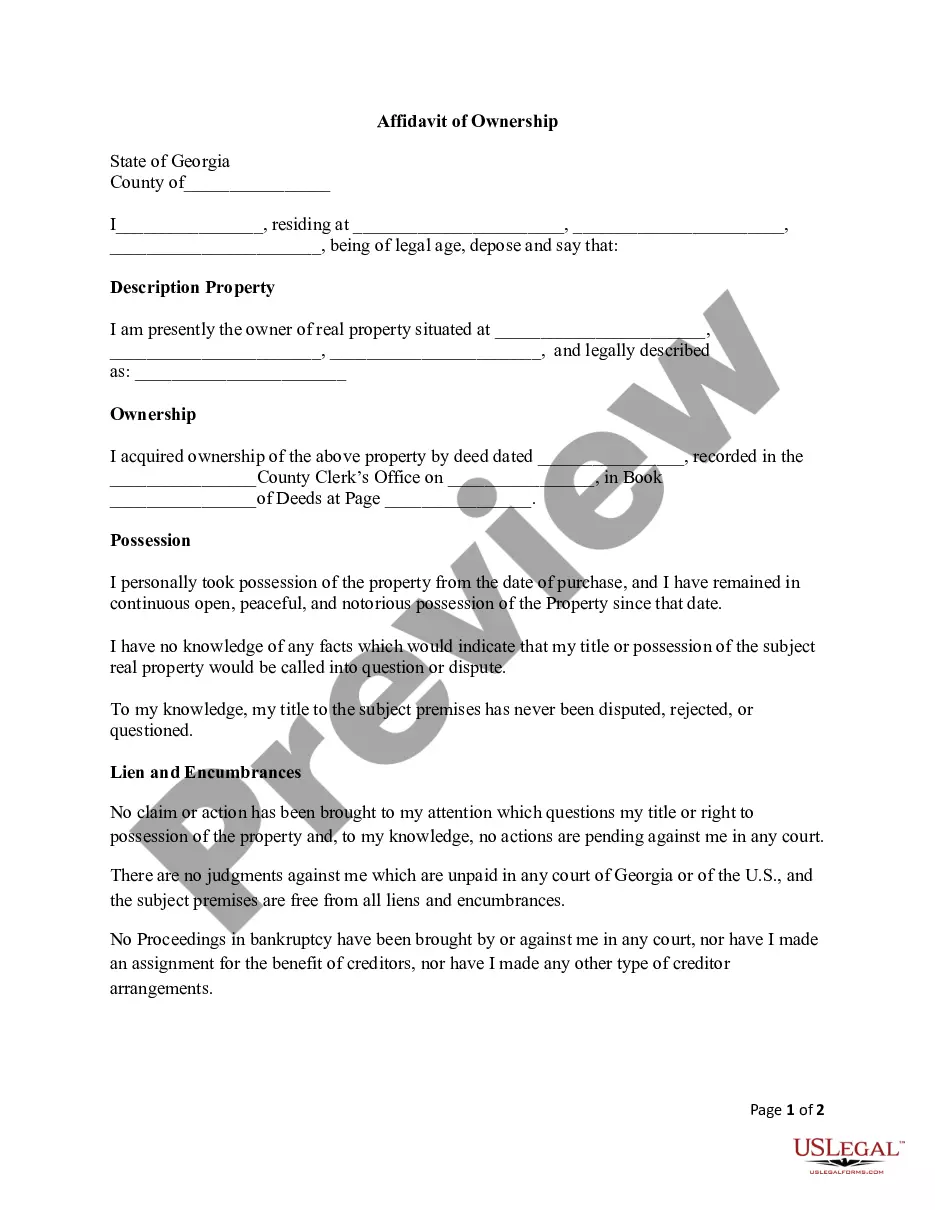
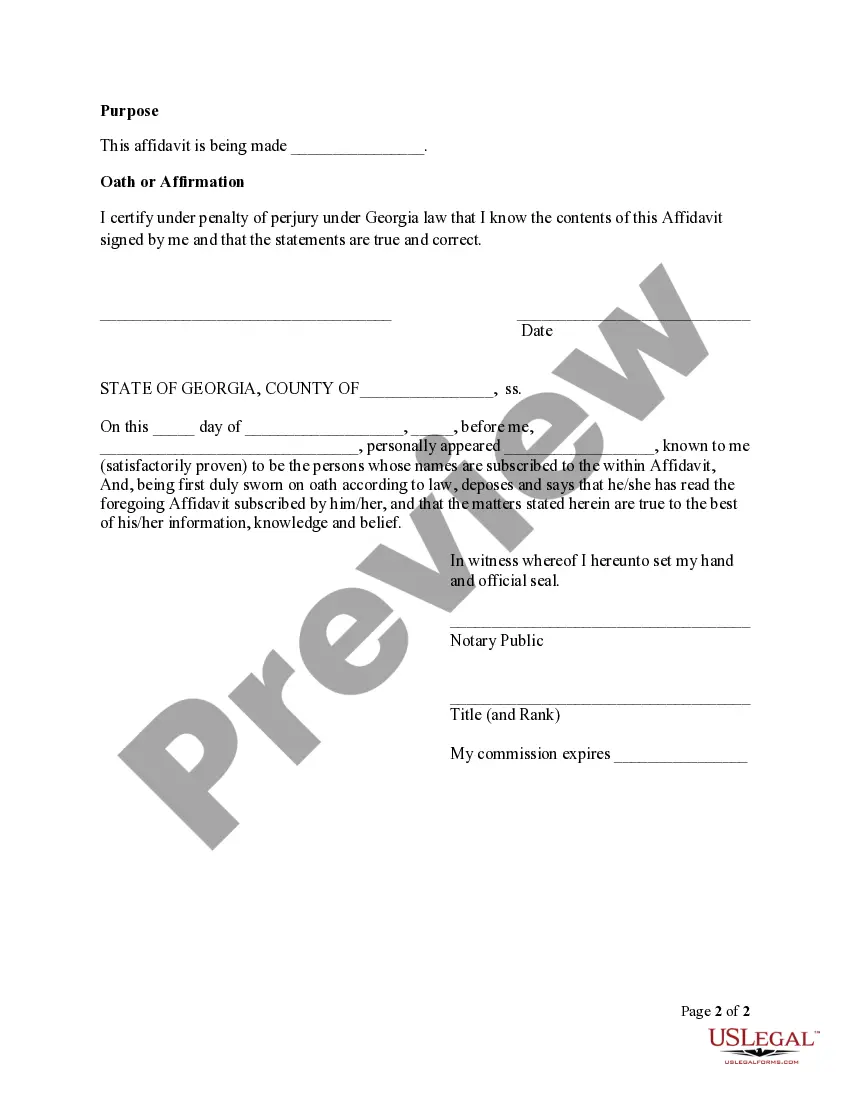
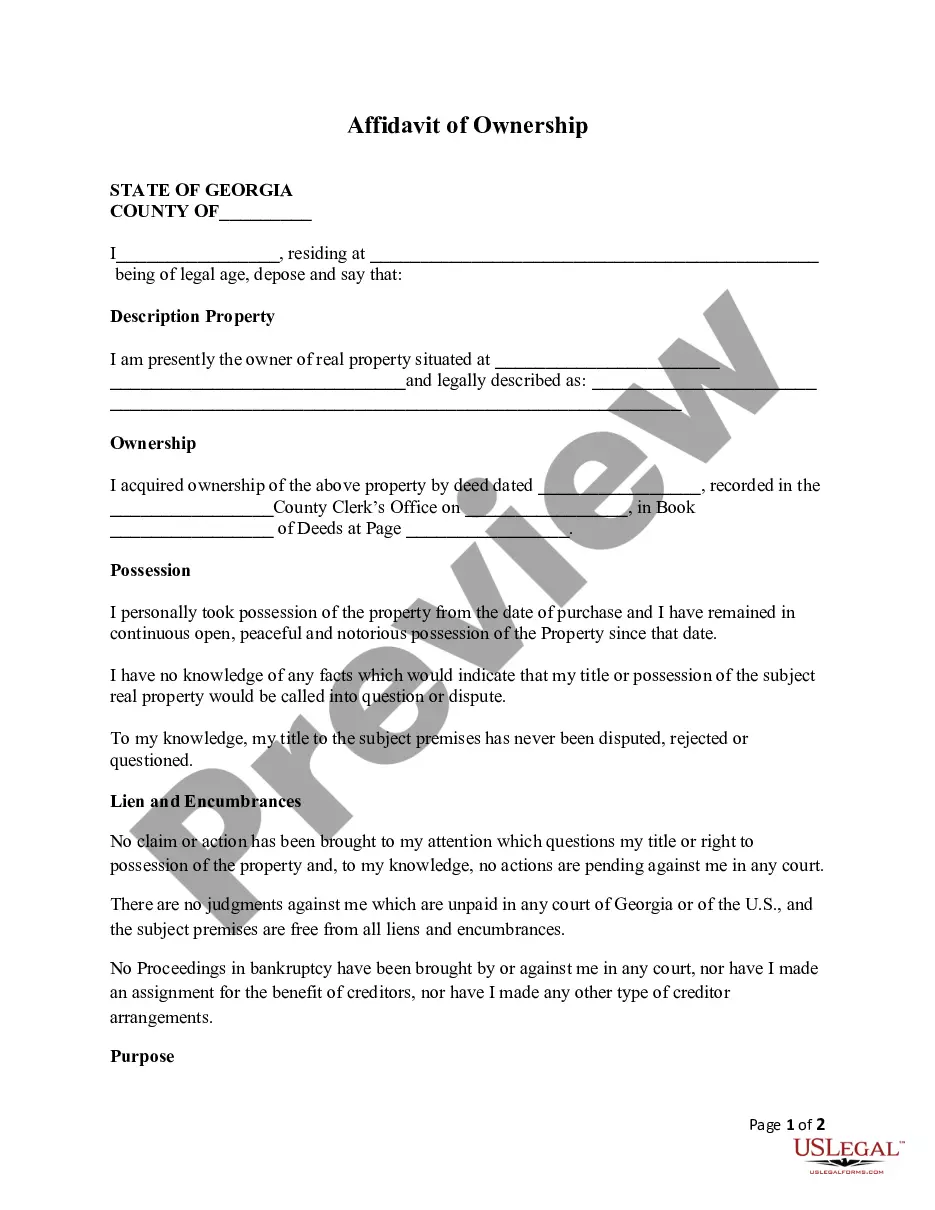
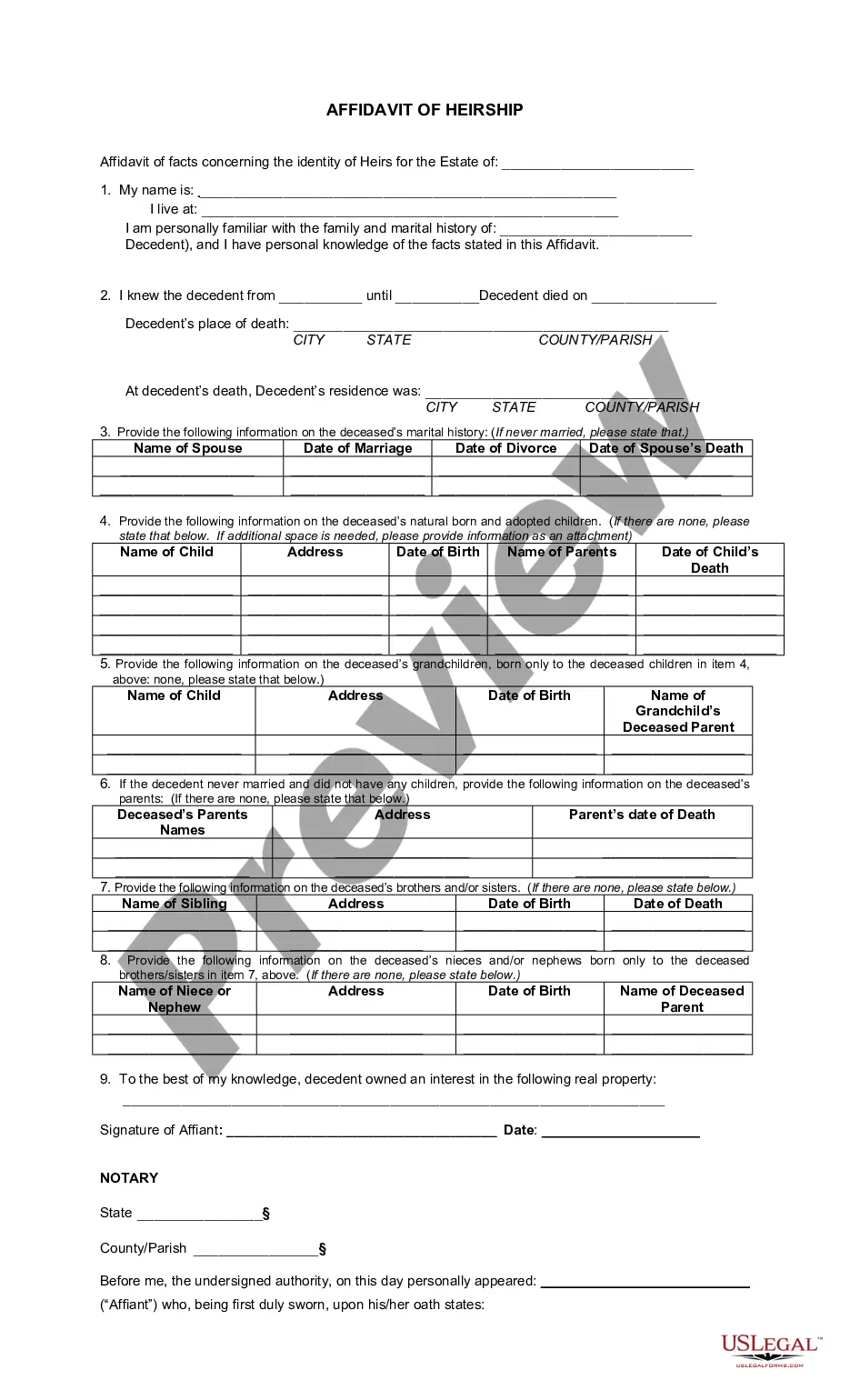
An Affidavit of Ownership is a legal document used to establish proof of ownership for a piece of real estate. This form is particularly important when there may be questions about the title or possession of the property. Unlike sales records or title deeds, the affidavit provides a sworn statement affirming ownership, which can be required in various legal situations.
What’s included in this form
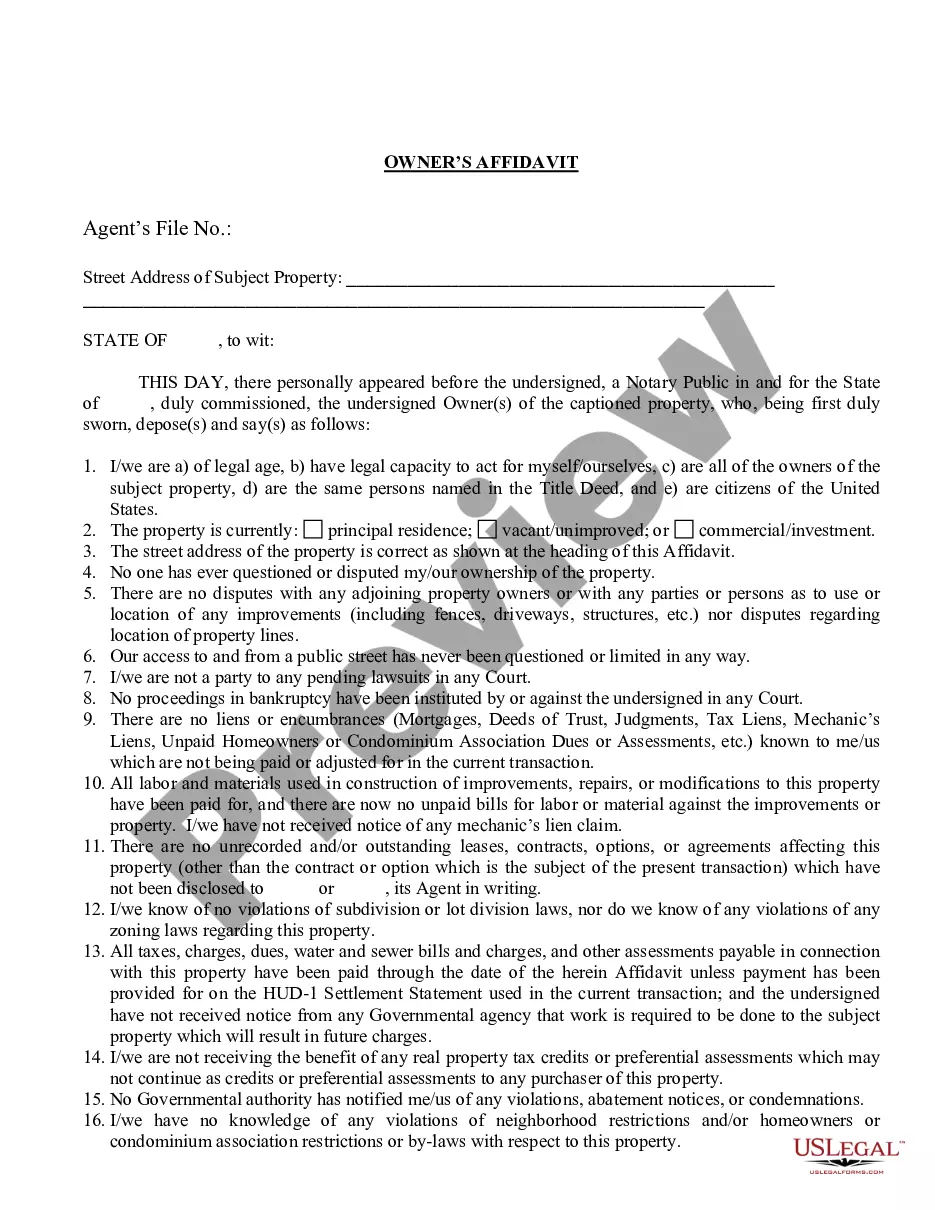
- Identification of the property owner, including name and address.
- Description of the property being claimed, including its location and legal description.
- Details of how ownership was acquired, including dates and relevant deed information.
- Statement confirming continuous and peaceful possession of the property.
- Disclosure of any liens, encumbrances, or legal claims against the property.
- A notary section to validate the affidavit's authenticity.
When to use this form
This form should be used when an individual needs to formally assert ownership of a property, especially in cases where proof of title is required. Situations may include applying for loans against the property, transferring ownership, or resolving disputes regarding the property. It is also useful in situations involving estate planning or probate proceedings.
Who should use this form
- Property owners seeking to prove their ownership status.
- Individuals involved in real estate transactions.
- Heirs or executors managing an estate that includes real property.
- Anyone needing to clarify property title or address ownership disputes.
How to complete this form
- Identify yourself as the property owner, including your full name and address.
- Specify the details of the property, including its physical location and legal description.
- Provide information regarding the acquisition of the property, including deed details and dates.
- Certify your continuous possession of the property and disclose any lien or encumbrance status.
- Sign the affidavit in the presence of a notary public to validate the document.
Is notarization required?
Yes, this form must be notarized to be legally valid. The notarization process ensures that the affidavit is authentic and that the statements made are verified under oath. US Legal Forms offers integrated online notarization services, allowing you to complete this step securely and conveniently via a video call, with no need to travel.
Get your form ready online
Our built-in tools help you complete, sign, share, and store your documents in one place.
Make edits, fill in missing information, and update formatting in US Legal Forms—just like you would in MS Word.
Download a copy, print it, send it by email, or mail it via USPS—whatever works best for your next step.
Sign and collect signatures with our SignNow integration. Send to multiple recipients, set reminders, and more. Go Premium to unlock E-Sign.
If this form requires notarization, complete it online through a secure video call—no need to meet a notary in person or wait for an appointment.
We protect your documents and personal data by following strict security and privacy standards.

Make edits, fill in missing information, and update formatting in US Legal Forms—just like you would in MS Word.

Download a copy, print it, send it by email, or mail it via USPS—whatever works best for your next step.

Sign and collect signatures with our SignNow integration. Send to multiple recipients, set reminders, and more. Go Premium to unlock E-Sign.

If this form requires notarization, complete it online through a secure video call—no need to meet a notary in person or wait for an appointment.

We protect your documents and personal data by following strict security and privacy standards.
Typical mistakes to avoid
- Failing to include a complete legal description of the property.
- Not signing the affidavit in the presence of a notary.
- Overlooking to disclose any existing liens or legal claims.
- Entering incorrect dates related to property acquisition.
Why complete this form online
- Easy access to customizable templates that meet legal standards.
- Ability to quickly edit and update information as needed.
- Convenient download options for immediate use or filing.
- Reliability of forms drafted by licensed attorneys with legal expertise.
Looking for another form?
Form popularity
FAQ
The purpose of an owner's affidavit is to clarify and confirm ownership of property or assets. It serves as a legal tool to substantiate claims during transactions, estate processes, or disputes. By using a Georgia Affidavit of Ownership, you provide additional support to your ownership assertion, making it easier to resolve legal issues. This document functions as proof that strengthens your legal position.
Yes, in Georgia, it is important for an affidavit to be notarized to ensure the document's legitimacy. Notarization verifies your identity and confirms that you are signing willingly. A notarized Georgia Affidavit of Ownership carries more weight in legal proceedings, thus increasing its effectiveness. Hence, always include this step in your preparation process.
For an affidavit to be valid, it must contain a clear declaration, be signed by the affiant, and ideally be notarized. The Georgia Affidavit of Ownership requires specific details about ownership, as well as the date of signing. Furthermore, consistent wording and accurate details strengthen the affidavit. Meeting these criteria ensures that your affidavit holds up in legal contexts.
While an affidavit may hold some weight without notarization, it generally lacks full legal standing. Notarization ensures that the document is credible and trustworthy. For a Georgia Affidavit of Ownership, it is strongly recommended to have it notarized to avoid potential challenges in legal scenarios. Without this step, you might face complications in proving ownership.
The new notary law in Georgia allows for remote online notarization, which adds convenience and accessibility. Under this law, individuals can have documents notarized without being physically present, making the process faster and more efficient. This change complements the traditional methods of notarization for documents like the Georgia Affidavit of Ownership. Be sure to stay informed about these updates to make the most of the services available.
To obtain a Georgia Affidavit of Ownership, you can start by drafting the document yourself or using online platforms like US Legal Forms. Make sure to include all required information, such as the owner’s details and description of the property or asset. After preparing the affidavit, you will need to have it signed in the presence of a notary public. This final step is crucial to ensure its validity.
Proof of ownership in Georgia can take several forms, such as a title, deed, or a Georgia Affidavit of Ownership. This document helps establish your legal claim to property or assets, providing necessary details to validate your ownership. It is essential for matters related to property transfers, legal claims, and estate management. Collecting the appropriate proof helps protect your rights as an owner.
In Georgia, a Georgia Affidavit of Ownership generally must be notarized to be considered valid. Notarization adds an important layer of authenticity and reliability. When you present a notarized document, it assures that the signatures and statements are genuine. Therefore, it is advisable to have your affidavit notarized.
A landowner affidavit is a legal document that verifies ownership of property in Georgia. This Georgia Affidavit of Ownership serves as proof when claiming rights over a piece of land. It is often used in various transactions or legal matters where ownership needs to be established clearly. Using our platform, you can easily create a Georgia Affidavit of Ownership with the right templates and guidance.
An affidavit and a deed serve different functions in legal context. A Georgia Affidavit of Ownership is a sworn statement regarding facts, such as property ownership, while a deed is a legal document that formally conveys property from one person to another. While both may be used in property transactions, they fulfill distinct roles. Understanding these differences is crucial for anyone involved in real estate to ensure compliance with legal standards.