District of Columbia Owner's Statement by Corporation
About this form
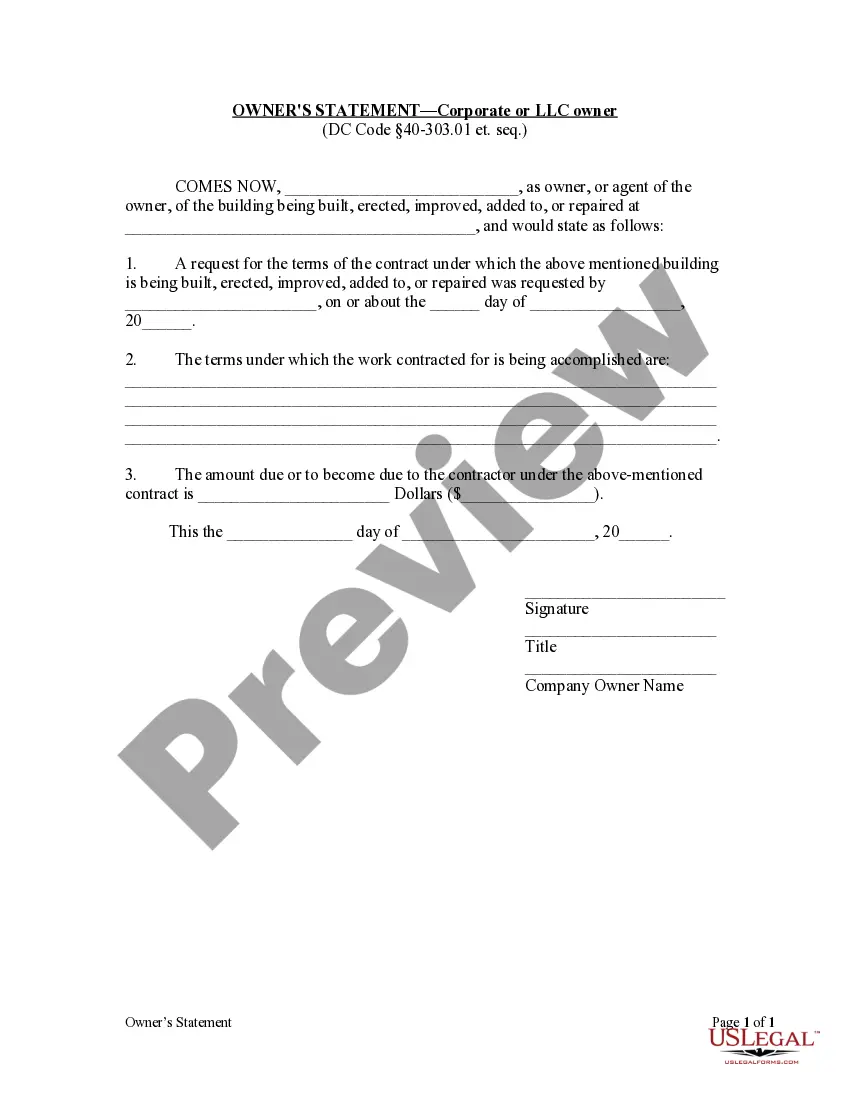
The Owner's Statement by Corporation is a legal document used by corporate owners in the District of Columbia to respond to requests from subcontractors or other parties for details about the terms of a construction contract. This form is essential for complying with District regulations that require transparency regarding contractual agreements in construction projects. It serves a unique purpose by formally documenting the contract terms, thus differentiating it from other construction-related forms.
Key parts of this document
- Party identification: Name of the corporate owner or their agent responsible for the building.
- Request date: The date on which the request for contract terms was made.
- Contract terms: Detailed description of the contractual obligations and the scope of work related to the construction project.
- Payment information: The total amount due or expected to be due to the contractor as per the contract.
- Signature and title: The signature of the owner or their authorized representative, along with the title and printed name of the corporate contact.

Situations where this form applies
This form should be used when a subcontractor, supplier, or any relevant party requests the terms of a contract related to construction. If you are a corporate owner and have received such a request, submitting this form helps fulfill the legal obligation to provide clarity regarding the contractual relationship and payment details. This form assures that necessary parties are informed about the contract terms governing the construction progress.
Who can use this document
- Corporate owners of buildings under construction or renovation.
- Authorized agents representing corporate owners.
- Subcontractors or supply chain members seeking contract term details for ongoing projects.
Instructions for completing this form
- Identify and enter the name of the corporate owner or agent on the first line.
- Provide the address of the construction site where the work is being performed.
- Document the date when the request for the contract terms was made.
- Detail the terms under which the work is being performed, including scope and responsibilities.
- Specify the amount due to the contractor in both written and numerical format.
- Have the form signed by the appropriate corporate representative, including their title and printed name.
Does this form need to be notarized?
This form does not typically require notarization unless specified by local law. Ensure that you check for any unique local regulations that may dictate notarization needs for construction-related documents.
Get your form ready online
Our built-in tools help you complete, sign, share, and store your documents in one place.
Make edits, fill in missing information, and update formatting in US Legal Forms—just like you would in MS Word.
Download a copy, print it, send it by email, or mail it via USPS—whatever works best for your next step.
Sign and collect signatures with our SignNow integration. Send to multiple recipients, set reminders, and more. Go Premium to unlock E-Sign.
If this form requires notarization, complete it online through a secure video call—no need to meet a notary in person or wait for an appointment.
We protect your documents and personal data by following strict security and privacy standards.

Make edits, fill in missing information, and update formatting in US Legal Forms—just like you would in MS Word.

Download a copy, print it, send it by email, or mail it via USPS—whatever works best for your next step.

Sign and collect signatures with our SignNow integration. Send to multiple recipients, set reminders, and more. Go Premium to unlock E-Sign.

If this form requires notarization, complete it online through a secure video call—no need to meet a notary in person or wait for an appointment.

We protect your documents and personal data by following strict security and privacy standards.
Typical mistakes to avoid
- Not specifying the correct date of the request, which can lead to confusion.
- Failing to sign the form, resulting in it being invalid or unenforceable.
- Leaving out important contract details, which can cause disputes later.
- Providing incomplete payment information, leading to ambiguity about financial obligations.
Benefits of completing this form online
- Convenience of immediate access and download from any location.
- Editability allows for easy customization to fit specific contract needs.
- Reliability of having a professionally drafted document reviewed by legal experts.
- Eliminates the need for in-person visits to legal offices or courthouses.
Quick recap
- The Owner's Statement by Corporation is crucial for transparency between contractors and property owners.
- Completing this form accurately is important to facilitate communication regarding contract terms.
- It is essential for corporate owners and their agents to understand the legal implications of the information provided.
Looking for another form?


Form popularity
FAQ
Forming an LLC or a corporation will allow you to take advantage of limited personal liability for business obligations. LLCs are favored by small, owner-managed businesses that want flexibility without a lot of corporate formality. Corporations are a good choice for a business that plans to seek outside investment.
An LLC is very similar to a corporation, but while corporations are taxed separately from individual owners, LLCs let their income flow from the business directly to the individuals. In other words, if you have an LLC, you pay your personal income tax rate rather than a corporate income tax rate on your profits.
Unlike most business organizations, absent an agreement by all of the members of the LLC, ownership percentage has no real effect in terms of the governance and financial benefits. To increase the traditional benefits associated with ownership, control and financial return, you need to amend the operating agreement.
The main difference between an LLC and a corporation is that an llc is owned by one or more individuals, and a corporation is owned by its shareholders. No matter which entity you choose, both entities offer big benefits to your business. Incorporating a business allows you to establish credibility and professionalism.
The multi-member LLC is a Limited Liability Company with more than one owner. It is a separate legal entity from its owners, but not a separate tax entity. A business with multiple owners operates as a general partnership, by default, unless registered with the state as an LLC or corporation.
The members are the owners of an LLC, like shareholders are the owners of a corporation. Members do not own the LLC's property. They may or may not manage the business and affairs. Initial members are admitted at the time of formation.
A domestic LLC with at least two members is classified as a partnership for federal income tax purposes unless it files Form 8832 and elects to be treated as a corporation.
Percentages of Ownership In return, each LLC member gets a percentage of ownership in the assets of the LLC. Members usually receive ownership percentages in proportion to their contributions of capital, but LLC members are free to divide up ownership in any way they wish.
The main difference between an LLC and a corporation is that an llc is owned by one or more individuals, and a corporation is owned by its shareholders. No matter which entity you choose, both entities offer big benefits to your business. Incorporating a business allows you to establish credibility and professionalism.