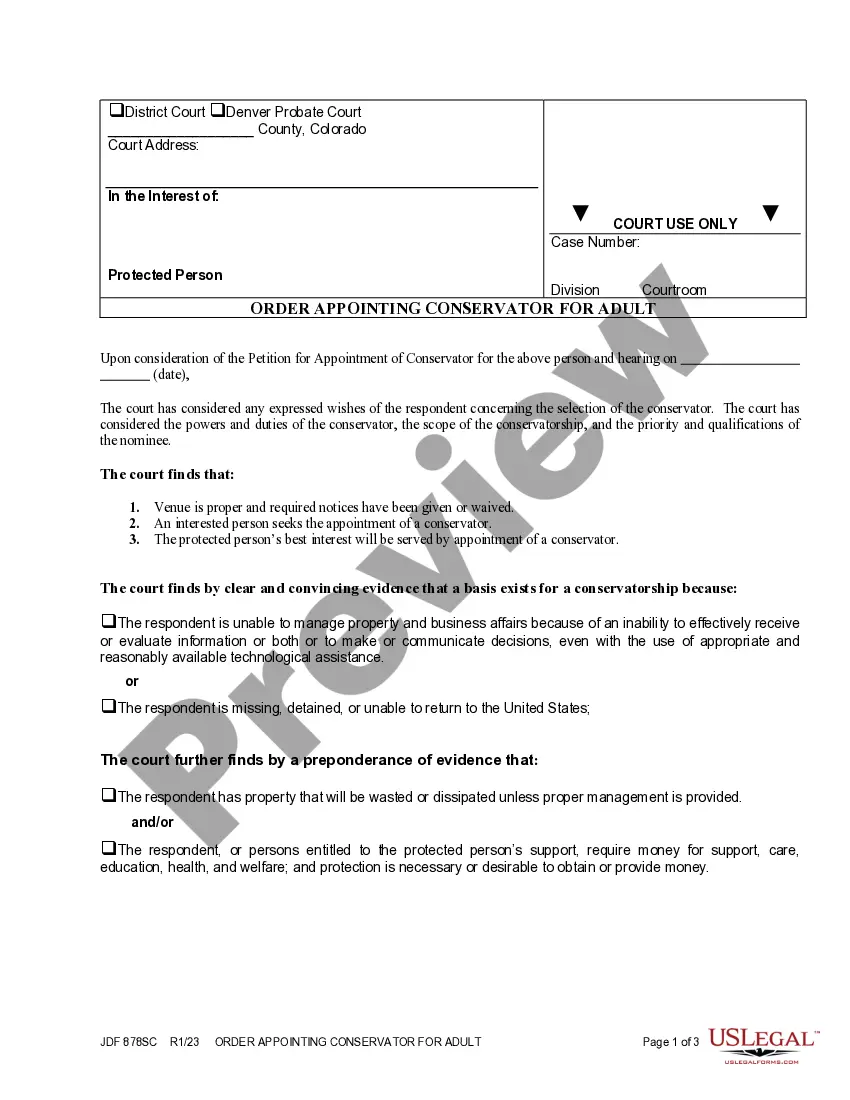
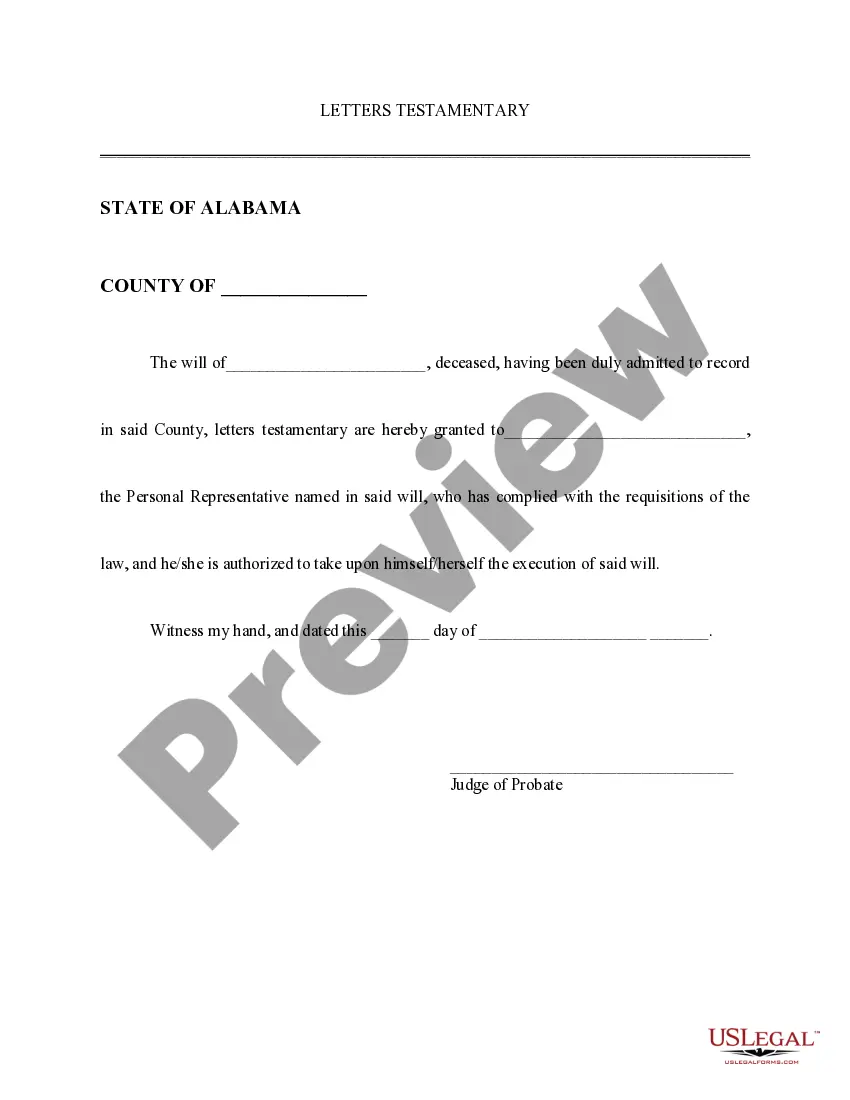
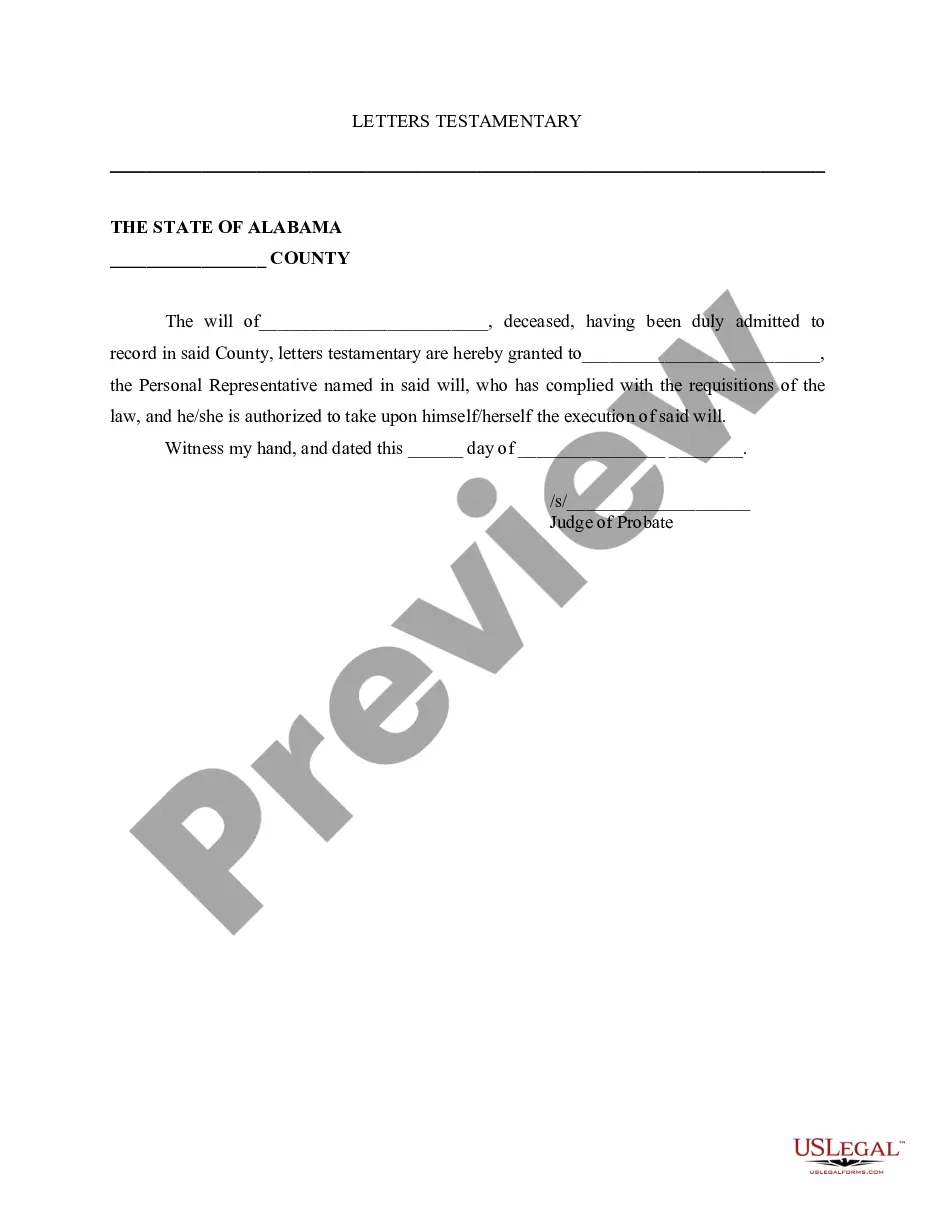
Alabama Letters Testamentary
What is this form?
The Letters Testamentary is a legal document issued by the probate court, which grants authority to an individual appointed as a personal representative of a deceased person's estate. This form serves as official documentation, allowing the appointed individual to manage and distribute the estate's assets according to the deceased's will. Unlike other probate documents, this form specifically verifies that the personal representative has the legal power to act on behalf of the estate.
Key parts of this document
- Title indicating the court that issued the Letters Testamentary.
- Name of the deceased individual whose estate is being managed.
- Name of the personal representative who is appointed to administer the estate.
- Date on which the Letters Testamentary are issued.
- Signature of the judge of probate confirming the issuance.

Common use cases
This form should be used when an individual has been named in a last will and testament as the personal representative of the deceased individual and the probate court has approved the will. It is necessary for proceeding with the estateâs administration, such as accessing bank accounts, distributing assets, and paying debts of the deceased. Without this form, the personal representative lacks the legal authority to perform these duties.
Who can use this document
- Individuals named as personal representatives in a will.
- Executors who have been granted authority by the probate court.
- Heirs or beneficiaries of the deceased's estate seeking to formalize the estate management process.
Instructions for completing this form
- Enter the name of the deceased individual accurately.
- Fill in the name of the personal representative as designated in the will.
- Add the date on which the letters are issued by the probate court.
- Ensure the judge's signature is included, confirming the form's validity.
- Maintain copies for your records as well as for relevant financial institutions and beneficiaries.
Does this form need to be notarized?
This form does not typically require notarization unless specified by local law. Always check state regulations to ensure compliance in your jurisdiction.
Get your form ready online
Our built-in tools help you complete, sign, share, and store your documents in one place.
Make edits, fill in missing information, and update formatting in US Legal Forms—just like you would in MS Word.
Download a copy, print it, send it by email, or mail it via USPS—whatever works best for your next step.
Sign and collect signatures with our SignNow integration. Send to multiple recipients, set reminders, and more. Go Premium to unlock E-Sign.
If this form requires notarization, complete it online through a secure video call—no need to meet a notary in person or wait for an appointment.
We protect your documents and personal data by following strict security and privacy standards.

Make edits, fill in missing information, and update formatting in US Legal Forms—just like you would in MS Word.

Download a copy, print it, send it by email, or mail it via USPS—whatever works best for your next step.

Sign and collect signatures with our SignNow integration. Send to multiple recipients, set reminders, and more. Go Premium to unlock E-Sign.

If this form requires notarization, complete it online through a secure video call—no need to meet a notary in person or wait for an appointment.

We protect your documents and personal data by following strict security and privacy standards.
Mistakes to watch out for
- Failing to have the form signed by the judge of probate, which renders it invalid.
- Leaving out important details such as the dates or names.
- Using outdated forms that may not comply with current state requirements.
Benefits of completing this form online
- Convenient access to professional, attorney-drafted templates.
- Easy downloading for immediate use and modification as needed.
- Secure and reliable storage options for your documents.
Legal use & context
- This form serves as official proof of authority to manage a deceased person's estate.
- It is used in probate court proceedings for asset distribution and debt settlement.
- Filling out the form accurately is critical for the legal enforceability of the appointed personal representativeâs actions.
What to keep in mind
- The Letters Testamentary is essential for estate administration following a person's death.
- Correct completion of the form is necessary to provide legal authority to the personal representative.
- Each state has specific requirements, so users should ensure compliance with local laws.
Looking for another form?


Form popularity
FAQ
Alabama Letters Testamentary is a probate court document that grants authority to a named personal representative to manage the deceased’s estate. It confirms the representative’s legal power to act on behalf of the estate and is required to proceed with administration, including accessing assets, paying debts, and distributing property per the will.
Letters Testamentary are issued by the Alabama probate court after the will is admitted and a personal representative is appointed. This document provides the legal power to administer the estate, including collecting assets, paying debts, and distributing property under the will. The form certifies the executor’s authority to act for the estate.
The probate court creates (issues) Letters Testamentary after it approves the will and appoints a personal representative. The document serves as official proof the executor or personal representative may act on behalf of the estate, such as accessing accounts, paying debts, and distributing assets as directed.
Generally not without the authority granted by Letters Testamentary. This form provides the legal power to administer the estate, including gathering assets, paying debts, and disposing of property as directed by the will. Acting without letters may expose the person to liability for improper or unauthorized handling of assets.
In Alabama, assets that require administration are typically dealt with through probate when a will governs the estate and a personal representative is named. The Letters Testamentary are issued after the will is admitted, providing the executor with authority to manage and distribute estate assets in accordance with the will.
Letters Testamentary and Letters of Administration serve different situations. Letters Testamentary are issued when a will exists and is admitted, giving the named executor authority to administer the estate. Letters of Administration are used when there is no valid will or no appointed executor, authorizing another person to manage the estate.