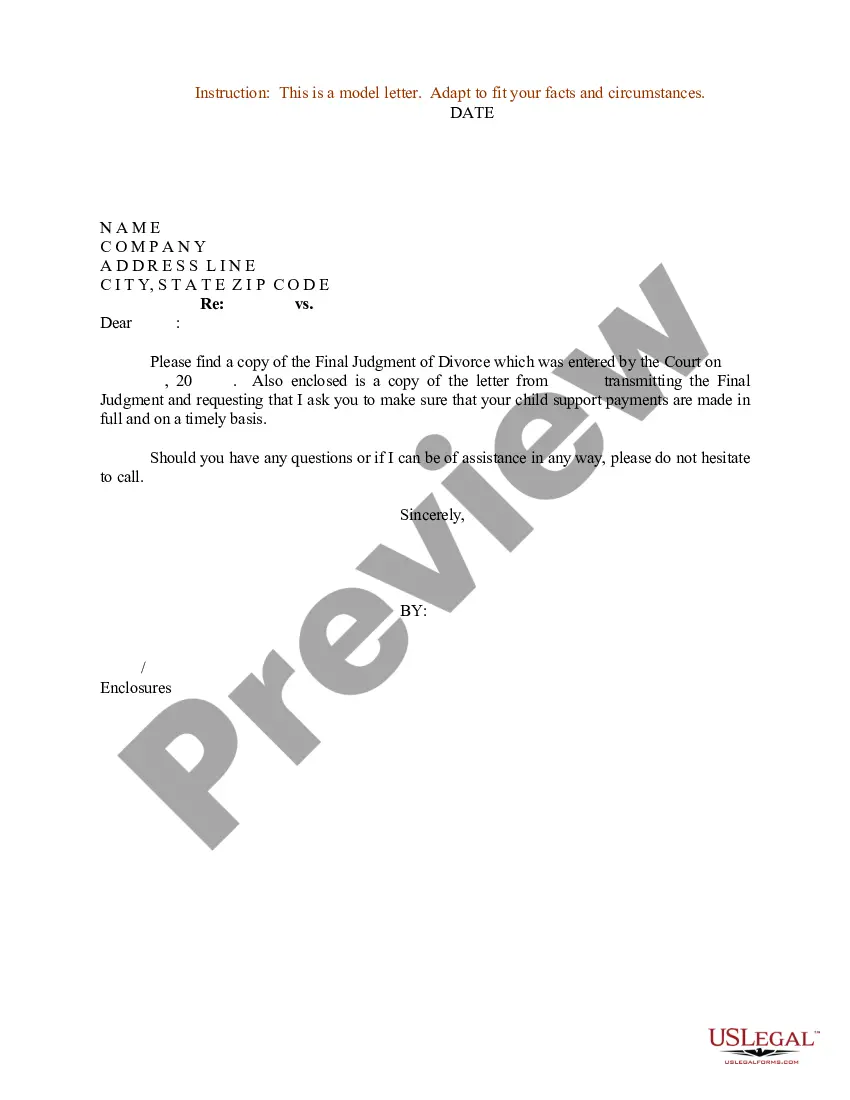
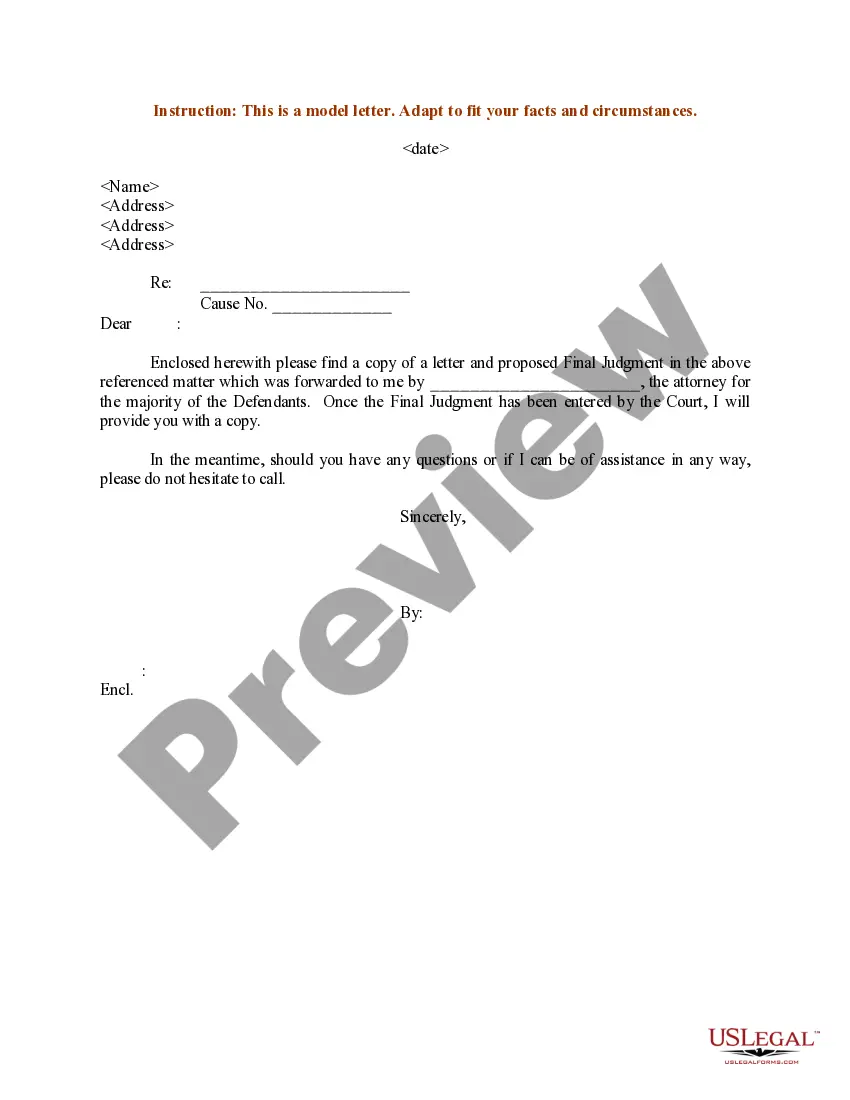
Final Judgement Form Formspy
Description

Get your form ready online
Our built-in tools help you complete, sign, share, and store your documents in one place.
Make edits, fill in missing information, and update formatting in US Legal Forms—just like you would in MS Word.
Download a copy, print it, send it by email, or mail it via USPS—whatever works best for your next step.
Sign and collect signatures with our SignNow integration. Send to multiple recipients, set reminders, and more. Go Premium to unlock E-Sign.
If this form requires notarization, complete it online through a secure video call—no need to meet a notary in person or wait for an appointment.
We protect your documents and personal data by following strict security and privacy standards.

Make edits, fill in missing information, and update formatting in US Legal Forms—just like you would in MS Word.

Download a copy, print it, send it by email, or mail it via USPS—whatever works best for your next step.

Sign and collect signatures with our SignNow integration. Send to multiple recipients, set reminders, and more. Go Premium to unlock E-Sign.

If this form requires notarization, complete it online through a secure video call—no need to meet a notary in person or wait for an appointment.

We protect your documents and personal data by following strict security and privacy standards.
Looking for another form?


How to fill out Sample Letter Regarding Final Judgment Of Divorce?
Managing legal documents can be exasperating, even for seasoned professionals.
When you are searching for a Final Judgment Form Formspy and lack the time to dedicate to finding the right and updated version, the tasks can be taxing.
Access state- or county-specific legal and organizational documents.
US Legal Forms encompasses any needs you might have, ranging from personal to business paperwork, all in one location.
If this is your first experience with US Legal Forms, create a free account to gain unlimited access to all platform benefits. Here are the steps to follow after accessing the desired form: Verify that this is the correct form by previewing it and reviewing its details. Ensure the sample is valid in your state or county. Select Buy Now when you are prepared. Choose a monthly subscription plan. Locate the format you need, and Download, complete, sign, print, and send your documents. Enjoy the US Legal Forms online library, backed by 25 years of experience and reliability. Transform your daily document management into a seamless and user-friendly process today.
- Utilize cutting-edge tools to complete and manage your Final Judgment Form Formspy.
- Tap into a valuable resource pool of articles, tutorials, handbooks, and materials pertinent to your situation and needs.
- Save time and effort searching for the documents you require, and utilize US Legal Forms’ advanced search and Preview tool to locate Final Judgment Form Formspy and obtain it.
- If you possess a subscription, Log In to your US Legal Forms account, search for the form, and procure it.
- Check the My documents tab to view the documents you have previously downloaded and manage your folders as desired.
- A robust web form library could be a game changer for anyone seeking to navigate these scenarios effectively.
- US Legal Forms stands as a frontrunner in online legal forms, offering over 85,000 state-specific legal documents accessible at any time.
- With US Legal Forms, you can effortlessly manage your legal and organizational forms.
Form popularity
FAQ
About the different, react-form is much more simple and easy to learn, but redux-form must have redux in your project and should have some basic knowledge about HOC and redux. The react-form need to handle the data yourself but redux-form use redux to handle the date in project and create actions?store and so on.
<FormSpy/> A component that subscribes to form state, and injects both form state and the form instance via a render prop. The <FormSpy/> will rerender any time the form state it is subscribed to changes. By default it subscribes to all form state.
Advantages: consistent behaviour for all forms. quick form development time. no redux-form boilerplate. code reuse. easy to change form library in the future, change is only in the lower wrapper component. not in all other forms components.
React Final Form is a thin React wrapper for Final Form, which is a subscriptions-based form state management library that uses the Observer pattern, so only the components that need updating are re-rendered as the form's state changes.
React Final Form was written by the same guy (@erikras) that wrote Redux Form, so much of the API is exactly the same. The primary difference is that, rather than "decorate" your form component with a Higher Order Component, you use React Final Form's <Form/> component to give you all your form state via a render prop.