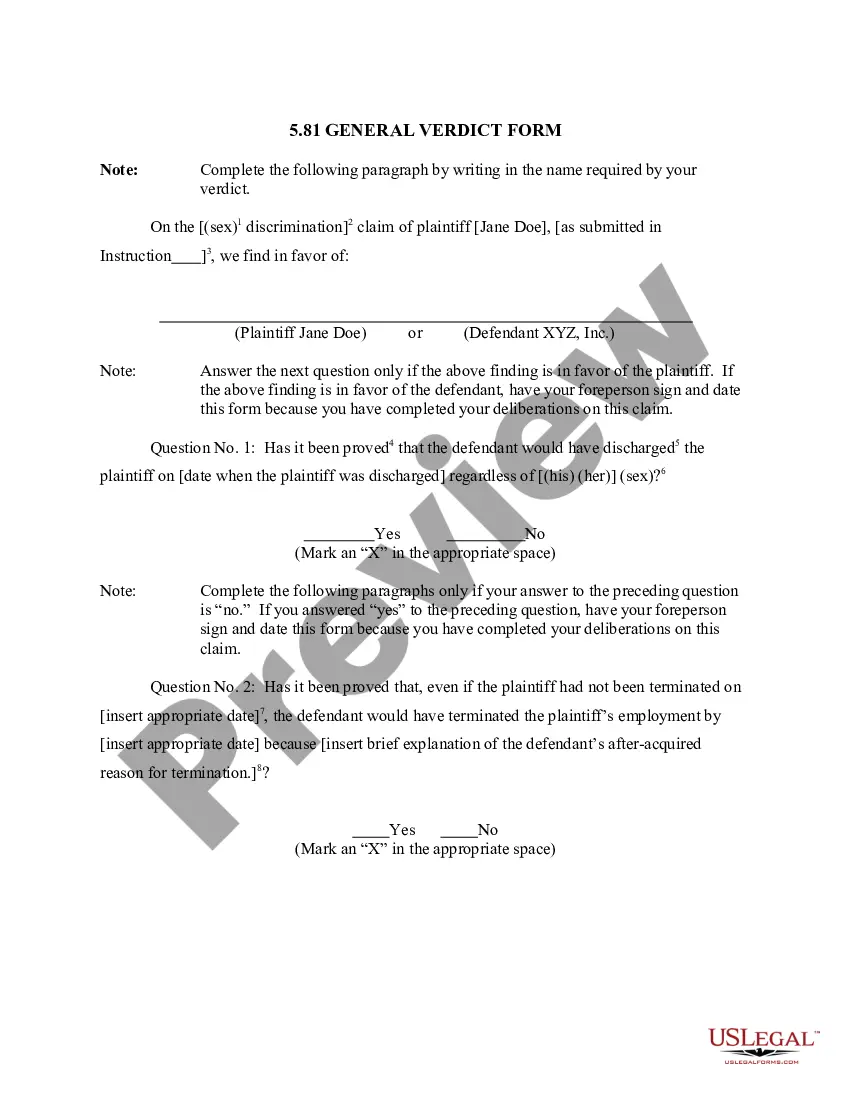
5.81 GENERAL VERDICT FORM
What is this form?
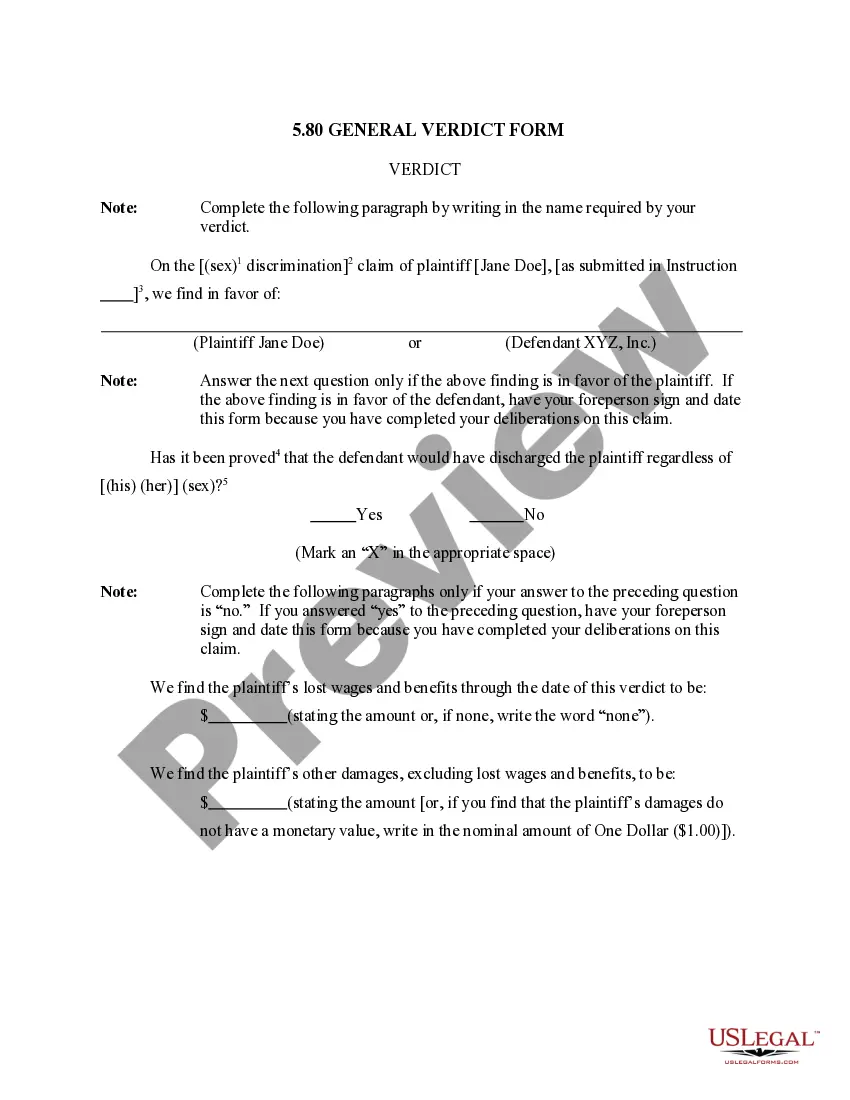
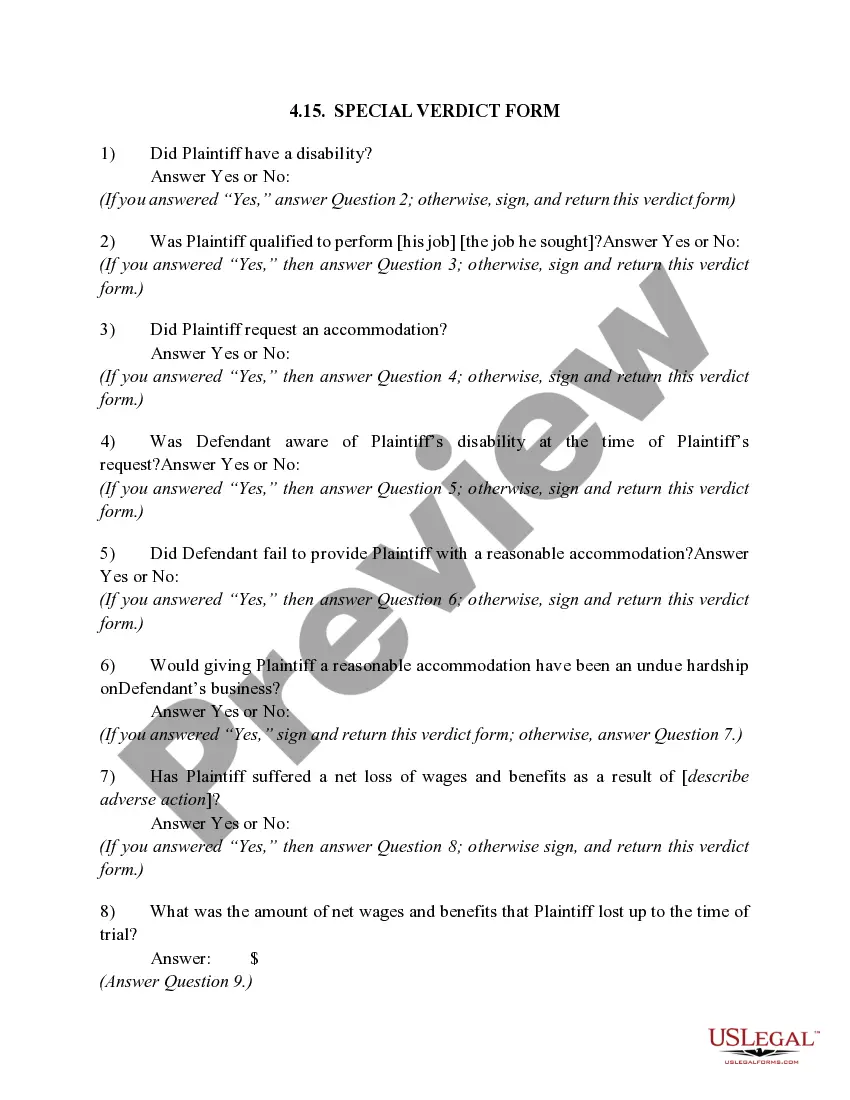
The General Verdict Form is a legal document used by jurors to record their final decision in cases involving discrimination claims, specifically focused on gender discrimination. It differentiates itself from other verdict forms by including specific questions that help determine whether the plaintiff was harmed due to discrimination, allowing a fair resolution to the case. This form is essential for ensuring that jurors follow a structured approach to their verdict on discrimination cases.
Key parts of this document
- The name of the plaintiff or defendant in the case.
- Questions to determine if the plaintiff's termination was due to discrimination.
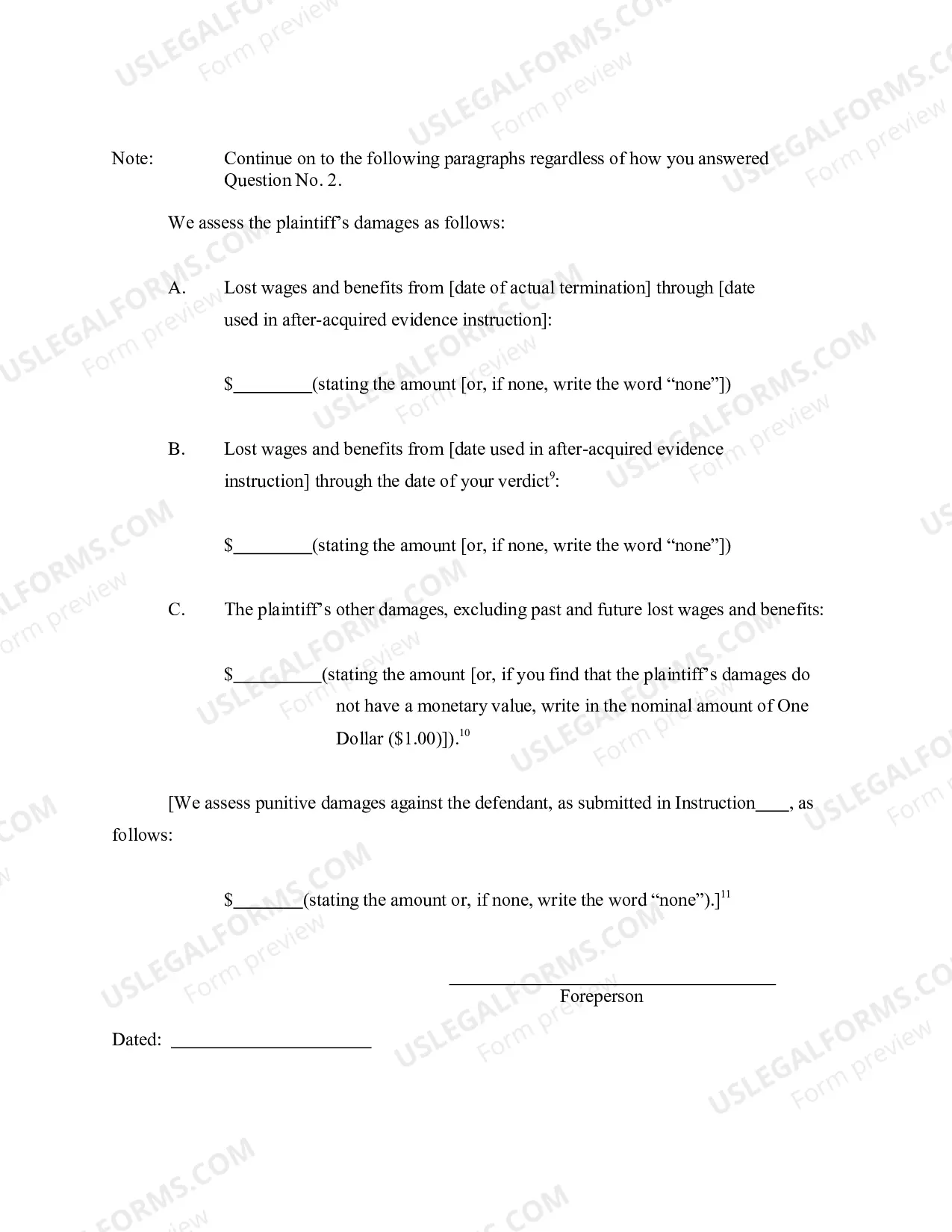
- Instructions for assessing damages incurred by the plaintiff.
- Space for jurors' findings on lost wages and other damages.
- Signature line for the foreperson indicating the conclusion of deliberations.
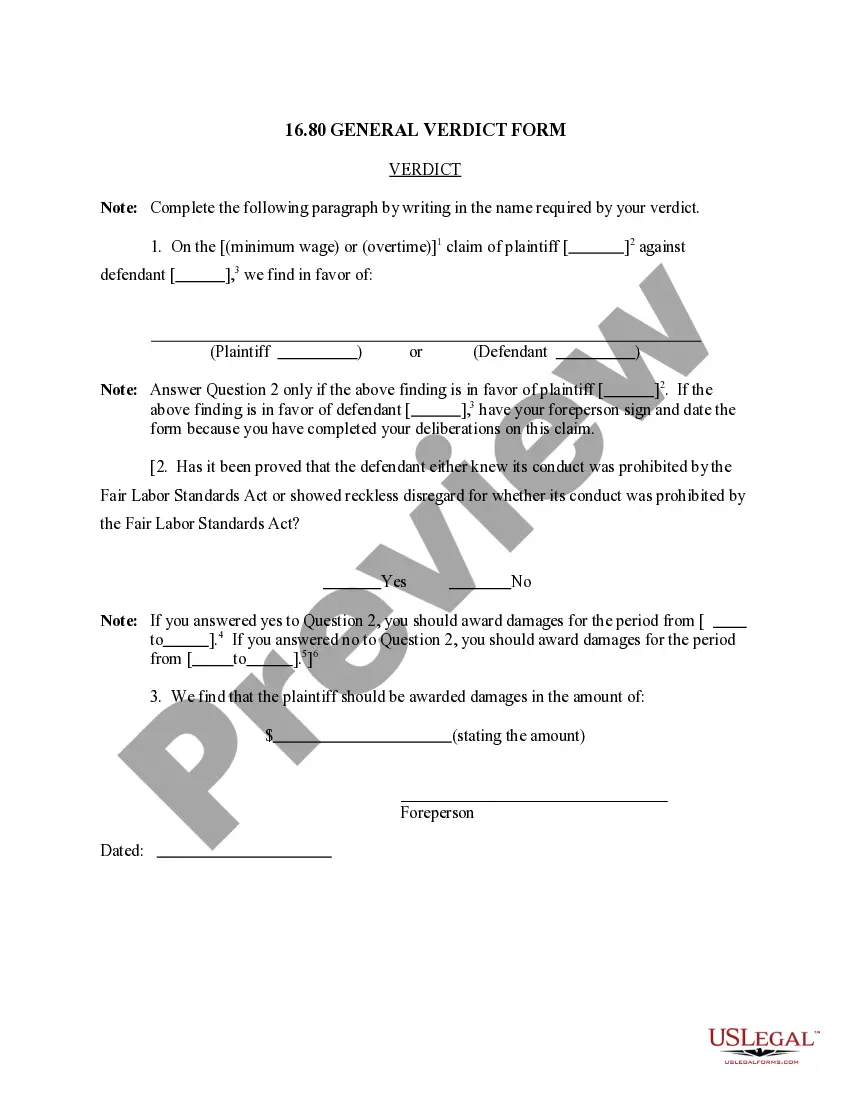
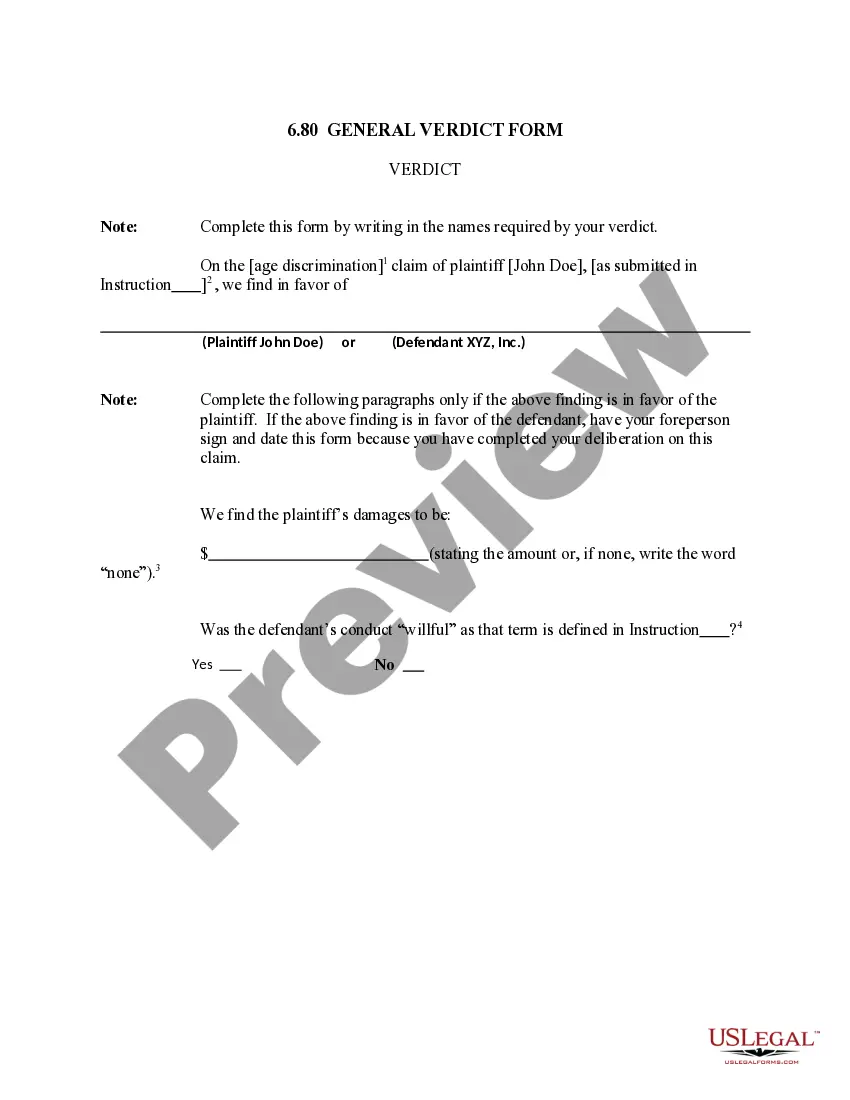
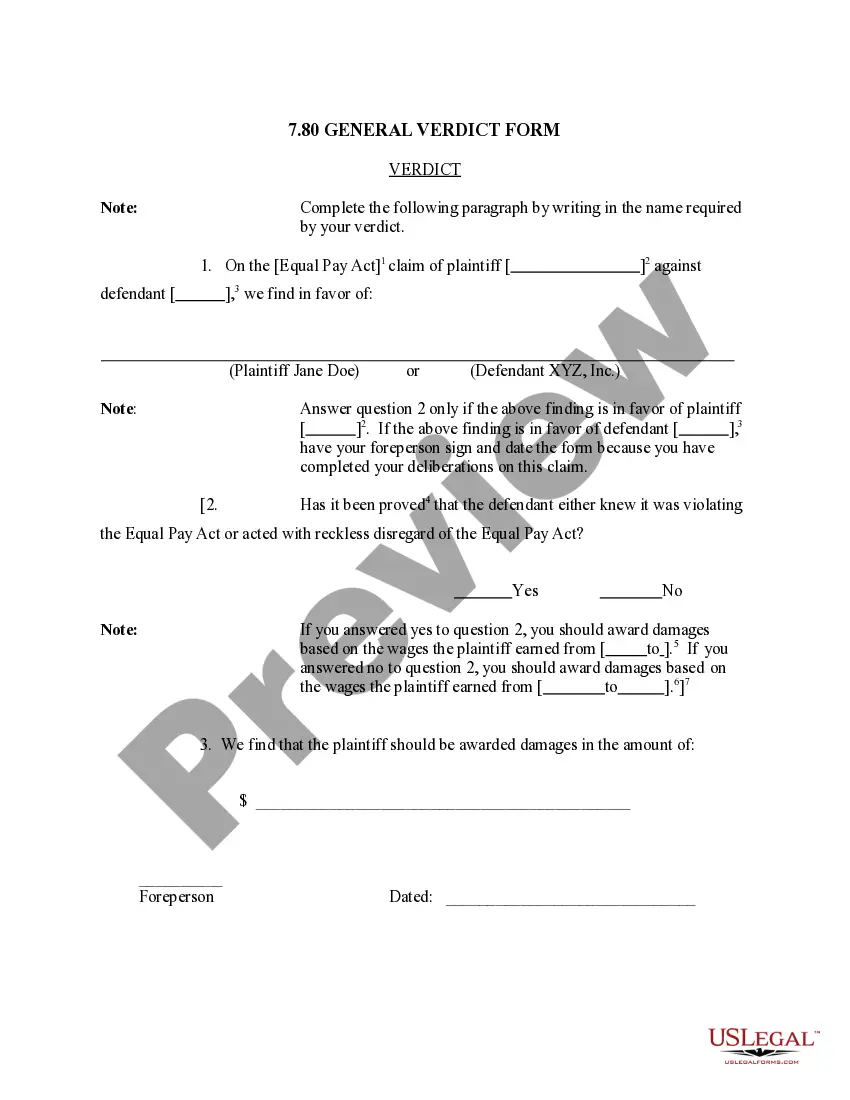
When this form is needed
This form should be used in civil jury trials involving claims of gender discrimination in employment. If a plaintiff believes they were unlawfully terminated or discriminated against based on their sex, the General Verdict Form facilitates the fulfillment of jury duties by guiding them through necessary evaluations and ensuring accurate verdict submissions.
Who can use this document
- Jurors assigned to a discrimination case involving termination or workplace dynamics.
- Legal professionals involved in drafting jury instructions for discrimination lawsuits.
- Judges overseeing civil trials related to employment discrimination.
Steps to complete this form
- Start by writing in the name of the plaintiff or defendant based on the court's instructions.
- Answer each question regarding the plaintiff's termination, marking 'Yes' or 'No' as appropriate.
- Assess and enter the total damages for lost wages from the relevant dates mentioned.
- Record any other damages and assess punitive damages if applicable.
- Ensure the foreperson signs and dates the form once deliberations are complete.
Is notarization required?
Notarization is not commonly needed for this form. However, certain documents or local rules may make it necessary. Our notarization service, powered by Notarize, allows you to finalize it securely online anytime, day or night.
Get your form ready online
Our built-in tools help you complete, sign, share, and store your documents in one place.
Make edits, fill in missing information, and update formatting in US Legal Forms—just like you would in MS Word.
Download a copy, print it, send it by email, or mail it via USPS—whatever works best for your next step.
Sign and collect signatures with our SignNow integration. Send to multiple recipients, set reminders, and more. Go Premium to unlock E-Sign.
If this form requires notarization, complete it online through a secure video call—no need to meet a notary in person or wait for an appointment.
We protect your documents and personal data by following strict security and privacy standards.

Make edits, fill in missing information, and update formatting in US Legal Forms—just like you would in MS Word.

Download a copy, print it, send it by email, or mail it via USPS—whatever works best for your next step.

Sign and collect signatures with our SignNow integration. Send to multiple recipients, set reminders, and more. Go Premium to unlock E-Sign.

If this form requires notarization, complete it online through a secure video call—no need to meet a notary in person or wait for an appointment.

We protect your documents and personal data by following strict security and privacy standards.
Avoid these common issues
- Failing to sign and date the form, which invalidates the verdict.
- Incorrectly marking answers to the questions, leading to confusion in the verdict.
- Omitting key details about damages, which can impact the final judgement.
Why complete this form online
- Convenience of accessing and downloading the form anytime, from anywhere.
- Editability allows for customization to fit specific case needs.
- Reliability, ensuring the form meets legal standards and requirements.
Legal use & context
- The General Verdict Form must adhere to local court rules that govern jury verdicts and civil rights litigation.
- This form provides a structured decision-making process, which is critical for fair judicial outcomes in discrimination cases.
- Understanding the context of the law is essential for jurors when applying the form to ensure accurate and just verdict outcomes.
Key takeaways
- The General Verdict Form is crucial for documenting jury decisions in gender discrimination cases.
- It includes specific questions to guide jurors through the deliberation process.
- All responses must be documented clearly to avoid any potential legal issues post-verdict.
Looking for another form?


Form popularity
FAQ
If it makes factual findings in addition to the ultimate legal conclusions, it returns a general verdict with interrogatories. (Ibid.) ?If it returns only factual findings, leaving the court to determine the ultimate legal result, it returns a special verdict.? (Ibid.)
A verdict in which the jury gives its findings on factual issues in the case, without necessarily stating which party should win.
General verdict with interrogatories refers to a general verdict accompanied by answers to written interrogatories on one or more issues of fact that bear on the verdict. A interrogatory is submitted by the judge to a jury when the court asks for a general verdict and wants to know the basis of the decision.
A general verdict is one that decides which party should win but does not make findings on any specific factual issues. A special verdict is one in which the jury provides its findings on specific factual issues.
A general verdict is a verdict in which the jury decides which party should win the case, without listing its specific findings on any disputed issues. Juries issuing a general verdict are not required to provide the court with the justifications or reasonings underlying their decision.
Verdicts are of several kinds, namely, privy and public, general, partial, and special.
There are several types of verdicts that are imposed in a civil trial: General Verdict. Special Verdict. Directed Verdict.
The verdict of a jury is either general or special. A general verdict is that by which they pronounce generally upon all or any of the issues, either in favor of the plaintiff or defendant; a special verdict is that by which the jury find the facts only, leaving the judgment to the Court.