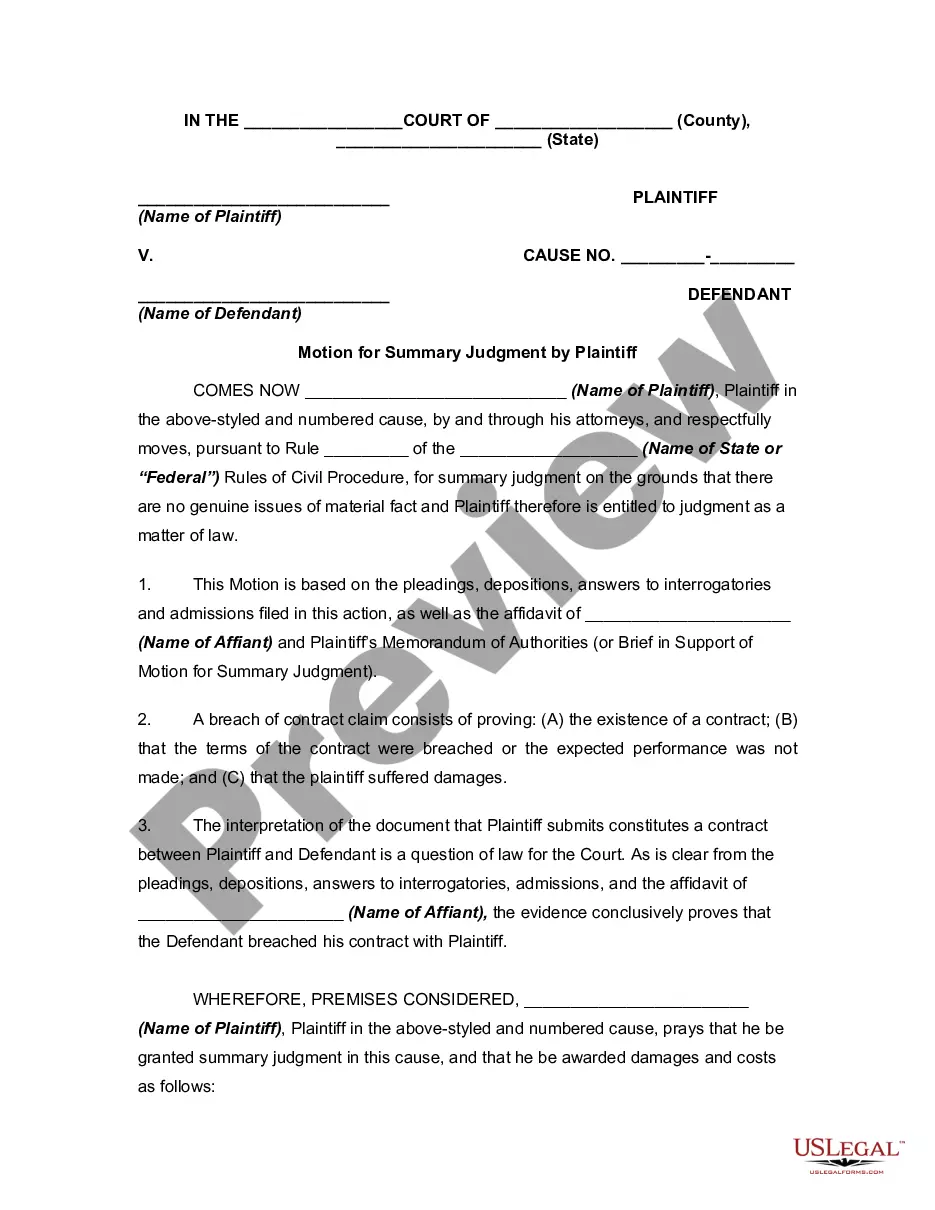
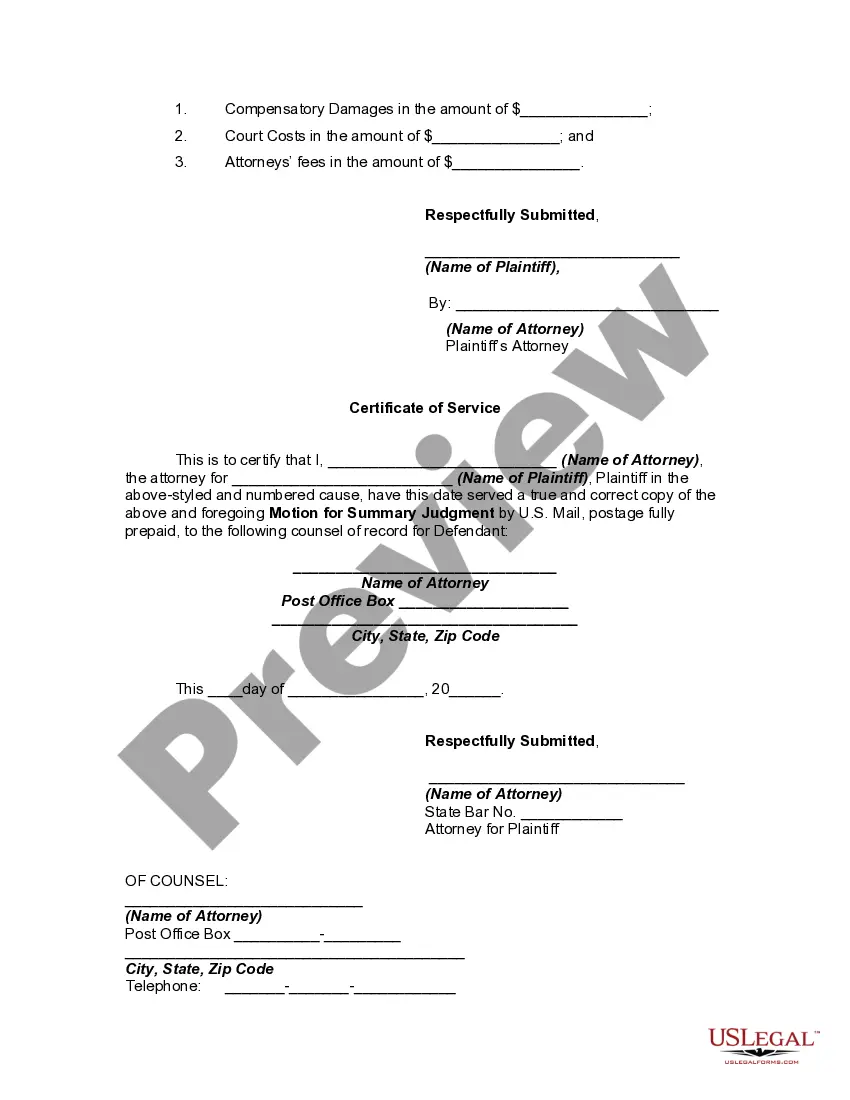
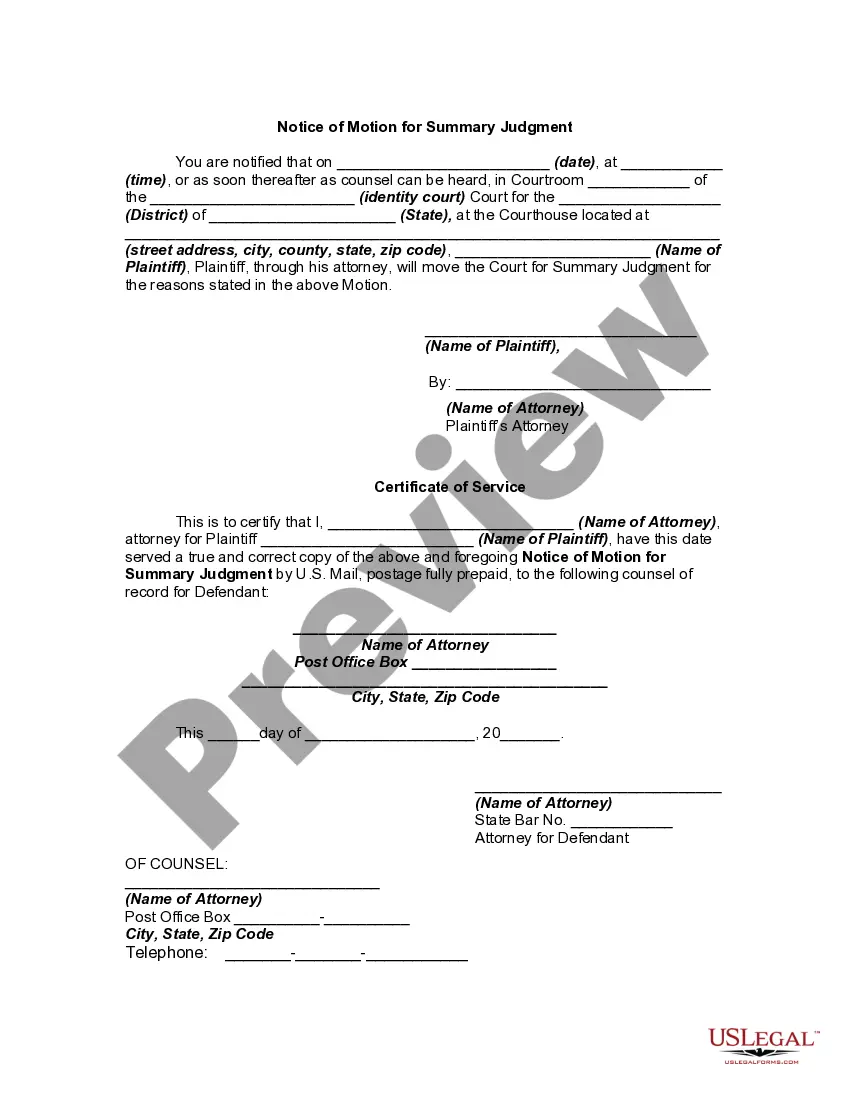
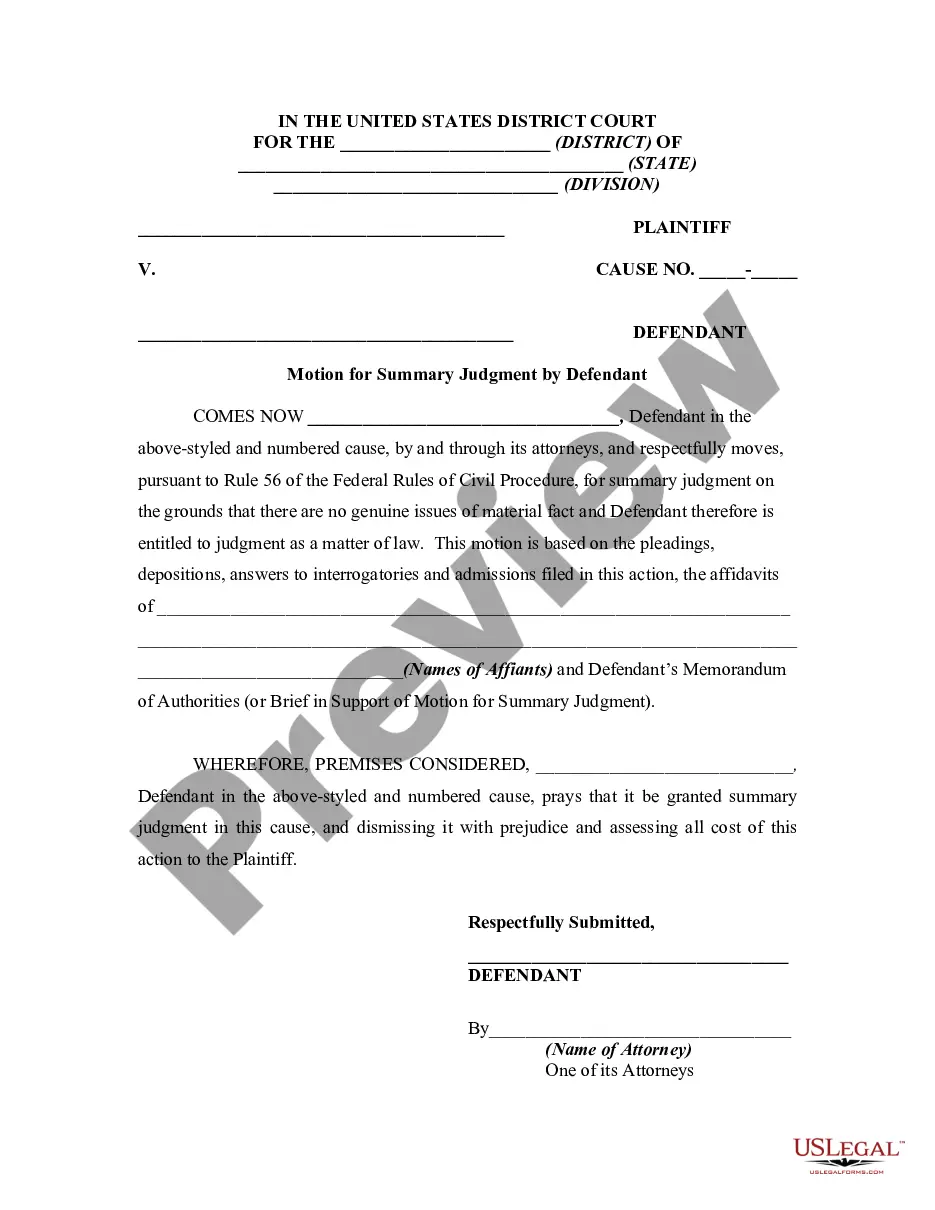
Motion For Summary Judgment Sample With Plaintiff
Description
Get your form ready online
Our built-in tools help you complete, sign, share, and store your documents in one place.
Make edits, fill in missing information, and update formatting in US Legal Forms—just like you would in MS Word.
Download a copy, print it, send it by email, or mail it via USPS—whatever works best for your next step.
Sign and collect signatures with our SignNow integration. Send to multiple recipients, set reminders, and more. Go Premium to unlock E-Sign.
If this form requires notarization, complete it online through a secure video call—no need to meet a notary in person or wait for an appointment.
We protect your documents and personal data by following strict security and privacy standards.

Make edits, fill in missing information, and update formatting in US Legal Forms—just like you would in MS Word.

Download a copy, print it, send it by email, or mail it via USPS—whatever works best for your next step.

Sign and collect signatures with our SignNow integration. Send to multiple recipients, set reminders, and more. Go Premium to unlock E-Sign.

If this form requires notarization, complete it online through a secure video call—no need to meet a notary in person or wait for an appointment.

We protect your documents and personal data by following strict security and privacy standards.
Looking for another form?

How to fill out Motion For Summary Judgment By Plaintiff For Breach Of Contract?
Whether for commercial objectives or for individual issues, everyone must confront legal circumstances at some stage in their existence.
Filling out legal paperwork necessitates meticulous focus, beginning with selecting the suitable form example.
With an extensive US Legal Forms catalog available, you do not have to waste time searching for the correct sample across the internet. Utilize the library’s straightforward navigation to locate the appropriate form for any scenario.
- Locate the sample you require by utilizing the search field or catalog browsing.
- Review the form’s details to ensure it corresponds to your case, state, and county.
- Select the form’s preview to examine it.
- If it is the wrong document, return to the search feature to find the Motion For Summary Judgment Sample With Plaintiff sample you require.
- Obtain the template if it satisfies your needs.
- If you already possess a US Legal Forms profile, click Log in to access previously stored templates in My documents.
- If you haven’t created an account yet, you can acquire the form by clicking Buy now.
- Select the correct pricing option.
- Complete the profile registration form.
- Choose your payment method: utilize a credit card or PayPal account.
- Select the file format you prefer and download the Motion For Summary Judgment Sample With Plaintiff.
- After it is downloaded, you can fill out the form using editing software or print it and complete it by hand.
Form popularity
FAQ
An example of a summary judgment occurs when a court rules in favor of one party based on evidence that shows there are no material facts in dispute. For instance, if a plaintiff submits a motion for summary judgment, the court may find that the evidence is clear enough to grant relief without proceeding to trial. This situation often saves time and resources for all parties involved. To see how this works in practice, studying a motion for summary judgment sample with plaintiff can be insightful.
Yes, a plaintiff can file a motion for summary judgment if they believe there is sufficient evidence to support their claims without the need for a trial. This motion allows them to request a ruling from the court based on the submitted evidence. It's crucial for the plaintiff to present clear and compelling arguments. For additional guidance, check out a motion for summary judgment sample with plaintiff.
When structuring a motion for summary judgment, begin with an introduction that outlines the purpose and basis of the motion. Proceed with the statement of facts, followed by the legal arguments that explain why the court should grant the motion. Conclude with a formal request for the judgment and include a certificate of service. Reviewing a motion for summary judgment sample with plaintiff will provide further clarity on the structure.
In a motion for summary judgment, you can use various types of evidence, including affidavits, depositions, and official documents. These pieces of evidence should demonstrate that there is no genuine dispute regarding material facts. You want to provide clear and concise proof to support your claims. Examining a motion for summary judgment sample with plaintiff can help you identify the appropriate types of evidence.
To format a motion for summary judgment, start with a title that clearly states it is a motion for summary judgment. Follow this with a table of contents, a statement of facts, and a legal argument section that supports your position. Be sure to include relevant case citations and a conclusion summarizing your request. For a practical guide, consider looking at a motion for summary judgment sample with plaintiff.
To craft an effective motion for summary judgment, ensure that your writing is concise and direct, focusing on the evidence that supports your position. Structure your motion logically, with a clear statement of facts and a compelling argument demonstrating that there are no material facts in dispute. It’s also essential to cite relevant case law and statutes. Consider using 'Motion for summary judgment sample with plaintiff' examples as a reference to enhance your motion's quality.
Writing a motion for summary judgment sample involves outlining the facts of your case, the evidence supporting your claims, and the legal basis for your motion. Start with a strong introduction, followed by clear arguments that establish why there is no genuine dispute of material fact. Make sure to reference supporting documents and rules of law. USLegalForms offers templates that can help you create a professional 'Motion for summary judgment sample with plaintiff'.
To effectively respond to a motion for summary judgment, you should first gather and review all relevant evidence and documents. Your answer needs to clearly counter the claims made by the moving party while referencing your own evidence. It is critical to present a well-structured argument based on facts and legal precedents. Utilizing a 'Motion for summary judgment sample with plaintiff' can also guide you in crafting a strong response.