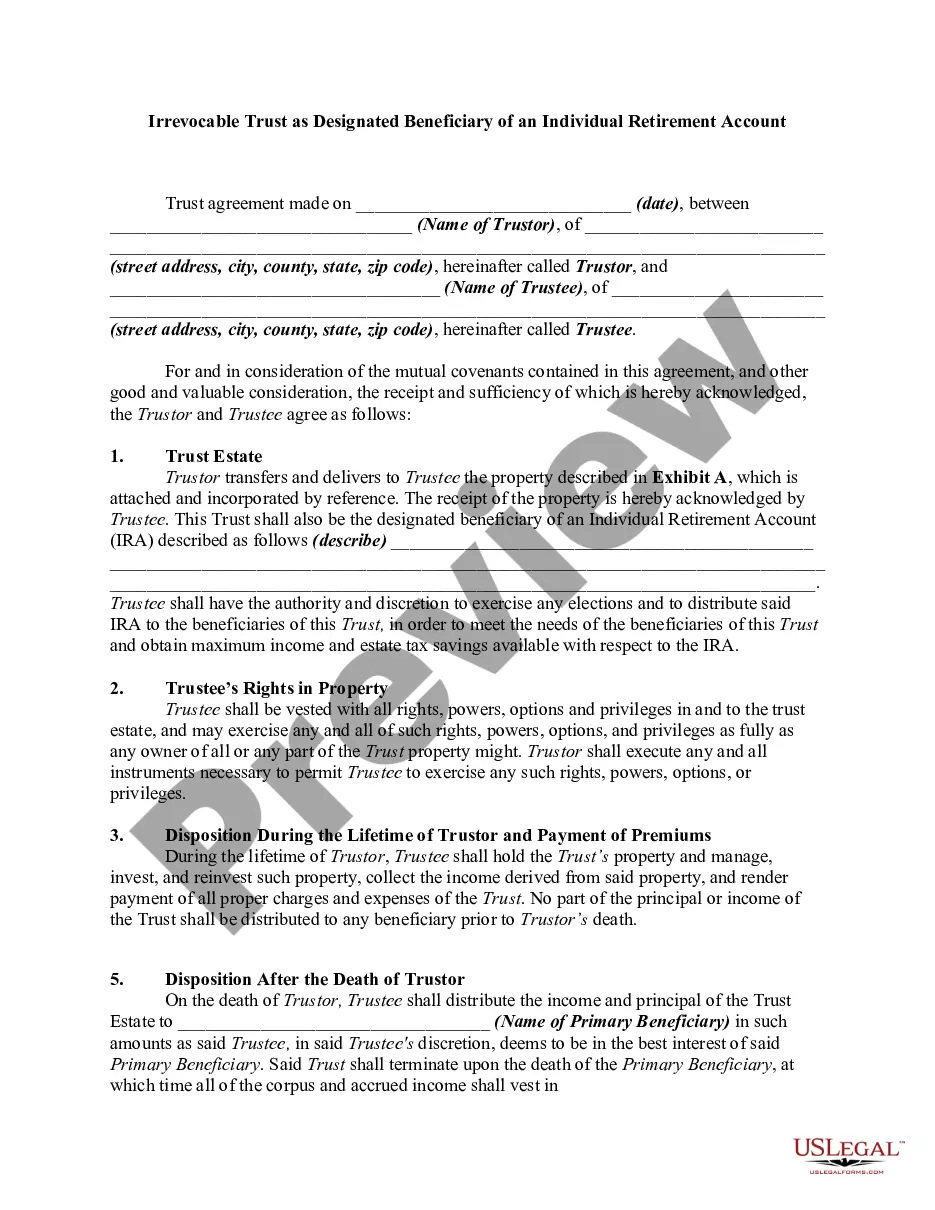
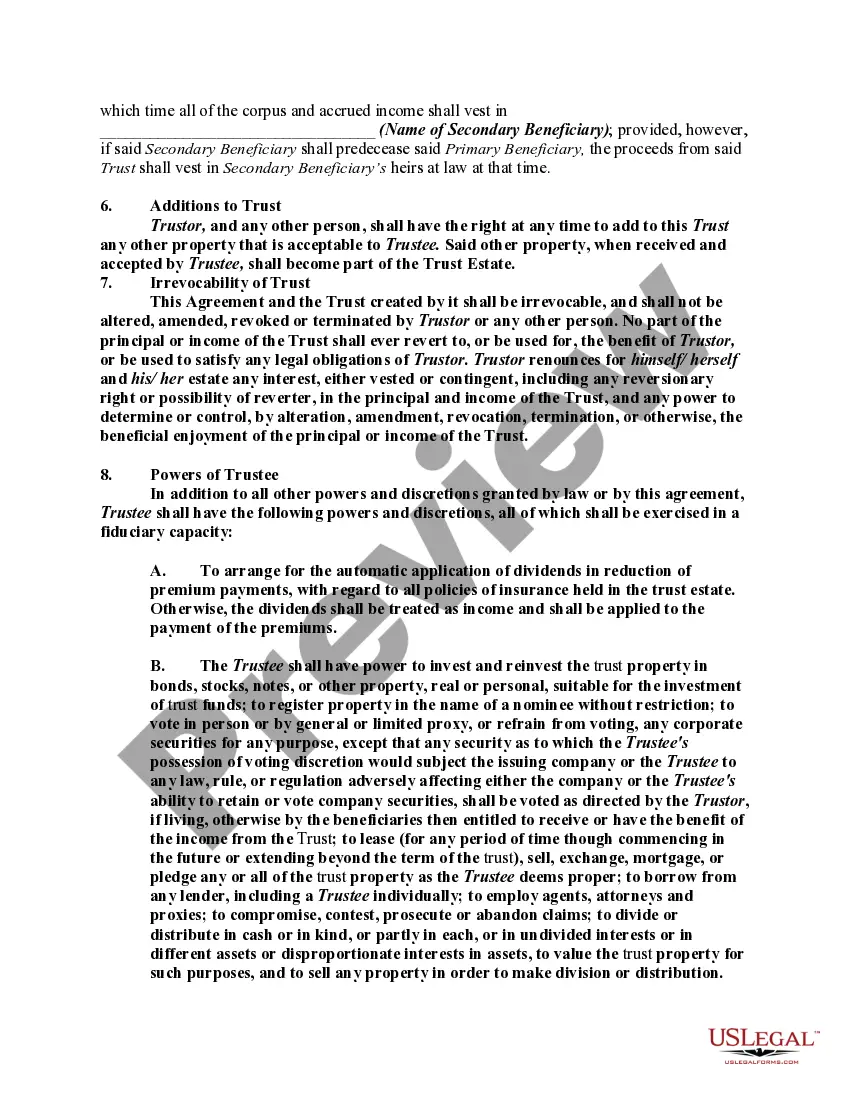
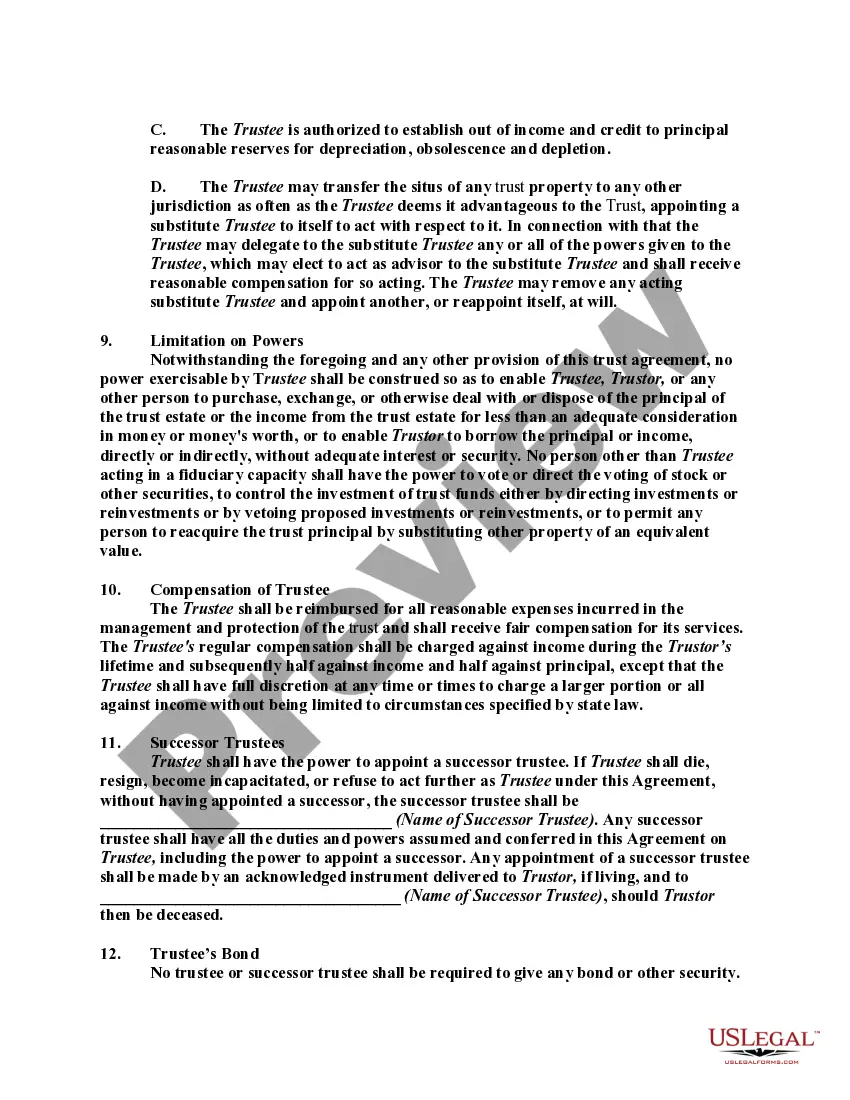
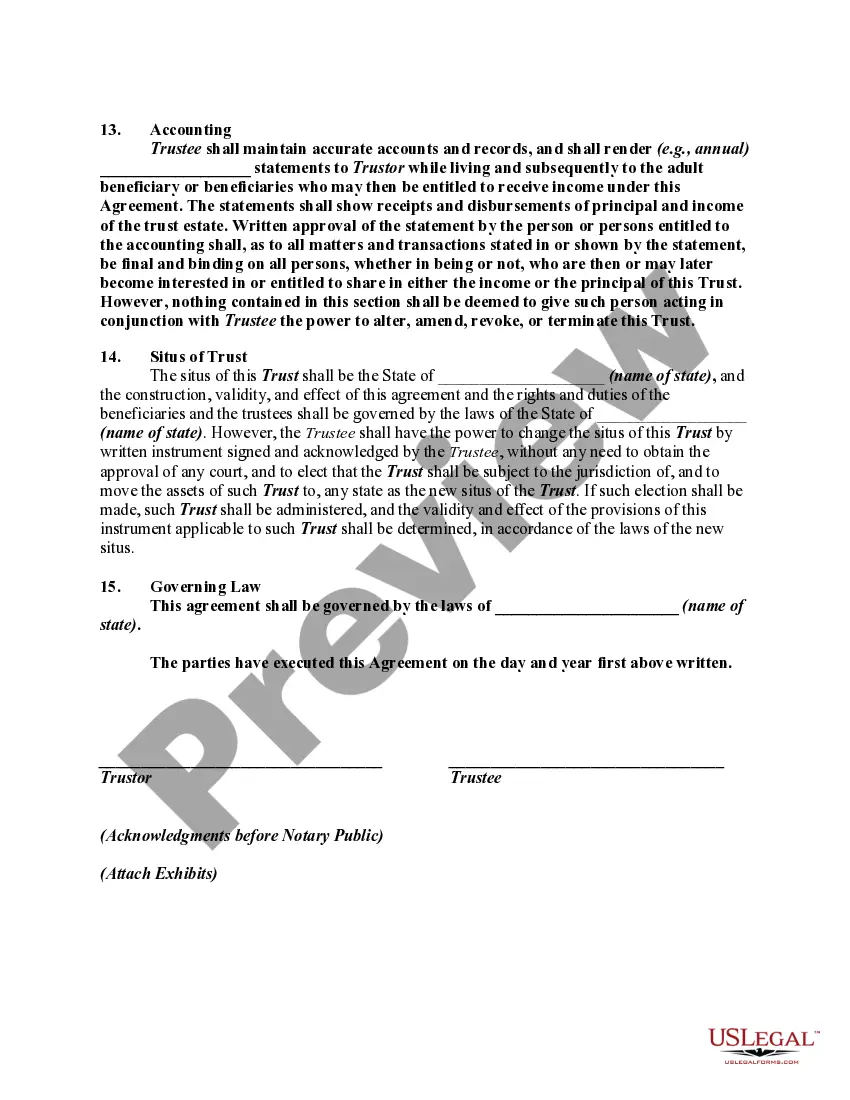
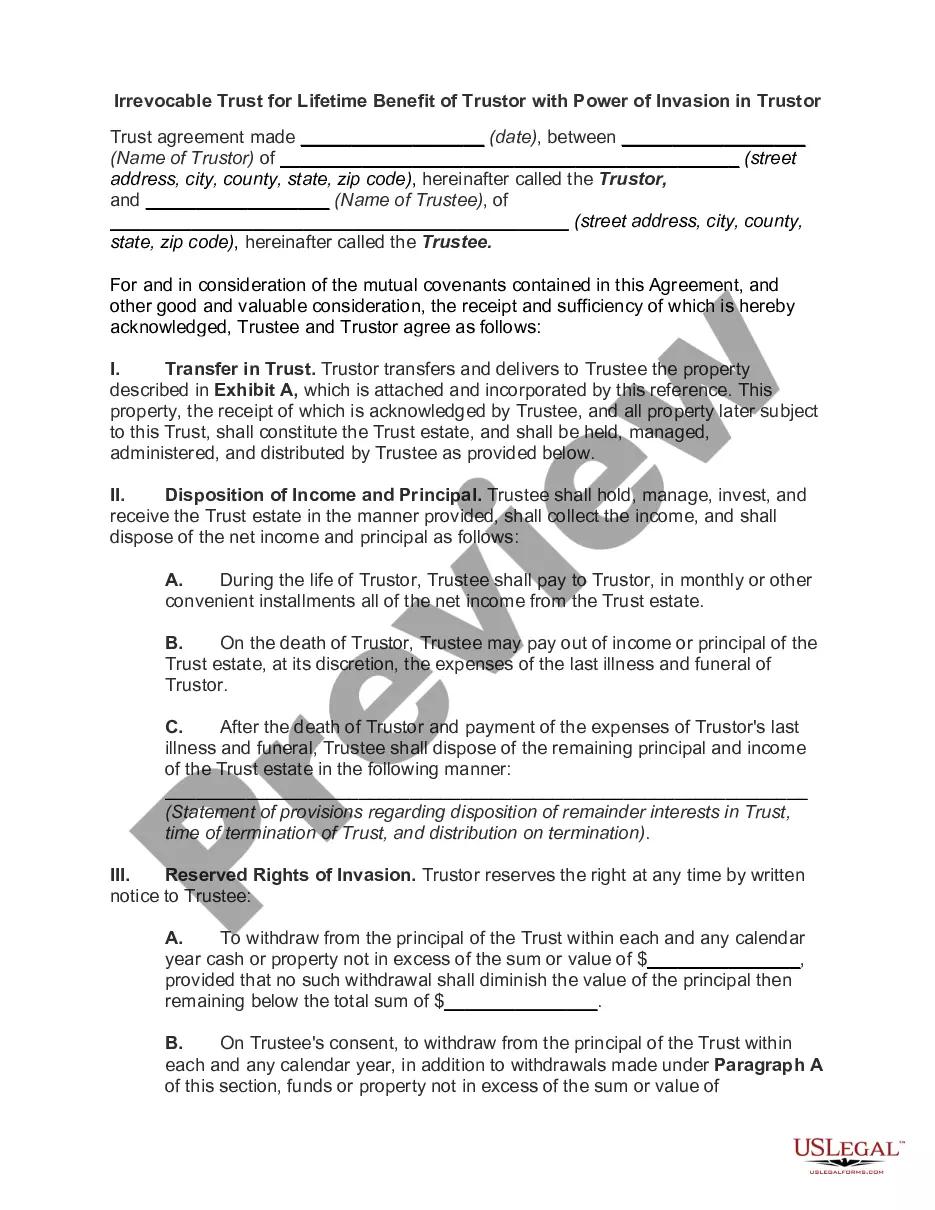
Irrevocable
Description

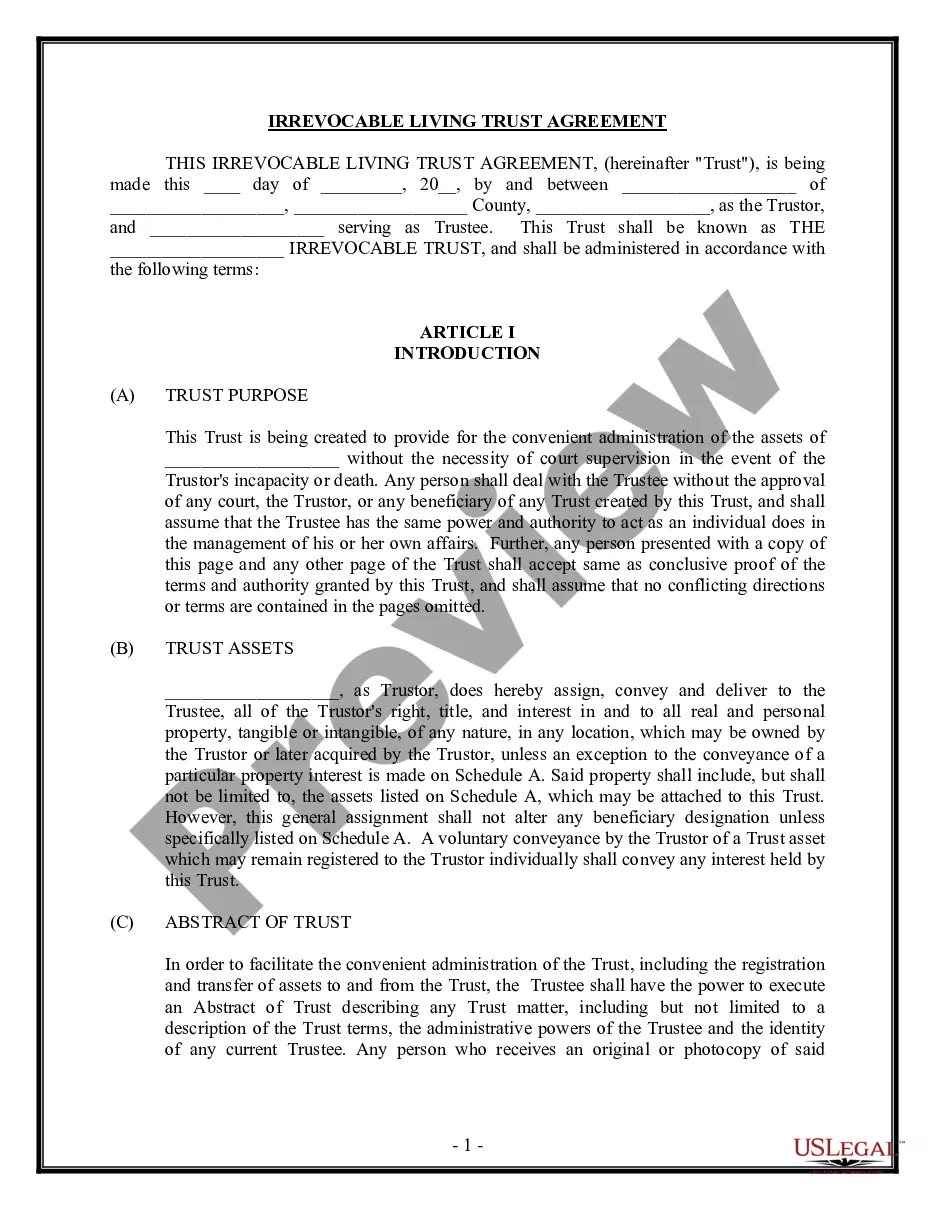
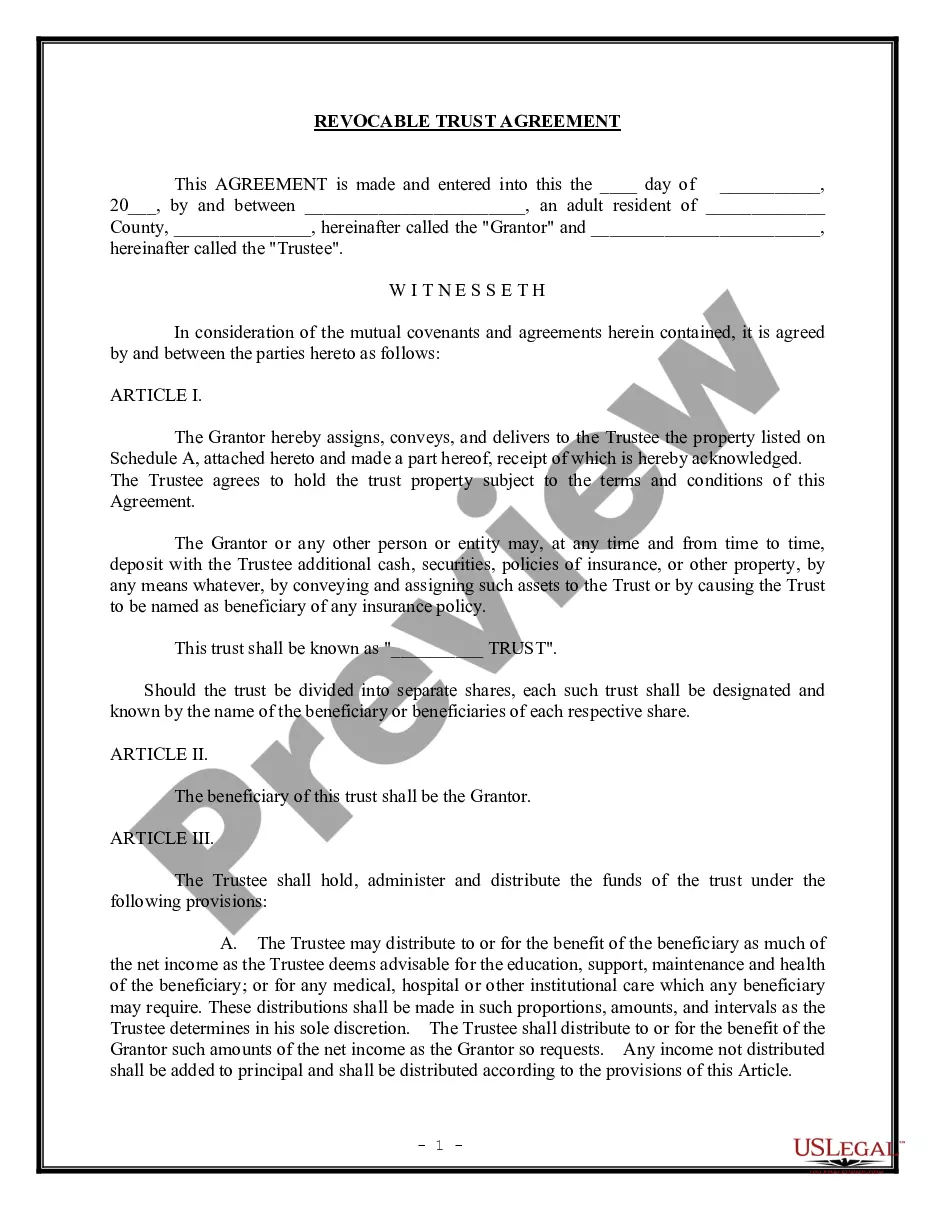
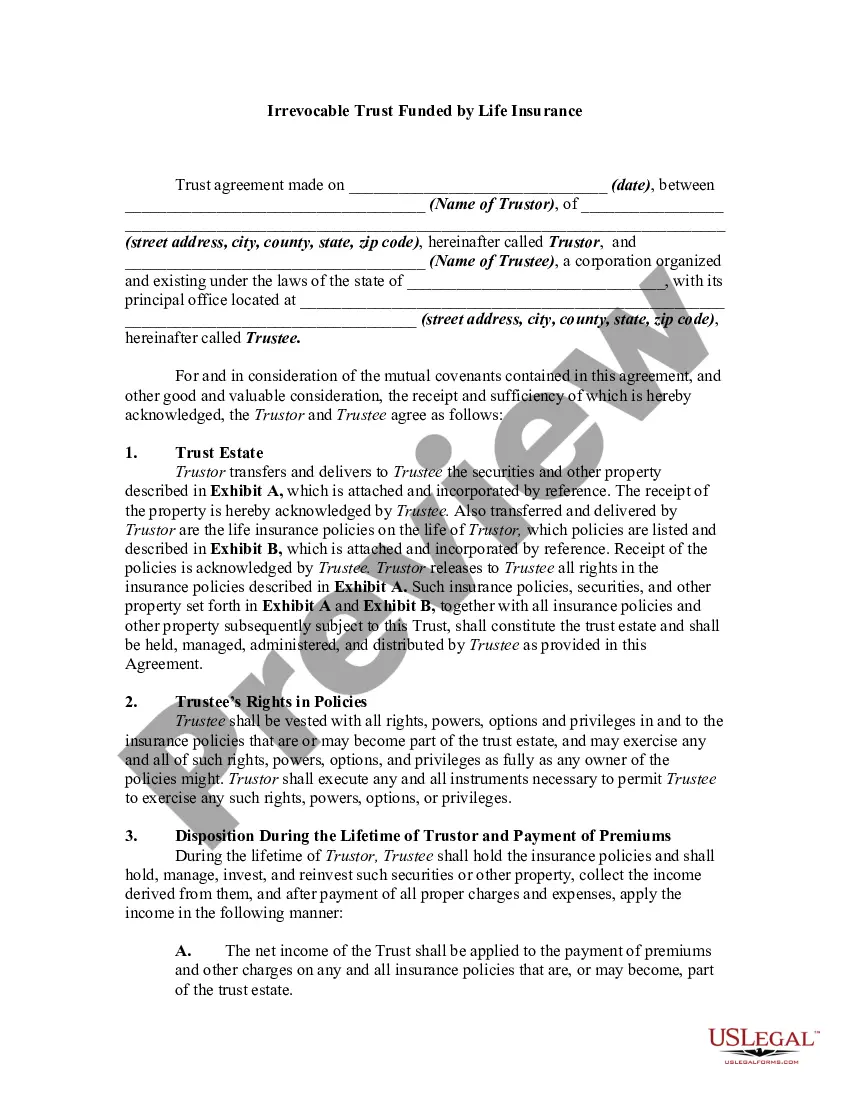
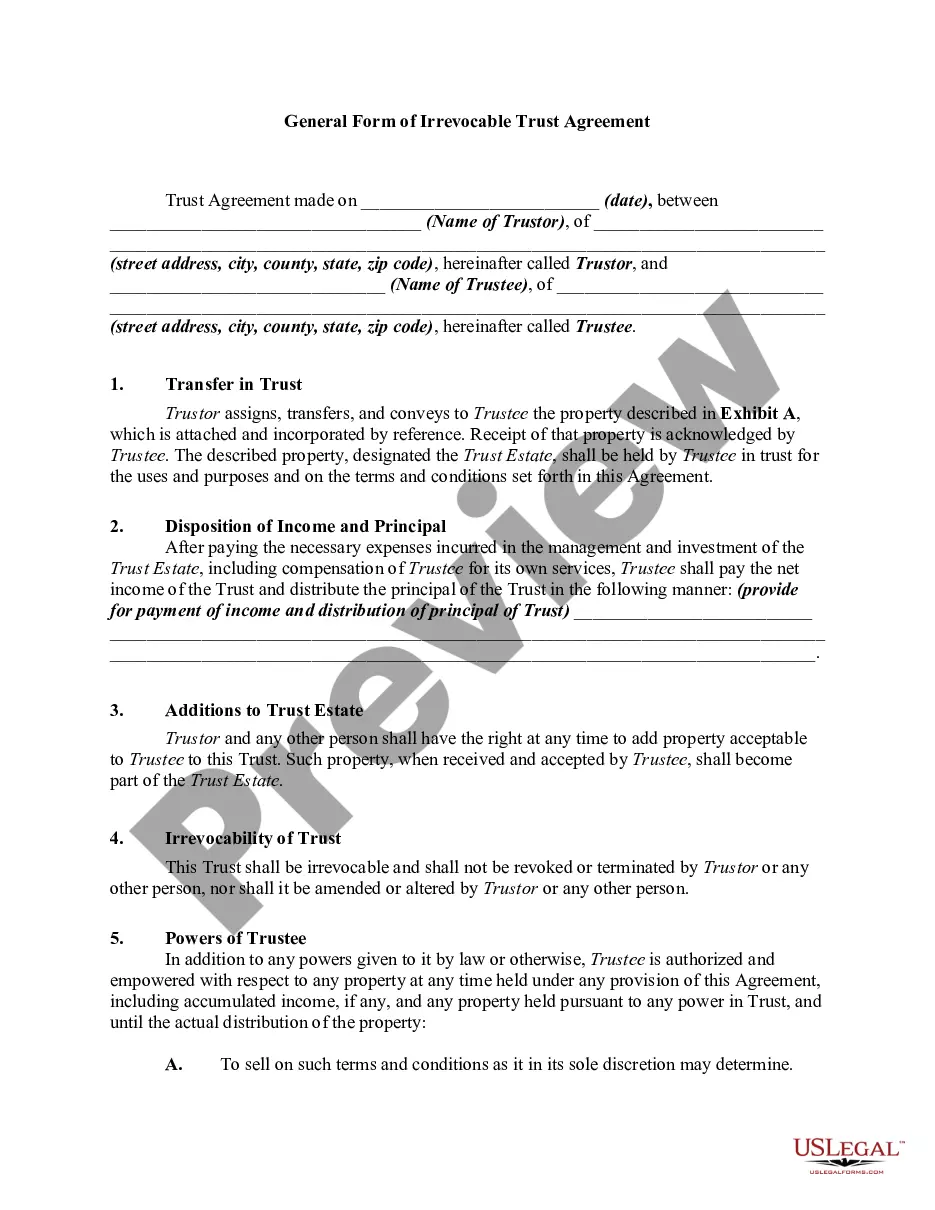
Get your form ready online
Our built-in tools help you complete, sign, share, and store your documents in one place.
Make edits, fill in missing information, and update formatting in US Legal Forms—just like you would in MS Word.
Download a copy, print it, send it by email, or mail it via USPS—whatever works best for your next step.
Sign and collect signatures with our SignNow integration. Send to multiple recipients, set reminders, and more. Go Premium to unlock E-Sign.
If this form requires notarization, complete it online through a secure video call—no need to meet a notary in person or wait for an appointment.
We protect your documents and personal data by following strict security and privacy standards.

Make edits, fill in missing information, and update formatting in US Legal Forms—just like you would in MS Word.

Download a copy, print it, send it by email, or mail it via USPS—whatever works best for your next step.

Sign and collect signatures with our SignNow integration. Send to multiple recipients, set reminders, and more. Go Premium to unlock E-Sign.

If this form requires notarization, complete it online through a secure video call—no need to meet a notary in person or wait for an appointment.

We protect your documents and personal data by following strict security and privacy standards.
Looking for another form?
How to fill out Irrevocable Trust As Designated Beneficiary Of An Individual Retirement Account?
- Begin by visiting the US Legal Forms website and logging into your existing account. Ensure your subscription is active to access all features.
- If you're new to US Legal Forms, search for the specific irrevocable form you require using the preview mode.
- Review the form description carefully to confirm it meets your local jurisdiction requirements before proceeding.
- If needed, utilize the Search tab to find additional templates that are suitable for your situation.
- Once you've selected the correct document, click on the 'Buy Now' button and choose the subscription plan that fits your needs.
- Complete your purchase by entering your payment information or utilizing your PayPal account for a seamless transaction.
- Download your selected form directly to your device. You can also find it later in the 'My Forms' section of your profile for easy access.
US Legal Forms empowers individuals and attorneys alike by offering a vast collection of over 85,000 editable legal forms. This extensive library is designed to ensure that users can easily create legally sound documents with confidence.
Start simplifying your legal processes today! Visit US Legal Forms now and explore the many options available for your irrevocable needs.
Form popularity
FAQ
Recent changes in tax laws have impacted how irrevocable trusts are treated, particularly concerning income tax liability. Depending on your situation, the trust may either retain its tax benefits or activate taxation on the distributable income. Staying updated with these changes is vital, and resources from USLegalForms can assist you in adjusting your trust accordingly.
Yes, you can create an irrevocable trust yourself, but it's crucial to understand the legal requirements involved. Although many people choose to consult an attorney for guidance, platforms like USLegalForms provide resources and templates to help you navigate the process independently. A well-drafted trust can maximize its benefits and ensure your intentions are met.
Typically, an irrevocable trust does not need to be filed with the court unless a legal dispute arises. Some states may require registration for certain types of irrevocable trusts, but often the trust operates outside of court supervision. However, utilizing USLegalForms can help clarify the specific requirements based on your state.
An irrevocable trust becomes valid when the grantor creates it, transfers assets to the trust, and cannot modify or revoke it later. To ensure validity, the trust must comply with state laws, including proper execution, necessary signatures, and clear identification of beneficiaries. Setting up an irrevocable trust through a platform like USLegalForms can guide you through required legalities, providing peace of mind.
Final irrevocable refers to a decision or agreement that is conclusively binding and cannot be rescinded. This term emphasizes total commitment in legal and financial matters, where no future changes can be made. It's crucial to understand that once something is labeled final and irrevocable, there is no room for revision or reconsideration. Thus, knowing this distinction is vital for anyone entering into legal agreements.
Some may view irrevocable trusts negatively due to their fixed nature and inability to be altered. Once established, the assets placed in these trusts are inaccessible to the grantor, which could limit flexibility in managing one’s wealth. However, irrevocable trusts do offer benefits, such as asset protection and tax advantages. Evaluating your personal circumstances is important before deciding on an irrevocable trust.
A synonym for irrevocable is 'unchangeable.' This term captures the essence of decisions or agreements that cannot be modified once established. In legal contexts, understanding the synonymous terms helps clarify the nature of commitments. By knowing that 'unchangeable' can be used in place of 'irrevocable,' you can better grasp the importance of making informed decisions.
The nearest meaning of irrevocable relates to being unchangeable or irreversible. This definition reflects the nature of certain agreements or decisions that lock parties into an arrangement without the ability to go back. Irrevocable decisions can have significant implications in law, finance, and personal planning, emphasizing the need for careful consideration. Essentially, it denotes a commitment that stands firm across time.
To be irrevocable means that a decision or agreement is final and binding without the option for change or retraction. This condition creates a strong commitment, often found in legal and financial documents. For example, when someone establishes an irrevocable trust, they relinquish control over the assets within it permanently. Clarity on this concept is vital for anyone engaging in legal transactions.
Yes, irrevocable typically signifies permanence in legal terms. Once something is deemed irrevocable, it cannot be altered, rescinded, or undone. This quality is significant in legal agreements, including trusts or contracts, where permanence ensures that the terms are honored over time. Therefore, it is crucial to consider all implications before making an irrevocable choice.