Abuse Process For User
Description



Get your form ready online
Our built-in tools help you complete, sign, share, and store your documents in one place.
Make edits, fill in missing information, and update formatting in US Legal Forms—just like you would in MS Word.
Download a copy, print it, send it by email, or mail it via USPS—whatever works best for your next step.
Sign and collect signatures with our SignNow integration. Send to multiple recipients, set reminders, and more. Go Premium to unlock E-Sign.
If this form requires notarization, complete it online through a secure video call—no need to meet a notary in person or wait for an appointment.
We protect your documents and personal data by following strict security and privacy standards.

Make edits, fill in missing information, and update formatting in US Legal Forms—just like you would in MS Word.

Download a copy, print it, send it by email, or mail it via USPS—whatever works best for your next step.

Sign and collect signatures with our SignNow integration. Send to multiple recipients, set reminders, and more. Go Premium to unlock E-Sign.

If this form requires notarization, complete it online through a secure video call—no need to meet a notary in person or wait for an appointment.

We protect your documents and personal data by following strict security and privacy standards.
Looking for another form?
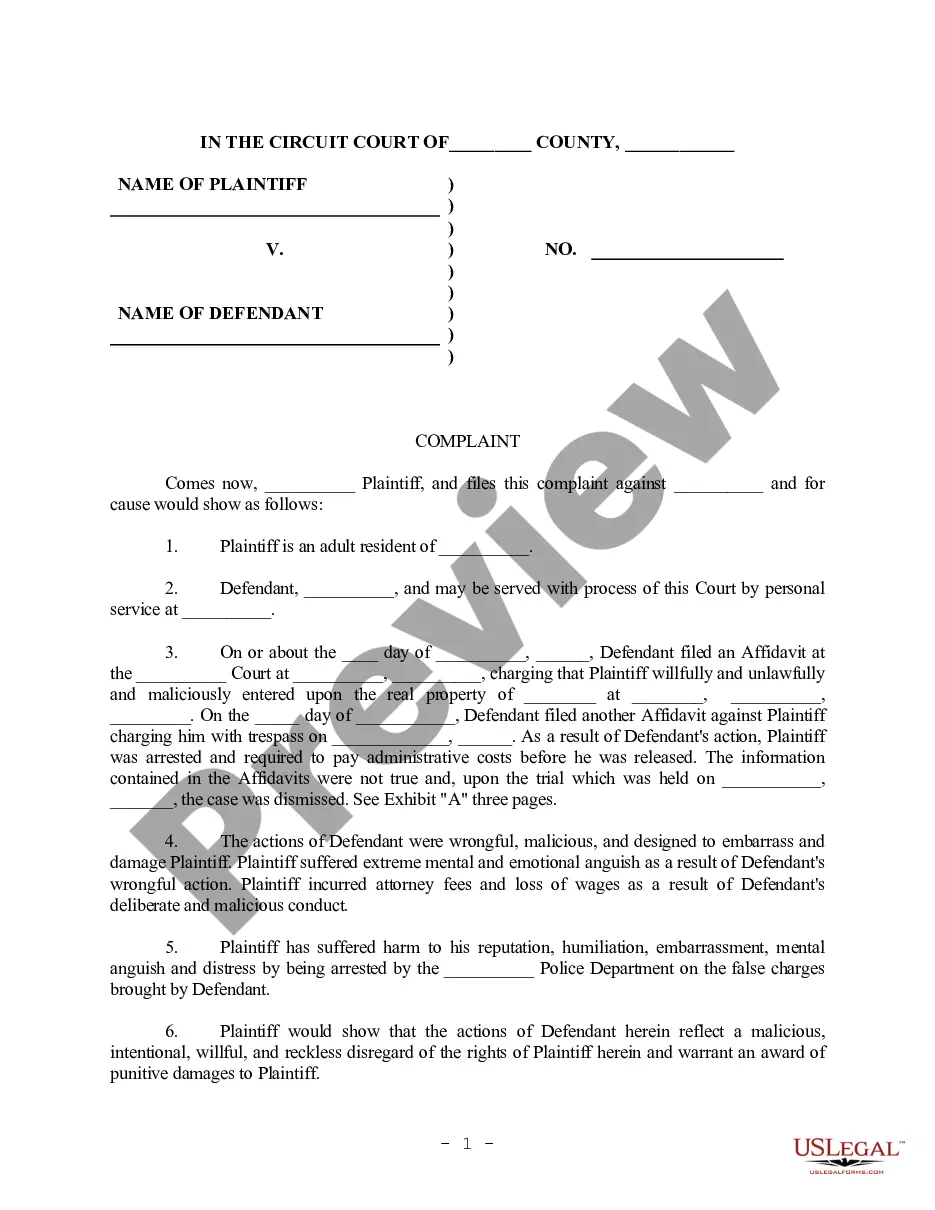
How to fill out Complaint For Malicious Prosecution, False Imprisonment, Abuse Of Process?
- If you are a returning user, log in to your account and download your desired form template by clicking the Download button. Ensure your subscription is active; if not, renew it based on your chosen payment plan.
- For new users, start by browsing the Preview mode and reading the form description to confirm you have selected the correct document for your local jurisdiction.
- If you need to look for an alternative template, utilize the Search tab at the top of the page to find a more fitting option. Once you find the right document, proceed to the next step.
- Purchase the document by clicking the Buy Now button. Select your preferred subscription plan and create an account to access the full library of resources.
- Complete the payment process by entering your credit card information or opting for PayPal. Upon successful payment, download your form.
- Finally, save the form on your device for easy access. You can revisit it anytime in the My Forms section of your profile.
In conclusion, US Legal Forms simplifies the legal document process, providing a vast array of options and valuable resources. Whether you are a frequent user or a first-timer, following these steps ensures you can easily access the forms you need.
Don’t hesitate! Start using US Legal Forms today to empower your documentation needs.
Form popularity
FAQ
If you suspect abuse, the best course of action is to document every detail relevant to the situation. You should then consult with a qualified attorney who specializes in abuse process matters to discuss your findings. They can guide you through the reporting process, which may involve contacting local authorities or pursuing legal action. Using USLegalForms can also provide you with essential documentation to support your report.
In Illinois, the elements of abuse of process include the existence of an ulterior purpose and the misuse of legal process. This means proving that someone initiated legal action not for its intended purpose but to achieve a different goal. Additionally, there must be an improper act, such as coercion or intimidation involved. Legal resources on platforms like USLegalForms can assist you in understanding these nuances.
An example of an abuse of process case could involve a party using a court order to harass another party, such as filing multiple, baseless lawsuits merely to intimidate them. This illustrates how the legal system can be misused to achieve ulterior motives. Understanding these dynamics can help you identify if you are a victim of abuse. You can find resources on USLegalForms to better navigate this situation.
The process of abusing in a legal context refers to the deliberate misuse of legal avenues or procedures to achieve a goal not intended by the law. This could manifest in various forms, such as filing frivolous lawsuits or misusing court orders to harass others. Understanding this concept is important for safeguarding one's rights and identifying potential abuses.
The US Code does not define abuse of process explicitly but relates to wrongful legal actions that misuse judicial procedures for an improper purpose. Many states have their own statutes that address this concern within their legal frameworks. Familiarizing yourself with your state's laws can offer clarity on how the abuse process for user applies at the federal level.
Malicious prosecution focuses on whether a legal action was initiated without probable cause and for an improper purpose, while abuse of process involves the misuse of legal procedures for ulterior motives. Both concepts address misuse of the legal system, but they apply to different aspects of legal actions. It's essential to understand this distinction when contemplating action against wrongful legal practices.
Proving abuse of power of attorney involves demonstrating that the agent acted outside their authority or for personal gain rather than the principal's interests. This often requires presenting evidence that the agent made unauthorized decisions or transactions. If you suspect such behavior, consider using resources available on the USLegalForms platform to document and support your case.
In Virginia, the elements of abuse of process include a legal procedure being used for an improper purpose, an ulterior motive, and an act in the course of the process that is a violation of the process's intended use. Each element must be demonstrated to prove the abuse process for user claims. Consulting legal resources can help clarify these intricacies.
An example of abuse of process is when a creditor files a lawsuit to collect a debt but does so to manipulate or intimidate the debtor rather than to seek a legitimate resolution. In this scenario, the creditor may not genuinely intend to pursue a legal remedy but rather seeks leverage in negotiations. Identifying such instances is crucial for anyone facing legal challenges.
Abuse of process occurs when someone uses legal proceedings for an ulterior motive rather than the intended purpose. Examples include filing lawsuits to harass someone, using legal threats to intimidate, or pursuing a court action solely to delay a resolution. Understanding these examples can help you recognize and address any potential abuse of process.