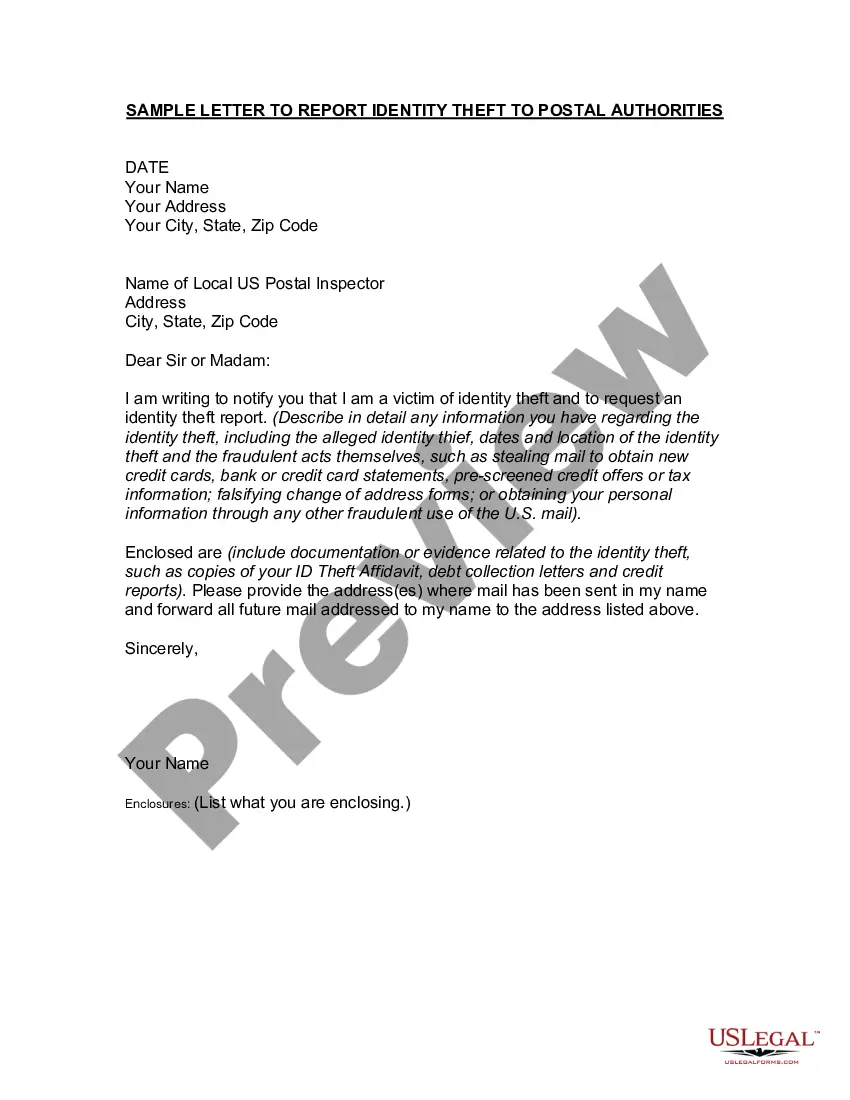
Letter Notifying Identity For Death
Description
Get your form ready online
Our built-in tools help you complete, sign, share, and store your documents in one place.
Make edits, fill in missing information, and update formatting in US Legal Forms—just like you would in MS Word.
Download a copy, print it, send it by email, or mail it via USPS—whatever works best for your next step.
Sign and collect signatures with our SignNow integration. Send to multiple recipients, set reminders, and more. Go Premium to unlock E-Sign.
If this form requires notarization, complete it online through a secure video call—no need to meet a notary in person or wait for an appointment.
We protect your documents and personal data by following strict security and privacy standards.

Make edits, fill in missing information, and update formatting in US Legal Forms—just like you would in MS Word.

Download a copy, print it, send it by email, or mail it via USPS—whatever works best for your next step.

Sign and collect signatures with our SignNow integration. Send to multiple recipients, set reminders, and more. Go Premium to unlock E-Sign.

If this form requires notarization, complete it online through a secure video call—no need to meet a notary in person or wait for an appointment.

We protect your documents and personal data by following strict security and privacy standards.
Looking for another form?
How to fill out Letter Notifying Postal Authorities Of Identity Theft?
Locating a reliable source for obtaining the most current and suitable legal documents is a significant part of dealing with bureaucracy.
Identifying the correct legal forms requires precision and careful consideration, which is why it is crucial to source samples of Letter Notifying Identity For Death exclusively from reputable providers, such as US Legal Forms. An incorrect template can squander your time and postpone your circumstances. With US Legal Forms, there is minimal to worry about. You can access and verify all the particulars concerning the document’s applicability and significance for your situation and in your jurisdiction.
After obtaining the form on your device, you can edit it using the editor or print it and complete it manually. Eliminate the hassle associated with your legal documentation. Browse the extensive US Legal Forms library where you can discover legal samples, assess their relevance to your situation, and download them instantly.
- Utilize the catalog navigation or search bar to locate your sample.
- Review the form’s details to ensure it meets the standards of your state and locality.
- Examine the form preview, if available, to confirm that the template is indeed the one you seek.
- Return to the search to find the appropriate document if the Letter Notifying Identity For Death does not meet your requirements.
- Once you are certain about the form’s applicability, download it.
- If you are a registered user, click Log in to verify and access your selected forms in My documents.
- If you do not possess an account yet, click Buy now to acquire the form.
- Select the pricing option that best fits your needs.
- Proceed with the registration to complete your purchase.
- Finalize your transaction by choosing a payment method (credit card or PayPal).
- Select the file format for downloading Letter Notifying Identity For Death.
Form popularity
FAQ
Notifying death requires careful consideration of the audience and method of communication. You can use direct communication for close friends and family, while a formal letter may be suitable for broader audiences. Be gentle in your wording, providing the necessary information without overwhelming the recipients. Platforms like uslegalforms can assist in crafting a letter notifying identity for death, ensuring you convey the message with the right tone.
The proper way to announce a death involves sensitivity and clarity. You can choose to announce it through phone calls, social media, or formal letters. It’s critical to convey the news respectfully, ensuring that the information is accurate and includes necessary details like memorial service dates. Utilizing a letter notifying identity for death can help you communicate this difficult news effectively.
To write a letter informing about a death, begin with a respectful salutation. Clearly state the name of the deceased and mention their connection to you or the recipient. Include essential details such as the date and location of the passing, along with any memorial service information. Remember, a letter notifying identity for death should convey a sense of support and compassion to those receiving it.
When announcing a death, it's important to be clear and compassionate. Start by stating the person's name and their relationship to you. You may want to include details about the person's life and their impact on others. Lastly, consider mentioning the arrangements for memorial services or gatherings, as this can help provide closure for those affected.
Yes, most funeral homes will notify Social Security about a person's death as part of their services. This notification is essential to stop benefits and ensure that the deceased's records are updated. You may also want to provide a letter notifying identity for death to facilitate this process.
No, a Power of Attorney (POA) becomes invalid upon a person's death. Once a person passes away, you cannot use a POA to manage their affairs. It is essential to obtain a letter notifying identity for death and follow the proper legal processes to handle the deceased's estate.
A letter of authorization for a deceased person is a document that grants someone the power to act on behalf of the deceased's estate. This letter is vital for managing assets, settling debts, and handling financial matters. When creating such a letter, be sure to include a letter notifying identity for death to confirm the authority granted.
You can obtain a death notification form from various sources, including hospitals, funeral homes, and state websites. These forms are essential for officially notifying agencies of a person's passing. Utilizing services like US Legal Forms can simplify this process by providing downloadable and customizable templates.
Yes, you can write your own letter of authority, but it is crucial to ensure it meets legal standards. A letter notifying identity for death often requires specific information and format, which is why using templates from reliable sources, like US Legal Forms, can provide clarity and compliance.
After the death of her husband, a wife may have access to his bank account depending on how the account is set up. If the account is joint, she retains full access. However, if the account is solely in her husband's name, she may need a letter notifying identity for death to access the funds, or she may need to go through probate.