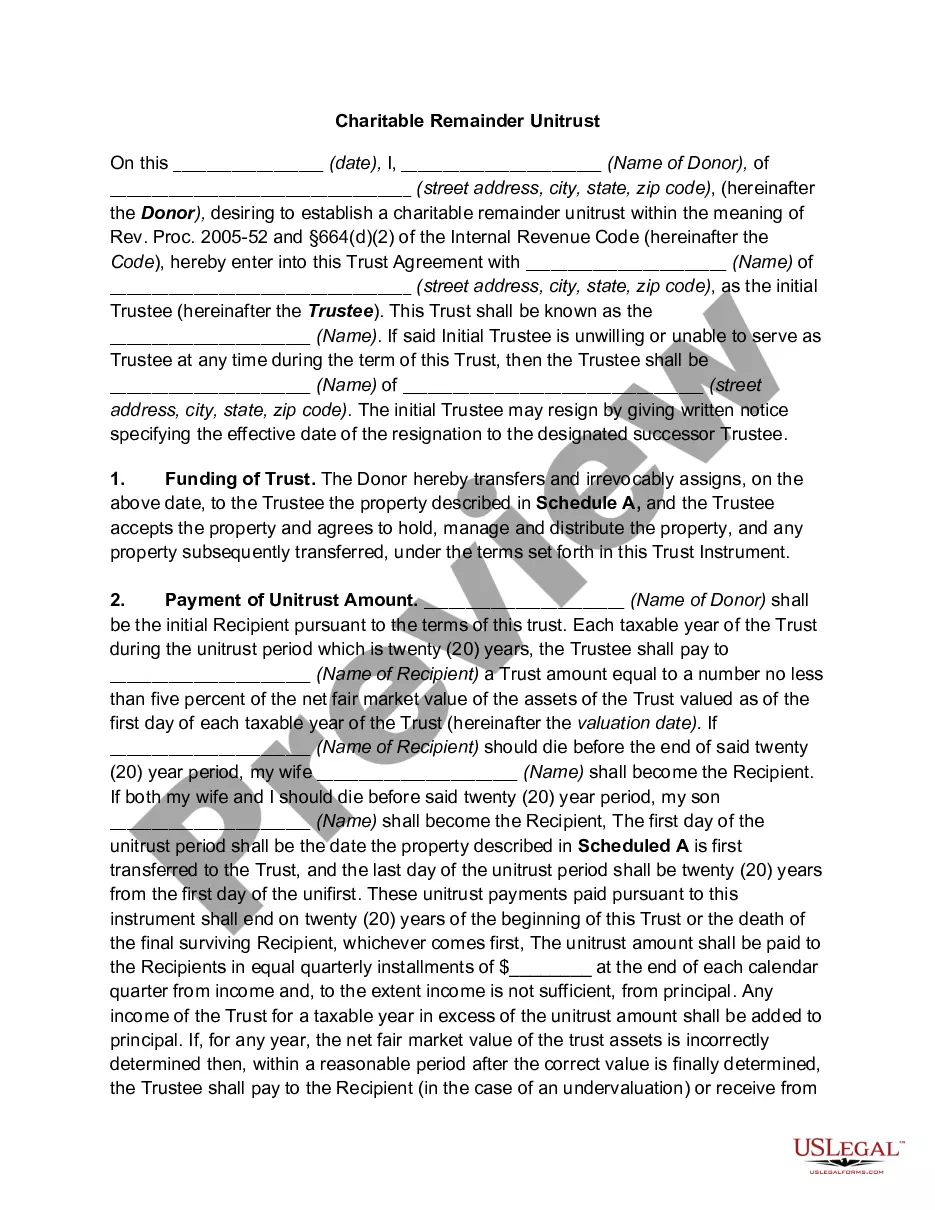
Charitable Remainder Unitrust Living For The Moment
Description
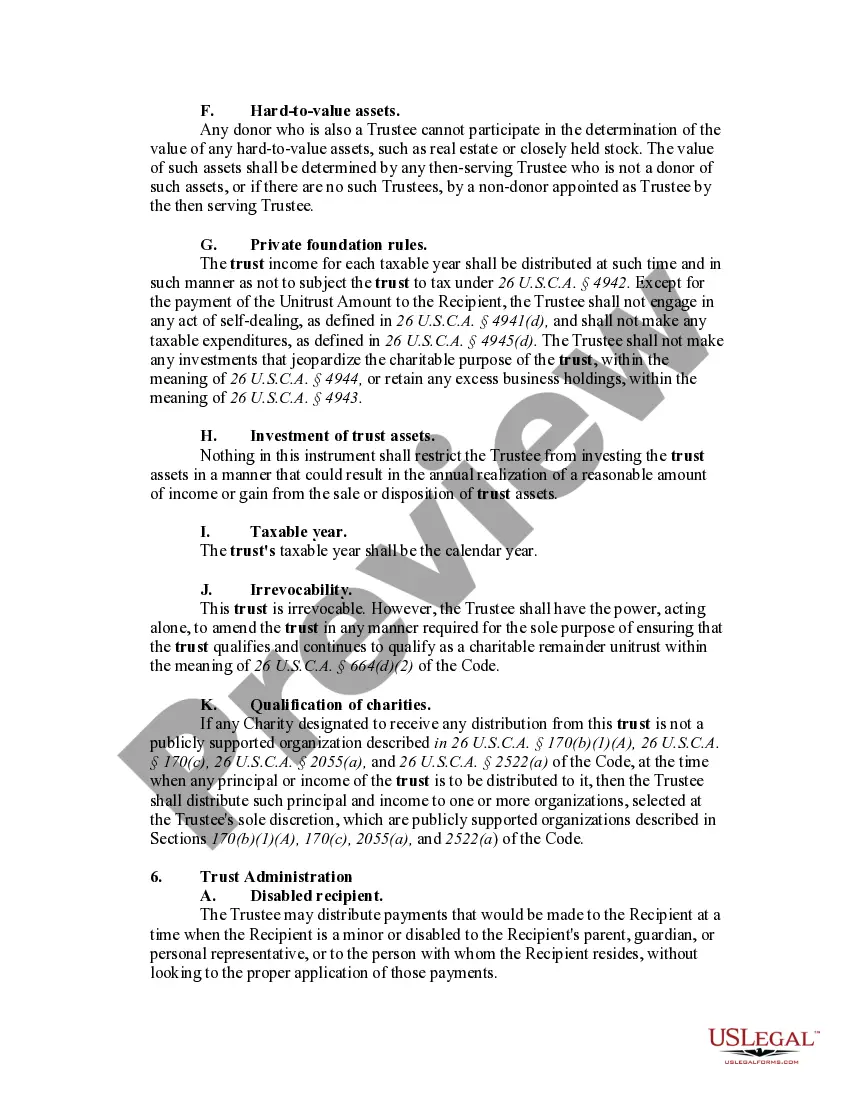
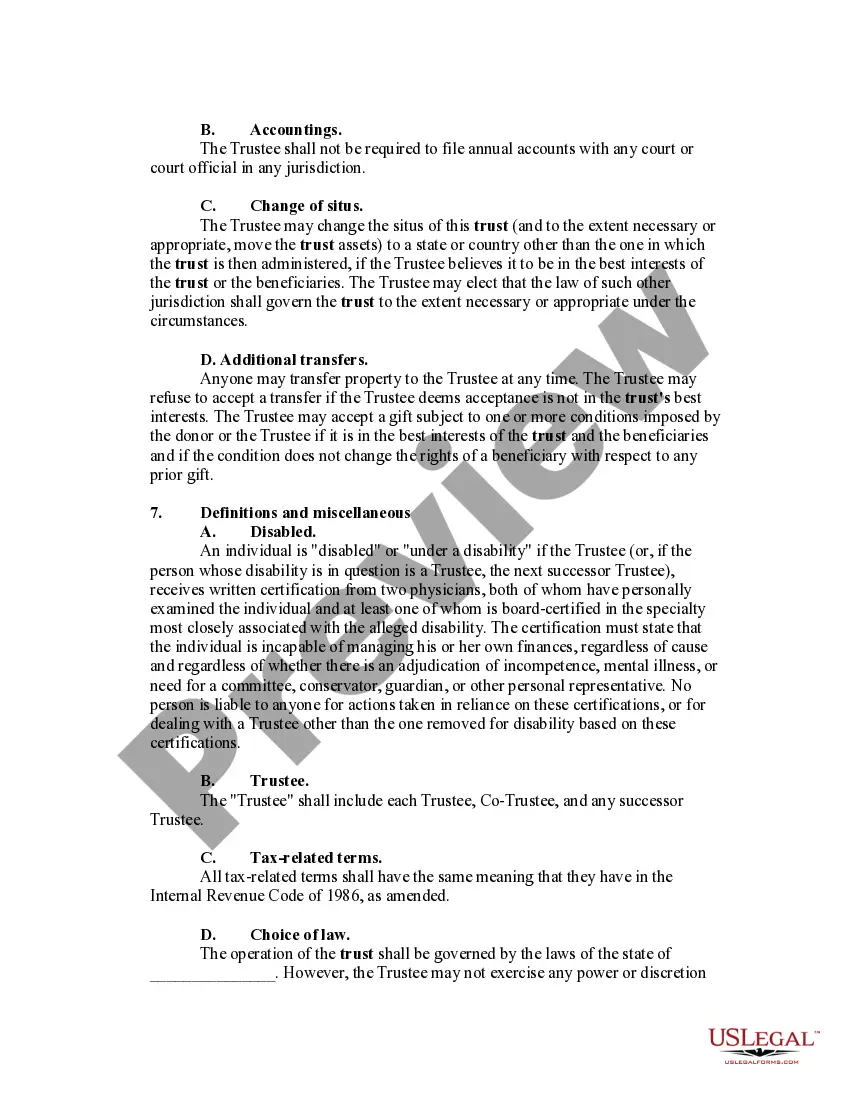
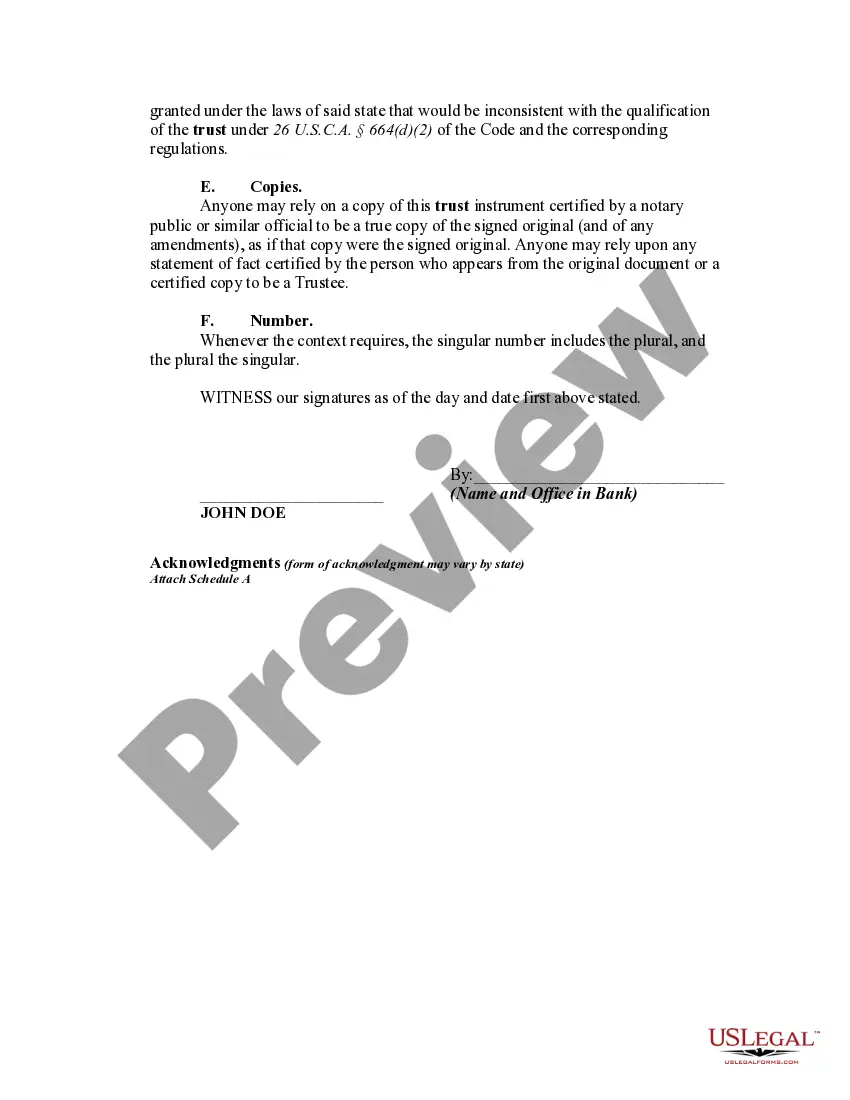
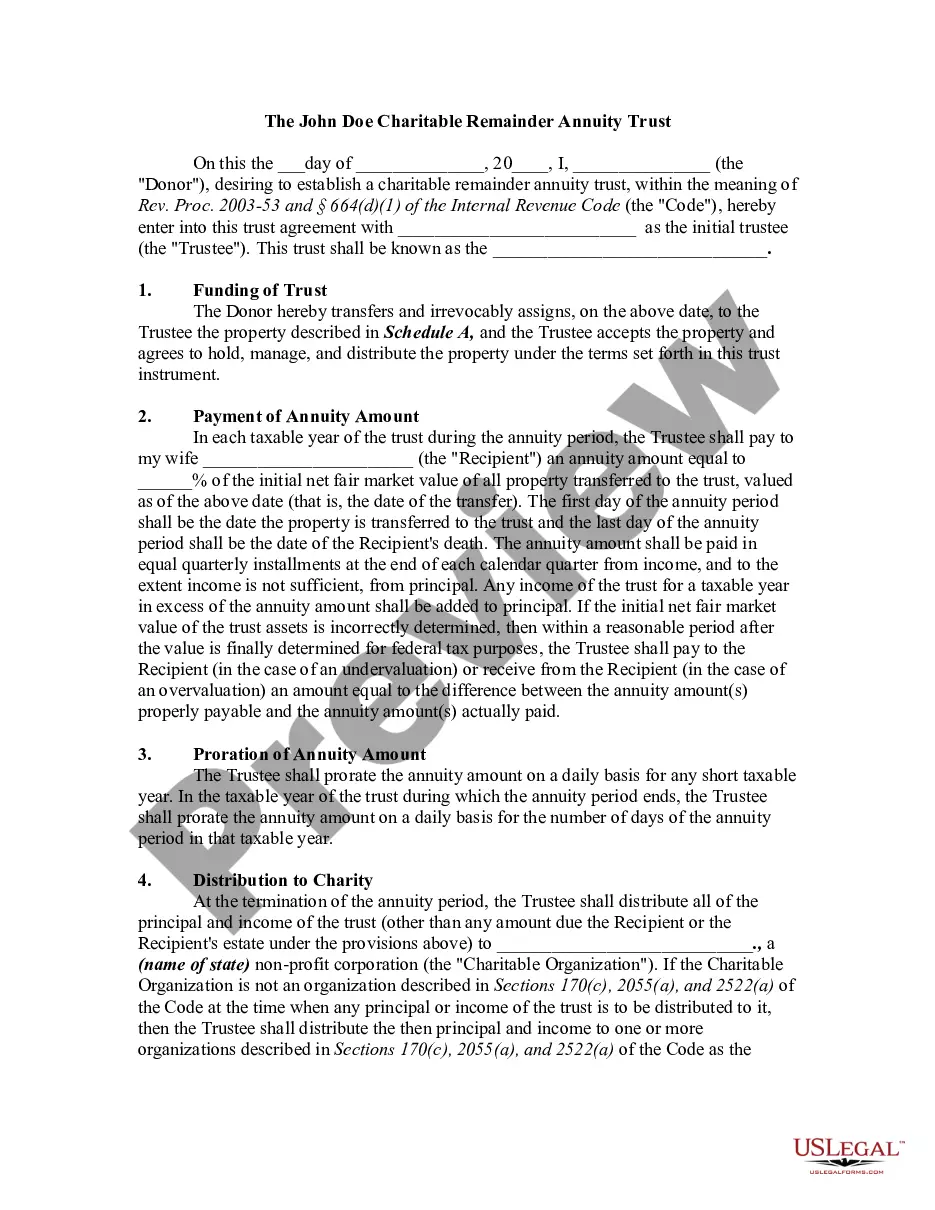
Get your form ready online
Our built-in tools help you complete, sign, share, and store your documents in one place.
Make edits, fill in missing information, and update formatting in US Legal Forms—just like you would in MS Word.
Download a copy, print it, send it by email, or mail it via USPS—whatever works best for your next step.
Sign and collect signatures with our SignNow integration. Send to multiple recipients, set reminders, and more. Go Premium to unlock E-Sign.
If this form requires notarization, complete it online through a secure video call—no need to meet a notary in person or wait for an appointment.
We protect your documents and personal data by following strict security and privacy standards.

Make edits, fill in missing information, and update formatting in US Legal Forms—just like you would in MS Word.

Download a copy, print it, send it by email, or mail it via USPS—whatever works best for your next step.

Sign and collect signatures with our SignNow integration. Send to multiple recipients, set reminders, and more. Go Premium to unlock E-Sign.

If this form requires notarization, complete it online through a secure video call—no need to meet a notary in person or wait for an appointment.

We protect your documents and personal data by following strict security and privacy standards.
Looking for another form?







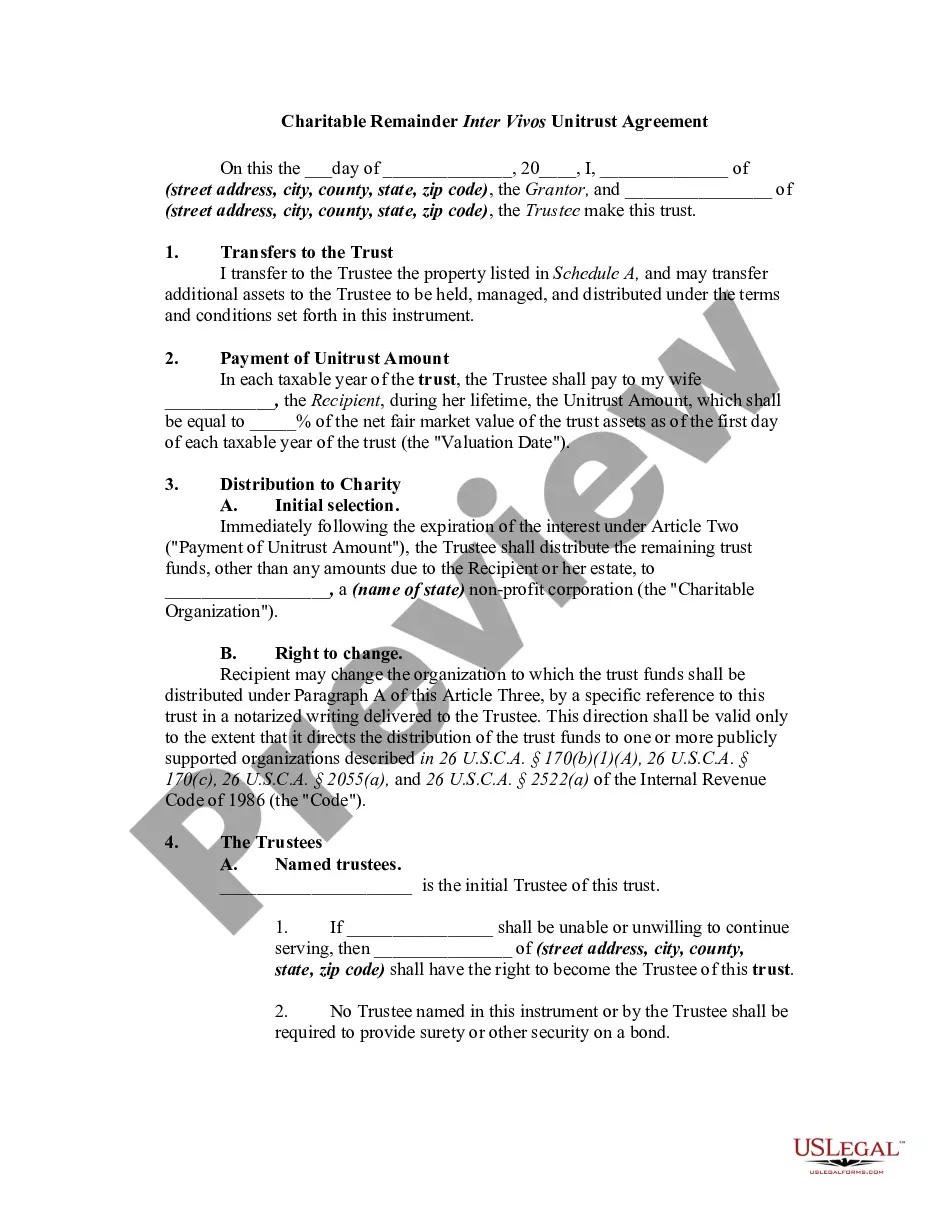
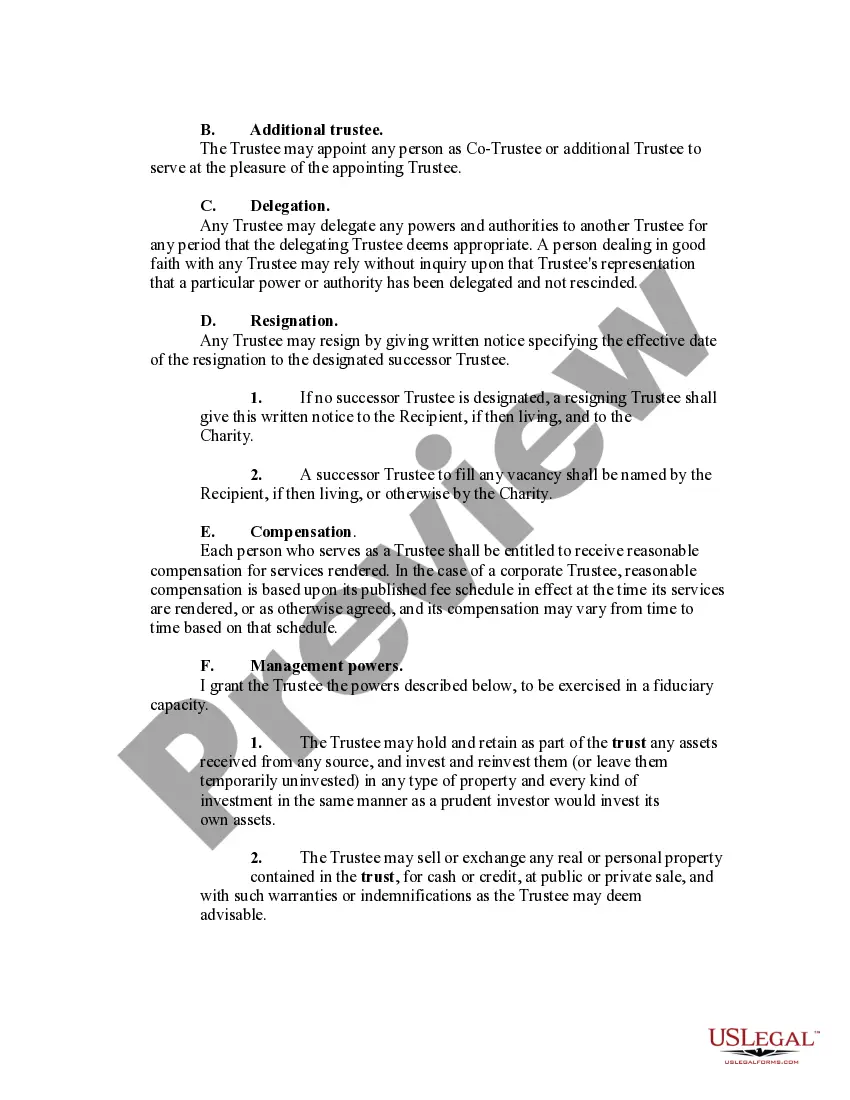
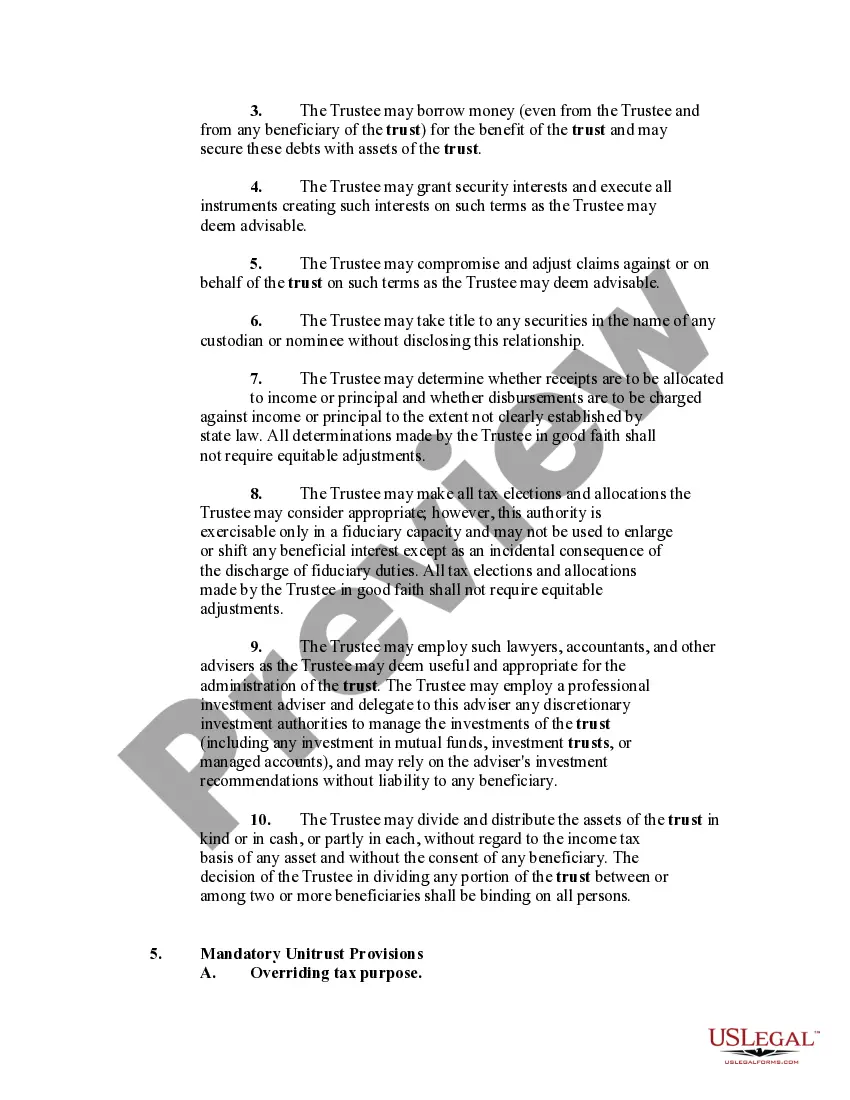
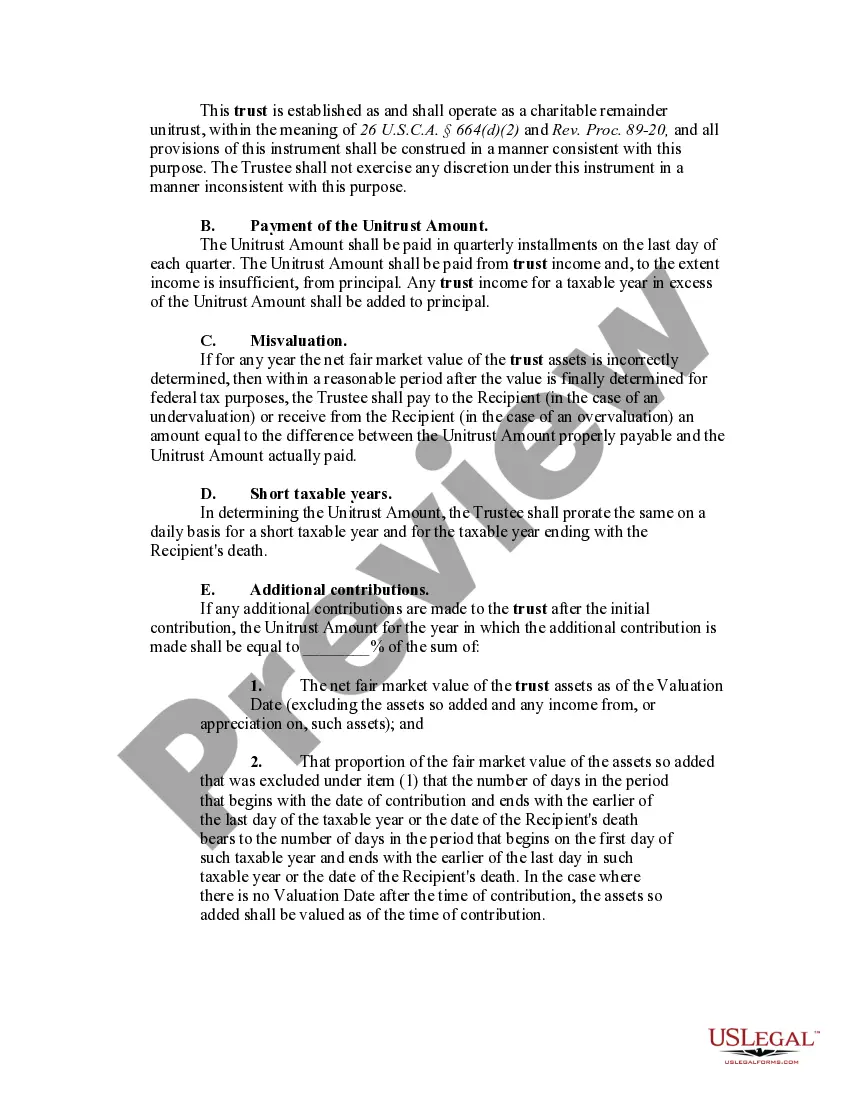
How to fill out Charitable Remainder Inter Vivos Unitrust Agreement?
- Log in to your US Legal Forms account if you're a returning user, ensuring your subscription is current. If it needs renewal, proceed to update it as per your payment plan.
- For first-time users, browse our extensive library. Check the preview mode and description of the form to confirm it matches your needs and local jurisdiction.
- If necessary, utilize the Search tab to locate alternative templates or specific documents that are better suited for your requirements.
- Once you've found the correct form, click on the Buy Now button and select a subscription plan that best fits you. Create an account to access the full library.
- Complete your purchase by entering your payment details, either through credit card or PayPal.
- After the transaction, download the form directly to your device and access it at any time from the My Forms section in your account.
In conclusion, US Legal Forms provides a robust and user-friendly platform for acquiring essential legal documents, making it easier to manage your charitable remainder unitrust obligations.
Don't hesitate to get started—visit US Legal Forms today and empower yourself with the legal resources you need.
Form popularity
FAQ
The term unitrust generally refers to a trust that distributes a fixed percentage of its value to beneficiaries each year; a charitable remainder trust (including unitrusts) has a charitable purpose at the core. While all unitrusts can be set up as charitable remainder trusts, not all unitrusts are inherently charitable. By understanding this distinction, you can better navigate your options, especially if you are considering charitable remainder unitrusts living for the moment as a valuable financial tool.
A charitable remainder unitrust (CRUT) is specifically designed to provide income to beneficiaries while ultimately benefiting a charity. In contrast, a standard trust may not have charitable intentions and can be used for various purposes, such as estate planning. The key difference lies in the CRUT's philanthropy focus, allowing you to combine personal benefit with charitable support. This makes charitable remainder unitrusts living for the moment a unique vehicle for both financial and altruistic objectives.
A CRT (Charitable Remainder Trust) and a CLT (Charitable Lead Trust) serve different purposes in charitable giving. With a CRT, the donor receives income during their lifetime, while the charitable organization receives the remaining assets thereafter. Conversely, a CLT provides income to the charity first, with the remainder going to the donor's heirs. Knowing this distinction helps in deciding which option aligns better with your charitable ambitions, especially if you are focused on charitable remainder unitrusts living for the moment.
Choosing between a CRAT (Charitable Remainder Annuity Trust) and a CRUT (Charitable Remainder Unitrust) hinges on your financial goals. A CRAT pays a fixed annuity, which can provide predictable income, while a CRUT pays a variable amount based on the trust’s annual value. If you seek flexibility or expect your assets' value to rise substantially, a CRUT may be the better option. Understanding these differences is crucial for anyone considering charitable remainder unitrusts living for the moment.
To calculate the charitable tax deduction for a charitable remainder trust, you need to determine the present value of the charitable remainder. This involves identifying the annual payout amount to the income beneficiary and using IRS tables to find the appropriate discount rate. By subtracting the present value of payments from the total contribution amount, you achieve the deductible amount. For those interested in charitable remainder unitrusts living for the moment, understanding this calculation is crucial.
The tax deduction for a charitable remainder trust depends on various factors, including the present value of the charitable interest and the amount contributed to the trust. Generally, the IRS allows a charitable deduction based on the value of the remainder interest designated for charitable organizations. With careful planning, you can maximize your benefits while setting up your charitable remainder unitrust living for the moment.
Alongside the requirement that the remainder interest for charities be at least 10%, the 10% rule also ensures that beneficiaries receive a fair return from the trust. It's vital for the benefit distribution to uphold both charity interests and personal financial needs. Knowing this enables you to structure your charitable remainder unitrust living for the moment in a way that keeps both recipients happy.
The 5% rule for charitable remainder trusts states that the CRT must distribute an annual payout of at least 5% of its assets to the named beneficiaries. This ensures that the beneficiaries receive consistent financial support during the trust's life. Understanding this rule lets you effectively manage your charitable remainder unitrust living for the moment while fulfilling your financial obligations.
The 10 percent test for charitable remainder unitrusts, or CRUTs, verifies that the remainder interest for the charitable organization is at least 10% of the initial trust assets. This test serves as a safeguard, ensuring that charities receive a significant benefit from the trust. Meeting this requirement is essential for maintaining tax-advantaged status in your charitable remainder unitrust living for the moment.
The 10% rule for a charitable remainder trust requires that the present value of the charitable remainder must be at least 10% of the total value of the trust's assets at the time of its creation. This rule helps ensure that a meaningful portion of the trust benefits charitable organizations, aligning with your philanthropic goals. Understanding this aspect is crucial when you plan your charitable remainder unitrust living for the moment.