State Specific Employment Laws Within A Company In Utah
Description
















Get your form ready online
Our built-in tools help you complete, sign, share, and store your documents in one place.
Make edits, fill in missing information, and update formatting in US Legal Forms—just like you would in MS Word.
Download a copy, print it, send it by email, or mail it via USPS—whatever works best for your next step.
Sign and collect signatures with our SignNow integration. Send to multiple recipients, set reminders, and more. Go Premium to unlock E-Sign.
If this form requires notarization, complete it online through a secure video call—no need to meet a notary in person or wait for an appointment.
We protect your documents and personal data by following strict security and privacy standards.
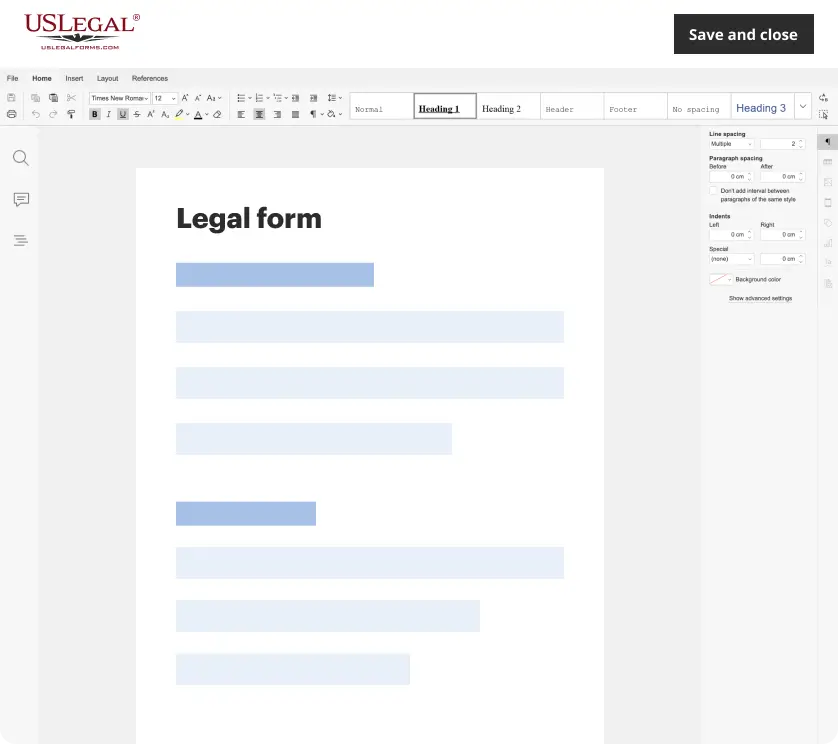
Make edits, fill in missing information, and update formatting in US Legal Forms—just like you would in MS Word.
Download a copy, print it, send it by email, or mail it via USPS—whatever works best for your next step.
Sign and collect signatures with our SignNow integration. Send to multiple recipients, set reminders, and more. Go Premium to unlock E-Sign.
If this form requires notarization, complete it online through a secure video call—no need to meet a notary in person or wait for an appointment.
We protect your documents and personal data by following strict security and privacy standards.
Looking for another form?




Form popularity
FAQ
Rest Breaks in Utah It is under the discretion of employers in Utah to provide a 15-minute compensated rest break for every 4 hours worked.
Employers cannot require minors under the age of 16 to work during school hours, work more than four hours before and after school hours, work more than 8 hours in a 24-hour period, work before 5 a.m. or after p.m. unless the next day is not a school day, work more than 40 hours in a week.
Utah Scheduling Notice Law Unlike some states that have enacted predictive scheduling laws requiring a minimum notice period (such as 7 or 14 days), Utah does not impose such requirements. Employers in Utah have the discretion to modify work schedules as needed, provided they comply with federal labor laws.
Business law encompasses a broad array of legal principles and regulations that dictate the formation, operation, and dissolution of various business entities. It covers areas such as contracts, employment, intellectual property, real estate, and taxation, among others.
(1) A private employer who employs 150 or more employees on or after , may not hire a new employee on or after , unless the private employer: (a) is registered with a status verification system to verify the federal legal working status of any new employee; and (b) uses the status verification ...
Utah is an employment-at-will state, which means that without a written employee contract, employees can be terminated for any reason at any time, provided that the reason is not discriminatory and that the employer is not retaliating against the employee for a rightful action.
Testing for drugs or alcohol. If an employer tests an employee or prospective employee for the presence of drugs or alcohol as a condition of hiring or continued employment, the employer is protected from liability as provided in this chapter if the employer complies with this chapter.
Federal U.S. employment laws generally apply only to those employees who work in the United States or its territories. There are a few exceptions though, as the following four major U.S. employment laws have some application abroad: Title VII of the Civil Rights Act. The Age Discrimination in Employment Act (ADEA).
State Employment Laws The Utah Labor Commission is the regulatory agency responsible for protecting the health, safety and economic well-being (i.e., wage, labor or anti-discrimination) of employees and employers. Visit the following for more information on state employment laws.
What is the New Child Custody Law in Utah? Utah's new child custody law, which went into effect on , is called the "Equal Parent-Time Schedule." This law allows parents to share equal physical custody of their children unless there is a reason why this would not be in the children's best interests.