Annual Board Directors Sample For Job Application In Ohio
Description



Get your form ready online
Our built-in tools help you complete, sign, share, and store your documents in one place.
Make edits, fill in missing information, and update formatting in US Legal Forms—just like you would in MS Word.
Download a copy, print it, send it by email, or mail it via USPS—whatever works best for your next step.
Sign and collect signatures with our SignNow integration. Send to multiple recipients, set reminders, and more. Go Premium to unlock E-Sign.
If this form requires notarization, complete it online through a secure video call—no need to meet a notary in person or wait for an appointment.
We protect your documents and personal data by following strict security and privacy standards.

Make edits, fill in missing information, and update formatting in US Legal Forms—just like you would in MS Word.

Download a copy, print it, send it by email, or mail it via USPS—whatever works best for your next step.

Sign and collect signatures with our SignNow integration. Send to multiple recipients, set reminders, and more. Go Premium to unlock E-Sign.

If this form requires notarization, complete it online through a secure video call—no need to meet a notary in person or wait for an appointment.

We protect your documents and personal data by following strict security and privacy standards.
Looking for another form?

Form popularity
FAQ
Federal and state-level laws, as well as a company's incorporation documents, require public and private corporations in the U.S. to have boards of directors (BoDs). Although private LLCs do not have the same requirements, some choose to elect a board of directors after incorporating.
How to form a board of directors Register articles of incorporation. You must file articles of incorporation in your state to gain legal status as a corporation. Create bylaws. Set up a board of directors agreement. Select your board of directors. Have an initial shareholder meeting.
A public company's board of directors is chosen by shareholders, and its primary job is to look out for shareholders' interests. In fact, directors are legally required to put shareholders' interests ahead of their own.
A typical board of directors has nine members, but some have three, and others have 31. Typically, private companies have between three and seven directors on their boards. To avoid voting ties, boards are usually an odd number.
How to form a board of directors Register articles of incorporation. You must file articles of incorporation in your state to gain legal status as a corporation. Create bylaws. Set up a board of directors agreement. Select your board of directors. Have an initial shareholder meeting.
Yes. Your Ohio corporate bylaws are official legal documents, which means you can use them in a court of law to prove your limited liability status, or show how your corporation functions. It also means you're subject to legal ramifications if you don't follow your bylaws.
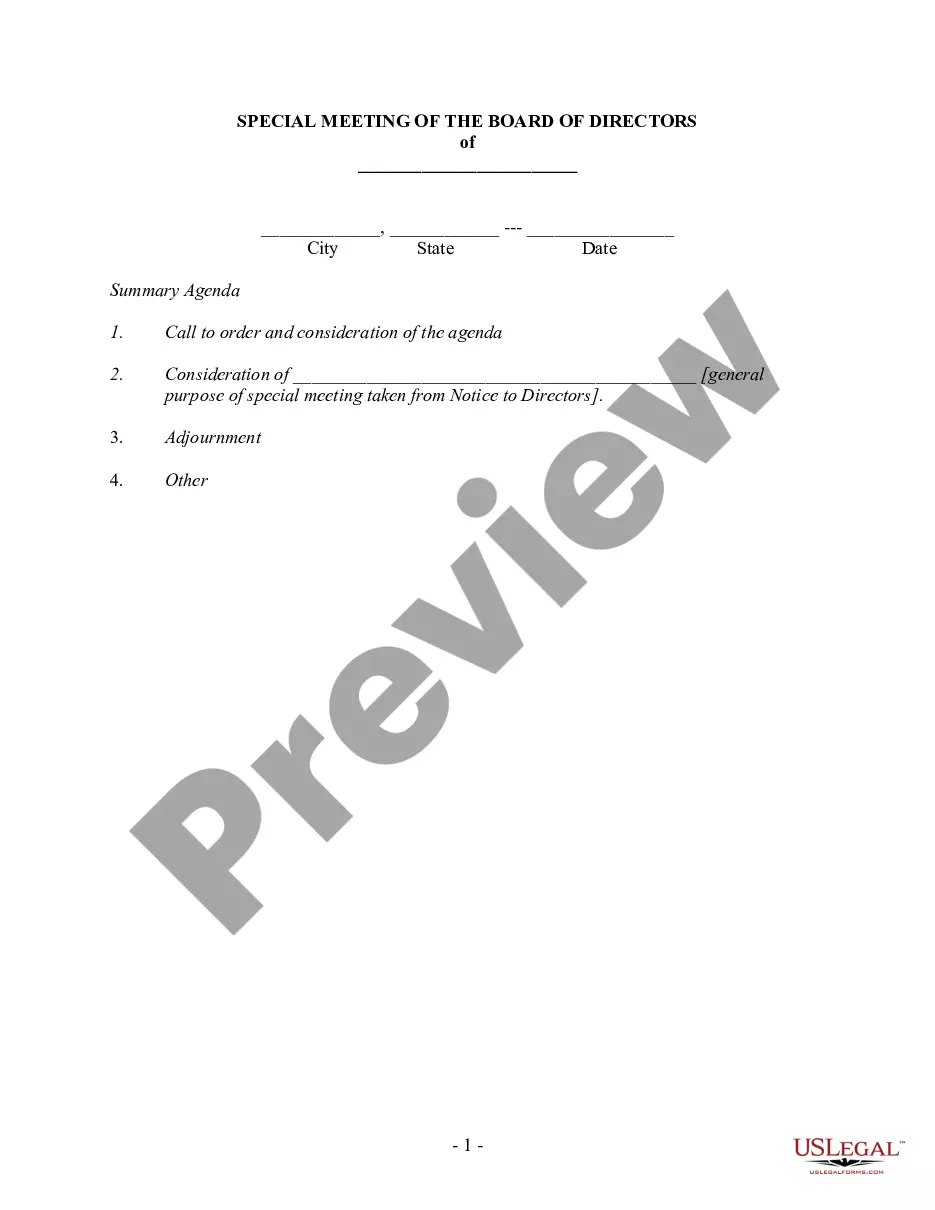
Board meeting agenda format example Call to order & roll call: A brief welcome and confirmation of quorum. Approval of previous meeting minutes: Review and approve the minutes from the last meeting. Reports: Financial reports, committee updates, and presentations from the executive director.
Do I have to file an annual report? Business entities in Ohio are not required to file an annual report. However, certain types of entities and registrations are required to file reports at different intervals.
The structure of a meeting is defined as the systematic organization of its components, aimed at maximizing productivity, ensuring clarity, and fostering participation. Key elements of meeting structure include the development of agendas, allocation of roles and responsibilities, and adherence to time frames.
Information captured in an LLC's annual meeting minutes usually includes: The meeting's date, time, and location. Who wrote the minutes. The names of the members in attendance. Brief description of the meeting agenda. Details about what the members discussed. Decisions made or voting actions taken.

