Director In Meeting In Fulton
Description



Get your form ready online
Our built-in tools help you complete, sign, share, and store your documents in one place.
Make edits, fill in missing information, and update formatting in US Legal Forms—just like you would in MS Word.
Download a copy, print it, send it by email, or mail it via USPS—whatever works best for your next step.
Sign and collect signatures with our SignNow integration. Send to multiple recipients, set reminders, and more. Go Premium to unlock E-Sign.
If this form requires notarization, complete it online through a secure video call—no need to meet a notary in person or wait for an appointment.
We protect your documents and personal data by following strict security and privacy standards.

Make edits, fill in missing information, and update formatting in US Legal Forms—just like you would in MS Word.

Download a copy, print it, send it by email, or mail it via USPS—whatever works best for your next step.

Sign and collect signatures with our SignNow integration. Send to multiple recipients, set reminders, and more. Go Premium to unlock E-Sign.

If this form requires notarization, complete it online through a secure video call—no need to meet a notary in person or wait for an appointment.

We protect your documents and personal data by following strict security and privacy standards.
Looking for another form?




Form popularity
FAQ
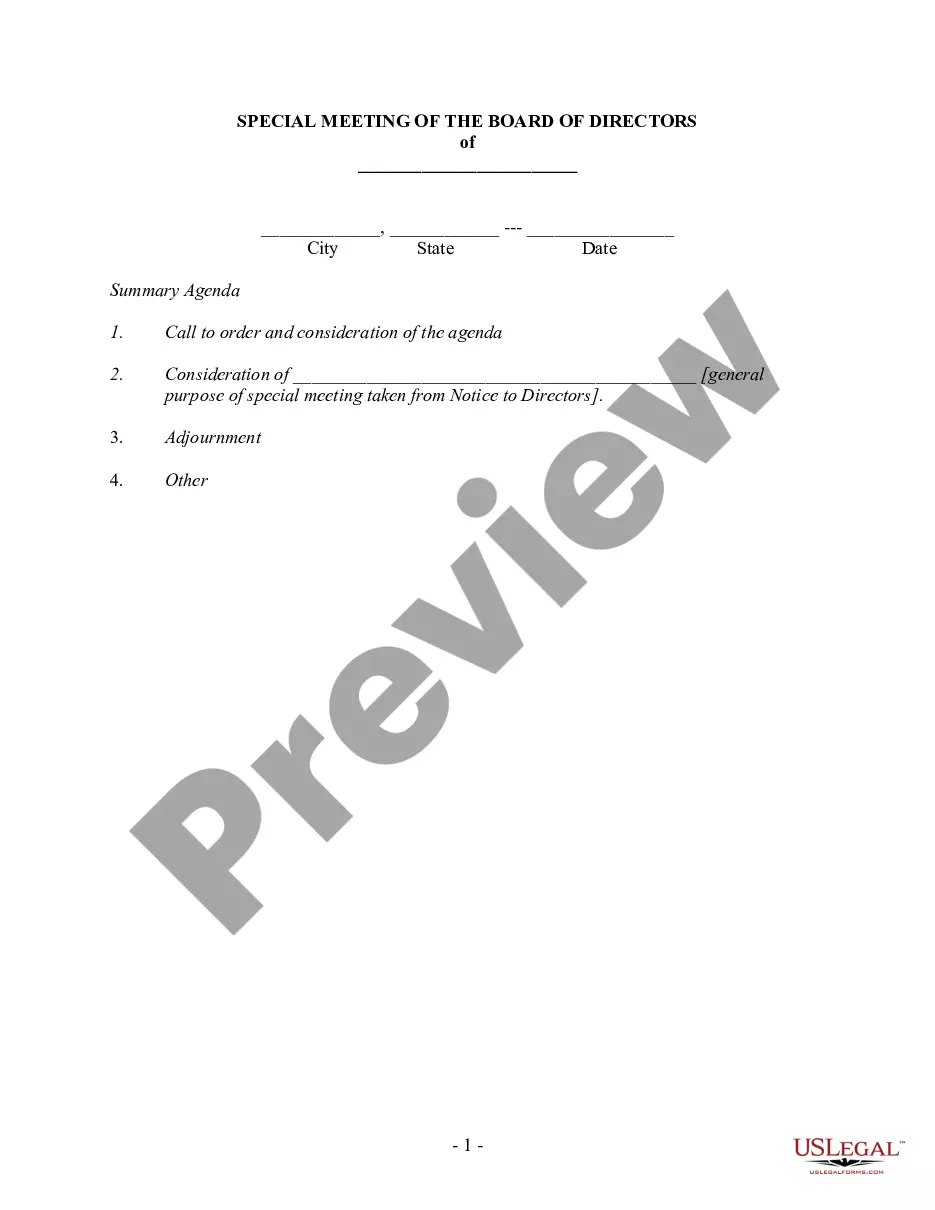
While shareholders' meetings represent ownership, board meetings embody the company's leadership. The board of directors, acting as a bridge between management and shareholders, is responsible for making strategic decisions, overseeing management, and safeguarding the company's long-term interests.
Directors' meetings refer to board meetings or board committee meetings where different viewpoints are considered before deciding on a course of action. Directors must be able to establish that their decisions are made with care and diligence, in good faith and for a proper purpose.
Directors must be held accountable for their actions. A board meeting provides a suitable, formal opportunity for directors to explain the reasoning behind their decisions, and receive guidance from their fellow directors on the areas in which they are not excelling.
Directors' meetings refer to board meetings or board committee meetings where different viewpoints are considered before deciding on a course of action. Directors must be able to establish that their decisions are made with care and diligence, in good faith and for a proper purpose.
Jessica Corbitt - Director of External Affairs - Fulton County Government | LinkedIn.
David Clark - Director of Public Works - Fulton County | LinkedIn.
Agenda items and their descriptions: Agenda items are topics that should be brought up during the meeting. These include feedback on old meeting minutes, action items, decisions about company policies and updates on current issues. Detailed agendas usually include brief descriptions of each item.
A Board Meeting is a formal meeting of the board of directors of an organization and any invited guests, held at definite intervals and as needed to review performance, consider policy issues, address major problems and perform the legal business of the board.
Consider following these steps to request a meeting with your boss: Check their availability. Pick a location. Prepare your notes. Write a subject line. Choose the proper vocabulary. Format your email correctly. Prepare or include your documentation. Follow up.
When addressing the board, always use the title Mr. Chairman” or Madam Chairwoman.” If you are unsure of the proper title, Board of Directors” is always acceptable. When speaking to the board, always refer to them as sir” or ma'am.”

