Llc Corporation Canada
Description
Get your form ready online
Our built-in tools help you complete, sign, share, and store your documents in one place.
Make edits, fill in missing information, and update formatting in US Legal Forms—just like you would in MS Word.
Download a copy, print it, send it by email, or mail it via USPS—whatever works best for your next step.
Sign and collect signatures with our SignNow integration. Send to multiple recipients, set reminders, and more. Go Premium to unlock E-Sign.
If this form requires notarization, complete it online through a secure video call—no need to meet a notary in person or wait for an appointment.
We protect your documents and personal data by following strict security and privacy standards.

Make edits, fill in missing information, and update formatting in US Legal Forms—just like you would in MS Word.

Download a copy, print it, send it by email, or mail it via USPS—whatever works best for your next step.

Sign and collect signatures with our SignNow integration. Send to multiple recipients, set reminders, and more. Go Premium to unlock E-Sign.

If this form requires notarization, complete it online through a secure video call—no need to meet a notary in person or wait for an appointment.

We protect your documents and personal data by following strict security and privacy standards.
Looking for another form?

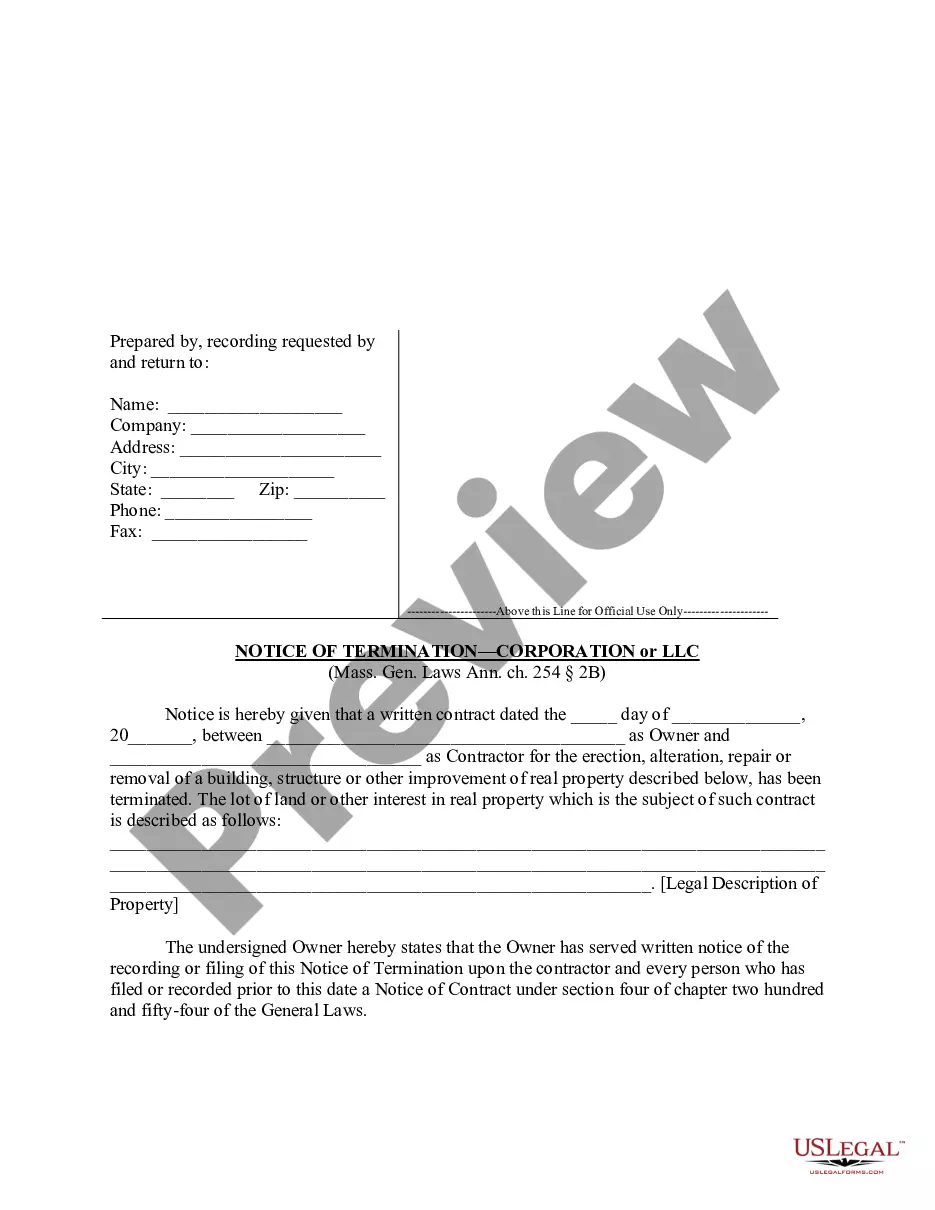
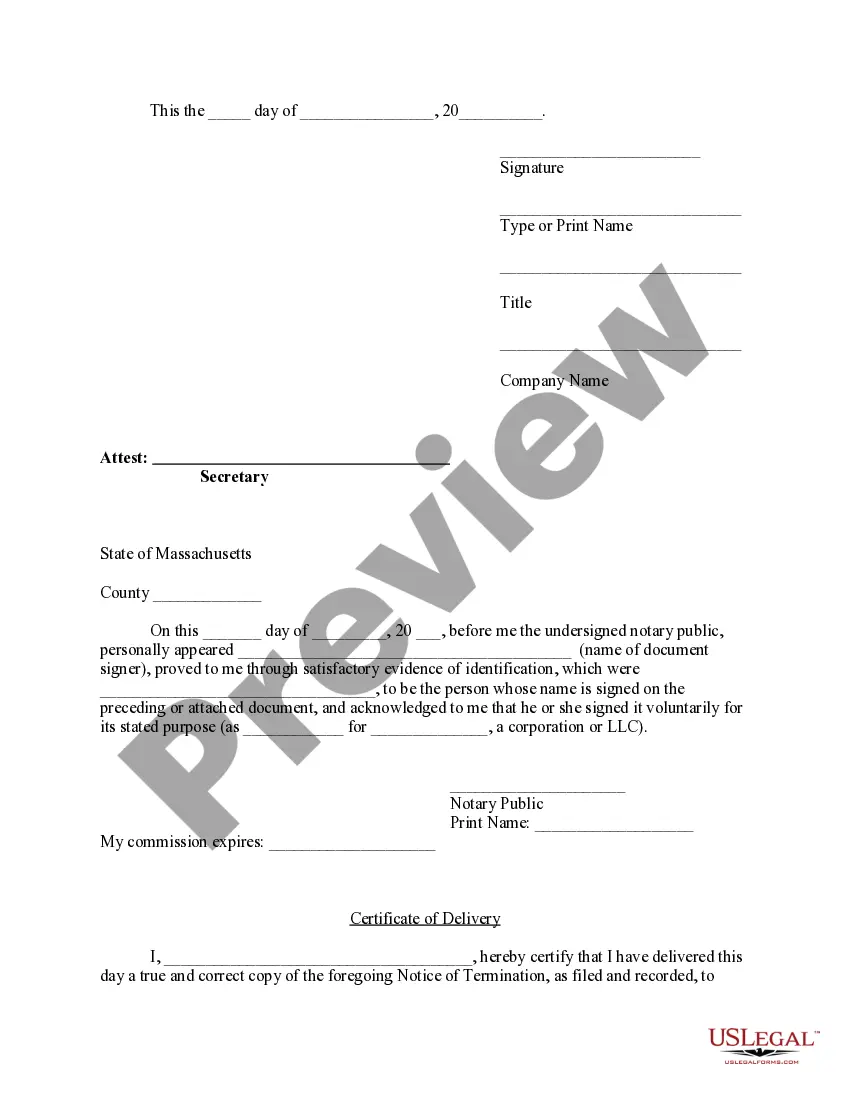
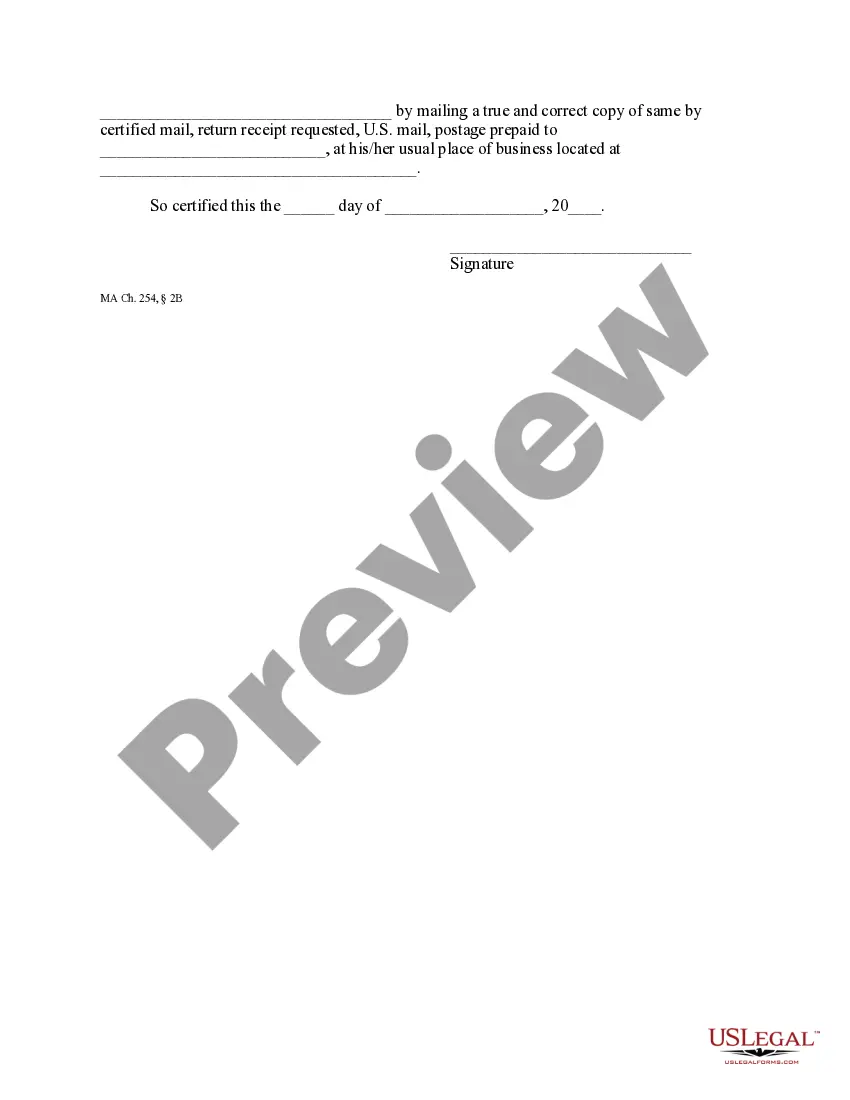
How to fill out Massachusetts Notice Of Termination By Corporation Or LLC?
- If you are a returning user, log in to your account and click the Download button next to your required form template. Ensure your subscription is active; renew if necessary.
- For first-time users, start by browsing the Preview mode and form descriptions to find a document that fits your needs and local jurisdiction.
- Use the Search function to find alternative templates if the initial one does not meet your criteria.
- Once you locate a suitable form, click on the Buy Now button and select a subscription plan. You will need to create an account to access the comprehensive library.
- Complete your purchase using your credit card or PayPal, ensuring your payment is processed.
- Download the form to your device for completion. You can always access it later from the My Forms section of your profile.
By utilizing US Legal Forms, you can ensure that your legal documents are precise and compliant with your needs. Their extensive collection outshines competitors, providing unmatched value.
Start now and experience the convenience of US Legal Forms—set your LLC corporation in Canada with ease!
Form popularity
FAQ
The primary downside of an LLP is that it often requires at least two partners to function correctly, which could limit flexibility for solo entrepreneurs. Additionally, the regulations surrounding LLPs may result in more administrative tasks compared to forming an LLC corporation. If you are considering this structure, be sure to weigh these factors against your business objectives.
The main difference between LLC and LLP in Canada lies in liability and management. An LLC corporation in Canada offers limited liability protection to all members, while an LLP provides this protection specifically to its partners. As you evaluate your options, consider the implications of liability and the management structure that best suits your business.
Canada's legal framework has historically favored corporations and partnerships as the primary business structures. The absence of LLCs may confuse many, especially those familiar with U.S. business structures. Nonetheless, forming a corporation or partnership in Canada, similar to an LLC corporation, can yield significant advantages.
When comparing a limited partnership to an LLC corporation in Canada, it often comes down to personal liability and management structure. An LLC provides limited liability protection to all members, whereas a limited partnership places that protection only on limited partners. Therefore, your choice should reflect your risk tolerance and the level of control you wish to retain.
Canada does not officially recognize LLCs in the same manner as the United States. Instead, Canadian jurisdictions primarily use the corporation and partnership structures. If you are considering forming an LLC corporation in Canada, it's essential to explore alternative structures that provide limited liability.
Choosing between an LLP and an LLC really depends on your specific business needs. An LLC corporation in Canada provides more flexibility with ownership and management structure, while an LLP offers some liability protection. However, the decision should align with your business goals, as some businesses may benefit more from the structure of an LLP, especially in professional fields.
Canada's version of an LLC aligns most closely with a corporation. While the structure may differ slightly, both provide essential benefits like limited liability and flexibility in management. Choosing to set up a corporation in Canada offers advantages similar to an LLC corporation Canada, making it a viable option for entrepreneurs. Understanding these differences can help you select the right structure for your business endeavors.
US LLCs face unique tax considerations when doing business in Canada. Generally, if an LLC carries on business in Canada, it may need to file a Canadian tax return, depending on the nature of its activities. Such tax implications can be complex, so it’s advisable to consult tax professionals. Using resources from uslegalforms can provide clarity and assist in managing cross-border tax obligations efficiently.
To incorporate a business similar to an LLC in Canada, you need to follow specific steps to register a corporation. This process typically involves selecting a business name, filing the articles of incorporation, and obtaining a business number. Platforms like uslegalforms offer valuable resources and templates to navigate this process smoothly, making your experience much easier and ensuring compliance with local laws.
Yes, Canada does not have an exact equivalent of an LLC, but it offers a similar structure known as a corporation. This type of corporation provides limited liability protection to its owners, much like an LLC in the United States. When considering a business structure in Canada, it’s wise to explore creating a corporation for similar benefits to an LLC corporation Canada. Consulting professionals can help you make the right choice.