Employee Agree Period For A Meeting
Description
Get your form ready online
Our built-in tools help you complete, sign, share, and store your documents in one place.
Make edits, fill in missing information, and update formatting in US Legal Forms—just like you would in MS Word.
Download a copy, print it, send it by email, or mail it via USPS—whatever works best for your next step.
Sign and collect signatures with our SignNow integration. Send to multiple recipients, set reminders, and more. Go Premium to unlock E-Sign.
If this form requires notarization, complete it online through a secure video call—no need to meet a notary in person or wait for an appointment.
We protect your documents and personal data by following strict security and privacy standards.

Make edits, fill in missing information, and update formatting in US Legal Forms—just like you would in MS Word.

Download a copy, print it, send it by email, or mail it via USPS—whatever works best for your next step.

Sign and collect signatures with our SignNow integration. Send to multiple recipients, set reminders, and more. Go Premium to unlock E-Sign.

If this form requires notarization, complete it online through a secure video call—no need to meet a notary in person or wait for an appointment.

We protect your documents and personal data by following strict security and privacy standards.
Looking for another form?

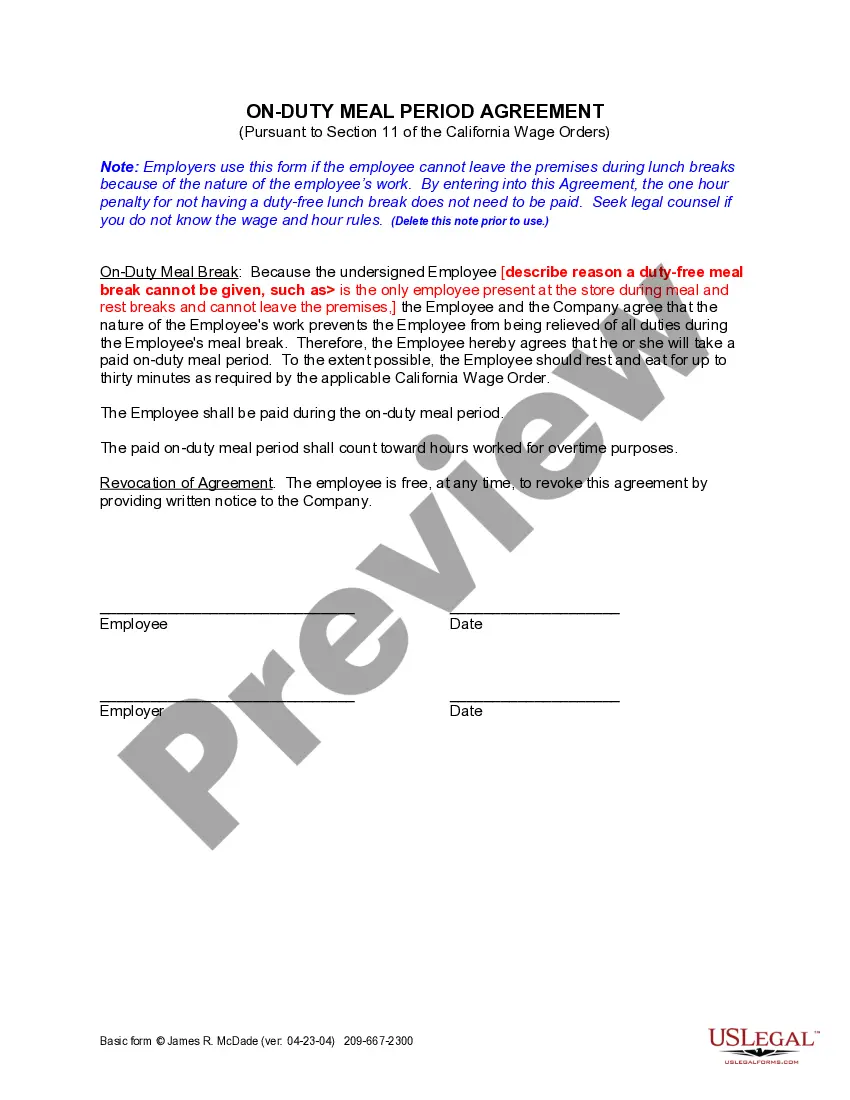
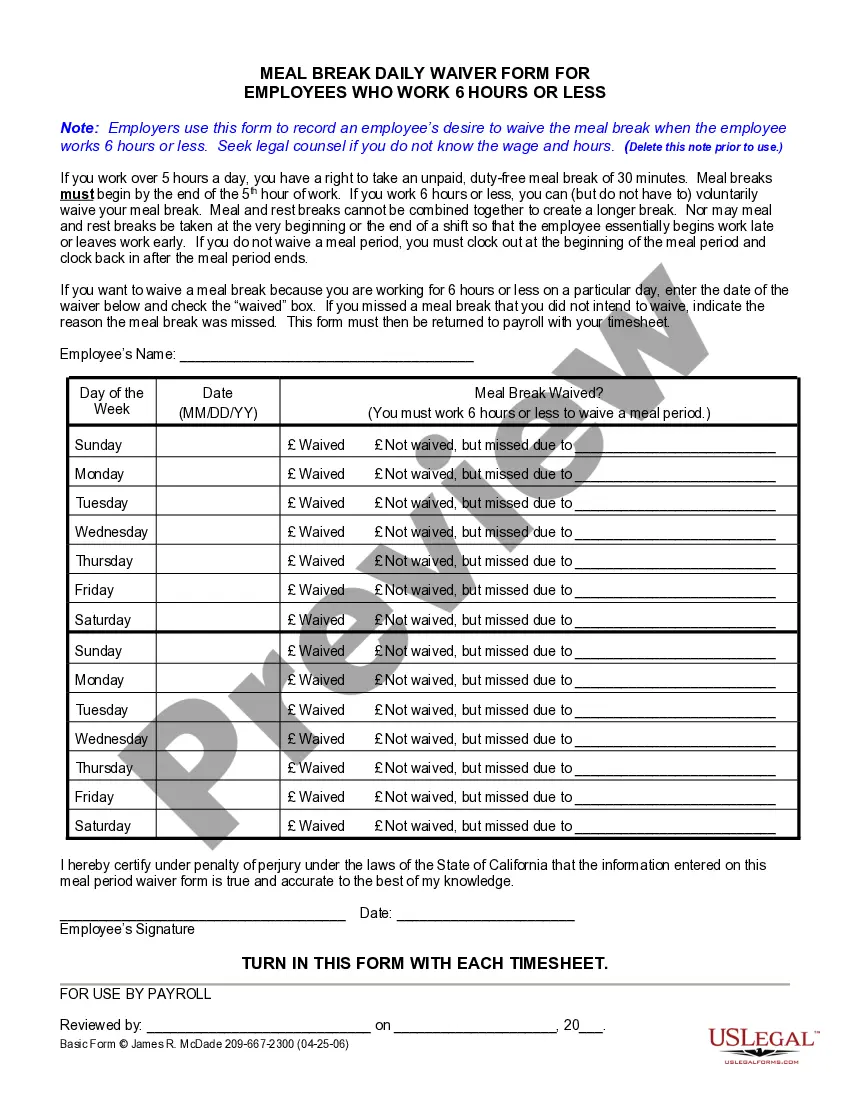
How to fill out California On Duty Meal Period Agreement?
- Begin by logging in to your existing US Legal Forms account. If you're new, create an account to access their extensive resource library.
- Review the form descriptions and preview mode to select a template that fits your needs and local requirements.
- If you need an alternative template, utilize the search feature to find the most suitable option. Once located, proceed to the next step.
- Choose your desired subscription plan by clicking the Buy Now button. Ensure you register for an account to unlock library benefits.
- Enter your payment information, either via credit card or PayPal, to finalize your purchase.
- Finally, download the needed document directly onto your device, ensuring quick access in the My Forms section of your profile for future reference.
By following these steps, you can efficiently obtain legal documents tailored to your needs. With US Legal Forms, individuals and attorneys benefit from a robust collection of forms and expert assistance to ensure their documents are accurate and legally sound.
Ready to streamline your legal needs? Visit US Legal Forms today to explore their vast library!
Form popularity
FAQ
To maintain fairness, employers should provide reasonable notice before a disciplinary meeting. A minimum of 48 hours is a common practice that aligns with the employee agree period for a meeting. This amount of time allows employees to prepare and attend with peace of mind. Remember, clear communication fosters trust and respect in the workplace.
It is essential to provide sufficient notice before a disciplinary meeting to ensure a fair process. Generally, a notice period of at least 48 hours is recommended. This timeframe is part of your employee agree period for a meeting and helps employees prepare adequately. Always strive for clarity in your communication.
Notifying an employee about a disciplinary hearing should happen well in advance, ideally within the employee agree period for a meeting. A minimum of 48 hours notice is standard, but providing more time is generally advisable. Adequate notice allows the employee to gather any necessary information or support. Clear communication of this timeframe is essential.
Participation in meetings during your day off may depend on specific company policies. Typically, you should not be required to attend work meetings outside your scheduled hours. It is important to clarify the employee agree period for a meeting to avoid misunderstandings. Always check your employee handbook for guidance.
In most cases, employees cannot refuse to attend work meetings, as participation is usually part of job responsibilities. However, if the meeting context is inappropriate, it may be worth discussing with HR. Understanding the employee agree period for a meeting helps clarify expectations. Open communication can often resolve concerns.
While there is no strict rule, meetings should be efficient and purposeful to respect everyone's time. A good guideline is to limit meetings to one hour. The employee agree period for a meeting should include only critical discussions to ensure productivity. Remember, the focus should be on actionable outcomes.
Typically, a disciplinary hearing should be scheduled promptly after the issues arise. Waiting too long can complicate matters and may negatively impact workplace morale. The employee agree period for a meeting should be set in a way that balances thoroughness and urgency. Aim to finalize the hearing within a week if possible.
Providing adequate notice for a disciplinary meeting is crucial. Generally, the employee agree period for a meeting should allow at least 48 hours. This time frame ensures that the employee has sufficient opportunity to prepare. It also demonstrates respect for their rights and the process.
When professionally asking for a meeting, clarity is key. Start by explaining the purpose of the meeting and specifying the desired outcomes. Make sure to propose several times to accommodate others’ schedules, recognizing the importance of the employee agree period for a meeting. Such professionalism enhances the likelihood of securing a positive response.
To request attendance, craft a message that explains the meeting's objective and its significance for the participants. A simple invitation that outlines the agenda can help others prepare and feel invested. Emphasize that their participation is key, thus respecting the employee agree period for a meeting. Communication like this fosters teamwork and collaboration.