Texas Involuntary Commitment Form With Two Points
Description
Get your form ready online
Our built-in tools help you complete, sign, share, and store your documents in one place.
Make edits, fill in missing information, and update formatting in US Legal Forms—just like you would in MS Word.
Download a copy, print it, send it by email, or mail it via USPS—whatever works best for your next step.
Sign and collect signatures with our SignNow integration. Send to multiple recipients, set reminders, and more. Go Premium to unlock E-Sign.
If this form requires notarization, complete it online through a secure video call—no need to meet a notary in person or wait for an appointment.
We protect your documents and personal data by following strict security and privacy standards.

Make edits, fill in missing information, and update formatting in US Legal Forms—just like you would in MS Word.

Download a copy, print it, send it by email, or mail it via USPS—whatever works best for your next step.

Sign and collect signatures with our SignNow integration. Send to multiple recipients, set reminders, and more. Go Premium to unlock E-Sign.

If this form requires notarization, complete it online through a secure video call—no need to meet a notary in person or wait for an appointment.

We protect your documents and personal data by following strict security and privacy standards.
Looking for another form?





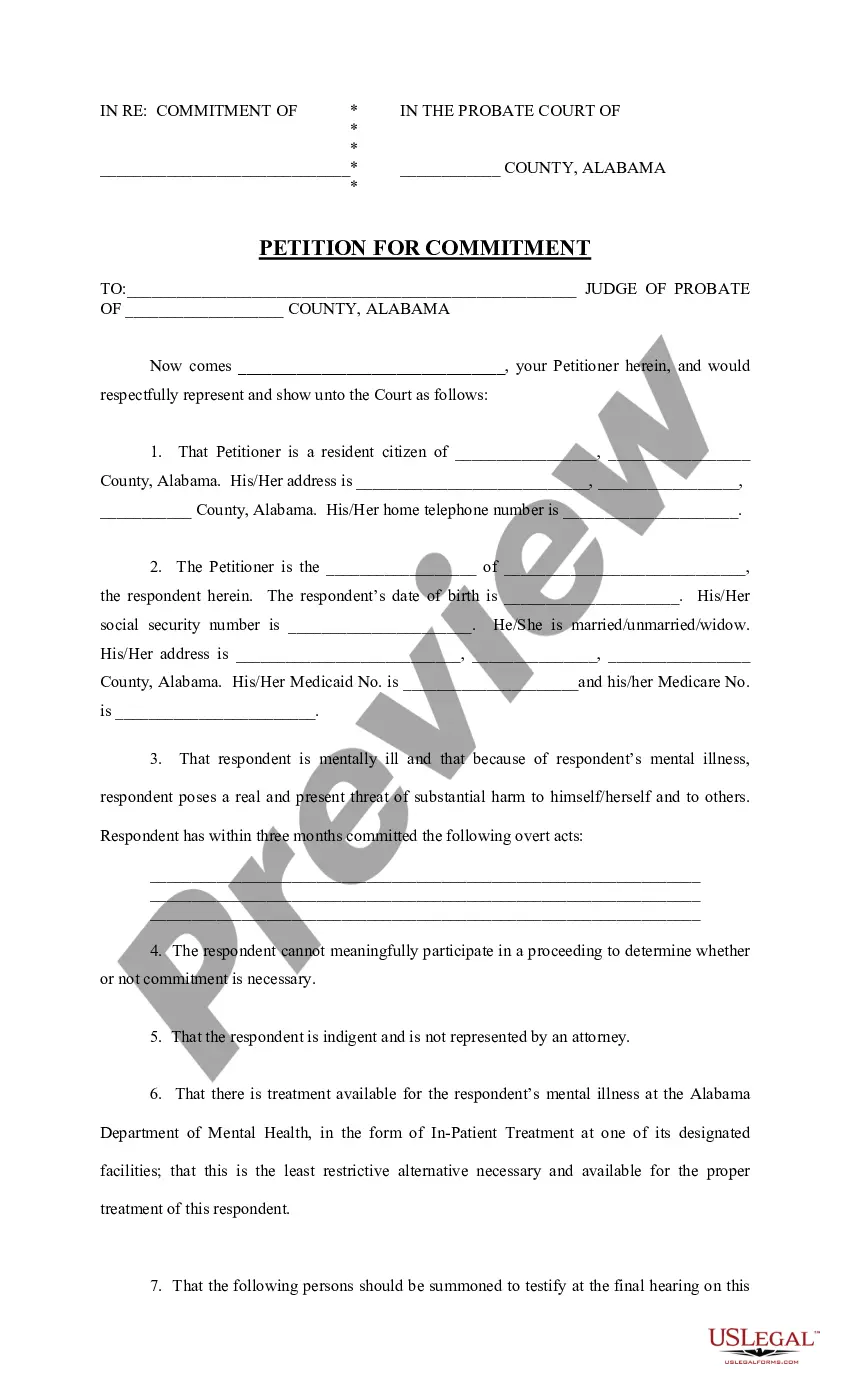
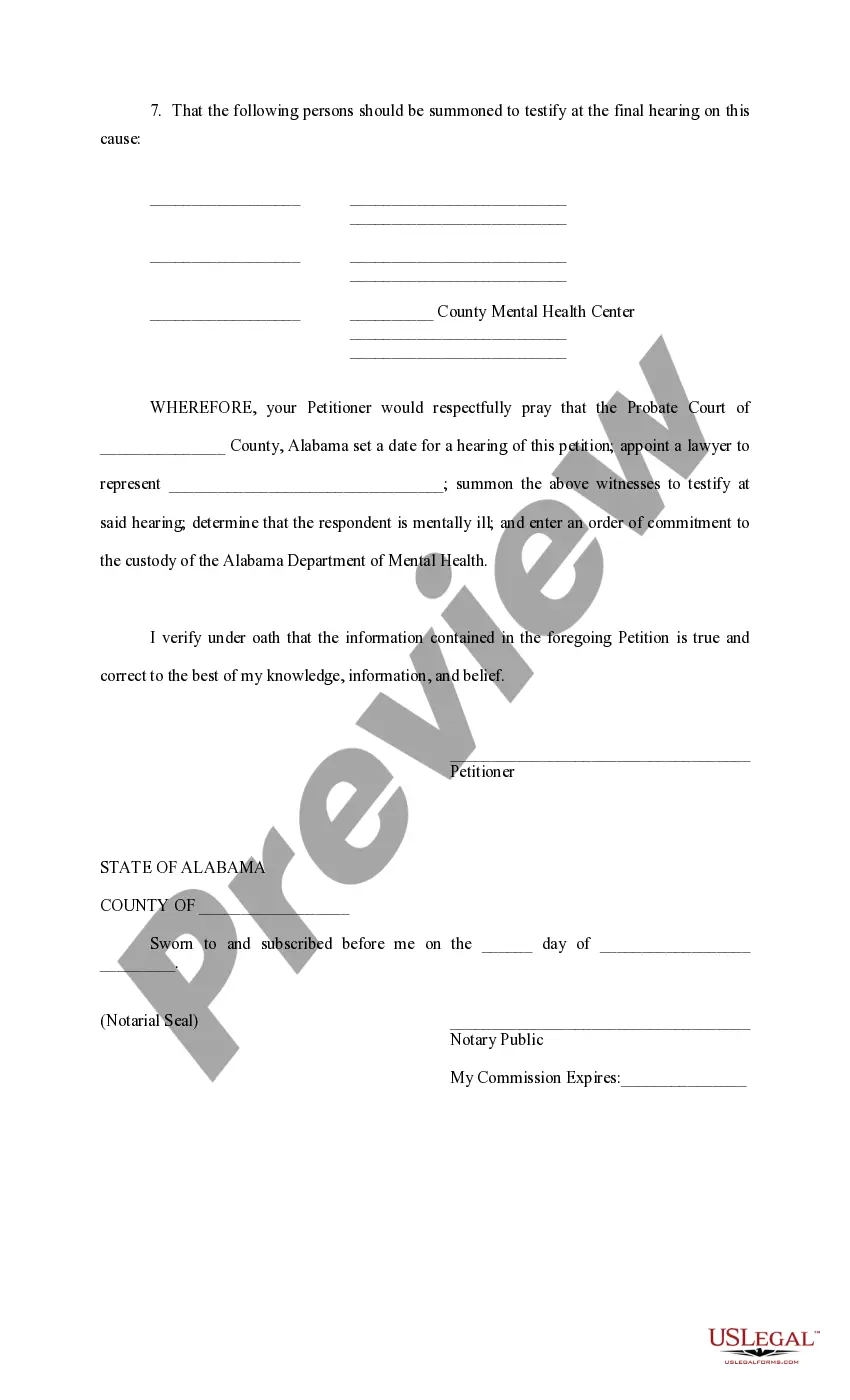
How to fill out Alabama Petition For Mental Health Commitment?
Regardless of whether it is for professional reasons or personal matters, everybody encounters legal dilemmas at some stage in their life. Filling out legal forms necessitates meticulous focus, starting from selecting the correct form template.
For example, if you select an incorrect edition of the Texas Involuntary Commitment Form With Two Points, it will be dismissed upon submission. Hence, it is vital to have a trustworthy source of legal documents such as US Legal Forms.
With a comprehensive US Legal Forms collection available, you no longer need to waste time searching for the correct template online. Take advantage of the library's user-friendly layout to find the suitable template for any situation.
- Locate the template you require by utilizing the search bar or catalog browsing.
- Review the form’s details to confirm it aligns with your situation, state, and county.
- Select the form’s preview to inspect it.
- If it is the wrong document, return to the search feature to find the Texas Involuntary Commitment Form With Two Points template you seek.
- Download the document when it corresponds to your criteria.
- If you possess a US Legal Forms account, click Log in to access previously saved templates in My documents.
- If you do not yet have an account, you may purchase the form by clicking Buy now.
- Select the appropriate pricing option.
- Complete the account registration form.
- Choose your payment method: use a credit card or PayPal account.
- Select the file format you prefer and download the Texas Involuntary Commitment Form With Two Points.
- Once saved, you can fill out the form using editing software, or print it and complete it by hand.
Form popularity
FAQ
The criteria for involuntary hospitalization are as follows: patients must exhibit dangerous behavior toward themselves or others, they must be helpless and unable to provide for their basic daily needs, and there is a danger of ?essential harm? to their mental health if they do not receive mental care.
A person shall be involuntarily committed by the court for outpatient treatment over objection only if all of the following criteria are satisfied by clear and convincing evidence: (1) The person is 18 years of age or older. (2) The person has a documented mental condition.
The Physician's Certificate must demonstrate sufficient facts for the Court to believe that the proposed patient is mentally ill and, as a result of the mental illness, is substantially likely to cause serious harm to self or others.
Throughout most of the developed world, the standard for both involuntary psychiatric hospitalization and involuntary outpatient treatment is that the person has a mental illness and represents an acute threat to self or others and that less coercive measures (eg, acute outpatient crisis intervention, voluntary ...
If an OPC is issued, a probable cause hearing must be held within 72 hours. At this hearing the judge decides whether the patient will be held at a mental health facility or released, while awaiting the mental health hearing.