Texas Involuntary Commitment Form With 2 Points
Description
Get your form ready online
Our built-in tools help you complete, sign, share, and store your documents in one place.
Make edits, fill in missing information, and update formatting in US Legal Forms—just like you would in MS Word.
Download a copy, print it, send it by email, or mail it via USPS—whatever works best for your next step.
Sign and collect signatures with our SignNow integration. Send to multiple recipients, set reminders, and more. Go Premium to unlock E-Sign.
If this form requires notarization, complete it online through a secure video call—no need to meet a notary in person or wait for an appointment.
We protect your documents and personal data by following strict security and privacy standards.

Make edits, fill in missing information, and update formatting in US Legal Forms—just like you would in MS Word.

Download a copy, print it, send it by email, or mail it via USPS—whatever works best for your next step.

Sign and collect signatures with our SignNow integration. Send to multiple recipients, set reminders, and more. Go Premium to unlock E-Sign.

If this form requires notarization, complete it online through a secure video call—no need to meet a notary in person or wait for an appointment.

We protect your documents and personal data by following strict security and privacy standards.
Looking for another form?





How to fill out Alabama Petition For Mental Health Commitment?
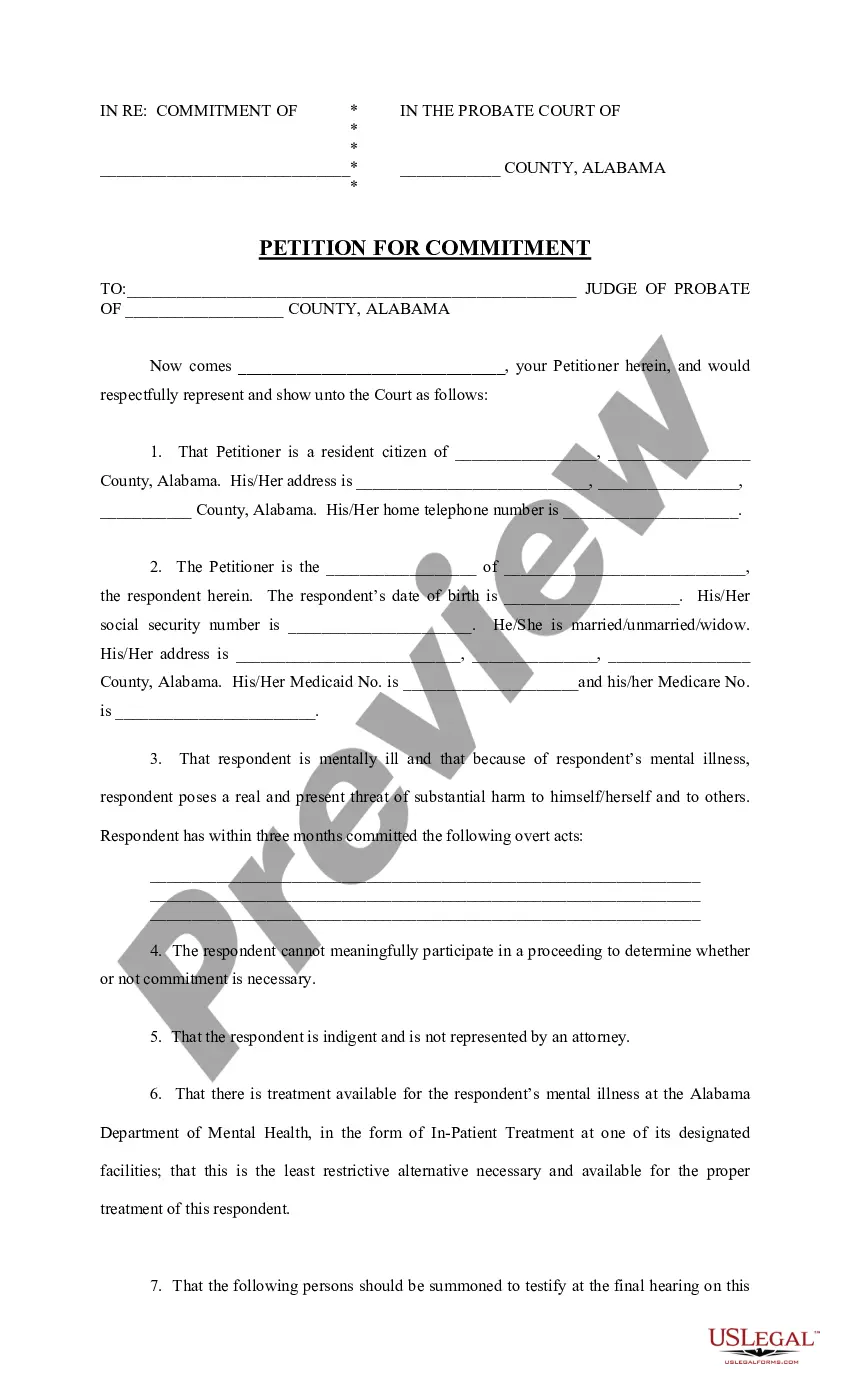
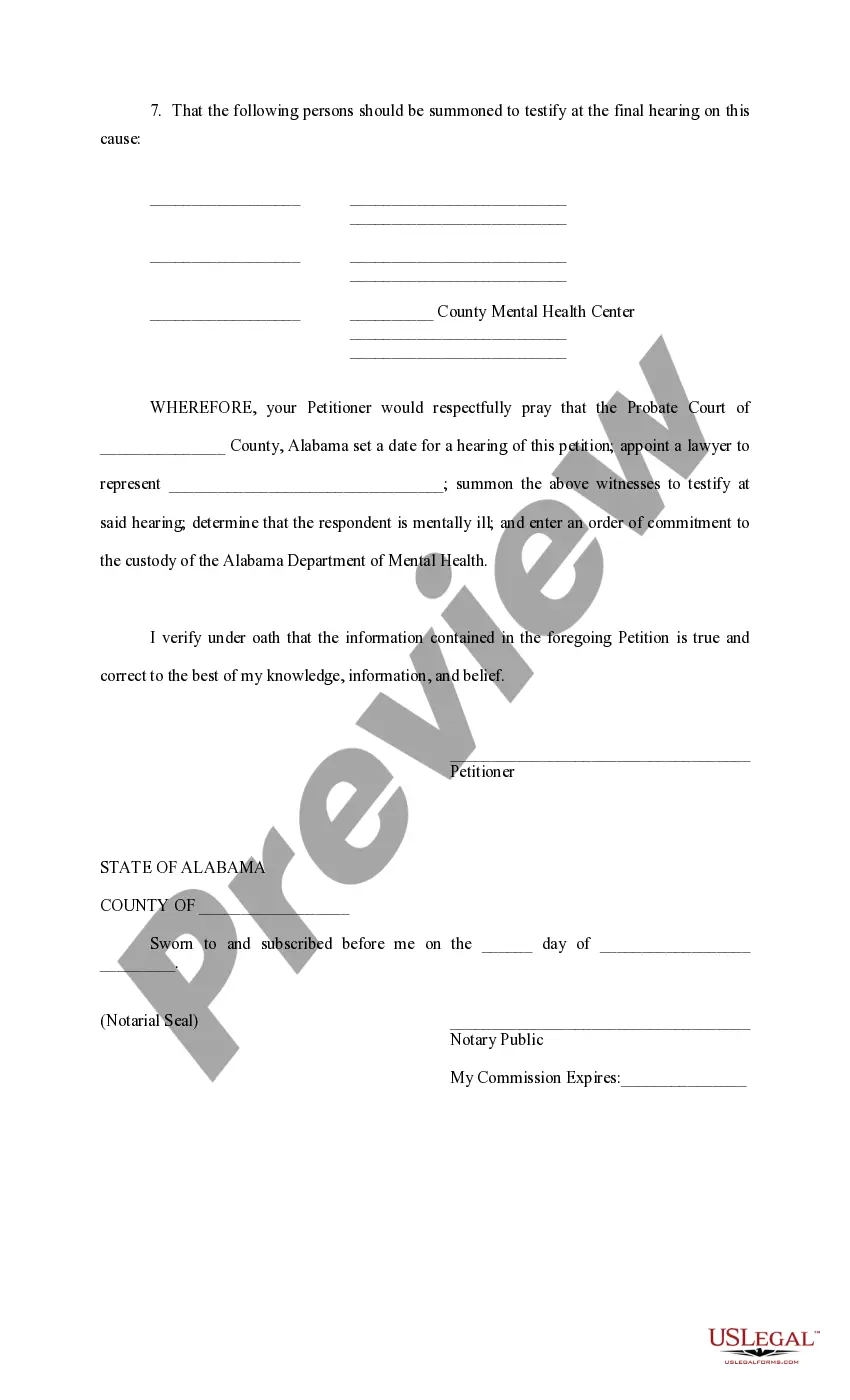
The Texas Involuntary Commitment Document With 2 Points you observe on this page is a versatile legal template crafted by experienced attorneys in compliance with federal and local laws.
For over 25 years, US Legal Forms has supplied individuals, enterprises, and legal practitioners with more than 85,000 authenticated, state-specific documents for any business and personal needs.
Subscribe to US Legal Forms to have verified legal templates for all of life's situations readily available.
- Search for the document you require and verify it.
- Review the sample you found and preview it or check the form description to make sure it meets your needs. If it doesn't, use the search function to find the correct one. Click Buy Now once you have identified the template you want.
- Register and Log In.
- Choose the pricing option that works best for you and set up an account. Use PayPal or a credit card for a swift payment. If you already possess an account, Log In and verify your subscription to proceed.
- Obtain the editable template.
- Select the file format you prefer for your Texas Involuntary Commitment Document With 2 Points (PDF, Word, RTF) and download the template to your device.
- Fill out and sign the documents.
- Print the template to complete it manually. Alternatively, utilize an online multifunctional PDF editor to rapidly and accurately fill in and sign your form with an electronic signature.
- Retrieve your documents again.
- Reuse the same document anytime it's required. Access the My documents section in your profile to redownload any forms you previously saved.
Form popularity
FAQ
(1) a statement that the guardian [or applicant] has reason to believe and does believe that the ward evidences mental illness; (2) a statement that the guardian [or applicant] has reason to believe and does believe that the ward evidences a substantial risk of serious harm to the ward or others; (3) a specific ...
The Physician's Certificate must demonstrate sufficient facts for the Court to believe that the proposed patient is mentally ill and, as a result of the mental illness, is substantially likely to cause serious harm to self or others.
A person who misuses or abuses alcohol or drugs to the extent that they cannot make rational decisions about their basic requirements, such as food, shelter, and medical treatment, would serve as an example.
If an OPC is issued, a probable cause hearing must be held within 72 hours. At this hearing the judge decides whether the patient will be held at a mental health facility or released, while awaiting the mental health hearing.
A person shall be involuntarily committed by the court for outpatient treatment over objection only if all of the following criteria are satisfied by clear and convincing evidence: (1) The person is 18 years of age or older. (2) The person has a documented mental condition.