Delaware Revocation of Premarital or Prenuptial Agreement
About this form
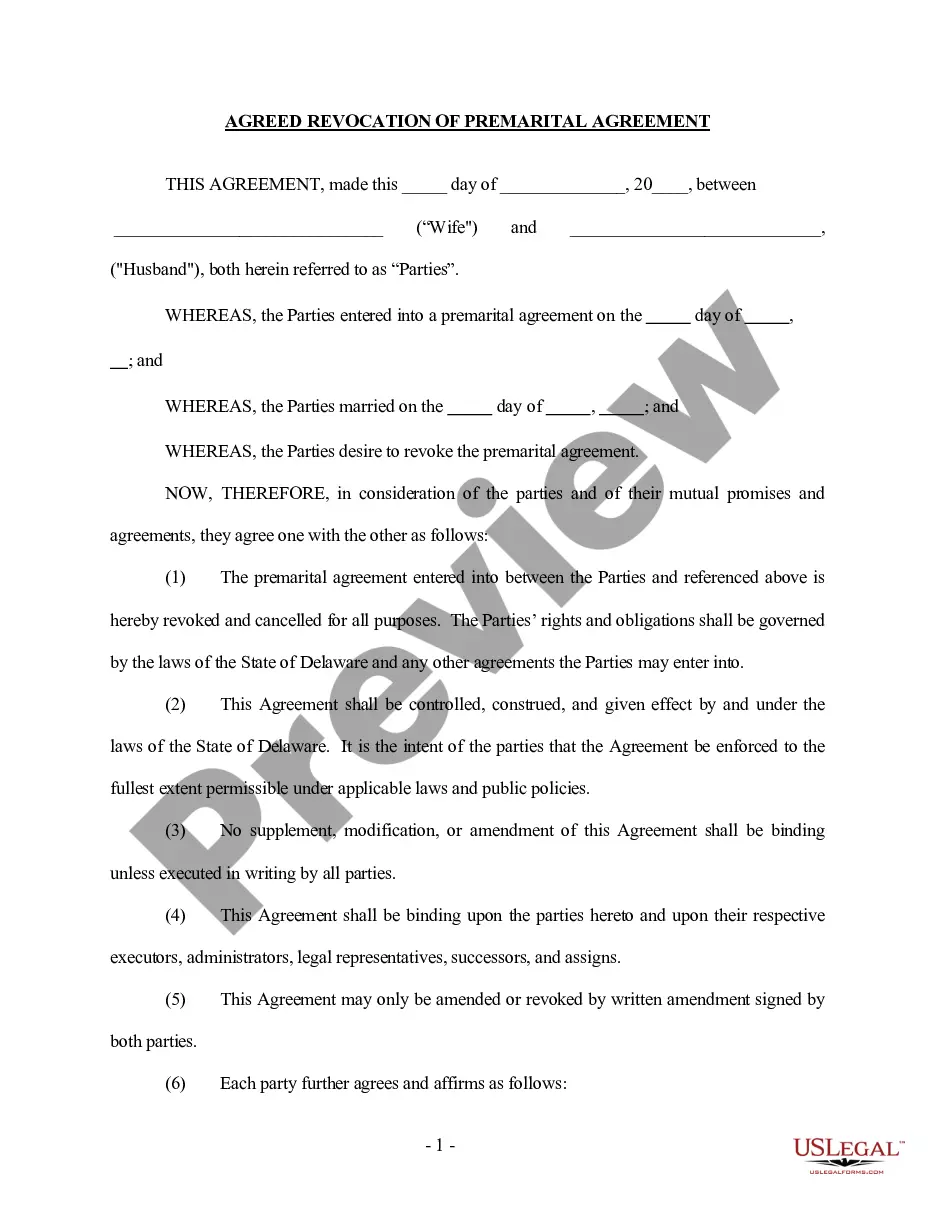
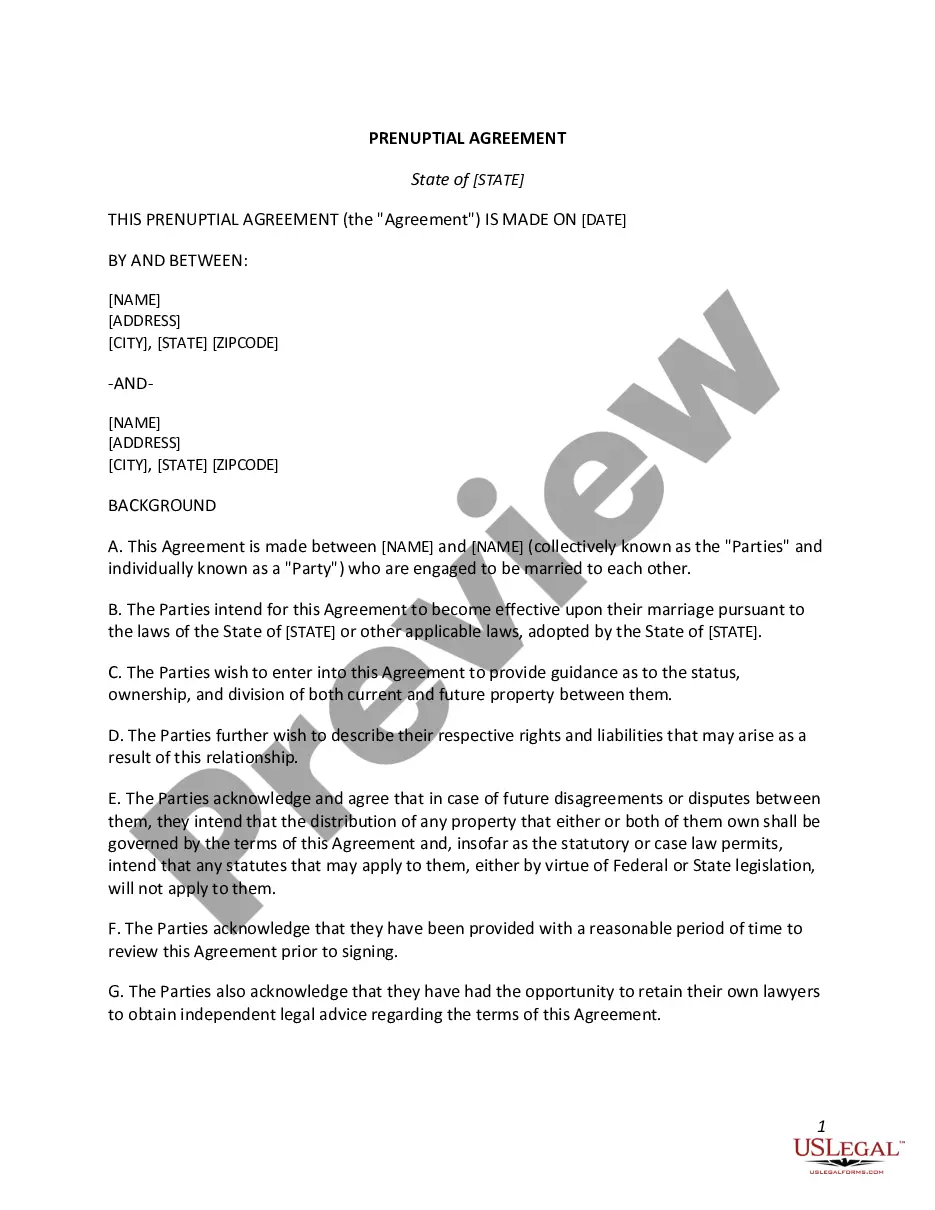
The Revocation of Premarital or Prenuptial Agreement is a legal document that allows married couples to officially cancel a previously signed premarital agreement. This form serves as a formal acknowledgement that the parties no longer wish to be bound by the terms of their original agreement. By using this form, both spouses can ensure that their mutual decision to revoke the agreement is documented, clear, and binding upon them and their legal representatives.
Key parts of this document
- Date of execution - the specific day when the revocation takes effect.
- Names of the parties - the full names of both husband and wife.
- Revocation clause - stating that the original premarital agreement is revoked.
- Governing law - specifies that Delaware law governs the agreement.
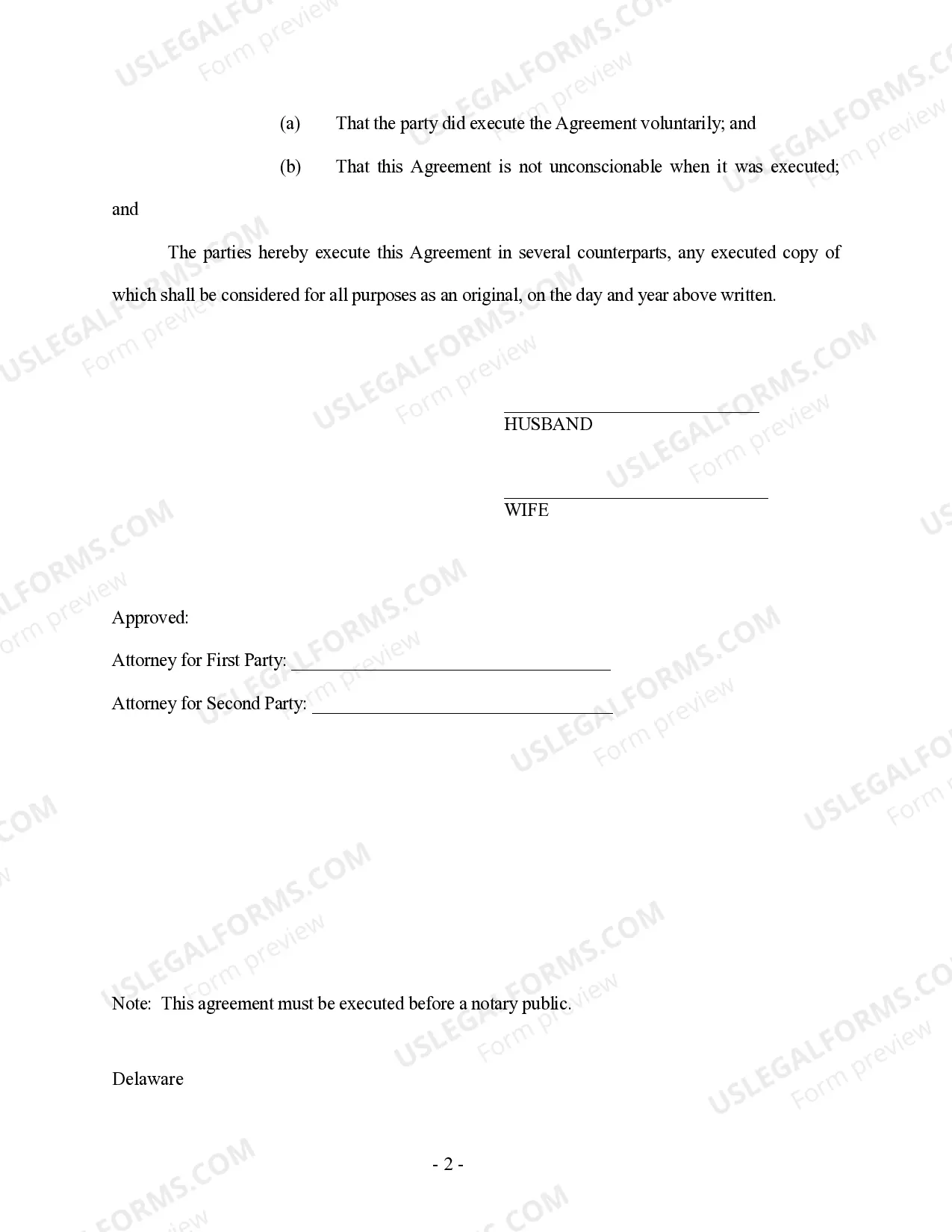
- Signatures - the signatures of both parties affirming their agreement to revoke.
When to use this document
This form should be used when a married couple decides to revoke an existing premarital or prenuptial agreement. Common scenarios include when both parties agree to new terms of their marriage, wish to simplify their legal documentation, or when personal circumstances change significantly. This form serves to protect both parties by formally documenting the revocation of any previous agreements.
Who should use this form
- Married couples who have a premarital agreement they wish to revoke.
- Parties needing legal proof that their previous agreement is nullified.
- Individuals looking to clarify their obligations and rights in the context of their marriage.
How to prepare this document
- Identify the parties involved by entering the names of both the husband and wife.
- Enter the date on which the revocation is being executed.
- Read the revocation clause carefully to ensure it meets your understanding of the agreement.
- Each party should sign the form to validate the revocation.
- Keep a copy of the completed form for your records.
Does this document require notarization?
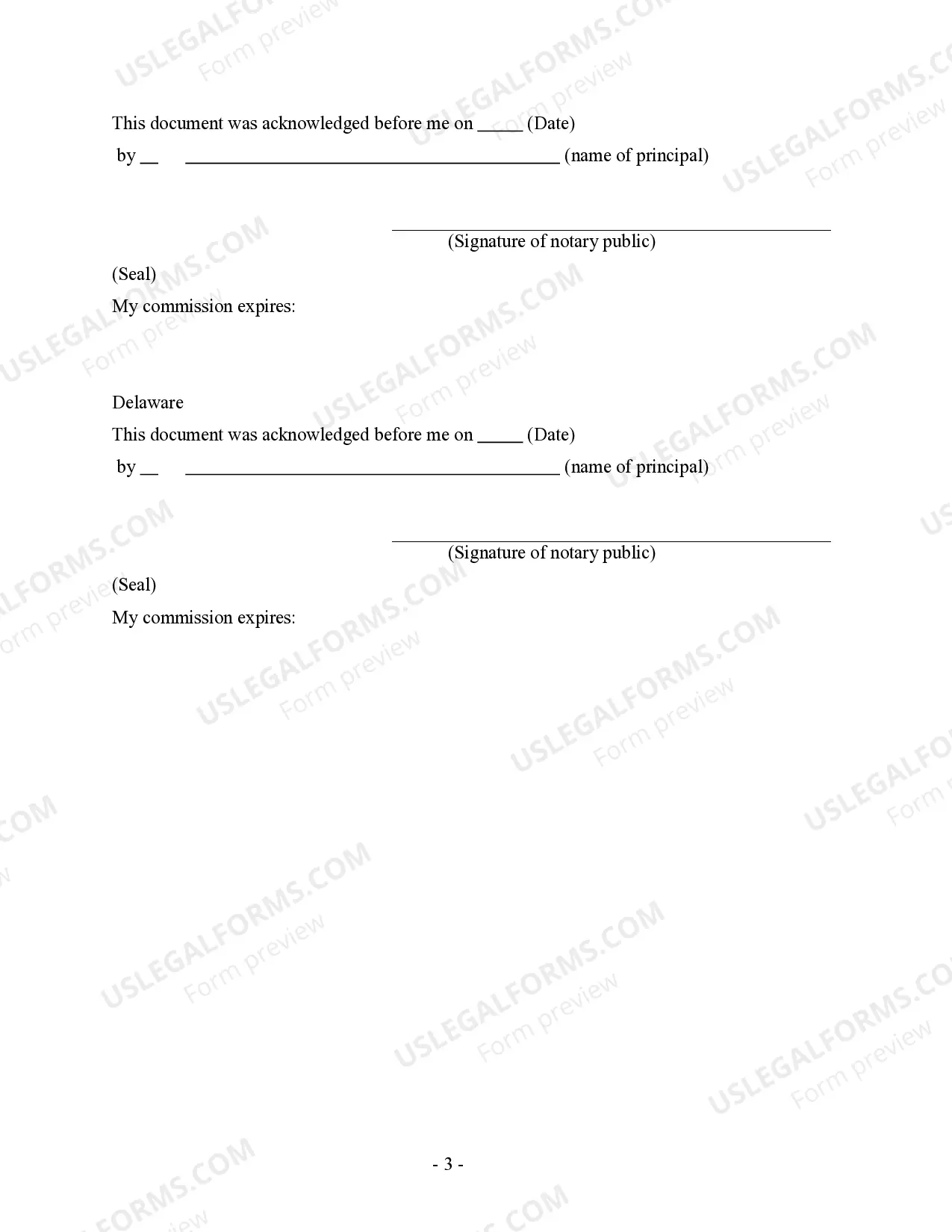
This form usually doesn’t need to be notarized. However, local laws or specific transactions may require it. Our online notarization service, powered by Notarize, lets you complete it remotely through a secure video session, available 24/7.
Get your form ready online
Our built-in tools help you complete, sign, share, and store your documents in one place.
Make edits, fill in missing information, and update formatting in US Legal Forms—just like you would in MS Word.
Download a copy, print it, send it by email, or mail it via USPS—whatever works best for your next step.
Sign and collect signatures with our SignNow integration. Send to multiple recipients, set reminders, and more. Go Premium to unlock E-Sign.
If this form requires notarization, complete it online through a secure video call—no need to meet a notary in person or wait for an appointment.
We protect your documents and personal data by following strict security and privacy standards.

Make edits, fill in missing information, and update formatting in US Legal Forms—just like you would in MS Word.

Download a copy, print it, send it by email, or mail it via USPS—whatever works best for your next step.

Sign and collect signatures with our SignNow integration. Send to multiple recipients, set reminders, and more. Go Premium to unlock E-Sign.

If this form requires notarization, complete it online through a secure video call—no need to meet a notary in person or wait for an appointment.

We protect your documents and personal data by following strict security and privacy standards.
Common mistakes to avoid
- Failing to enter the correct date of execution.
- Not having both parties sign the document.
- Leaving out the names of both parties involved.
Benefits of using this form online
- Convenience of downloading the form at any time.
- Editability allows for personal customization to suit specific needs.
- Reliability, knowing that the form is drafted by licensed attorneys.
Looking for another form?

Form popularity
FAQ
Overturning a prenuptial agreement can range from straightforward to complex, depending on the circumstances. In Delaware, legal grounds such as fraud, duress, or sudden changes in circumstances may support a case for invalidation. Engaging with an experienced attorney can help you navigate the Delaware Revocation of Premarital or Prenuptial Agreement process effectively, ensuring that you understand your options and rights.
To revoke a prenuptial agreement in Delaware, both spouses must agree to the revocation and sign a written document that clearly states this intention. This revocation should comply with specific legal guidelines to be valid. Utilizing platforms like US Legal Forms can simplify this process, providing templates and guidance for creating a legally sound revocation of your premarital or prenuptial agreement.
Yes, a prenuptial agreement can be cancelled under certain circumstances. In Delaware, a spouse can seek the revocation of a premarital or prenuptial agreement if both parties agree to the cancellation or if one party can prove that the agreement is invalid. It is important to consult with a legal professional who understands the intricacies of Delaware Revocation of Premarital or Prenuptial Agreement to ensure all legal requirements are met.
A prenuptial agreement may be deemed invalid if one party can prove that they did not voluntarily sign it, or if there was a misrepresentation or concealment of significant assets. Additionally, an agreement that significantly favors one party over another could also be struck down. Learning about the Delaware Revocation of Premarital or Prenuptial Agreement can provide valuable strategies for your situation.
A prenup may be declared null and void if it was made under duress, if there was a lack of full financial disclosure, or if it is deemed to be unconscionable. In Delaware, courts will review these factors to determine the validity of the agreement. Utilizing insights on the Delaware Revocation of Premarital or Prenuptial Agreement can clarify these nuances.
Destroying a prenuptial agreement legally can involve writing and signing a formal document that states your wishes to revoke the original agreement. This process should comply with Delaware law to ensure that your revocation is effective and recognized. Engage with resources that specialize in the Delaware Revocation of Premarital or Prenuptial Agreement for proper guidance.
To make a prenup null and void, you must establish valid grounds such as fraud, misunderstanding, or lack of fair disclosure during its formation. Additionally, if circumstances have significantly changed since the agreement was signed, this may support your case for revocation. Understanding the specifics of Delaware Revocation of Premarital or Prenuptial Agreement will aid in your efforts.
Nullifying a prenuptial agreement generally involves proving that it is unenforceable due to specific legal reasons. This could include demonstrating that the agreement was entered into without the full understanding of its implications or if it violates public policy. Consulting with a professional familiar with the Delaware Revocation of Premarital or Prenuptial Agreement can help you navigate this process effectively.
To make your prenuptial agreement invalid, you need to demonstrate that it does not meet the legal requirements set forth by Delaware law. These requirements include lack of voluntary consent from both parties, failure to disclose assets, or if the agreement was signed under duress or coercion. Seeking guidance on the Delaware Revocation of Premarital or Prenuptial Agreement can clarify your path to invalidation.
Yes, prenups can be nullified, especially if they meet certain conditions such as fraud or undue influence. If either spouse can show that the agreement was not fair or mutual, a court may rule it invalid. Understanding the nuances of prenup laws through platforms like USLegalForms can provide essential support in navigating these situations effectively.