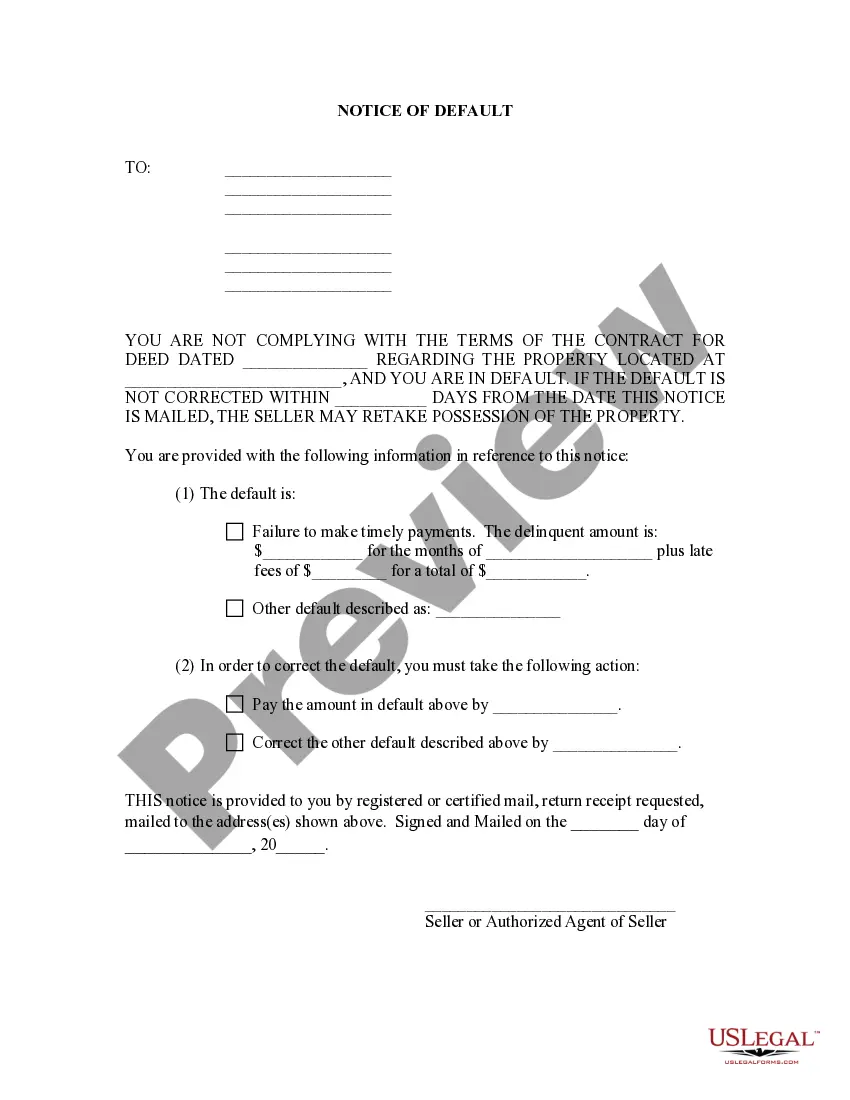
Delaware General Notice of Default for Contract for Deed
What is this form?
The General Notice of Default for Contract for Deed is a legal document used by sellers to inform purchasers that they are in default of their contract obligations. This form specifies the reasons for the default, outlines the actions required to remedy the situation, and details the seller's intended actions if the default is not corrected. Unlike other notices, this form addresses performance issues specifically related to a contract for deed arrangement.
Main sections of this form
- Identification of the seller and purchaser.
- Description of the property involved in the contract.
- Specific reasons for the default.
- Required actions to cure the default.
- Intended remedies by the seller if the default remains unaddressed.
When this form is needed
This form is necessary when a purchaser fails to meet their obligations under a contract for deed, such as missing payments or neglecting property maintenance. It serves as a formal notification that enables the seller to initiate the process of correcting the defaults and protects their interests. Use this form to document the default and the necessary steps for resolution.
Who should use this form
- Property sellers who have entered into a contract for deed.
- Purchasers who have defaulted on their contractual obligations.
- Legal representatives assisting sellers in managing contract disputes.
Completing this form step by step
- Identify the seller and purchaser with their full names and addresses.
- Specify the property subject to the contract for deed.
- Clearly state the reasons for the default in detail.
- Outline the performance needed to cure the default.
- Indicate the remedies the seller intends to pursue if the default is not resolved.
Does this document require notarization?
This form must be notarized to be legally valid. US Legal Forms provides secure online notarization powered by Notarize, allowing you to complete the process through a verified video call.
Get your form ready online
Our built-in tools help you complete, sign, share, and store your documents in one place.
Make edits, fill in missing information, and update formatting in US Legal Forms—just like you would in MS Word.
Download a copy, print it, send it by email, or mail it via USPS—whatever works best for your next step.
Sign and collect signatures with our SignNow integration. Send to multiple recipients, set reminders, and more. Go Premium to unlock E-Sign.
If this form requires notarization, complete it online through a secure video call—no need to meet a notary in person or wait for an appointment.
We protect your documents and personal data by following strict security and privacy standards.

Make edits, fill in missing information, and update formatting in US Legal Forms—just like you would in MS Word.

Download a copy, print it, send it by email, or mail it via USPS—whatever works best for your next step.

Sign and collect signatures with our SignNow integration. Send to multiple recipients, set reminders, and more. Go Premium to unlock E-Sign.

If this form requires notarization, complete it online through a secure video call—no need to meet a notary in person or wait for an appointment.

We protect your documents and personal data by following strict security and privacy standards.
Typical mistakes to avoid
- Failing to specify the reasons for default clearly.
- Not providing complete contact information for both parties.
- Leaving out necessary signatures or dates.
Why use this form online
- Convenient access to professionally drafted legal forms.
- Edit and customize the form to meet specific needs.
- Immediate downloadable format to expedite the notification process.
Key takeaways
- The General Notice of Default for Contract for Deed is essential for addressing defaults in property contracts.
- Understanding the key components helps ensure proper completion.
- It's important to be aware of state-specific requirements when using this form.
Looking for another form?
Form popularity
FAQ
A contract for deed is an agreement where the buyer makes installment payments to the seller for a property, and the seller retains legal title until full payment is complete. It’s important to understand that the Delaware General Notice of Default for Contract for Deed outlines the process and consequences if the buyer fails to meet their payment obligations. This notice serves as a formal alert, ensuring that buyers are aware of their responsibilities. If you are looking for assistance with creating or understanding these contracts, U.S. Legal Forms can provide the necessary resources and templates to ensure clarity and compliance.
A defaulting buyer may regain title and possession through various means outlined in the contract, often contingent upon state laws. The Delaware General Notice of Default for Contract for Deed typically allows a specified period for the buyer to cure the default, which means they must remedy the missed payments or other breaches. Engaging legal assistance can help navigate the options available to the defaulting buyer for recovery. Utilizing platforms like USLegalForms can help clarify these steps and provide necessary documentation.
Filling out a land contract form requires attention to several key details. First, ensure you include the names of both parties involved, a clear description of the property, and the terms of payment. You may want to refer to the Delaware General Notice of Default for Contract for Deed to understand the implications of the terms you set. If you are unsure, platforms like USLegalForms can provide templates and guidance to streamline this process.
When a seller defaults on a real estate contract, the buyer often has the right to seek remedies outlined in the agreement. This can include retaining the Delaware General Notice of Default for Contract for Deed, which formally notifies the seller of their default. The buyer may pursue options such as rescinding the contract, seeking damages, or enforcing specific performance. It's crucial for buyers to understand their rights in this situation to protect their investment.
When someone defaults on a land contract, the seller has the right to pursue remedy options, including issuing a Delaware General Notice of Default for Contract for Deed. This notice allows the defaulting party a chance to resolve the payment issue. If unresolved, the seller may initiate legal proceedings to reclaim possession of the property. This emphasizes the importance of maintaining communication and seeking resolutions promptly.
In Delaware, the timeline for foreclosure can vary but generally ranges from several months to over a year. The process begins after the issuance of a Delaware General Notice of Default for Contract for Deed. Factors affecting this timeline include court schedules and any potential delays from disputes. Engaging with legal counsel may expedite the understanding and navigation of this process.
Several factors can void a land contract, including failure to meet legal requirements or significant mistakes in the agreement. Additionally, acts like fraud or incapacity of one party can invalidate the contract. A well-documented Delaware General Notice of Default for Contract for Deed can sometimes play a role when defaults occur. Consulting with a legal professional can provide clarity on your specific circumstances.
To void a contract for deed, you typically need to provide substantial legal grounds, such as fraud or misrepresentation. If you are in this situation, understanding the legal framework in Delaware is crucial. Consulting with a legal expert can help guide the process effectively. Be aware that this can involve filing legal notices and possibly a Delaware General Notice of Default for Contract for Deed.
When a buyer defaults on a land contract, they may lose their right to the property. The seller can issue a Delaware General Notice of Default for Contract for Deed, which formally notifies the buyer of the default. This gives the buyer a chance to remedy the situation, often by making overdue payments. If the buyer fails to act, the seller can seek legal possession of the property.
In Delaware, a valid deed must have specific requirements, including a legal description of the property and proper execution by the grantor. It is also essential that the deed is acknowledged before a notary public and recorded with the appropriate county office. Following these guidelines can help avoid potential misunderstandings, especially regarding the Delaware General Notice of Default for Contract for Deed.