Connecticut Quitclaim Deed by Two Individuals to Corporation
Overview of this form
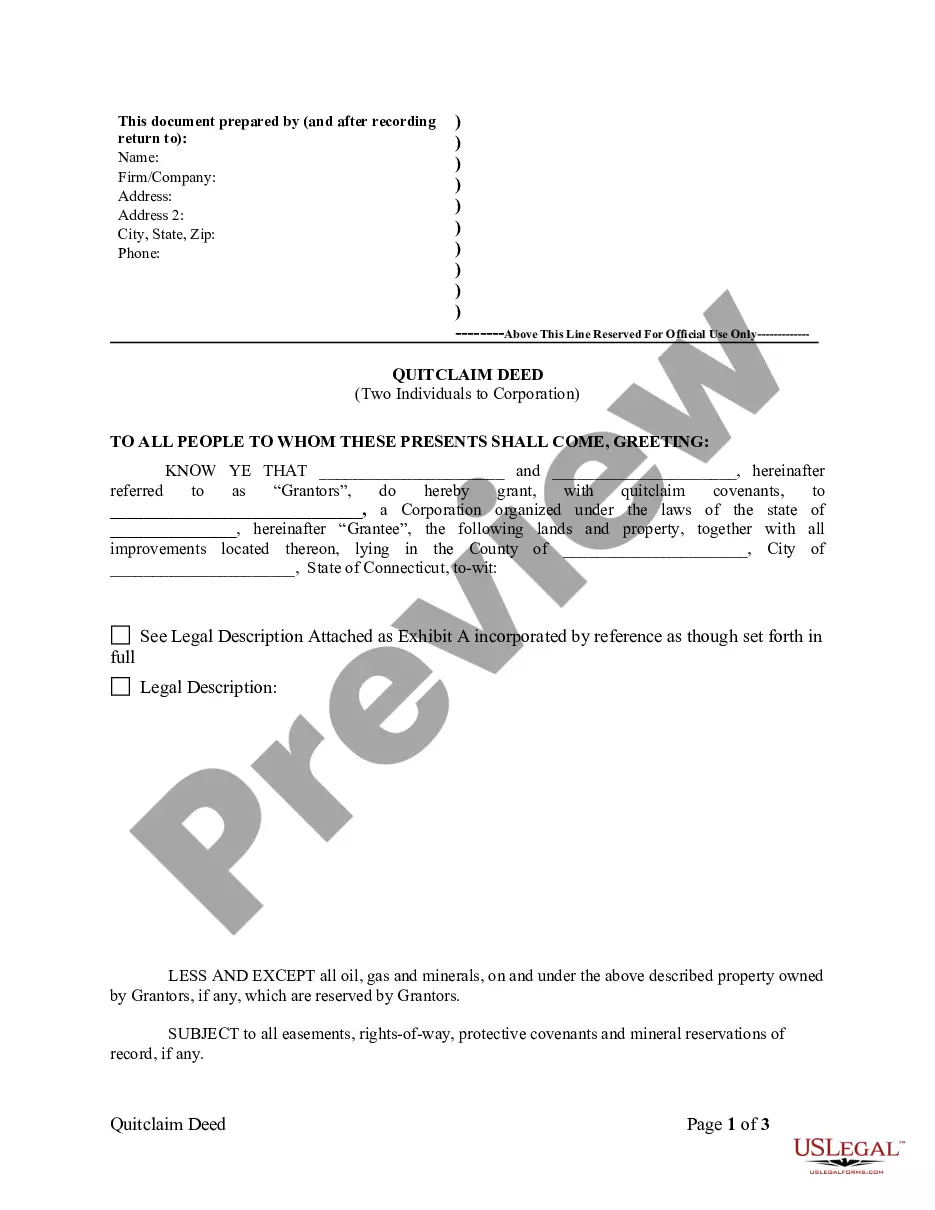
The Quitclaim Deed by Two Individuals to Corporation is a legal document used to transfer property ownership from two individuals (the Grantors) to a corporation (the Grantee). This form allows the Grantors to convey their interest in the property without any guarantees regarding the title. Unlike a warranty deed, a quitclaim deed does not ensure that the property is free from liens or other claims. It is a straightforward way to formalize the transfer of property rights.
Main sections of this form
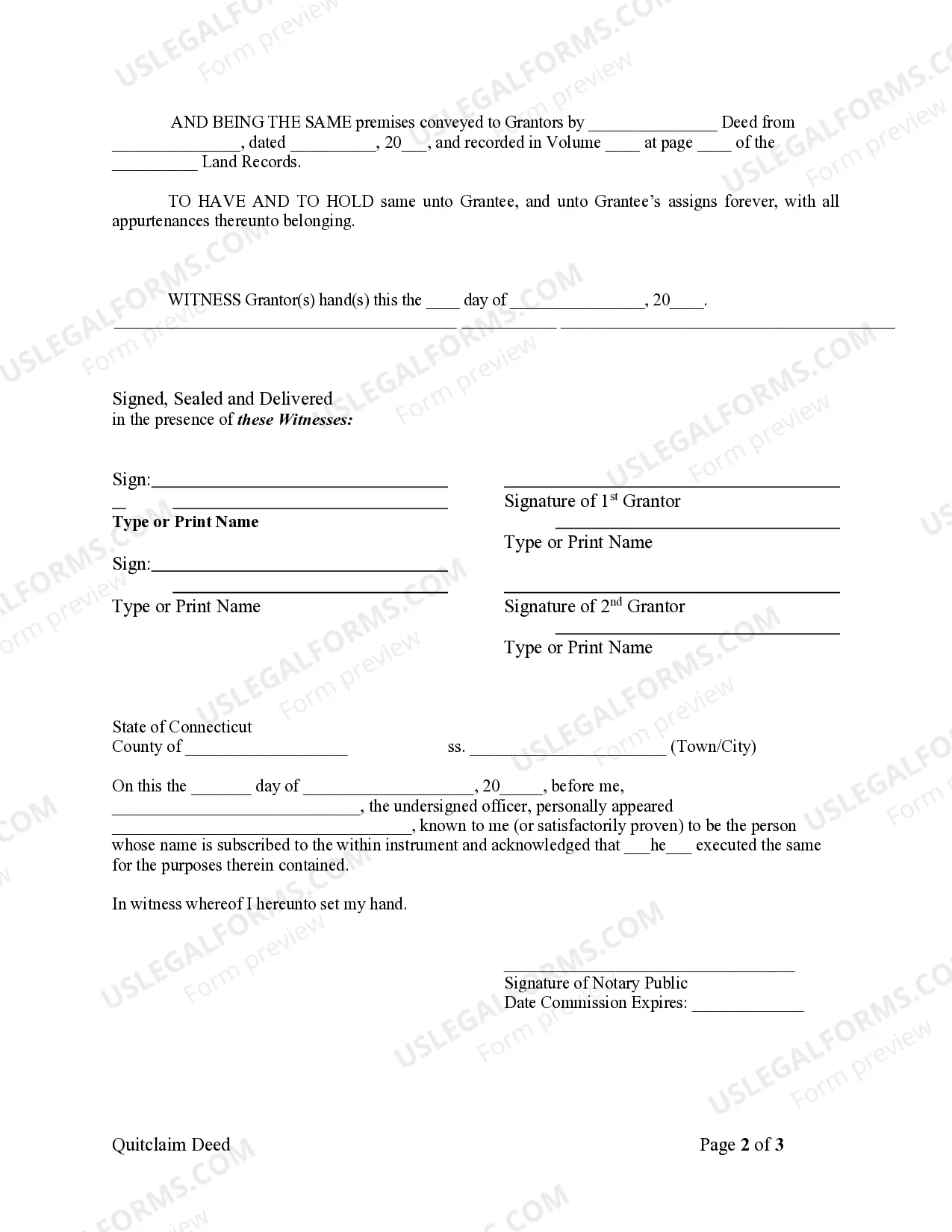
- Identification of Grantors: Names and signatures of the two individuals transferring the property.
- Identification of Grantee: The legal name of the corporation receiving the property.
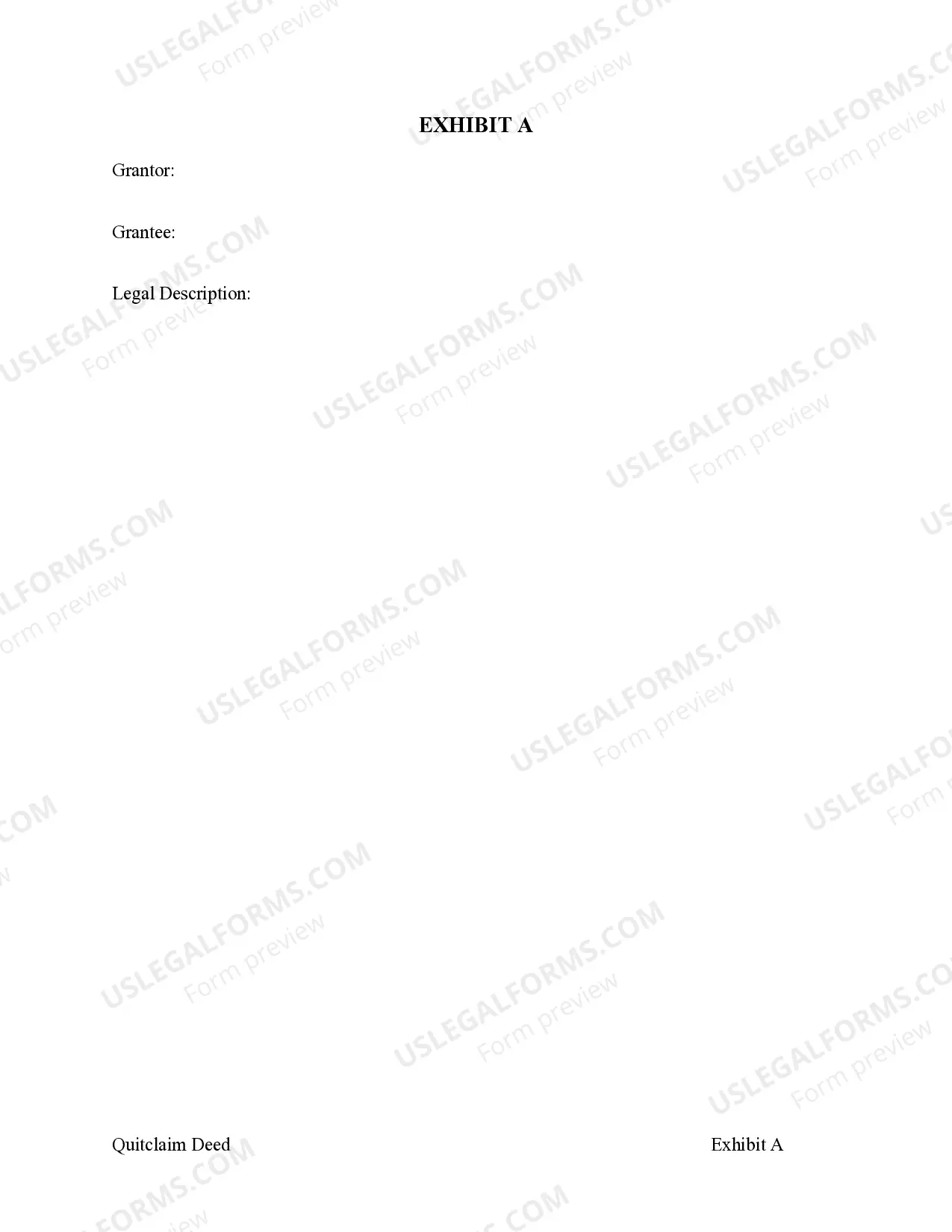
- Property Description: A detailed description of the property being conveyed.
- Reservation Clause: Notation of any oil, gas, and mineral rights that are excluded from the transfer.
- Easements and Rights: Mention of any existing easements or rights-of-way that may affect the property.
- Effective Date: The date on which the deed is signed and becomes effective.



When to use this document
This form is typically used when two individuals wish to transfer property ownership to a corporation. Common scenarios include transferring family-owned property into a business entity for liability protection or simplifying estate management. Additionally, it can be used in situations where property needs to be jointly owned by a corporation for business purposes.
Who should use this form
- Individuals who co-own a property and wish to transfer ownership to a corporation.
- Business owners who need to formalize property ownership in their corporate entity.
- Individuals seeking to simplify the management of inherited or jointly owned real estate.
How to complete this form
- Identify the parties: Clearly state the names of the two Grantors and the Grantee (the corporation).
- Specify the property: Provide a comprehensive description of the property being transferred.
- Enter the reservation clause: Indicate any oil, gas, or mineral rights that are not included in the transfer.
- List easements: Mention any existing easements or rights-of-way to ensure transparency regarding property use.
- Sign the document: Have both Grantors sign the deed in the presence of witnesses.
Is notarization required?
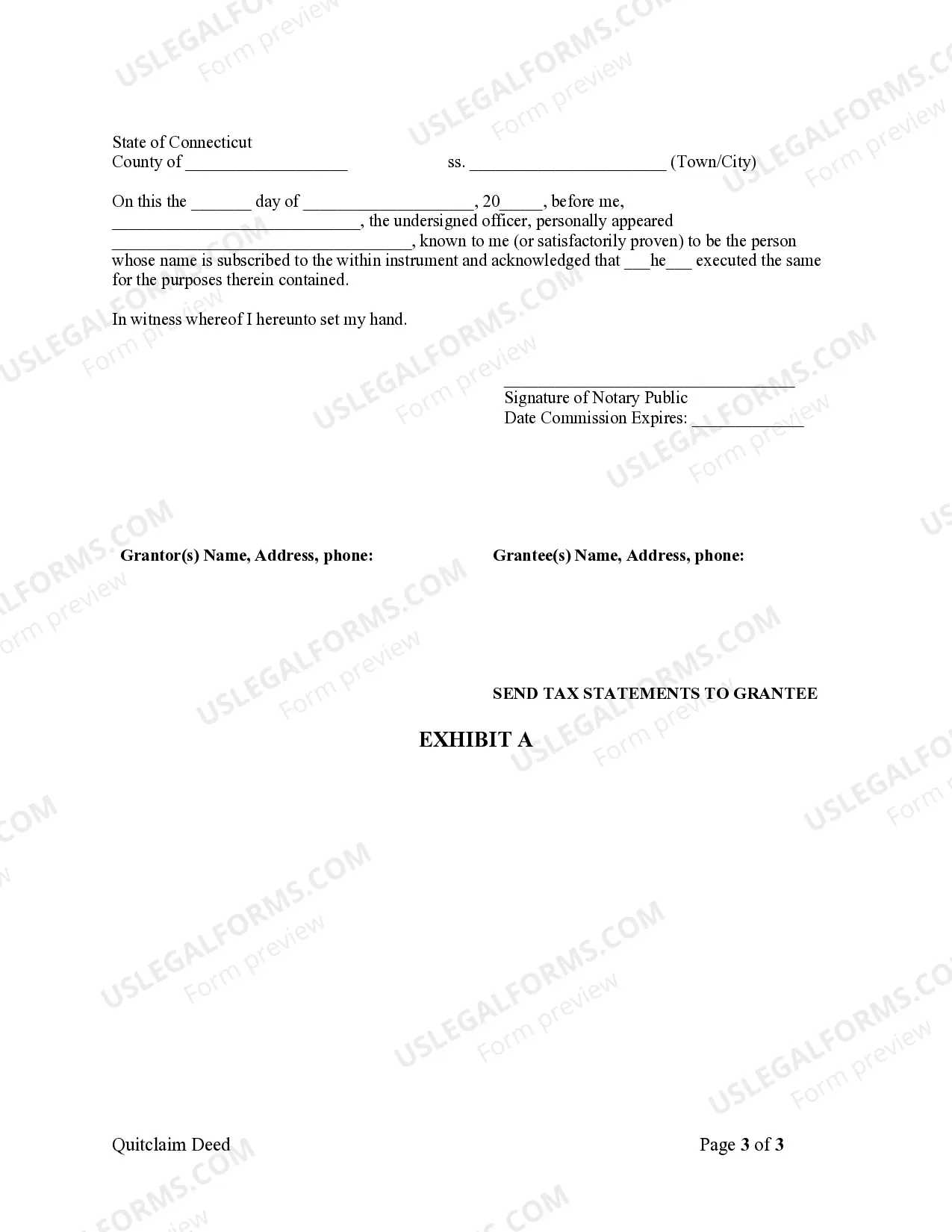
This form must be notarized to be legally valid. US Legal Forms provides secure online notarization powered by Notarize, allowing you to complete the process through a verified video call.
Get your form ready online
Our built-in tools help you complete, sign, share, and store your documents in one place.
Make edits, fill in missing information, and update formatting in US Legal Forms—just like you would in MS Word.
Download a copy, print it, send it by email, or mail it via USPS—whatever works best for your next step.
Sign and collect signatures with our SignNow integration. Send to multiple recipients, set reminders, and more. Go Premium to unlock E-Sign.
If this form requires notarization, complete it online through a secure video call—no need to meet a notary in person or wait for an appointment.
We protect your documents and personal data by following strict security and privacy standards.

Make edits, fill in missing information, and update formatting in US Legal Forms—just like you would in MS Word.

Download a copy, print it, send it by email, or mail it via USPS—whatever works best for your next step.

Sign and collect signatures with our SignNow integration. Send to multiple recipients, set reminders, and more. Go Premium to unlock E-Sign.

If this form requires notarization, complete it online through a secure video call—no need to meet a notary in person or wait for an appointment.

We protect your documents and personal data by following strict security and privacy standards.
Mistakes to watch out for
- Failing to provide a complete property description, which may lead to ambiguity in ownership.
- Omitting necessary signatures or witness information, rendering the deed invalid.
- Not specifying any easements or reservations, which could lead to future disputes.
- Neglecting to record the quitclaim deed with the appropriate local authority after execution.
Benefits of using this form online
- Convenience: Easily download and complete the form at your own pace.
- Editability: Customize the form to your specific needs without hassle.
- Reliability: Forms are crafted by licensed attorneys, ensuring compliance with legal standards.
Looking for another form?
Form popularity
FAQ
To remove someone from a deed in Connecticut, you typically need to execute a quit claim deed to transfer their interest. Both parties must agree to the removal, often requiring a signed document from the person being removed. After preparing the Connecticut Quitclaim Deed by Two Individuals to Corporation, file it with the local town clerk to formalize the change. This process ensures that the property records accurately reflect ownership.
Quitclaim deeds are often viewed with caution because they do not guarantee clear title to the property. They simply transfer whatever interest the grantor has, which might include unresolved liens or encumbrances. In many cases, buyers prefer warranties to ensure full ownership rights. Therefore, when using a Connecticut Quitclaim Deed by Two Individuals to Corporation, be aware of these potential risks.
Several factors can void a quit claim deed, such as lack of mutual consent or failure to meet state requirements. For example, if one party did not agree to the transfer, the deed may be considered invalid. Similarly, if the deed lacked the necessary signatures or was not recorded properly, it could be voided. Understanding these elements can help you complete a valid Connecticut Quitclaim Deed by Two Individuals to Corporation.
Yes, a quitclaim deed must be signed by both parties involved. In the case of a Connecticut Quitclaim Deed by Two Individuals to Corporation, all parties must agree on the transfer of property rights. Failing to obtain both signatures may result in a voided deed. Therefore, ensure all necessary parties participate in the signing.
A Connecticut Quitclaim Deed by Two Individuals to Corporation may come with certain drawbacks. Primarily, this type of deed offers no guarantees regarding the state of the property title, which could result in surprises for the new owner. Additionally, it does not protect the buyer if any liens or claims exist on the property. Thus, it is important to conduct thorough due diligence before proceeding.
Similar to the previous question, a Connecticut Quitclaim Deed by Two Individuals to Corporation can accommodate multiple parties as grantees or grantors. Including several individuals can clarify property ownership among co-owners. Ensure that the deed’s details accurately reflect all parties' names to avoid future confusion. This approach promotes transparency and eases the management of shared property.
There is no strict limit to the number of individuals who can be included on a Connecticut Quitclaim Deed by Two Individuals to Corporation. You can add as many co-owners as necessary, provided their names are clearly stated in the deed. Each individual will hold equal interest in the property unless specified otherwise. This flexibility can be beneficial for families or groups looking to share property ownership.
In Connecticut, a quitclaim deed must meet certain requirements to be valid. The document must include the names of both individuals transferring the property to a corporation, a description of the property, and the signatures of the grantors. Furthermore, the deed must be notarized before recording it with the town clerk. Following these steps is essential for ensuring a proper Connecticut Quitclaim Deed by Two Individuals to Corporation.
Yes, both parties should be present to execute a Connecticut Quitclaim Deed by Two Individuals to Corporation. This ensures that all parties understand and agree to the terms of the deed. Additionally, having both individuals present helps prevent any disputes later on. However, if one party cannot attend, they may be able to authorize a representative to sign on their behalf.
After a Connecticut Quitclaim Deed by Two Individuals to Corporation is filed, it becomes part of the public record. This filing confirms the transfer of ownership and protects the rights of the new owner. Additionally, the previous owners relinquish any claim to the property, which is critical for future transactions. Keep an eye on any notices or additional documentation that may arise after the filing process.