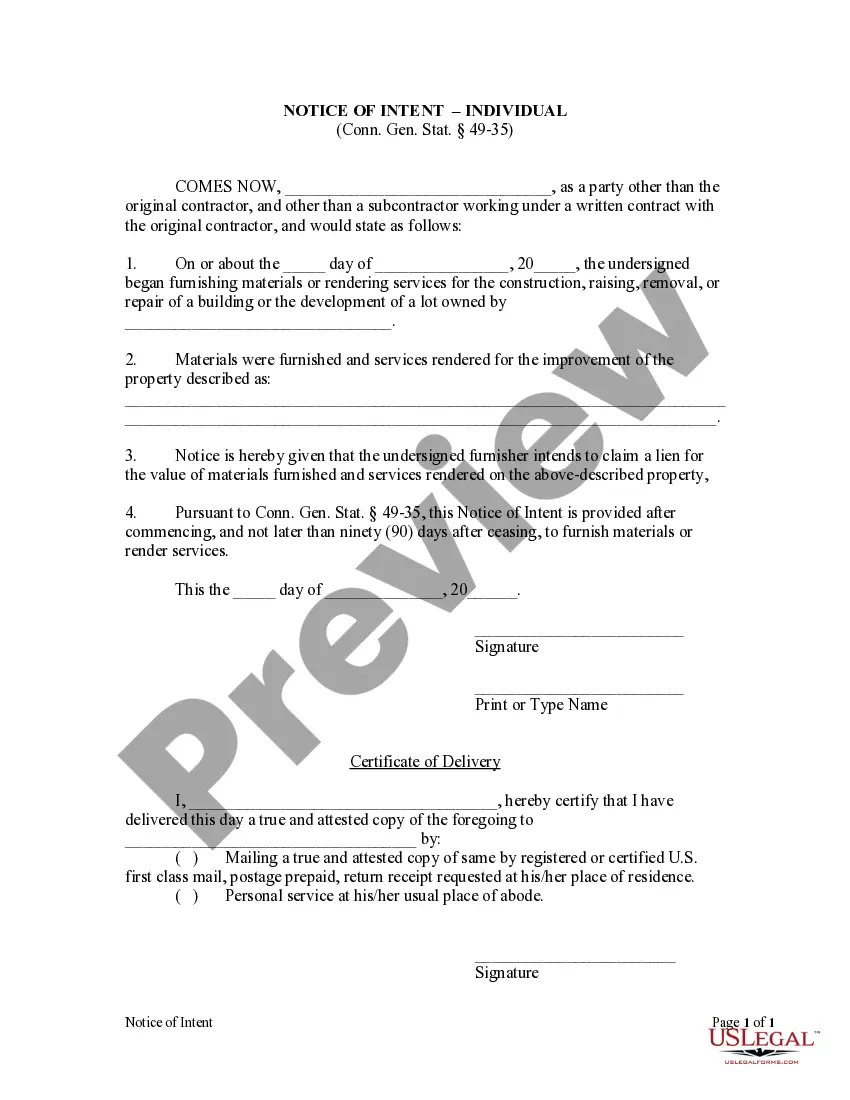
Connecticut Notice of Intent - Individual
What this document covers
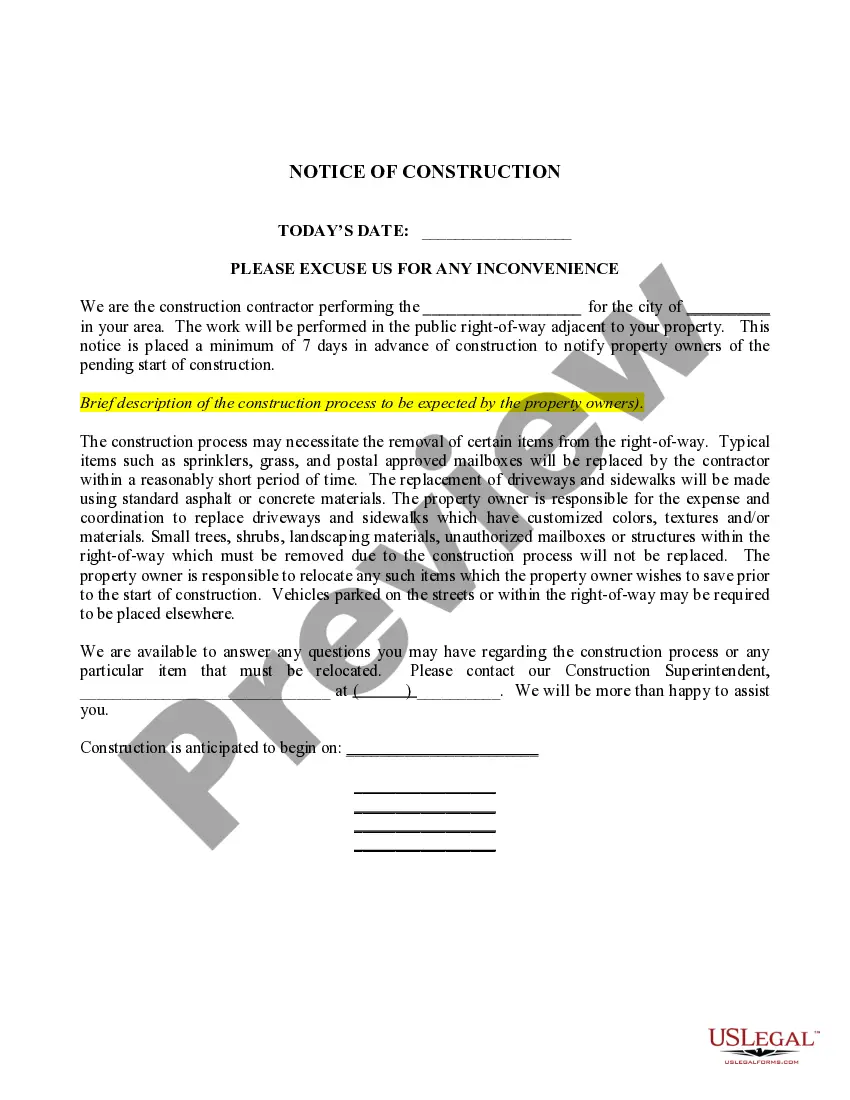
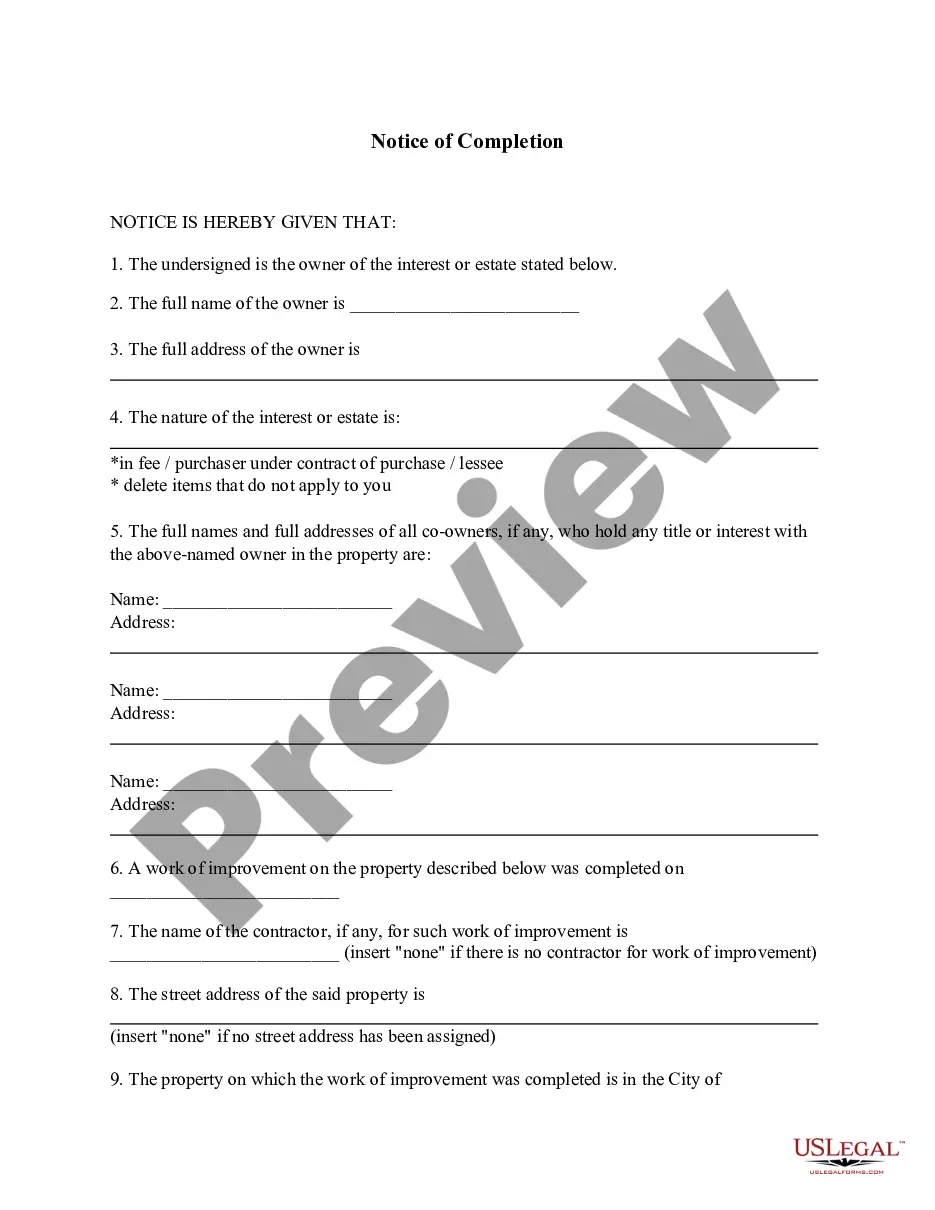
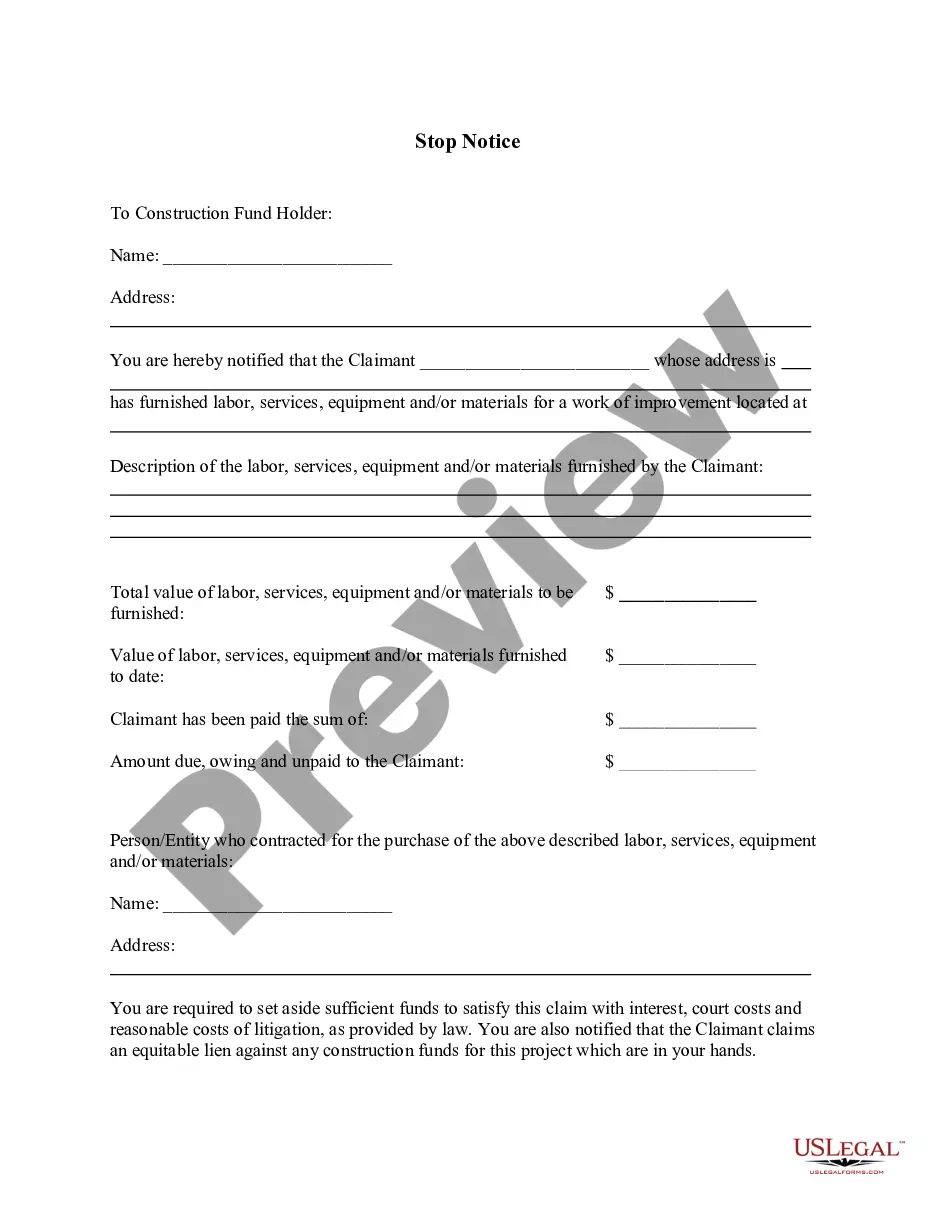
The Notice of Intent - Individual is a legal document that allows parties other than the original contractor to inform property owners of their intention to claim a mechanic's lien. Unlike other forms related to property claims, this notice must be sent after providing materials or services and within a specific timeframe to maintain the right to file a lien.
Key parts of this document
- Identifying details of the individual claiming the lien.
- Specific date when materials or services began.
- Description of the property affected by the lien.
- Statement of intent to claim a lien for provided materials and services.
- Certificate of delivery confirming the notice was sent to the property owner and original contractor.
When this form is needed
This form should be used when you have provided materials or services to a property but are not the original contractor. If you have not received payment or if the original contractor has recorded a lien, this notice must be submitted to protect your rights to claim a mechanic's lien.
Who needs this form
- Suppliers of materials who have not been paid.
- Contractors who rendered services but have not received compensation.
- Subcontractors without a written agreement with the original contractor.
- Any individual or party involved in a construction-related project seeking to protect their lien rights.
How to prepare this document
- Provide your name and the name of the property owner.
- Specify the date when you started to furnish materials or render services.
- Clearly describe the property related to your claim.
- State your intent to claim a lien for the services or materials provided.
- Enter the date of completion and sign the form.
- Deliver a copy of the notice to the property owner and original contractor.
Notarization guidance
Notarization is not commonly needed for this form. However, certain documents or local rules may make it necessary. Our notarization service, powered by Notarize, allows you to finalize it securely online anytime, day or night.
Get your form ready online
Our built-in tools help you complete, sign, share, and store your documents in one place.
Make edits, fill in missing information, and update formatting in US Legal Forms—just like you would in MS Word.
Download a copy, print it, send it by email, or mail it via USPS—whatever works best for your next step.
Sign and collect signatures with our SignNow integration. Send to multiple recipients, set reminders, and more. Go Premium to unlock E-Sign.
If this form requires notarization, complete it online through a secure video call—no need to meet a notary in person or wait for an appointment.
We protect your documents and personal data by following strict security and privacy standards.

Make edits, fill in missing information, and update formatting in US Legal Forms—just like you would in MS Word.

Download a copy, print it, send it by email, or mail it via USPS—whatever works best for your next step.

Sign and collect signatures with our SignNow integration. Send to multiple recipients, set reminders, and more. Go Premium to unlock E-Sign.

If this form requires notarization, complete it online through a secure video call—no need to meet a notary in person or wait for an appointment.

We protect your documents and personal data by following strict security and privacy standards.
Typical mistakes to avoid
- Failing to send the notice within the 90-day timeframe.
- Not including a complete description of the property.
- Omitting the required signatures.
Benefits of completing this form online
- Convenient access to legal forms anytime and anywhere.
- Editable templates that allow users to customize their information easily.
- Reliability through professionally drafted forms created by licensed attorneys.
Looking for another form?








Form popularity
FAQ
You can record your boss yelling at you in Connecticut if you are part of the conversation. Connecticut law allows you to record conversations without notifying the other party, as long as you are involved. Knowing the nuances of the Connecticut Notice of Intent - Individual can help protect your rights. If you need guidance, platforms like uslegalforms can be incredibly helpful.
Connecticut is a one-party consent state, meaning only one participant in a conversation needs to consent to recording it legally. This law applies to in-person conversations as well as phone calls. A solid understanding of the Connecticut Notice of Intent - Individual is beneficial for anyone who wants to avoid legal pitfalls. If you need assistance with this, consider using resources from uslegalforms.
In Connecticut, recording a phone call requires at least one party's consent. This means if you are part of the call, you can record it without notifying the other person. Familiarizing yourself with the Connecticut Notice of Intent - Individual is vital for anyone considering recording calls. Always ensure you follow the law to safeguard yourself.
Yes, in Connecticut, a person can legally record a conversation as long as they are participating in it. However, if you are not part of the conversation, recording without consent is prohibited. Understanding the Connecticut Notice of Intent - Individual can help clarify these rights. When in doubt, consult legal guidelines or resources to avoid issues.
In Connecticut, you generally need consent to record a conversation, especially if it occurs in a private setting. This falls under the Connecticut Notice of Intent - Individual guidelines. Without consent from all parties involved, you may face legal repercussions. It's essential to understand the law to protect your rights.
A letter of intent to place a lien serves as a communication notifying parties of the impending claim against their property. This letter outlines the reasons for the lien and provides critical information about the debt owed. Using a Connecticut Notice of Intent - Individual can help you formalize this process and protect your interests effectively.
The release of lien in Connecticut requires a specific form that documents the removal of a financial claim on your property. This document confirms that you have satisfied the conditions of the lien and frees your property from encumbrances. You can conveniently access this form through platforms like US Legal Forms, ensuring you follow all necessary legal protocols.
In Connecticut, a lien typically remains on your property for a period of five years unless it is renewed, released, or resolved. If you do not address the lien, it can lead to further complications, including legal action. To effectively manage your property rights, consider utilizing the Connecticut Notice of Intent - Individual to navigate this matter.
A Connecticut Notice of Intent - Individual is a formal document informing interested parties of a person's intention to take a specific action, especially in regards to potential claims on a property. This notice serves as a precautionary step to protect your legal rights. Understanding this process can help you avoid misunderstandings and disputes later on.
To file a lien on a property in Connecticut, you must first complete a Connecticut Notice of Intent - Individual. This document informs the property owner of your claim. After preparing the Notice of Intent, you submit it to the local town clerk where the property is located. It is essential to follow all local regulations to ensure your lien is valid and enforceable.