Connecticut Quitclaim Deed from Husband and Wife to an Individual
What this document covers
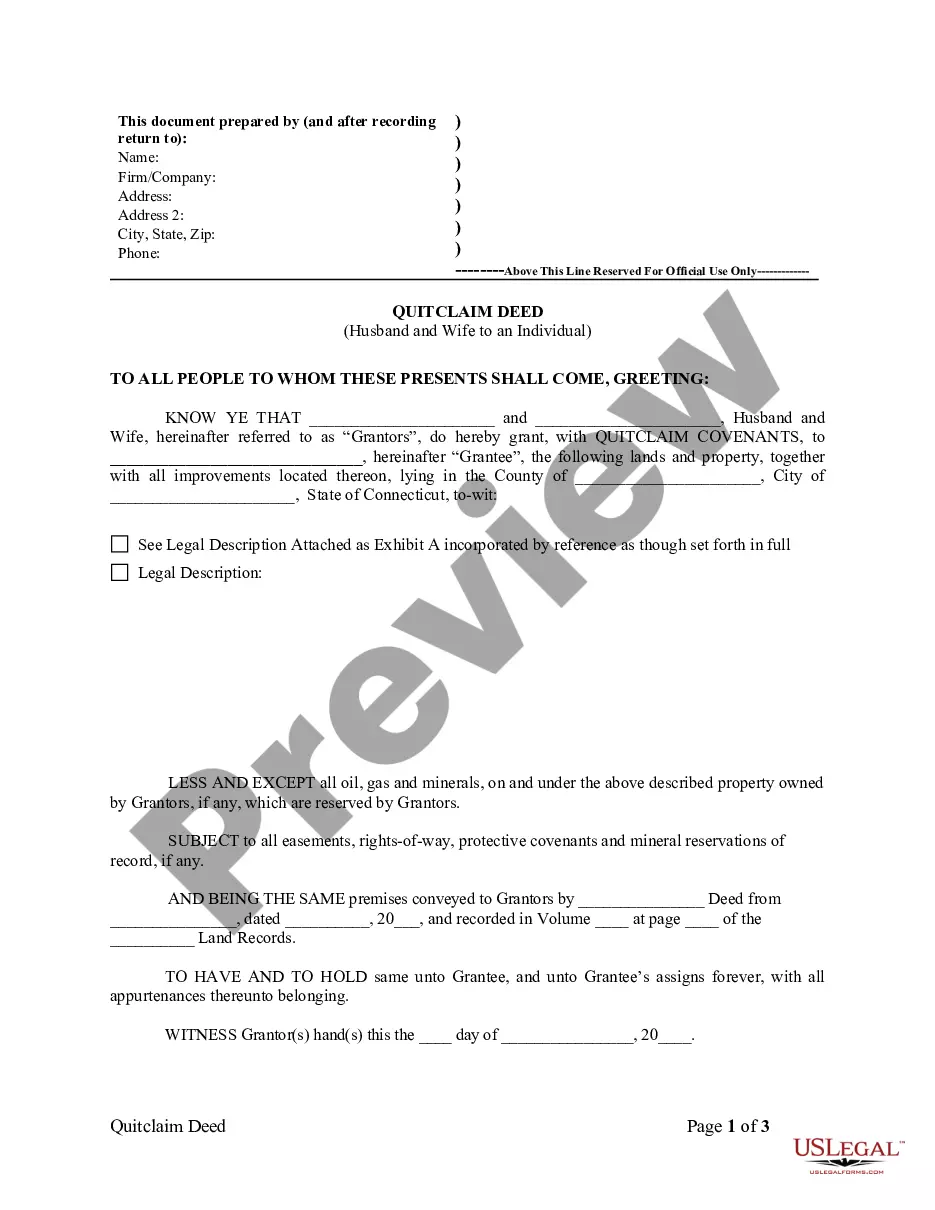
The Quitclaim Deed from Husband and Wife to an Individual is a legal document used when a married couple (the grantors) wishes to transfer their interest in a property to a single individual (the grantee). This form provides a straightforward way to convey property ownership without any warranties or guarantees regarding the title. Unlike other types of deeds, such as warranty deeds, this quitclaim deed does not ensure that the property is free of encumbrances. It is commonly used in situations where the transfer is a gift, or in intra-family transactions.
Key components of this form
- Identification of the grantors (husband and wife) and the grantee (individual).
- Description of the property being transferred.
- Details of any reservations, such as oil, gas, and mineral rights.
- Reference to the previous deed that established the grantors' ownership.
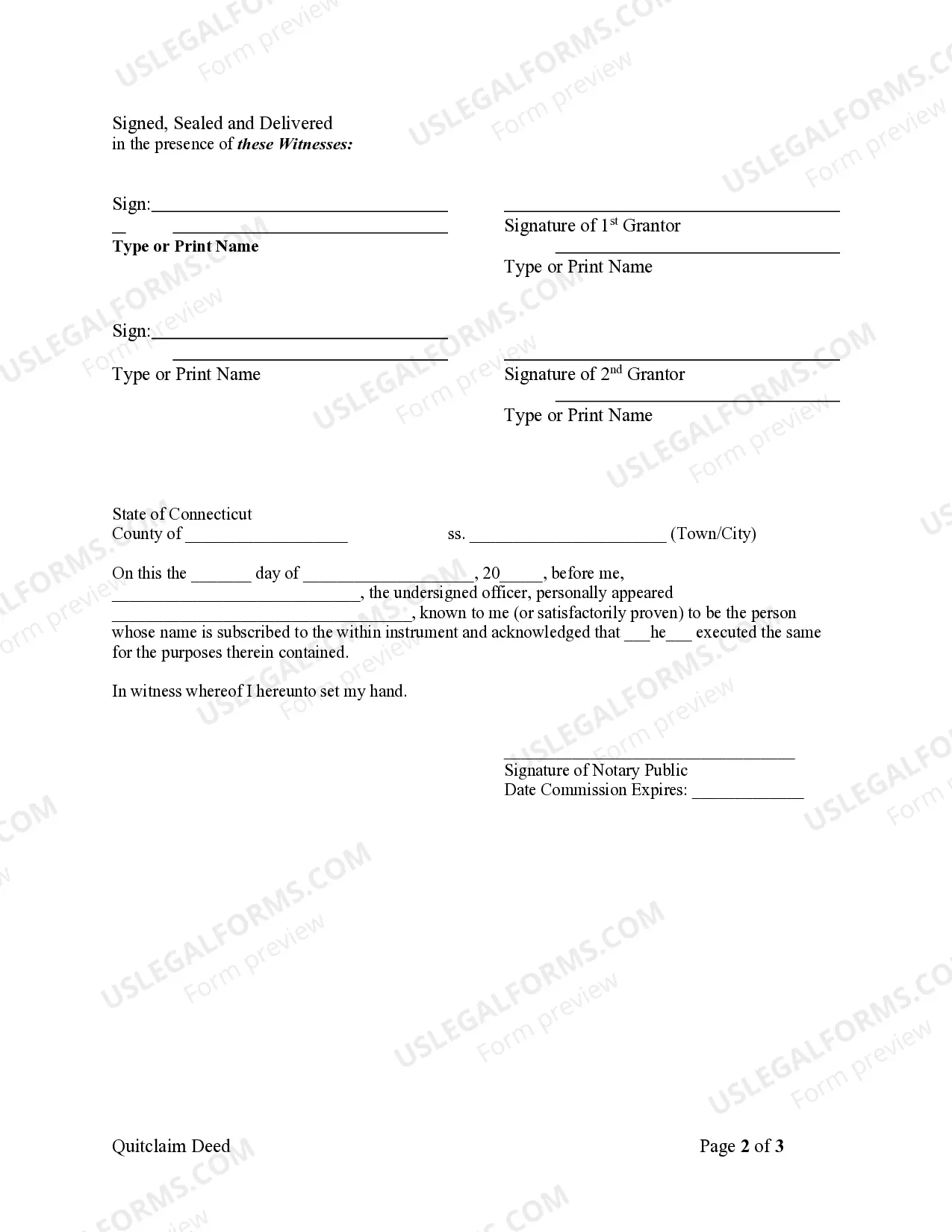
- Signatures of the grantors to finalize the transfer.





When this form is needed
This form is ideal to use in several scenarios, including: transferring ownership of a family property to a child or grandchild, handling property division during a divorce, or when one spouse purchases the other spouse's interest in a property. It is also useful in situations where property is being transferred as part of an estate settlement or gift.
Intended users of this form
- Married couples wishing to transfer real estate to an individual.
- Individuals involved in a divorce process looking to facilitate property transfers.
- Families managing inheritance or gift transactions related to property.
- Anyone who needs to document a straightforward property transfer without guarantees on the title.
Instructions for completing this form
- Identify the grantors - the husband and wife transferring the property.
- Specify the grantee - the individual receiving the property.
- Describe the property in detail, including boundaries and existing rights.
- Reference the previous deed including the date and recording information.
- Obtain the signatures of both grantors and ensure all required fields are filled.
Notarization requirements for this form
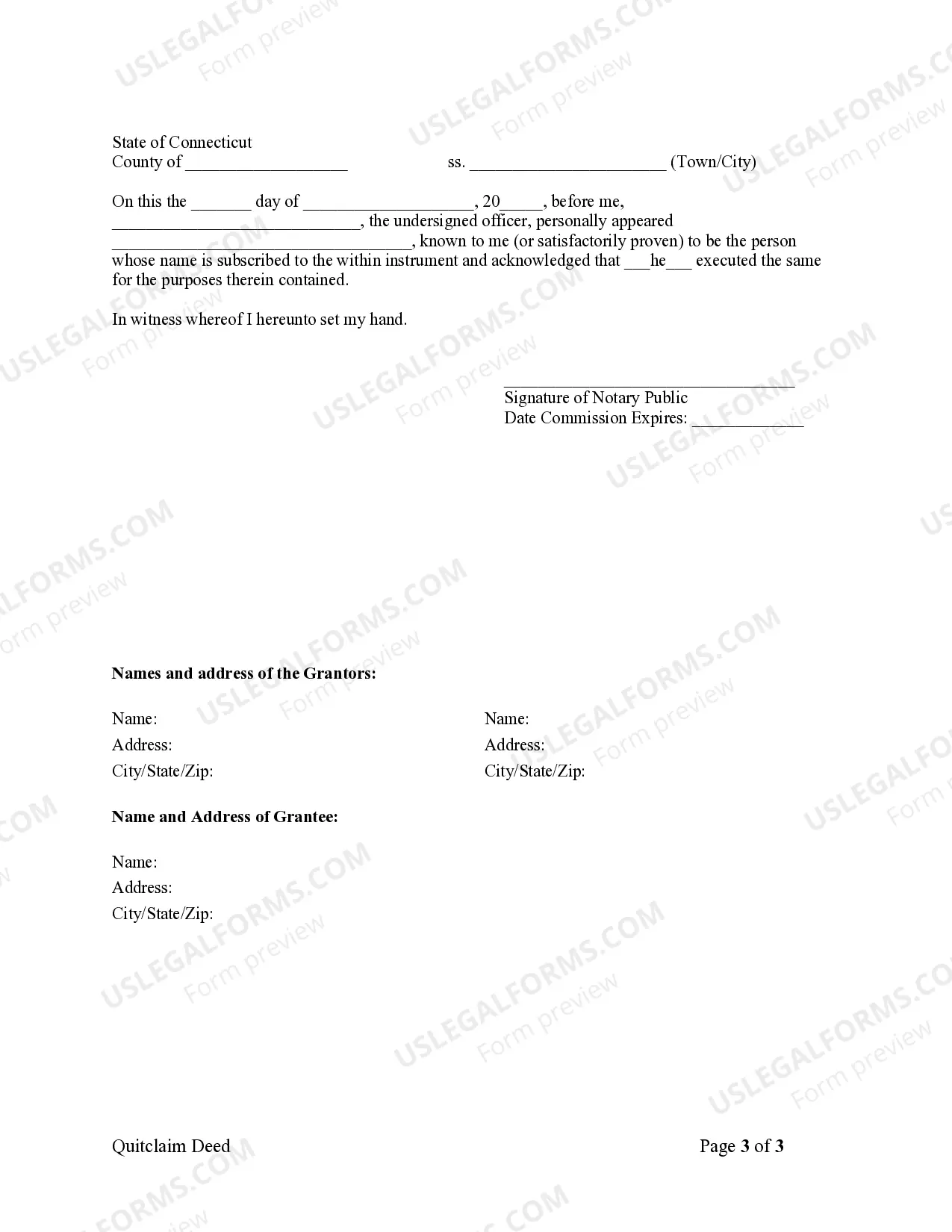
This form does not typically require notarization unless specified by local law. However, it is often advisable to have the deed notarized to ensure its validity and to avoid any future disputes regarding the transfer.
Get your form ready online
Our built-in tools help you complete, sign, share, and store your documents in one place.
Make edits, fill in missing information, and update formatting in US Legal Forms—just like you would in MS Word.
Download a copy, print it, send it by email, or mail it via USPS—whatever works best for your next step.
Sign and collect signatures with our SignNow integration. Send to multiple recipients, set reminders, and more. Go Premium to unlock E-Sign.
If this form requires notarization, complete it online through a secure video call—no need to meet a notary in person or wait for an appointment.
We protect your documents and personal data by following strict security and privacy standards.

Make edits, fill in missing information, and update formatting in US Legal Forms—just like you would in MS Word.

Download a copy, print it, send it by email, or mail it via USPS—whatever works best for your next step.

Sign and collect signatures with our SignNow integration. Send to multiple recipients, set reminders, and more. Go Premium to unlock E-Sign.

If this form requires notarization, complete it online through a secure video call—no need to meet a notary in person or wait for an appointment.

We protect your documents and personal data by following strict security and privacy standards.
Common mistakes
- Failing to properly describe the property, leading to confusion or disputes.
- Not including the necessary signatures, which may invalidate the deed.
- Omitting details about any retained rights, such as mineral rights.
- Not referencing the prior deed correctly can complicate property history.
Benefits of using this form online
- Convenience of accessing and downloading the form anytime, anywhere.
- Editability allows for easy customization to fit specific circumstances.
- Reliability from forms drafted by licensed attorneys ensuring legal compliance.
Looking for another form?
Form popularity
FAQ
Typically, grantors benefit the most from a Connecticut Quitclaim Deed from Husband and Wife to an Individual because it allows them to quickly transfer ownership without the hassle of ensuring clear title. This is particularly useful in family situations, such as divorce or estate planning, where speedy resolution is desired. However, it is crucial for grantees to understand the risks involved, ensuring they conduct thorough background checks on the property to protect themselves.
While a quit claim deed can serve its purpose in certain situations, it can be perceived as unfavorable due to the absence of title guarantees. The Connecticut Quitclaim Deed from Husband and Wife to an Individual simply relays whatever interest the grantors possess, making it risky for buyers. Buyers may find themselves entangled in disputes or facing financial difficulties if prior claims exist. Thus, due diligence is vital before proceeding with this kind of deed.
One major disadvantage for buyers receiving a Connecticut Quitclaim Deed from Husband and Wife to an Individual is the potential lack of title warranty. This means that buyers might inherit hidden claims or liens against the property that the seller did not disclose. Essentially, buyers take on the risk without the protections provided by warranty deeds, which can lead to unexpected legal issues or financial burdens down the line.
The process for executing a Connecticut Quitclaim Deed from Husband and Wife to an Individual involves several key steps. First, both parties must fill out the quitclaim deed form, ensuring accurate property descriptions and names. Then, the deed needs to be signed in the presence of a notary public to validate the transaction. Finally, it must be filed with the local town clerk’s office to ensure public record.
Quitclaim deeds, such as the Connecticut Quitclaim Deed from Husband and Wife to an Individual, may be viewed with skepticism because they do not guarantee clear title. Unlike warranty deeds which assure that the grantor has the right to transfer ownership, quitclaims only pass on whatever interest the grantor has, if any. This uncertainty can lead to complications in property ownership and title disputes in the future. Therefore, buyers must proceed with caution.
For a married couple, a quitclaim deed often serves as the best option, especially when transferring property between spouses. A Connecticut Quitclaim Deed from Husband and Wife to an Individual allows one partner to transfer their interest without extensive legal processes. It is direct and easy to execute, making it suitable for various circumstances like gifting property or resolving title issues. Using an online resource like US Legal Forms can help you create the deed correctly and efficiently.
The usual reason for using a quitclaim deed is to transfer property rights between individuals without making guarantees about the title's validity. In many cases, a Connecticut Quitclaim Deed from Husband and Wife to an Individual is used in situations like divorce, inheritance, or to clear up an ambiguous title. This deed effectively simplifies the process of ownership transfer, making it ideal for personal situations. Platforms like US Legal Forms offer templates that make drafting these documents easier.
A quitclaim deed for a married couple is a simple way to transfer property ownership between spouses. In the context of a Connecticut Quitclaim Deed from Husband and Wife to an Individual, it allows one spouse to convey their rights without warranty against claims. This type of deed is often used in divorce settlements, estate planning, or when spouses want to clarify ownership. It’s a straightforward approach that is both quick and legally recognized.
To transfer ownership from husband to wife, you can utilize a Connecticut Quitclaim Deed from Husband and Wife to an Individual. This legal document allows one spouse to relinquish their interest in the property to the other spouse. It's important to accurately complete and sign the deed, and then record it with the local land records office to ensure the transfer is official. Consulting a legal professional or using a reliable platform like US Legal Forms can help streamline this process.
In Connecticut, a quitclaim deed requires specific requirements to be valid. It must be in writing, include the grantor's and grantee's names, and be signed by the grantor. Additionally, you'll need to ensure the deed is notarized and properly filed with the local land records office. US Legal Forms can provide templates and guidance to help streamline this process.