Colorado Last Will and Testament for Divorced Person Not Remarried with No Children
Overview of this form
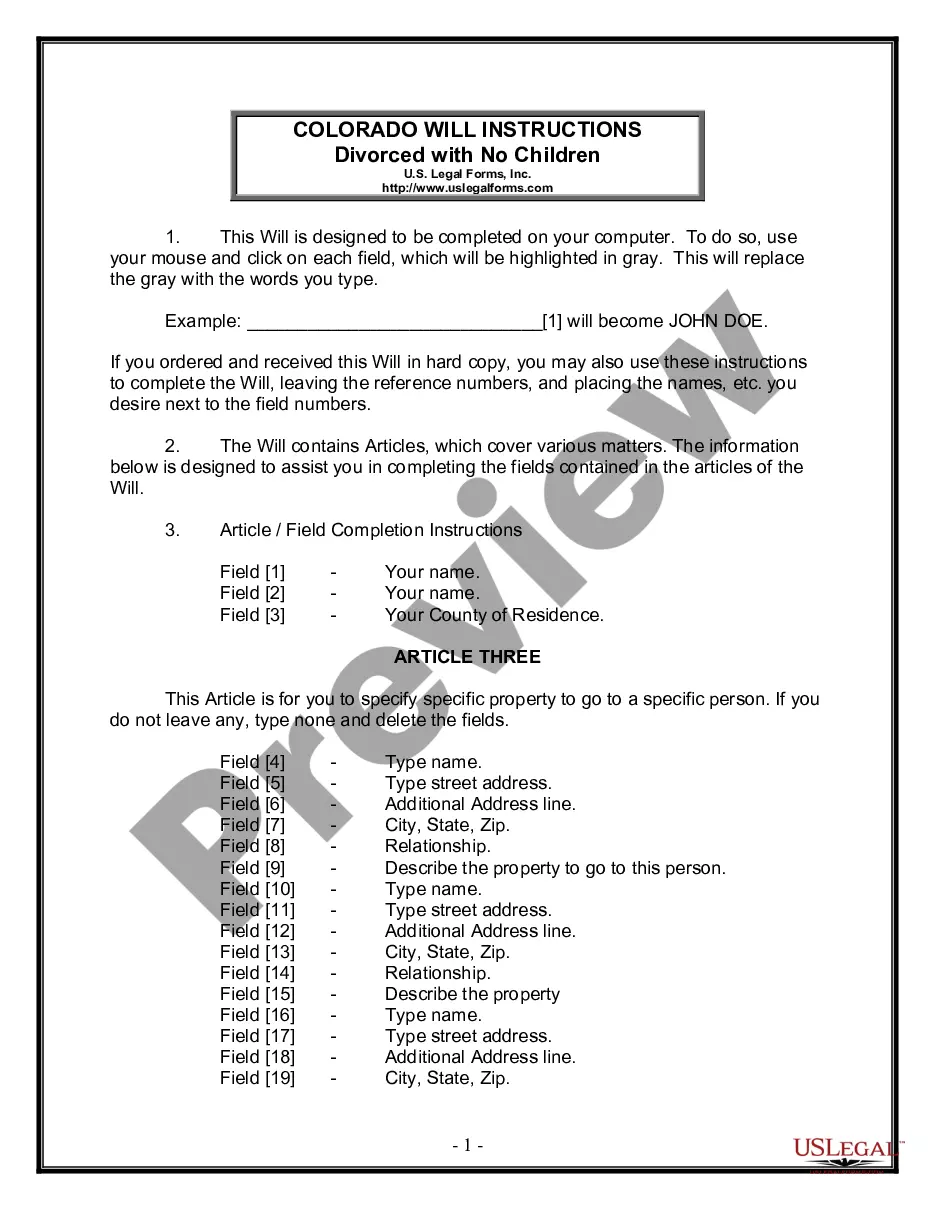
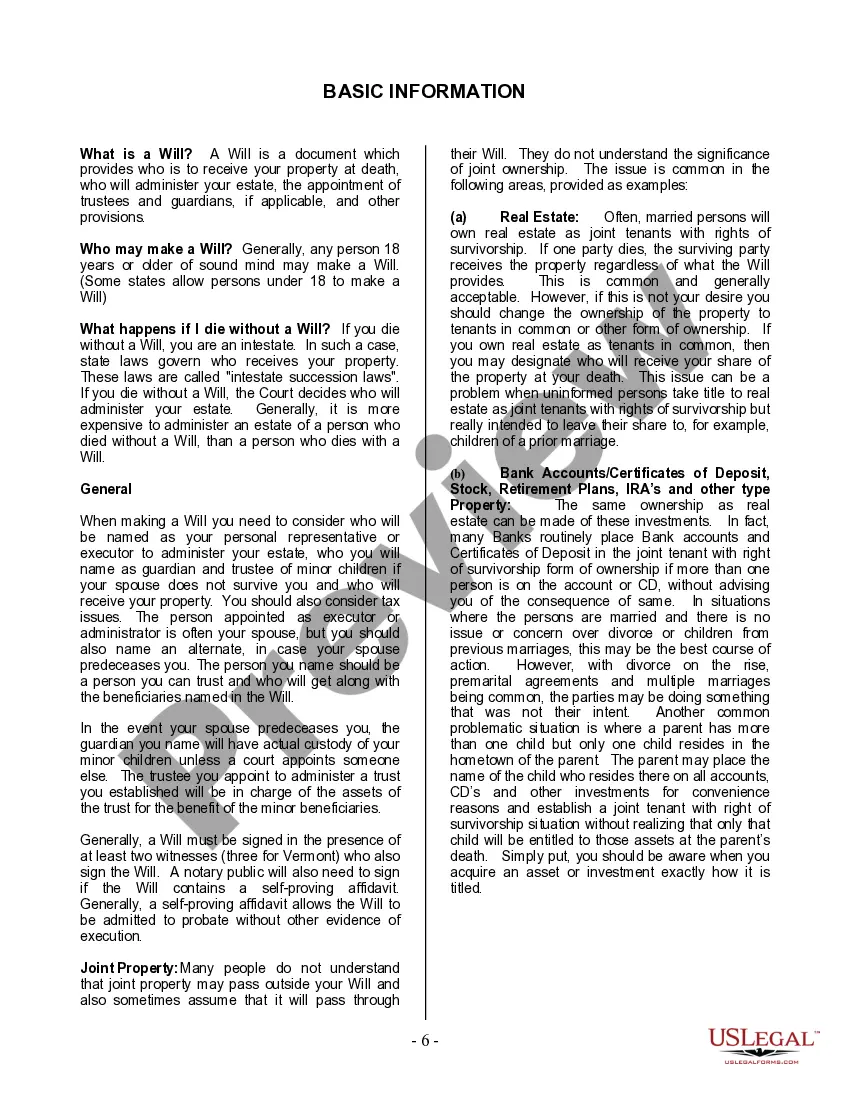
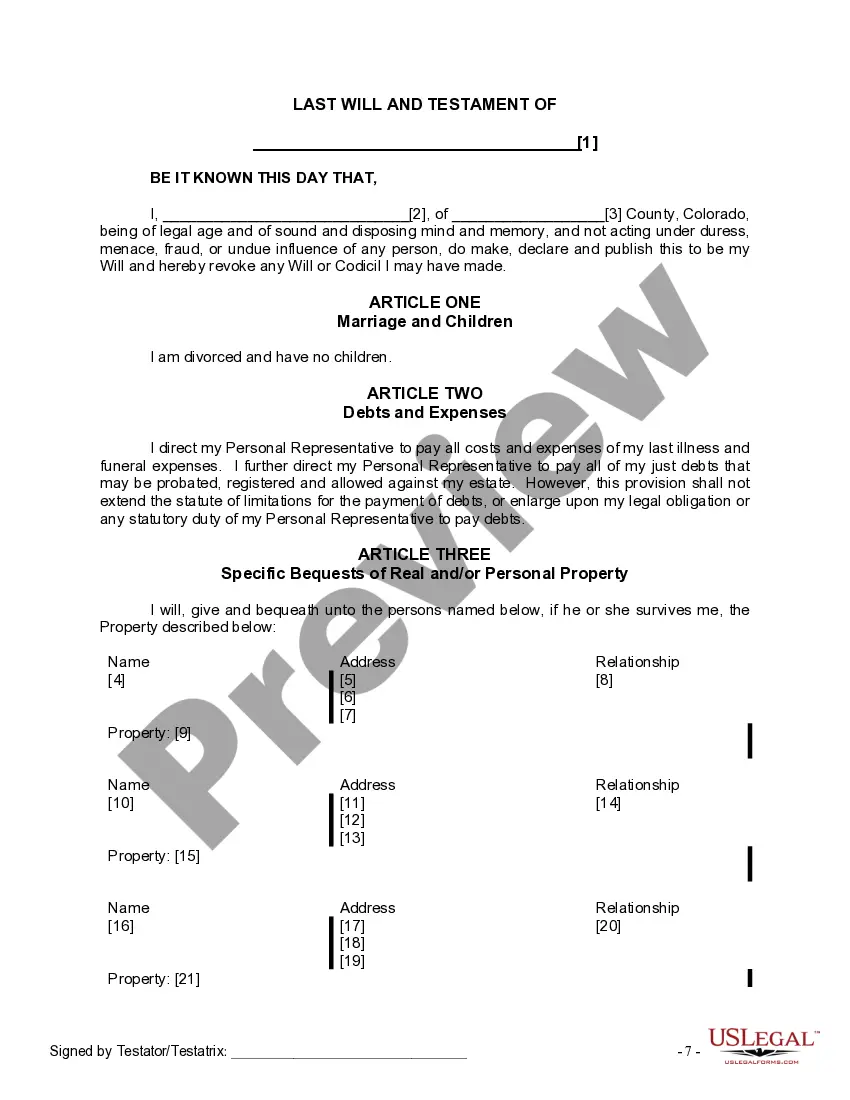
The Last Will and Testament for Divorced Person Not Remarried with No Children is a legal document that outlines how your property will be distributed upon your death if you are a divorced individual without children. This form specifies your preferences for appointing a personal representative, designating beneficiaries for your assets, and making any specific bequests. It is tailored specifically for those who have undergone divorce, ensuring that your wishes are clearly stated and legally binding.
Key components of this form
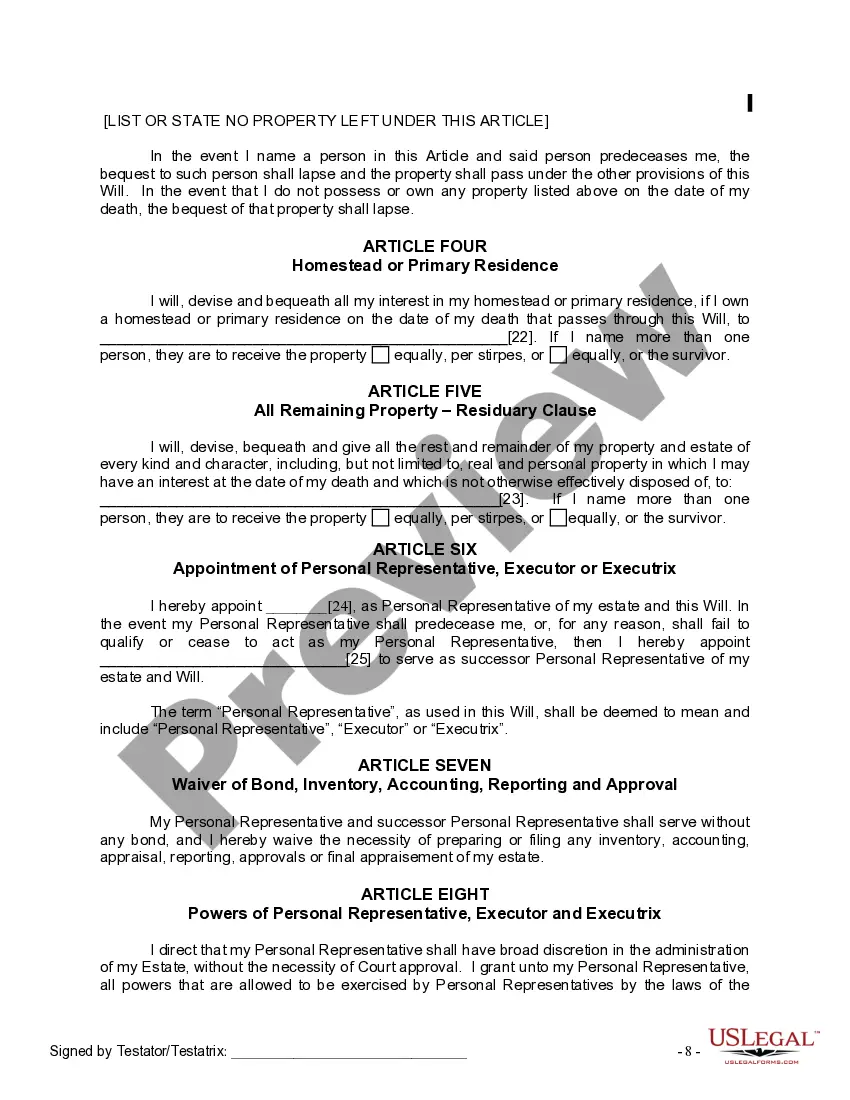
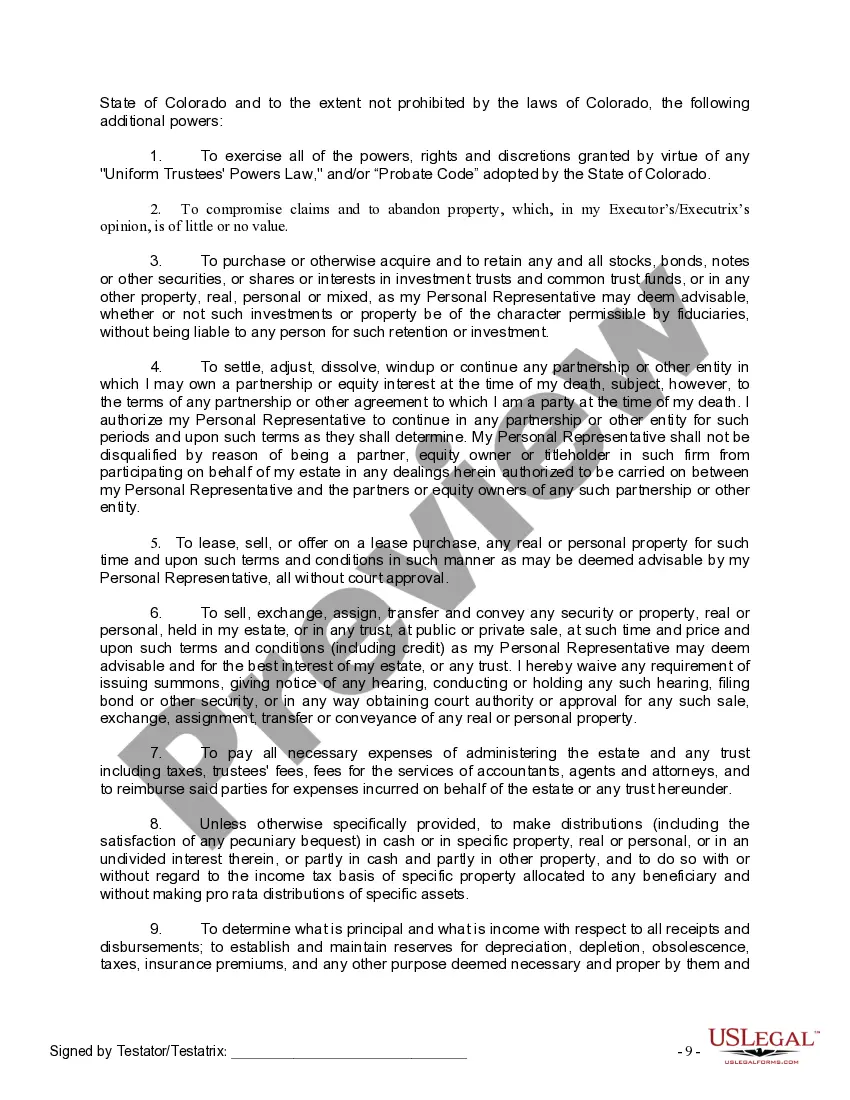
- Personal representative appointment: Designate an executor to manage and distribute your estate.
- Property distribution: Specify who receives your assets and how they are divided.
- Witness requirements: Must be signed in the presence of two witnesses who are not related to you.
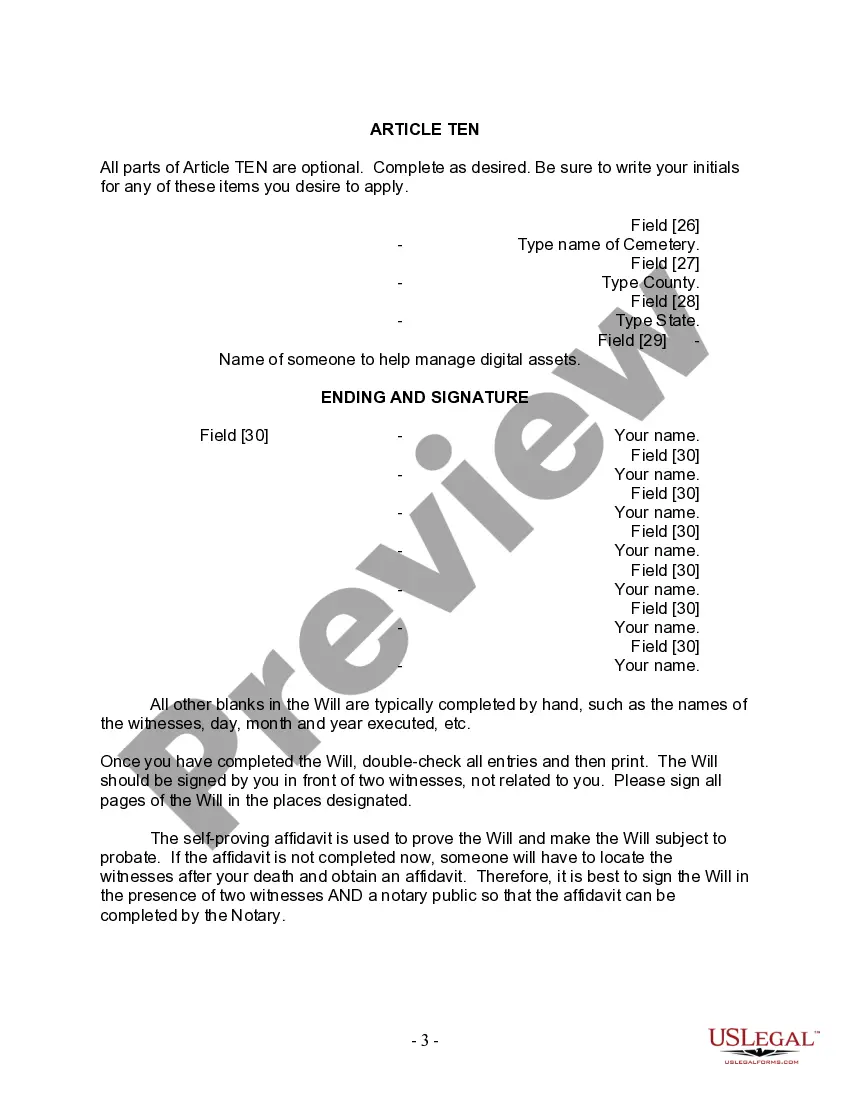
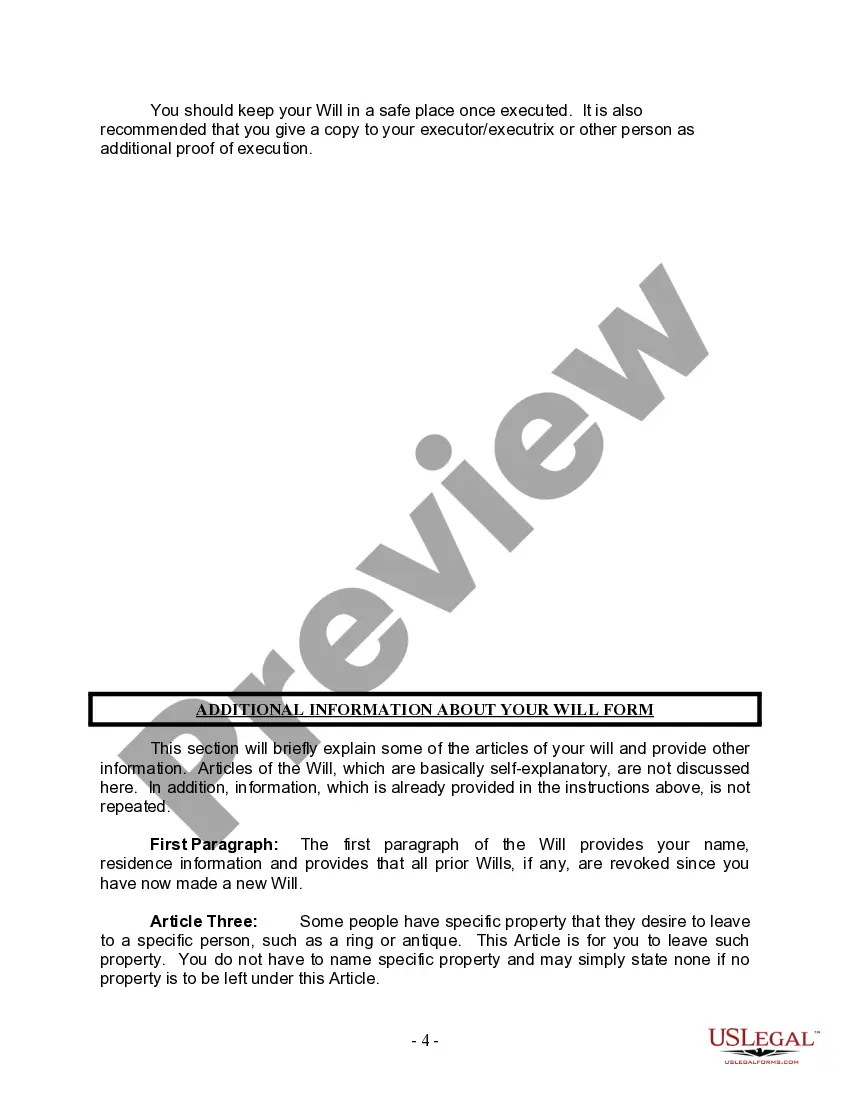
- Self-proving affidavit: Optionally included for a smoother probate process, requiring notarization.
- Special bequests: Ability to leave specific items to chosen individuals.


When this form is needed
This form is useful in scenarios where a divorced individual wishes to outline their end-of-life wishes regarding property and assets, such as when they want to ensure particular friends or family members are beneficiaries of their estate. It is also applicable to those who want to designate a personal representative to handle their affairs, especially when there are concerns about family dynamics that can arise post-divorce.
Who needs this form
This form is intended for:
- Any divorced individual who is not remarried.
- Individuals without children seeking to establish clear directives for their estate.
- Those who want to make sure their assets are passed on according to their wishes.
How to complete this form
- Begin by entering your full name and county of residence at the top of the document.
- Designate your personal representative by entering their name, and have a successor in mind as well.
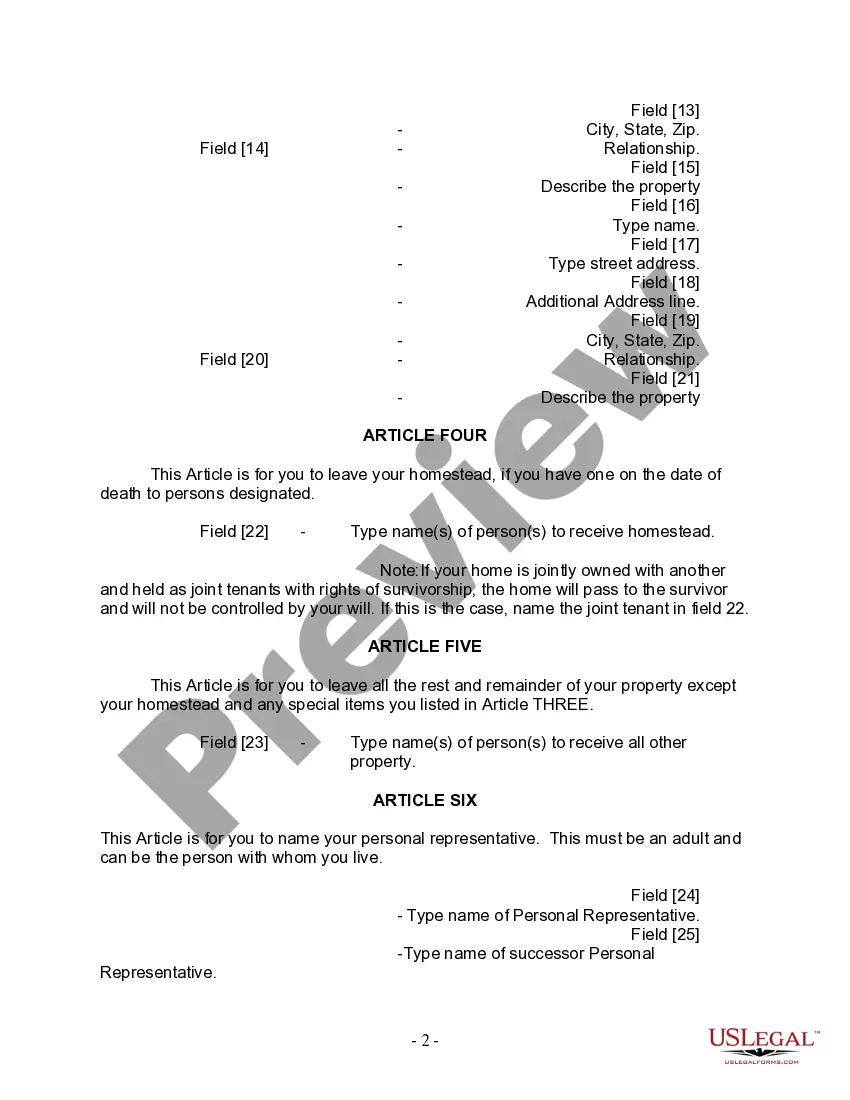
- Specify any specific property you wish to bequeath by filling in the names and details of the recipients.
- Complete the section for any homestead or primary residence you may own.
- Sign the document in front of your witnesses and have them sign as well, ensuring they are not related to you.
Does this document require notarization?
This form needs to be notarized to ensure legal validity. US Legal Forms provides secure online notarization powered by Notarize, allowing you to complete the process through a verified video call, available anytime.
Get your form ready online
Our built-in tools help you complete, sign, share, and store your documents in one place.
Make edits, fill in missing information, and update formatting in US Legal Forms—just like you would in MS Word.
Download a copy, print it, send it by email, or mail it via USPS—whatever works best for your next step.
Sign and collect signatures with our SignNow integration. Send to multiple recipients, set reminders, and more. Go Premium to unlock E-Sign.
If this form requires notarization, complete it online through a secure video call—no need to meet a notary in person or wait for an appointment.
We protect your documents and personal data by following strict security and privacy standards.

Make edits, fill in missing information, and update formatting in US Legal Forms—just like you would in MS Word.

Download a copy, print it, send it by email, or mail it via USPS—whatever works best for your next step.

Sign and collect signatures with our SignNow integration. Send to multiple recipients, set reminders, and more. Go Premium to unlock E-Sign.

If this form requires notarization, complete it online through a secure video call—no need to meet a notary in person or wait for an appointment.

We protect your documents and personal data by following strict security and privacy standards.
Common mistakes
- Not having the Will signed in the presence of two witnesses.
- Failing to include specific bequests and leaving asset distribution vague.
- Not updating the Will if circumstances change, such as a remarriage.
- Overlooking the requirements for notarization if a self-proving affidavit is added.
Why use this form online
- Convenient access to legally drafted documents without the need for an attorney.
- Editability allows you to modify the form according to your specific needs immediately.
- Instant download provides you with a copy that you can execute promptly.
- Guidance throughout the process helps ensure proper completion and compliance.
Looking for another form?
Form popularity
FAQ
In Colorado, when someone dies without a will, the remaining estate is distributed according to state law. The order typically starts with the spouse and children, but if you are a divorced person not remarried with no children, your assets could go to surviving parents or siblings. To prevent misallocation, drafting a Colorado Last Will and Testament is highly advisable.
If there is no will, the individuals who can inherit under Colorado's intestacy laws include the spouse, children, parents, and siblings. In the case of a divorced person not remarried with no children, the estate may pass to surviving parents or siblings first. To ensure your assets are distributed according to your desires, consider drafting a Colorado Last Will and Testament with clear guidelines.
When someone passes away without a will in Colorado, the state intestacy laws determine the heirs. Typically, this includes the spouse and children, but for a divorced person not remarried with no children, the inheritance may go to surviving parents or siblings. It is important to create a Colorado Last Will and Testament to avoid confusion and to establish clear intentions for your estate.
If there is no will, the executor does not have the authority to decide how assets are distributed. Instead, Colorado state law dictates the distribution of assets according to intestacy laws. For a divorced person not remarried with no children, understanding these laws is crucial when creating a Colorado Last Will and Testament to ensure your estate is handled according to your wishes.
In Colorado, getting divorced can impact your will significantly. Generally, any provisions in the will that benefit the former spouse become void upon divorce. Consequently, for a divorced person not remarried with no children, it is vital to update your Colorado Last Will and Testament to reflect new intentions after a divorce.
Yes, in Colorado, marriage does have an effect on a will. If you marry after creating a will, the new spouse may have certain rights to inherit unless explicitly excluded. Therefore, if you are a divorced person not remarried with no children, it is essential to carefully draft your Colorado Last Will and Testament to reflect your wishes.
For a will to be valid in Colorado, it must be in writing, signed by the testator, and witnessed by at least two individuals. The testator must be at least 18 years old and of sound mind at the time of signing. It is important to adhere to these requirements to ensure that your Colorado Last Will and Testament for a Divorced Person Not Remarried with No Children stands up in court.
In Colorado, the order of Next of Kin typically follows a hierarchy. If a person passes away without a will, the estate usually goes to the spouse, followed by children, parents, and then siblings. However, for a divorced person not remarried with no children, the estate would often go to surviving parents or siblings. Understanding this order is crucial when creating a Colorado Last Will and Testament for a Divorced Person Not Remarried with No Children.
Proving undue influence in Colorado involves demonstrating that someone exerted pressure on the testator, affecting their decision-making abilities. Key indicators may include a significant change in the will or a relationship where the influencer had power over the testator. In the context of a Colorado Last Will and Testament for Divorced Person Not Remarried with No Children, substantiating your claims can be complex. Consulting legal resources or uslegalforms can help guide you through this process.
The validity of a will in Colorado hinges on several factors, including the testator's mental capacity at signing, proper execution methods, and adherence to witnessing requirements. Additionally, the absence of undue influence or fraud also plays a critical role. Ensuring these factors align with your Colorado Last Will and Testament for Divorced Person Not Remarried with No Children is essential to uphold your intentions. Services from uslegalforms can help clarify these factors.