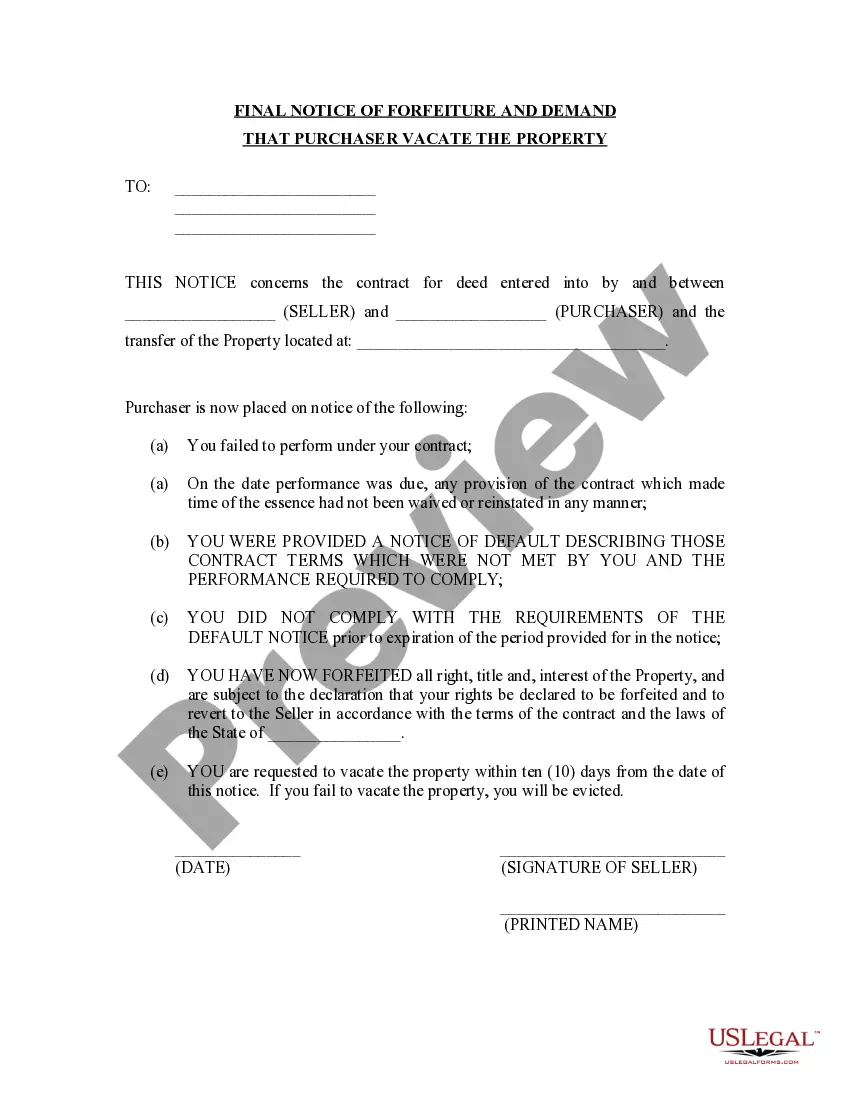
California Final Notice of Forfeiture and Request to Vacate Property under Contract for Deed
Overview of this form
The Final Notice of Forfeiture and Request to Vacate Property under Contract for Deed is an official document that informs a Purchaser that their contract for deed has been canceled by the Seller. This form is issued after prior notices of breach have been sent and not rectified. It clearly states that all prior payments made by the Purchaser are forfeited and indicates that any future occupancy of the property may lead to legal action.
Key parts of this document
- Identification of the Seller and Purchaser
- Details of the property under the contract
- Reference to previous notices of default
- Statement of forfeiture of prior payments
- Instructions for vacating the property
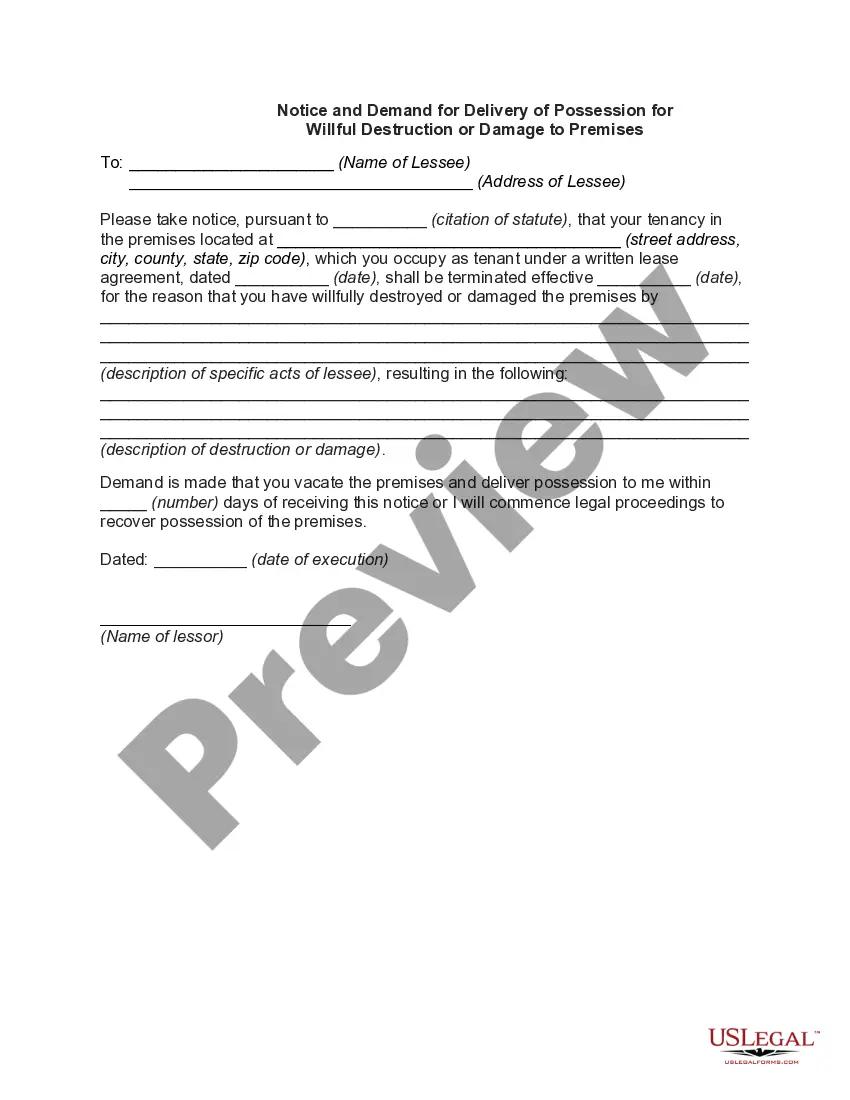
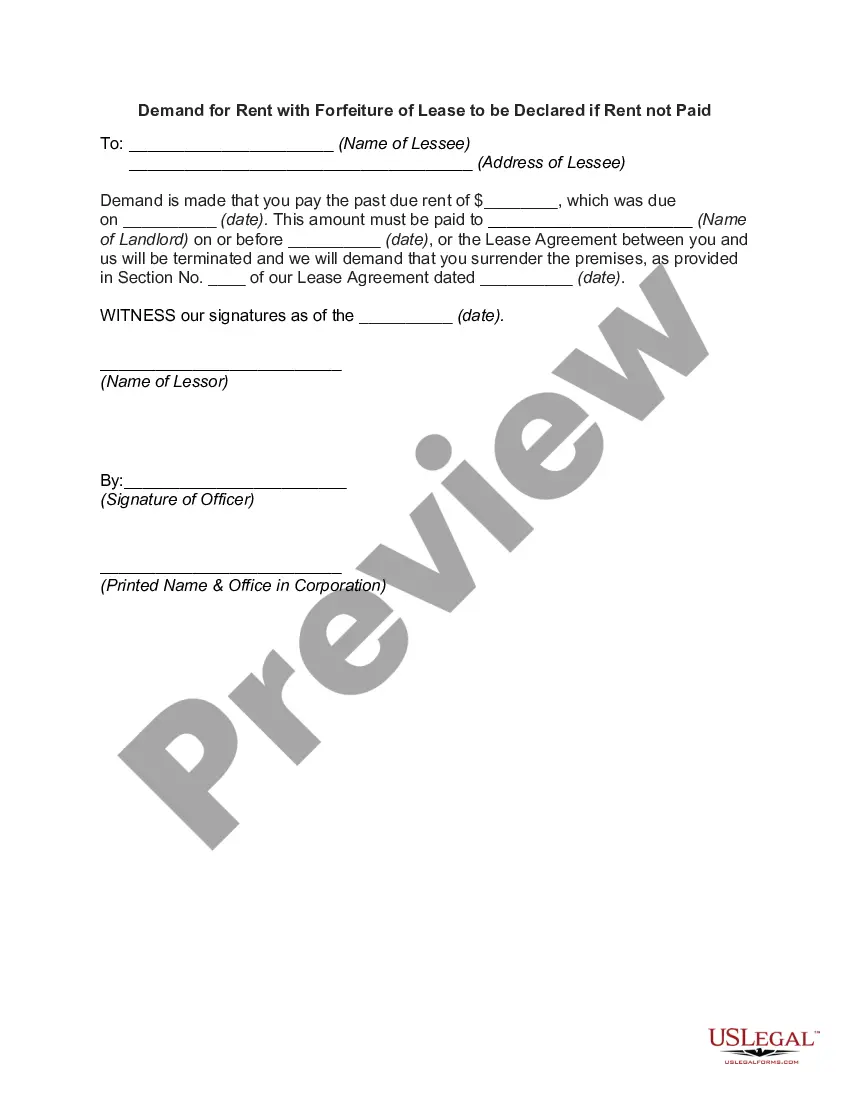
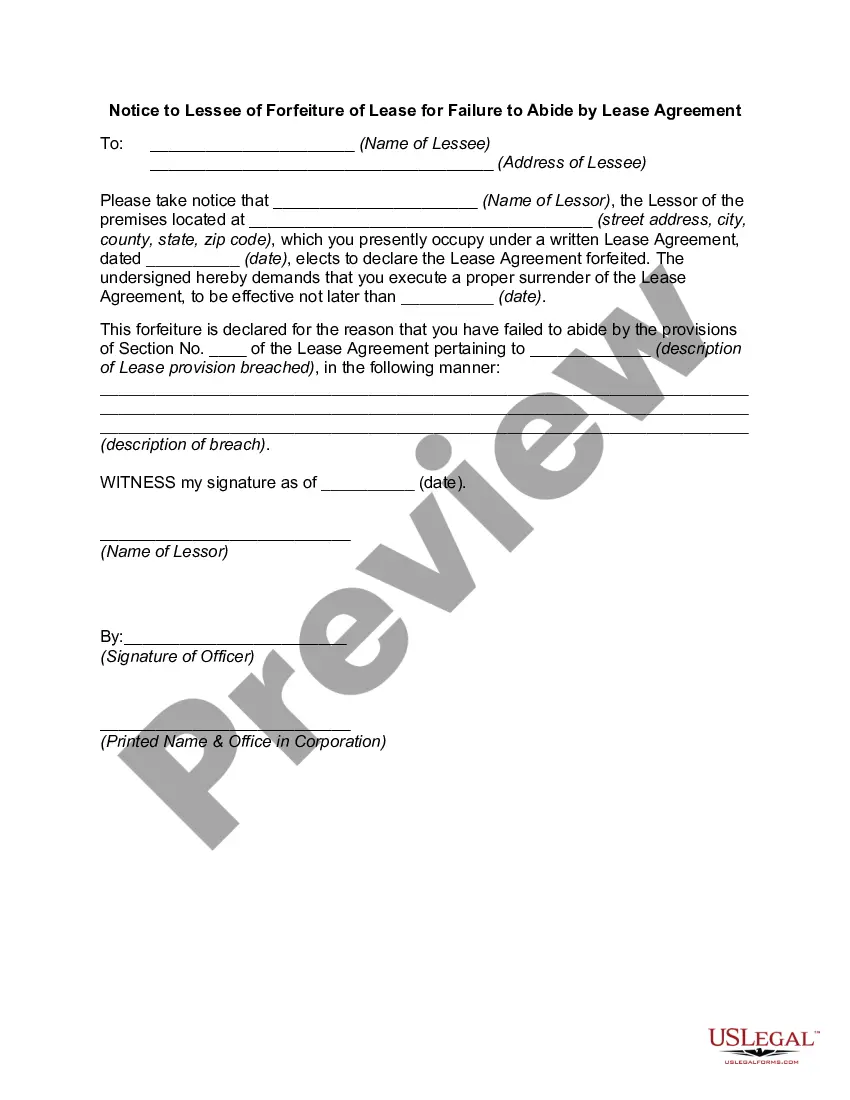
When to use this form
This form is used when a Seller wants to formally notify a Purchaser that they have not complied with the terms of a contract for deed after receiving previous warnings. It is necessary when the Seller intends to reclaim possession of the property and enforce the cancellation of the contract legally.
Who can use this document
- Property Sellers wishing to cancel a contract for deed
- Purchasers who have received notice of default
- Individuals involved in a real estate transaction under a contract for deed
Instructions for completing this form
- Identify the parties, including the Seller and Purchaser.
- Specify the property details, including address and relevant identifiers.
- Reference the previous notices of default and breaches.
- Include a statement of forfeiture and consequences of continued occupancy.
- Sign and date the form to validate the notice.
Notarization guidance
This form must be notarized to be legally valid. US Legal Forms provides secure online notarization powered by Notarize, allowing you to complete the process through a verified video call.
Get your form ready online
Our built-in tools help you complete, sign, share, and store your documents in one place.
Make edits, fill in missing information, and update formatting in US Legal Forms—just like you would in MS Word.
Download a copy, print it, send it by email, or mail it via USPS—whatever works best for your next step.
Sign and collect signatures with our SignNow integration. Send to multiple recipients, set reminders, and more. Go Premium to unlock E-Sign.
If this form requires notarization, complete it online through a secure video call—no need to meet a notary in person or wait for an appointment.
We protect your documents and personal data by following strict security and privacy standards.

Make edits, fill in missing information, and update formatting in US Legal Forms—just like you would in MS Word.

Download a copy, print it, send it by email, or mail it via USPS—whatever works best for your next step.

Sign and collect signatures with our SignNow integration. Send to multiple recipients, set reminders, and more. Go Premium to unlock E-Sign.

If this form requires notarization, complete it online through a secure video call—no need to meet a notary in person or wait for an appointment.

We protect your documents and personal data by following strict security and privacy standards.
Common mistakes
- Failing to provide sufficient details about the property.
- Not referencing all previous notices sent to the Purchaser.
- Leaving out signatures or dates, which can invalidate the document.
Benefits of completing this form online
- Easy access to professionally drafted templates.
- Time-saving with instant downloads available.
- Editable forms that let you customize the details.
- Reliable legal language designed for clarity and enforceability.
Main things to remember
- The form officially notifies the Purchaser of the cancellation of the contract.
- It's essential for Sellers who wish to reclaim their property after a breach.
- Ensure all required information is accurately filled out to avoid legal issues.
Looking for another form?


Form popularity
FAQ
A notice to vacate in California is a legal document issued by a landlord to notify a tenant that they must leave the rental property. It outlines the time frame for vacating and may include reasons for the eviction. Familiarity with the California Final Notice of Forfeiture and Request to Vacate Property under Contract for Deed can simplify compliance and clarify responsibilities for both parties.
Yes, California law typically requires a 30-day notice to vacate for month-to-month tenants. This notice period allows tenants ample time to prepare for moving out and makes the process smoother for all involved. Including a California Final Notice of Forfeiture and Request to Vacate Property under Contract for Deed can provide essential legal protections during this transition.
A notice letter for moving out in California formally communicates a tenant's intent to leave the property. This letter should specify the intended move-out date and mention any expectations for returning keys or cleaning the property. When creating such a letter, referencing a California Final Notice of Forfeiture and Request to Vacate Property under Contract for Deed can enhance clarity and structure.
An example of a letter to a tenant to vacate might begin with the landlord's details, followed by the tenant's name, and state the specific reason for the vacate request. It should also include a deadline for moving out and any necessary legal references. Enclosing a California Final Notice of Forfeiture and Request to Vacate Property under Contract for Deed clarifies the legal basis for the request, ensuring transparency.
A notice to vacate is typically used by a landlord to inform a tenant that they must leave the property by a specified date. In contrast, an eviction notice is a legal document enforcing the removal of a tenant who has flouted lease terms. Understanding these distinctions is essential for both landlords and tenants to navigate property agreements, particularly when dealing with cases involving a California Final Notice of Forfeiture and Request to Vacate Property under Contract for Deed.
A letter to vacate property in California is a written notice that informs a tenant of the intention to leave a rental property. This document details the timeline the tenant has to vacate and may include the reason for the departure. Utilizing a California Final Notice of Forfeiture and Request to Vacate Property under Contract for Deed ensures compliance with legal requirements, helping tenants understand their obligations.
Vacate rules in California depend on the type of tenancy and whether you are a landlord or tenant. Generally, a landlord can serve a California Final Notice of Forfeiture and Request to Vacate Property under Contract for Deed when a tenant violates the lease terms. It is crucial to follow the legal procedures to protect your rights and maintain compliance with the law.
When giving notice to a tenant to vacate in California, prepare the California Final Notice of Forfeiture and Request to Vacate Property under Contract for Deed. You can hand deliver the notice or send it via certified mail to ensure that the tenant receives it. Be sure to specify the reason for the notice and adhere to the appropriate time frame.
To serve a notice to vacate in California, first draft the California Final Notice of Forfeiture and Request to Vacate Property under Contract for Deed correctly. Use personal delivery or certified mail to send the notice to the tenant. Make sure to include all necessary details to avoid disputes and retain a copy of the notice for your records.
In California, the notice period a landlord must give varies based on the situation. Typically, a landlord must provide a 30-day notice for tenancies shorter than a year and a 60-day notice for longer tenancies. Understanding the California Final Notice of Forfeiture and Request to Vacate Property under Contract for Deed can help clarify your rights and responsibilities.