Arizona Revocation of Anatomical Gift Donation
Overview of this form
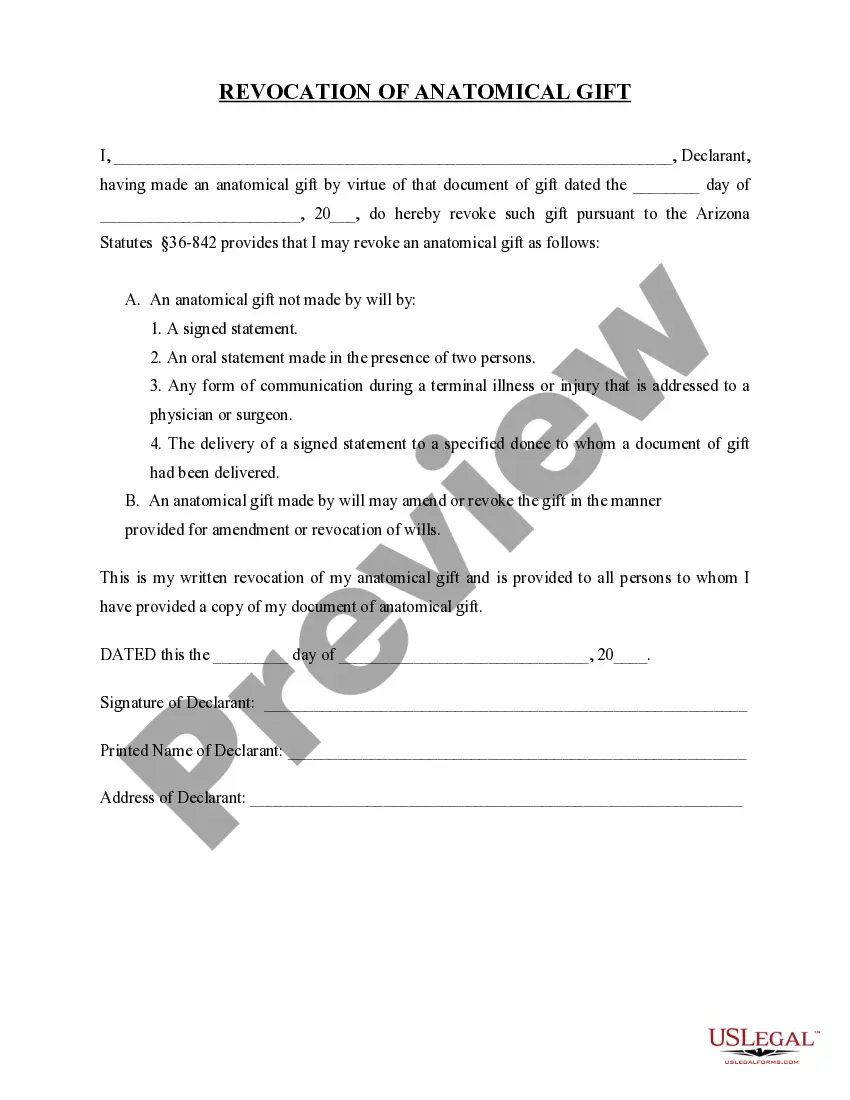
The Revocation of Anatomical Gift Donation form allows individuals to revoke a previously made decision regarding the donation of their body parts and organs upon death. This form serves to cancel any prior anatomical gift donation designations, ensuring that the individual's current wishes are respected. It is crucial for those who may have changed their mind about organ donation and need a formal way to indicate this change.
Main sections of this form
- A record that can be signed by the donor, another individual, or someone acting under the donor's direction if the donor is unable to sign.
- Requirements for witnessing: at least two adults, with one being a disinterested witness.
- A declaration stating the signing and witnessing procedure has been followed correctly.
Common use cases
You should use the Revocation of Anatomical Gift Donation form if you wish to cancel a previously executed anatomical gift donation. This may occur if your health circumstances change, you have personal or religious objections to organ donation, or you simply change your mind after making the original declaration.
Who this form is for
- Individuals who have previously consented to donate their organs and wish to revoke that decision.
- Family members or authorized representatives acting on behalf of the donor who are mandated to respect the donor's current wishes.
- Legal guardians handling decisions for individuals unable to make their own choices regarding organ donation.
How to complete this form
- Identify the original anatomical gift donation form that you wish to revoke.
- Fill in your name and any identifying details relevant to the previous designation.
- Gather at least two witnesses, ensuring one is a disinterested witness.
- Have all parties sign the form in the presence of witnesses.
- Complete any declarations required to confirm the signing and witnessing process.
Does this document require notarization?
This form does not typically require notarization unless specified by local law. However, you should ensure that all signatures are appropriately witnessed to maintain legitimacy.
Get your form ready online
Our built-in tools help you complete, sign, share, and store your documents in one place.
Make edits, fill in missing information, and update formatting in US Legal Forms—just like you would in MS Word.
Download a copy, print it, send it by email, or mail it via USPS—whatever works best for your next step.
Sign and collect signatures with our SignNow integration. Send to multiple recipients, set reminders, and more. Go Premium to unlock E-Sign.
If this form requires notarization, complete it online through a secure video call—no need to meet a notary in person or wait for an appointment.
We protect your documents and personal data by following strict security and privacy standards.

Make edits, fill in missing information, and update formatting in US Legal Forms—just like you would in MS Word.

Download a copy, print it, send it by email, or mail it via USPS—whatever works best for your next step.

Sign and collect signatures with our SignNow integration. Send to multiple recipients, set reminders, and more. Go Premium to unlock E-Sign.

If this form requires notarization, complete it online through a secure video call—no need to meet a notary in person or wait for an appointment.

We protect your documents and personal data by following strict security and privacy standards.
Mistakes to watch out for
- Failing to have the form witnessed correctly, which can invalidate the revocation.
- Not specifying the original anatomical gift donation clearly in the form.
- Using an outdated version of the revocation form that may not comply with current regulations.
Why complete this form online
- Convenience of instant access and download.
- Editability to customize according to your situation without the need for physical forms.
- Reliability in using attorney-drafted language that meets legal standards.
Legal use & context
- The form should clearly articulate the revocation to prevent any confusion regarding the individual's wishes posthumously.
- State laws may impose additional requirements, so it is advisable to be aware of local regulations surrounding anatomical gift donations.
Quick recap
- The Revocation of Anatomical Gift Donation is essential for individuals wishing to change their previous donation decisions.
- Proper completion involves understanding witness requirements and ensuring clear communication of wishes.
- It is important to keep documentation updated and accessible to relevant parties.
Looking for another form?
Form popularity
FAQ
To remove your organ donor designation from your driver's license in Arizona, visit the Arizona Department of Transportation (ADOT) office. You can request a new license without the donor status or update your organ donation preferences through their online portal or during your next renewal. Documenting your intent via the Arizona Revocation of Anatomical Gift Donation ensures that your wishes are clear and respected.
If you wish to change your organ donor status, you must complete the Arizona Revocation of Anatomical Gift Donation form. This form allows you to specify your new preferences regarding organ donation. After submission, it is a good idea to verify your status with the state's organ registry to ensure your updated wishes are accurately reflected.
Many Muslims can donate organs, as interpretations of Islamic teachings vary, and many support organ donation as a charitable act. However, beliefs regarding organ donation may differ among individuals, so consulting religious leaders or scholars can provide clarity. Understanding how the Arizona Revocation of Anatomical Gift Donation affects your decision may help in navigating these personal beliefs.
In Arizona, family members can express their opinions about organ donation decisions. However, if you have registered as a donor, your wishes generally take precedence over familial decisions. It's crucial to engage in open conversations with your family to ensure everyone understands and respects your intentions regarding the Arizona Revocation of Anatomical Gift Donation.
When a donor dies, the organ procurement organization will assess the donor's medical condition and eligibility for donation. If the organ donation is authorized, medical professionals will work swiftly to ensure that viable organs are donated effectively. Understanding the Arizona Revocation of Anatomical Gift Donation helps clarify your wishes and the potential outcomes for your organs after death.
Opting out of organ donation in Arizona may lead to limited access to potential life-saving transplants for those in need. Additionally, it can create emotional conflict among family members during a time of grief, particularly if your wishes remain unclear. It's essential to communicate your stance on donation decisions to your loved ones to mitigate any complications.
To stop being an organ donor in Arizona, you can revoke your anatomical gift. This process involves filling out the Arizona Revocation of Anatomical Gift Donation form, which you can find online or at specific legal resources. Once completed, ensure that you communicate this decision to the appropriate organ donation registry and family members to avoid any confusion.
Donate Life in Arizona is a campaign that promotes organ donation and educates the public about its life-saving benefits. The program encourages individuals to register as organ donors, raising awareness about the need for donations. Through initiatives and partnerships, they support families and increase the number of anatomical gifts, highlighting the importance of making informed decisions about the Arizona Revocation of Anatomical Gift Donation.
To check if you are an organ donor in Arizona, visit the official Arizona Organ and Tissue Donor Registry website. You may need to provide personal information like your name and date of birth to verify your status. This is an important step to ensure that your wishes are accurately reflected, especially if you are considering the Arizona Revocation of Anatomical Gift Donation.
After an organ donation, the remains of the donor are typically treated with great respect and dignity. The organs are recovered in a surgical procedure and the body is then handled according to the wishes of the donor or their family. In many cases, burial or cremation follows the organ recovery. Understanding the process can provide peace of mind regarding the Arizona Revocation of Anatomical Gift Donation.