Arizona Contract for Deed Seller's Annual Accounting Statement
What is this form?
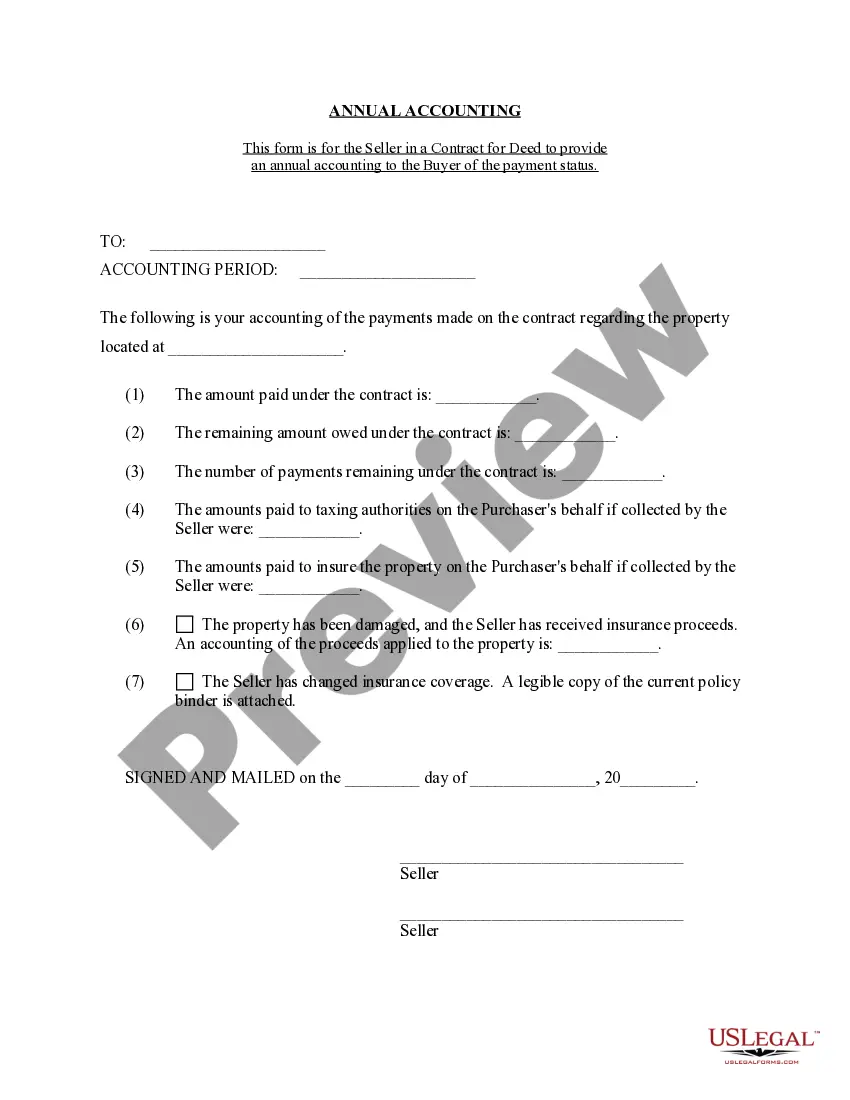
The Contract for Deed Seller's Annual Accounting Statement is a document used by sellers to inform purchasers about the total payments received towards the purchase price and interest of a property under a contract for deed. This form serves the important purpose of providing transparency regarding payments made over the year, distinguishing it from other financial statements that may not specifically address the contract for deed arrangement.
Main sections of this form
- Payment information: Details the number and amounts of payments received by the seller.
- Contract identification: References the contract for deed associated with the payments.
- Interest calculation: Outlines the interest accrued on the unpaid balance, if applicable.
- Seller and purchaser details: Includes the names and contact information of both parties involved in the contract.
- Yearly statements: Clarifies that this is an annual report, covering a specific time frame.

Situations where this form applies
This form should be used annually by sellers who have entered into a contract for deed with purchasers. It ensures that both parties are on the same page regarding the financial progress of the purchase. This form is particularly useful in situations where payments are made over time, and sellers want to provide documented accountability for the payments received.
Intended users of this form
- Property sellers who offer a contract for deed arrangement.
- Purchasers involved in a contract for deed who need a clear record of payments made.
- Real estate professionals managing transactions involving contracts for deed.
Instructions for completing this form
- Identify the seller and purchaser by entering their names and contact information.
- Specify the contract for deed by providing its reference number or title.
- Detail the payment history, including the number and amounts of payments received during the year.
- Calculate and include the interest earned on any unpaid balance, if applicable.
- Sign and date the statement to validate the information provided.
Notarization guidance
This form does not typically require notarization unless specified by local law. Always check local regulations to ensure compliance.
Get your form ready online
Our built-in tools help you complete, sign, share, and store your documents in one place.
Make edits, fill in missing information, and update formatting in US Legal Forms—just like you would in MS Word.
Download a copy, print it, send it by email, or mail it via USPS—whatever works best for your next step.
Sign and collect signatures with our SignNow integration. Send to multiple recipients, set reminders, and more. Go Premium to unlock E-Sign.
If this form requires notarization, complete it online through a secure video call—no need to meet a notary in person or wait for an appointment.
We protect your documents and personal data by following strict security and privacy standards.

Make edits, fill in missing information, and update formatting in US Legal Forms—just like you would in MS Word.

Download a copy, print it, send it by email, or mail it via USPS—whatever works best for your next step.

Sign and collect signatures with our SignNow integration. Send to multiple recipients, set reminders, and more. Go Premium to unlock E-Sign.

If this form requires notarization, complete it online through a secure video call—no need to meet a notary in person or wait for an appointment.

We protect your documents and personal data by following strict security and privacy standards.
Mistakes to watch out for
- Failing to provide complete payment information, leading to confusion.
- Not including the contract reference, which can cause ambiguity.
- Leaving out the date of the statement, which is essential for clarity.
- Incorrectly calculating interest, which can lead to disputes.
- Neglecting to sign and date the form, making it invalid.
Benefits of using this form online
- Convenience: Easily access and complete the form from anywhere.
- Editability: Make necessary changes without hassle before finalizing.
- Reliability: Ensure your statement follows legal standards set by licensed attorneys.
Main things to remember
- The Contract for Deed Seller's Annual Accounting Statement ensures transparency in financial reporting between parties.
- Complete this form accurately and submit it annually to fulfill contractual obligations.
- Failure to comply with reporting requirements can lead to potential disputes.
Looking for another form?

Form popularity
FAQ
A valid contract in Arizona requires mutual agreement, lawful purpose, and consideration exchanged between parties. It must also be in writing if it involves significant financial transactions. For those utilizing the Arizona Contract for Deed Seller's Annual Accounting Statement, ensuring compliance with these requirements can help avoid disputes and facilitate a smooth transaction.
Yes, Arizona is considered a deed state. This means that property transfers often involve deeds, making it important for sellers and buyers to understand the process. An Arizona Contract for Deed Seller's Annual Accounting Statement will reflect accurate details of the transaction under the prevailing state laws and practices.
Signing a contract as a deed provides a higher level of assurance for the parties involved. It demonstrates a serious commitment and often includes essential details regarding the terms and conditions. For those dealing with an Arizona Contract for Deed Seller's Annual Accounting Statement, having a deed can help clarify responsibilities, especially when payments are involved.
In Texas, property taxes are typically the responsibility of the buyer in a contract for deed arrangement. However, the specifics can vary depending on the terms outlined in the contract. Having clear agreements in place helps in avoiding disputes, making the Arizona Contract for Deed Seller's Annual Accounting Statement an important document for both sellers and buyers.
Contracts are not always freely assignable. Many agreements include restrictions on assignment to protect the interests of the parties involved. It's essential to review the contract terms carefully, especially for agreements like the Arizona Contract for Deed Seller's Annual Accounting Statement, to understand any limitations that may apply.
The assignment of rights in Arizona refers to transferring one's legal rights under a contract to another party. This process typically requires the consent of all parties involved unless otherwise stated in the contract. When dealing with an Arizona Contract for Deed Seller's Annual Accounting Statement, understanding these rights helps in ensuring proper management and compliance.
Yes, a seller can back out of a real estate contract in Arizona under certain conditions. If the buyer defaults or if both parties agree to terminate the contract, the seller may be able to withdraw. However, it’s vital to consider potential legal ramifications and financial obligations, including those related to the Arizona Contract for Deed Seller's Annual Accounting Statement.
In Montana, a contract for deed serves as a method of financing for purchasing property. The buyer makes payments directly to the seller while the seller retains the deed until the contract is completed. This arrangement often includes terms reflecting the responsibilities of both parties, which is crucial for transparency, particularly when preparing an Arizona Contract for Deed Seller's Annual Accounting Statement.
Some contracts contain specific clauses that prohibit assignment, known as anti-assignment clauses. Additionally, contracts that involve personal services or require the unique skills of a party generally cannot be assigned. In the context of real estate, understanding the implications of these clauses can ensure clear communication, especially when dealing with an Arizona Contract for Deed Seller's Annual Accounting Statement.
In Texas, the property owner is responsible for paying property taxes, which can include the buyer when they occupy the property under a contract for deed. The seller may also bear this responsibility until the contract terms are fulfilled and the deed is transferred. It’s wise for both buyers and sellers to clarify tax obligations in their contracts. Utilizing resources like the Arizona Contract for Deed Seller's Annual Accounting Statement can help keep these financial responsibilities organized.