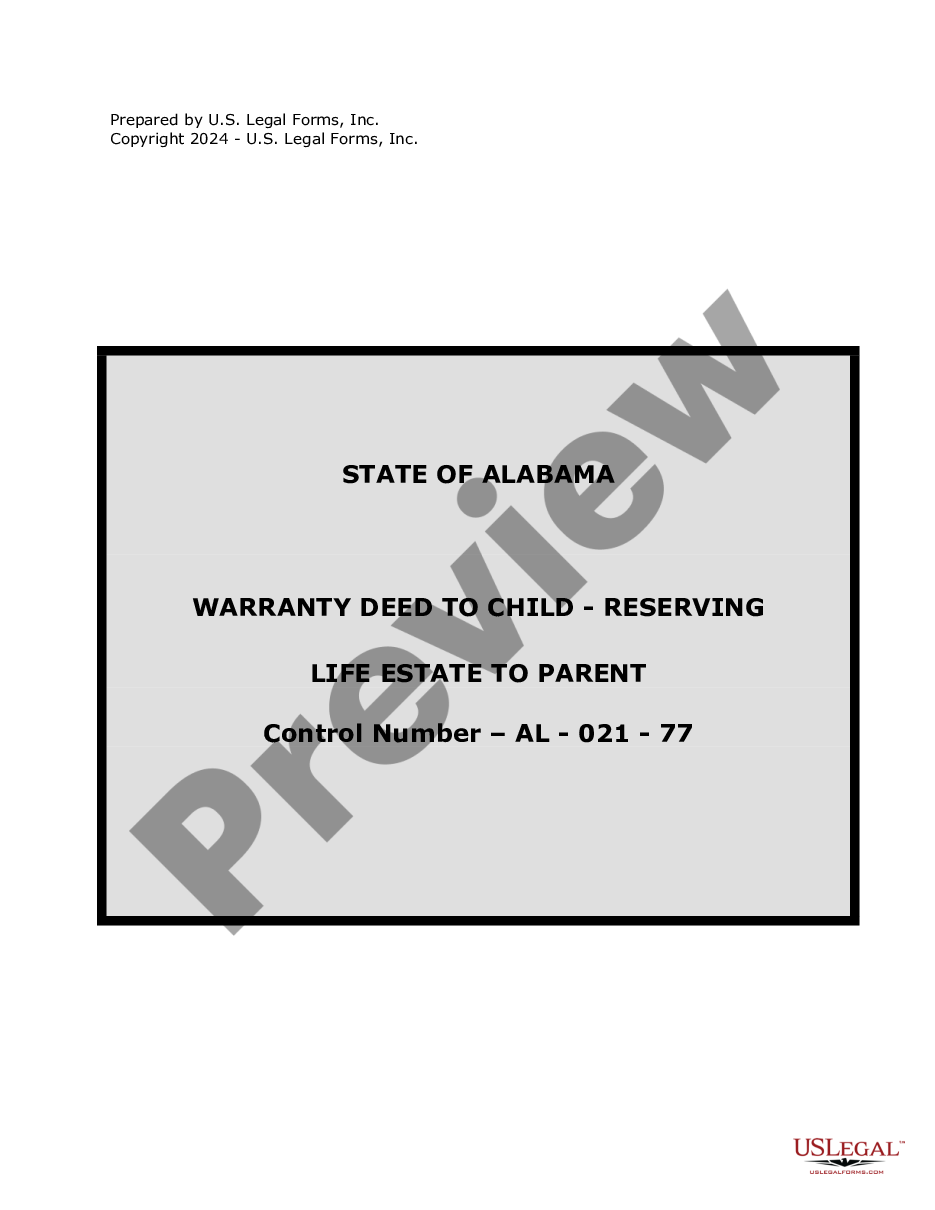
Alabama Warranty Deed to Child Reserving a Life Estate in the Parents

What is this form?
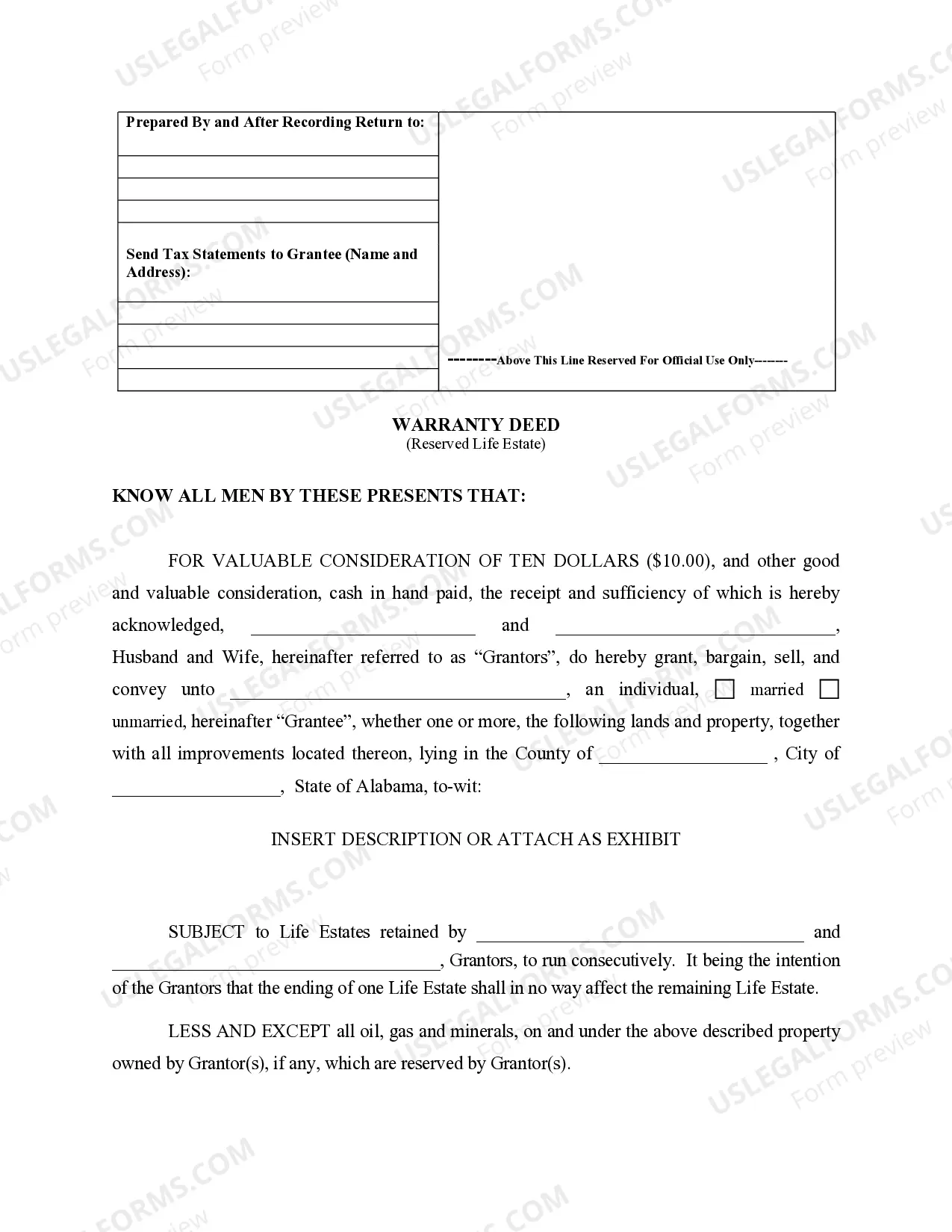
The Warranty Deed to Child Reserving a Life Estate in the Parents is a legal document that allows a parent or parents to transfer property ownership to their child while retaining a life estate. This means that the parents can continue to live in and use the property until their lifetime, at which point full ownership transfers to the child. This form is particularly useful for estate planning and can help avoid probate issues, unlike other forms of conveyance where full ownership is transferred immediately.
Form components explained
- Identification of the grantor(s) (parents) and grantee (child)
- Reservation of life estate clause for the grantor(s)
- Description of the property being conveyed
- Details regarding any mineral rights and easements
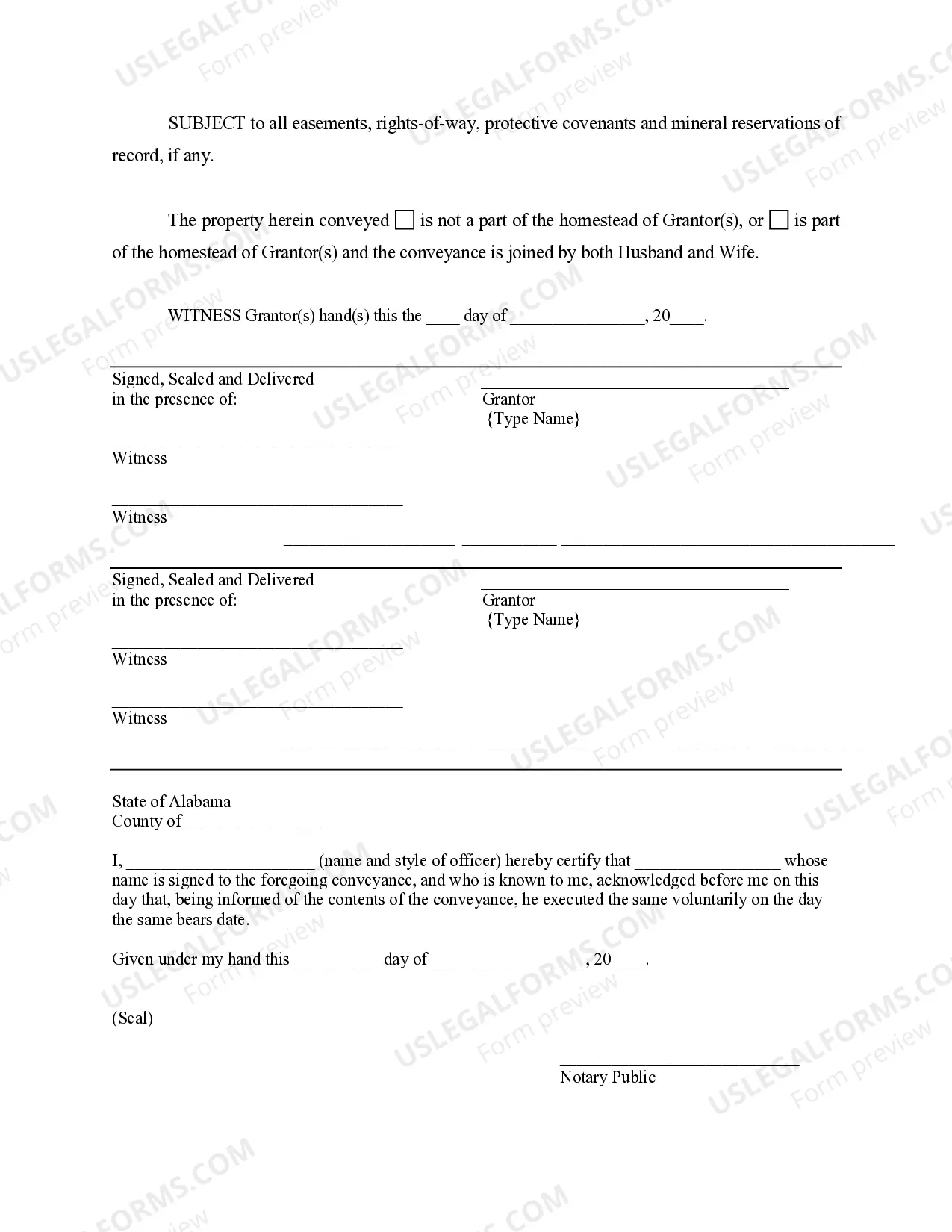
- Signature lines for all parties and witnesses
- Notary acknowledgment section





Situations where this form applies
This deed should be used when parents want to transfer property to their child while still having the right to live in that property for the rest of their lives. It is often used in estate planning to ensure that the child receives the property without involving probate court, thus simplifying the transfer of assets upon the parents' death.
Who this form is for
- Parents who own real estate and wish to transfer it to their child
- Individuals engaged in estate planning
- Homeowners wanting to avoid probate for their property
- Family members looking to establish clear ownership and use rights
Steps to complete this form
- Identify the grantor(s) by entering their names and addresses.
- Specify the name of the grantee (the child receiving the property).
- Provide a detailed description of the property being transferred.
- Include any relevant information about life estates and mineral rights.
- Collect signatures of the grantor(s) and any required witnesses.
- Complete the notary section to validate the document.
Notarization guidance
Yes, this form must be notarized to be legally valid. Proper notarization ensures that the identities of the grantors are confirmed, which is essential for the enforceability of the deed. US Legal Forms offers integrated online notarization, providing a secure and convenient way to complete this step without the need for travel.
Get your form ready online
Our built-in tools help you complete, sign, share, and store your documents in one place.
Make edits, fill in missing information, and update formatting in US Legal Forms—just like you would in MS Word.
Download a copy, print it, send it by email, or mail it via USPS—whatever works best for your next step.
Sign and collect signatures with our SignNow integration. Send to multiple recipients, set reminders, and more. Go Premium to unlock E-Sign.
If this form requires notarization, complete it online through a secure video call—no need to meet a notary in person or wait for an appointment.
We protect your documents and personal data by following strict security and privacy standards.

Make edits, fill in missing information, and update formatting in US Legal Forms—just like you would in MS Word.

Download a copy, print it, send it by email, or mail it via USPS—whatever works best for your next step.

Sign and collect signatures with our SignNow integration. Send to multiple recipients, set reminders, and more. Go Premium to unlock E-Sign.

If this form requires notarization, complete it online through a secure video call—no need to meet a notary in person or wait for an appointment.

We protect your documents and personal data by following strict security and privacy standards.
Mistakes to watch out for
- Failing to accurately describe the property can lead to disputes.
- Omitting witness signatures may invalidate the deed.
- Not having the document notarized when required could affect its legal enforceability.
Benefits of completing this form online
- Convenient access to legal forms from anywhere at any time.
- Edit the document easily to suit specific needs before printing.
- Assured reliability, as forms are drafted by licensed attorneys.
Looking for another form?


Form popularity
FAQ
The person holding the life estate -- the life tenant -- possesses the property during his or her life. The other owner -- the remainderman -- has a current ownership interest but cannot take possession until the death of the life estate holder.
The life tenant cannot change the remainder beneficiary without their consent. If the life tenant applies for any loans, they cannot use the life estate property as collateral. There's no creditor protection for the remainderman. You can't minimize estate tax.
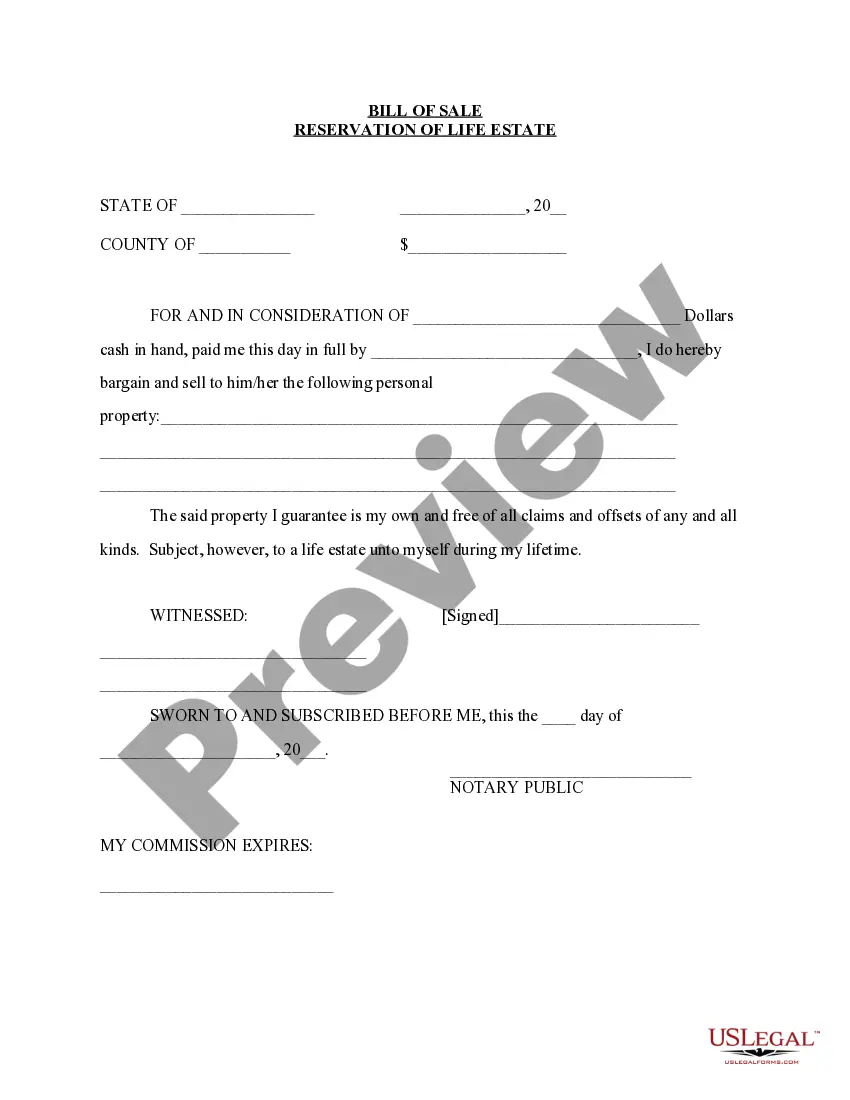
Reservation of the present interest allows the owner to retain ownership for a period of time measured by the life of one or more individuals, by a term of years, or by a combination of the two.
This life estate deed is a document that transfers ownership of real property, while reserving access and use of the property for the duration of the grantor's life. It allows the original owner (grantor) to remain on the premises with full access to and benefits from the property.
A life estate deed allows you to transfer property while reserving an interest during your lifetime or during the lifetime of someone else. Once the person who holds the life estate passes away, the Grantee fully owns the property.
A life estate deed permits the property owner to have full use of their property until their death, at which point the ownership of the property is automatically transferred to the beneficiary.
The two types of life estates are the conventional and the legal life estate. the grantee, the life tenant. Following the termination of the estate, rights pass to a remainderman or revert to the previous owner.
At death, property is transferred from your name (ownership) in one of three ways: by title; by beneficiary designation; or by probate. The trick to avoiding probate is to make sure all of your assets are set up as transfers under either joint title or beneficiary designation.
A life estate is a form of co-ownership that allows owners to hold interests at different points in time. One ownercalled a life tenantcan hold title to the property for his or her life. At the life tenant's death, the property passes automatically to another owner called a remainderman or remainder beneficiary.