Alabama Contract for Deed Seller's Annual Accounting Statement
What is this form?
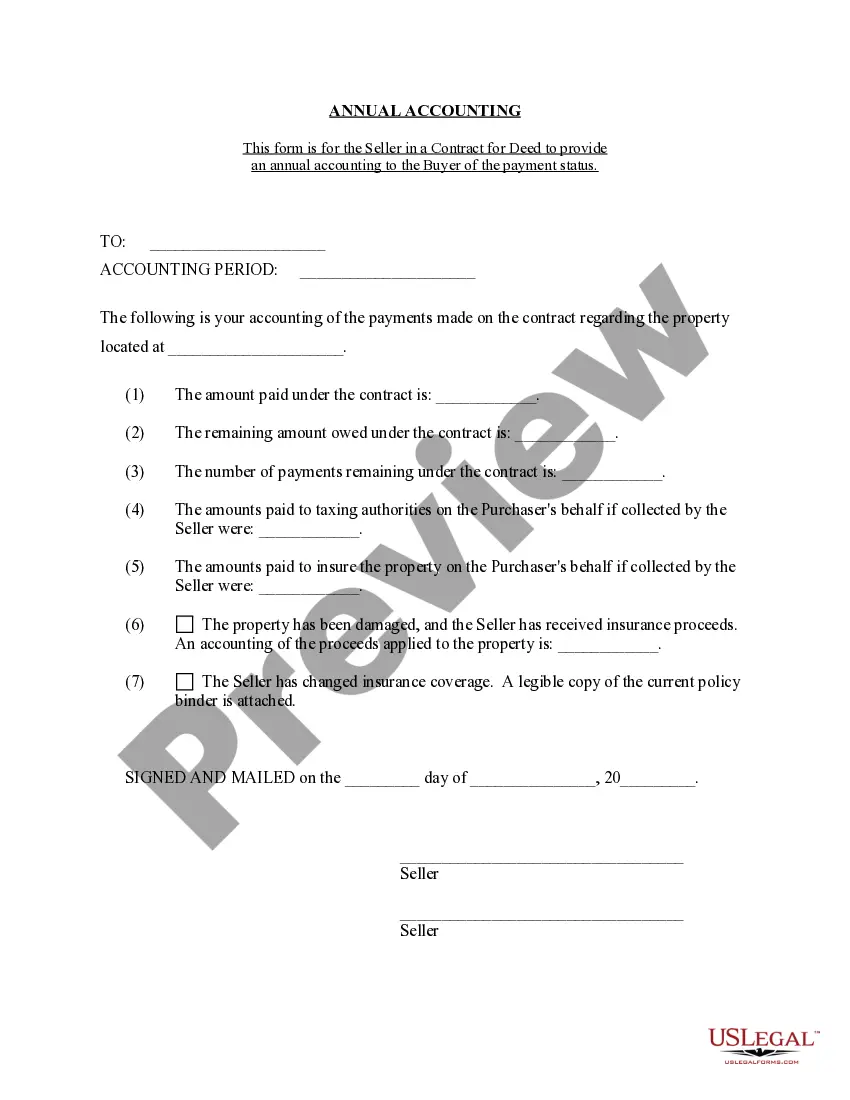
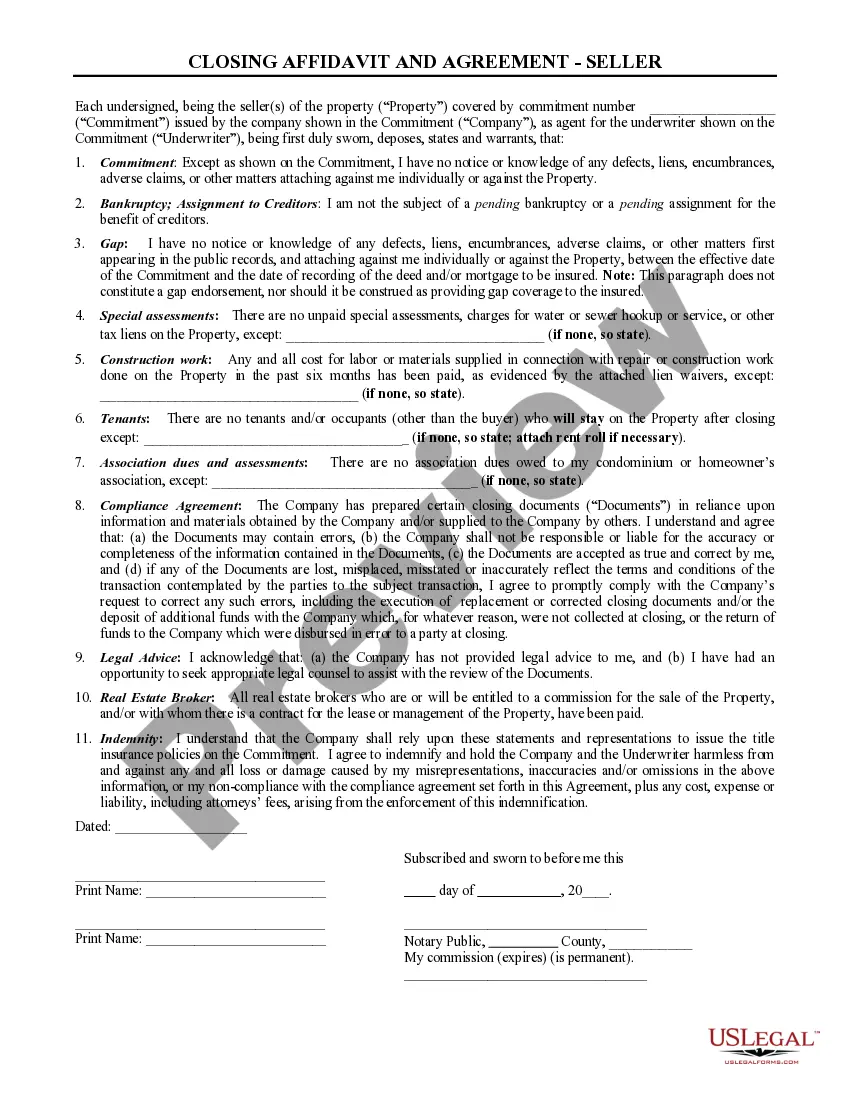
The Contract for Deed Seller's Annual Accounting Statement is a legal document used to inform the Purchaser about the payments received by the Seller towards the contract for deed's purchase price and interest over the past year. This form is essential for maintaining transparency in financial dealings between the parties involved. It differs from other forms as it specifically outlines annual payment details, making it crucial for anyone involved in a contract for deed transaction.
What’s included in this form
- Year of accounting period.
- Total amount of payments received during the year.
- Breakdown of payments, including principal and interest amounts.
- Contact information of the Seller.
- Signature of the Seller certifying the accuracy of the statement.

When to use this document
This form should be used annually by the Seller to provide an accounting statement to the Purchaser. It is particularly important in situations where the Purchaser is making installment payments for a property under a contract for deed agreement. Using this form helps both parties stay informed about their financial obligations and the status of payments made throughout the year.
Who this form is for
This form is intended for:
- Property Sellers engaged in a contract for deed arrangement.
- Purchasers receiving periodic payments towards a property purchase under a contract for deed.
- Real estate professionals who facilitate contract for deed transactions.
Instructions for completing this form
- Identify the year for which the accounting is being provided.
- List the total payments received during the accounting period.
- Break down the payments into principal and interest amounts for clarity.
- Include your contact information in case the Purchaser has questions.
- Sign and date the form to certify its accuracy.
Notarization requirements for this form
This form does not typically require notarization unless specified by local law. However, having it notarized can provide an additional layer of verification and security for both parties involved.
Get your form ready online
Our built-in tools help you complete, sign, share, and store your documents in one place.
Make edits, fill in missing information, and update formatting in US Legal Forms—just like you would in MS Word.
Download a copy, print it, send it by email, or mail it via USPS—whatever works best for your next step.
Sign and collect signatures with our SignNow integration. Send to multiple recipients, set reminders, and more. Go Premium to unlock E-Sign.
If this form requires notarization, complete it online through a secure video call—no need to meet a notary in person or wait for an appointment.
We protect your documents and personal data by following strict security and privacy standards.

Make edits, fill in missing information, and update formatting in US Legal Forms—just like you would in MS Word.

Download a copy, print it, send it by email, or mail it via USPS—whatever works best for your next step.

Sign and collect signatures with our SignNow integration. Send to multiple recipients, set reminders, and more. Go Premium to unlock E-Sign.

If this form requires notarization, complete it online through a secure video call—no need to meet a notary in person or wait for an appointment.

We protect your documents and personal data by following strict security and privacy standards.
Common mistakes to avoid
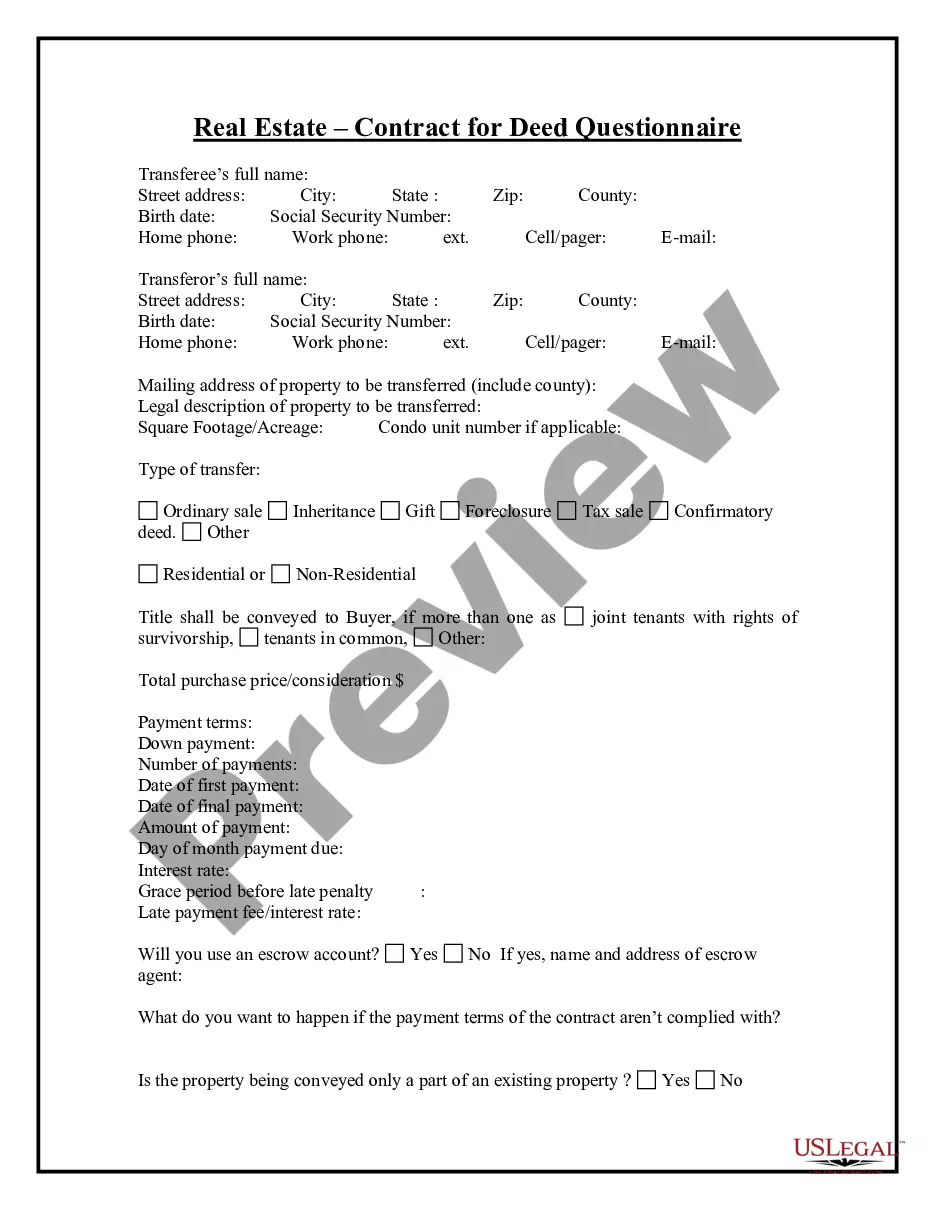
- Failing to provide a complete breakdown of payments received.
- Omitting the signature, which may invalidate the form.
- Using incorrect years for the accounting period.
Why use this form online
- Convenient access to download and complete at your own pace.
- Edit the form as needed to fit your specific transaction.
- Reliable template drafted by licensed attorneys to ensure legality.
Key takeaways
- The form is essential for facilitating transparent financial communications between the Seller and Purchaser.
- Annual accounting statements help ensure both parties are aligned on payment status.
- Completing the form accurately is vital to uphold legal obligations in a contract for deed arrangement.
Looking for another form?
Form popularity
FAQ
The Alabama (AL) state sales tax rate is currently 4%. Depending on local municipalities, the total tax rate can be as high as 11%.
Legislative Act 2015-448, entitled the Simplified Seller Use Tax Remittance Act, allows eligible sellers to participate in a program to collect, report and remit a flat eight percent (8%) sellers use tax on all sales made into Alabama.
Unlike in many other U.S. states, Alabama law employs a rule known as caveat emptor for the sale of used residential property. Caveat emptor is Latin for let the buyer beware, which means that the seller has no actual duty to advise the buyer of issues with the property's physical condition during the sale.
Alabama law provides that a seller or seller's agent has a duty to disclose information about used real estate in three scenarios 1) Defects affecting health and safety, 2) where a fiduciary relationship exists, and 3) upon specific inquiry by the buyer.
Buyer beware, also known as the doctrine of caveat emptor, is an age-old doctrine. It means that, if you intend to buy property, you generally bear the responsibility for finding out about the property's condition before purchasing it.
While there's no hard-and-fast list of which states follow caveat emptor and which don't, Alabama, Arkansas, Georgia, North Dakota, Virginia, and Wyoming are largely known as caveat emptor states. In others, courts have upheld the principle only some of the time.
In most cases, prepared food to be consumed on or off the premises is fully taxable in Alabama at 4%. However, counties and jurisdictions may charge an additional local sales tax of up to 7%, for a maximum possible combined sales tax of 11%.
4. How much does it cost to apply for a sales tax permit in Alabama? It's free to apply for a sales tax permit, but other business registration fees may apply.
The Alabama Supreme Court has held caveat emptor (buyer beware) to be the law in Alabama when selling existing homes. Everyone should be on notice that there is no warranty which comes with the sale of a used home. Buyers have a chance to inspect the property and should assume the responsibility of a purchase.