Alaska Notice of Default for Past Due Payments in connection with Contract for Deed
Overview of this form
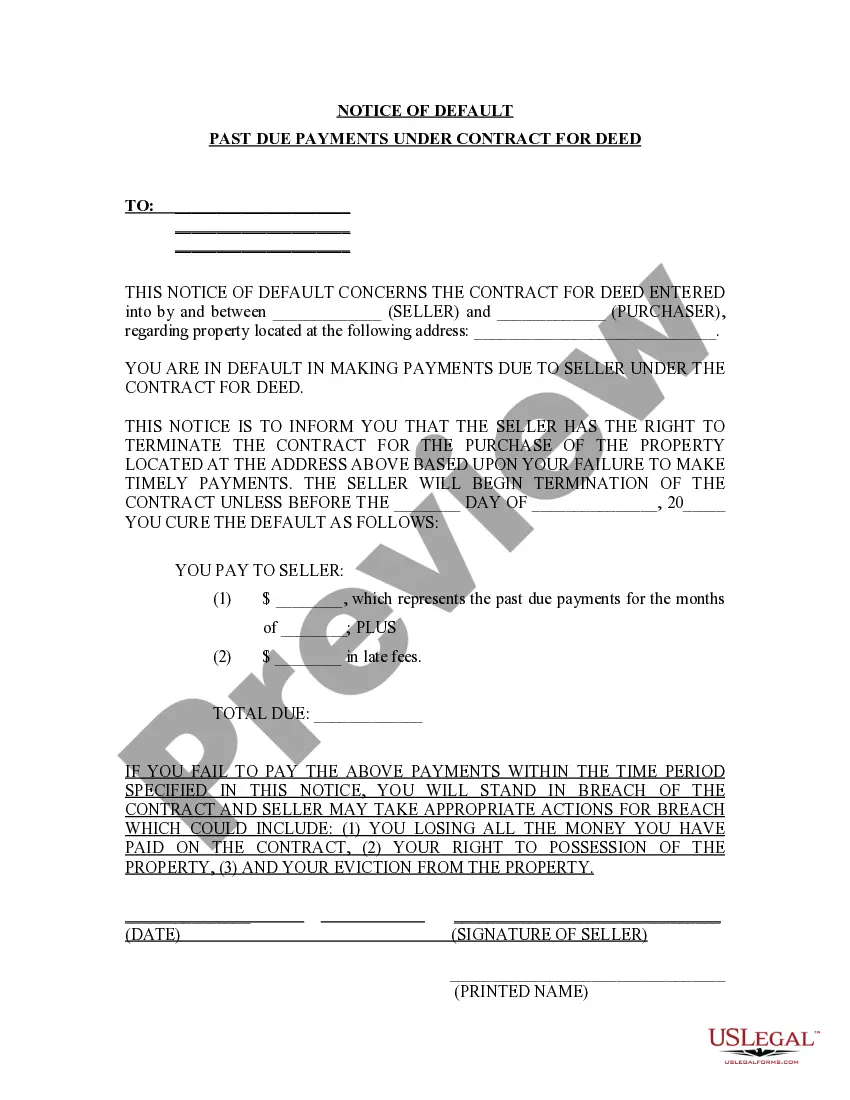
The Notice of Default for Past Due Payments in connection with Contract for Deed is a crucial document that allows a seller to formally notify a purchaser that they are behind on scheduled payments for a real estate contract. This form specifies the terms of the contract and indicates that failure to address the late payment could lead to default. It serves as the seller's initial communication regarding late payment issues, distinguishing it from other forms related to defaults and payment notices.
Key components of this form
- Seller's contact information: Identification of the party issuing the notice.
- Purchaser's details: Identification of the party receiving the notice.
- Contract details: Reference to the specific contract for deed, including dates and payment amounts.
- Payment delinquency: Clear statement of the overdue amount and payment terms missed.
- Consequences of non-compliance: Information about potential default and next steps if payment is not made.
When to use this document
This form should be used when a seller needs to notify a purchaser that they are late on payments for a contract for deed. It is particularly important in situations where timely payments are crucial to the continuation of the agreement. If the purchaser has missed one or more payments and the seller wants to initiate the default process as per the contract terms, this notice is a necessary first step to resolve the issue legally.
Who needs this form
- Sellers or property owners who have entered into a contract for deed.
- Purchasers who have missed their payment obligations under such a contract.
- Real estate professionals managing contract for deed agreements.
Completing this form step by step
- Identify the parties: Clearly fill in the names and contact information of both the seller and the purchaser.
- Specify the contract details: Include the relevant contract number, date of agreement, and property specifics.
- State the overdue payments: Indicate the amount due and the payment terms that have not been met.
- Explain consequences: Clearly outline what will happen if the purchaser fails to respond or rectify the late payment.
- Sign and date the notice: Ensure the seller signs the form and includes the date for legal validity.
Is notarization required?
Notarization is required for this form to take effect. Our online notarization service, powered by Notarize, lets you verify and sign documents remotely through an encrypted video session, available 24/7.
Get your form ready online
Our built-in tools help you complete, sign, share, and store your documents in one place.
Make edits, fill in missing information, and update formatting in US Legal Forms—just like you would in MS Word.
Download a copy, print it, send it by email, or mail it via USPS—whatever works best for your next step.
Sign and collect signatures with our SignNow integration. Send to multiple recipients, set reminders, and more. Go Premium to unlock E-Sign.
If this form requires notarization, complete it online through a secure video call—no need to meet a notary in person or wait for an appointment.
We protect your documents and personal data by following strict security and privacy standards.

Make edits, fill in missing information, and update formatting in US Legal Forms—just like you would in MS Word.

Download a copy, print it, send it by email, or mail it via USPS—whatever works best for your next step.

Sign and collect signatures with our SignNow integration. Send to multiple recipients, set reminders, and more. Go Premium to unlock E-Sign.

If this form requires notarization, complete it online through a secure video call—no need to meet a notary in person or wait for an appointment.

We protect your documents and personal data by following strict security and privacy standards.
Common mistakes to avoid
- Failing to specify the exact amount owed.
- Not providing sufficient details about the contract for deed.
- Omitting signatures or dates, making the form invalid.
- Not sending the notice to the correct address of the purchaser.
Why use this form online
- Convenience: Easily download and complete from anywhere.
- Time-saving: Quickly fill out and print the form without needing to visit a lawyer.
- Reliability: Forms drafted by licensed attorneys ensure you have a legally sound document.
Looking for another form?



Form popularity
FAQ
Write to the agency making the claim. Present evidence of why the NOD was improperly issued or why you legitimately cannot make payments. Ask the agency in the letter if they will take a lower monthly payment, total settlement or a payment plan. Send a copy of your letter by certified mail.
Breach: Everything You Need to Know. In contract law, a breach means the failure of a contracting party to perform their obligations according to the terms of the agreement.Default, according to the law of obligations and banking law, means to refuse to pay a debt when due.
In law, a default is the failure to do something required by law.
A default notice (sometimes referred to as a default letter or Notice of Default) is a formal letter sent to you by a creditor as a result of payments missed on a credit agreement between yourself and a credit provider.The notice will give you 14 days to pay any amount owed before issuing a default.
A default is a non-material breach of contract, whereby one party fails to perform a contractual obligation. What specifically constitutes a default will be set out in the contract terms, but generally, it can be defined as an omission or a failure to do what is expected or required.