Oklahoma Renunciation And Disclaimer of Joint Tenant or Tenancy Interest
Overview of this form
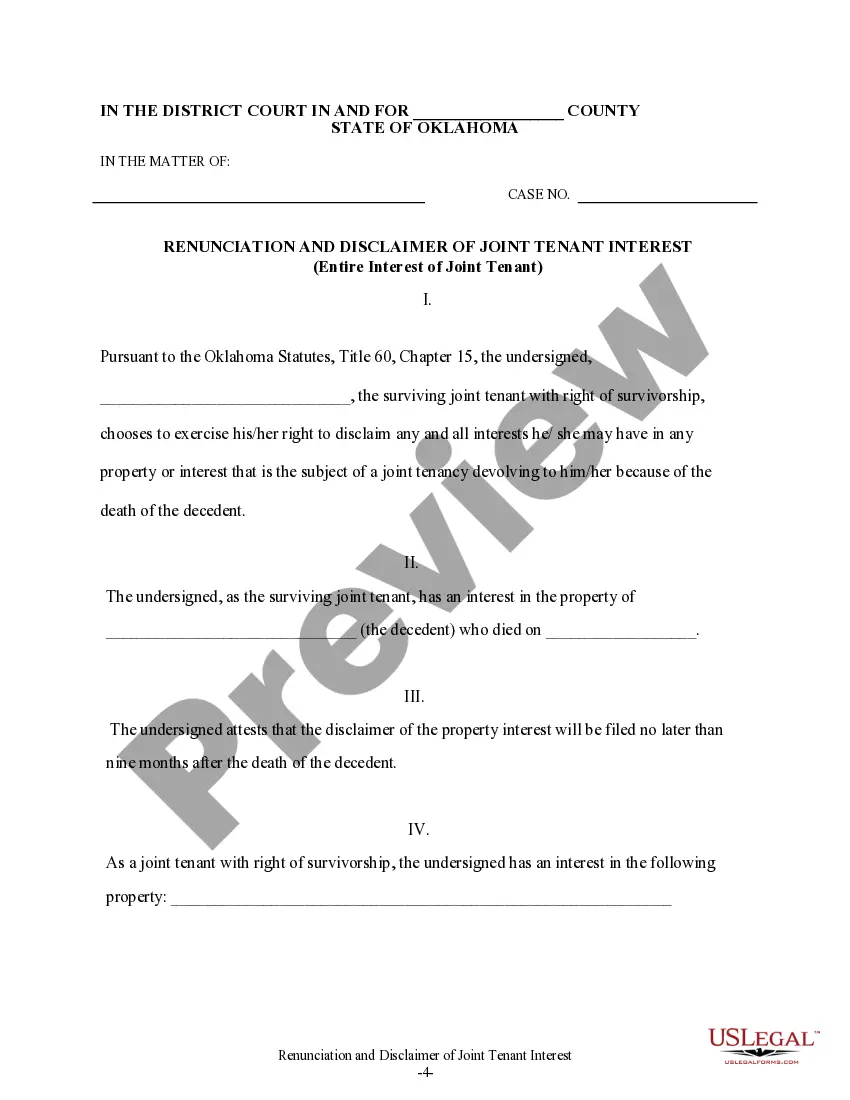
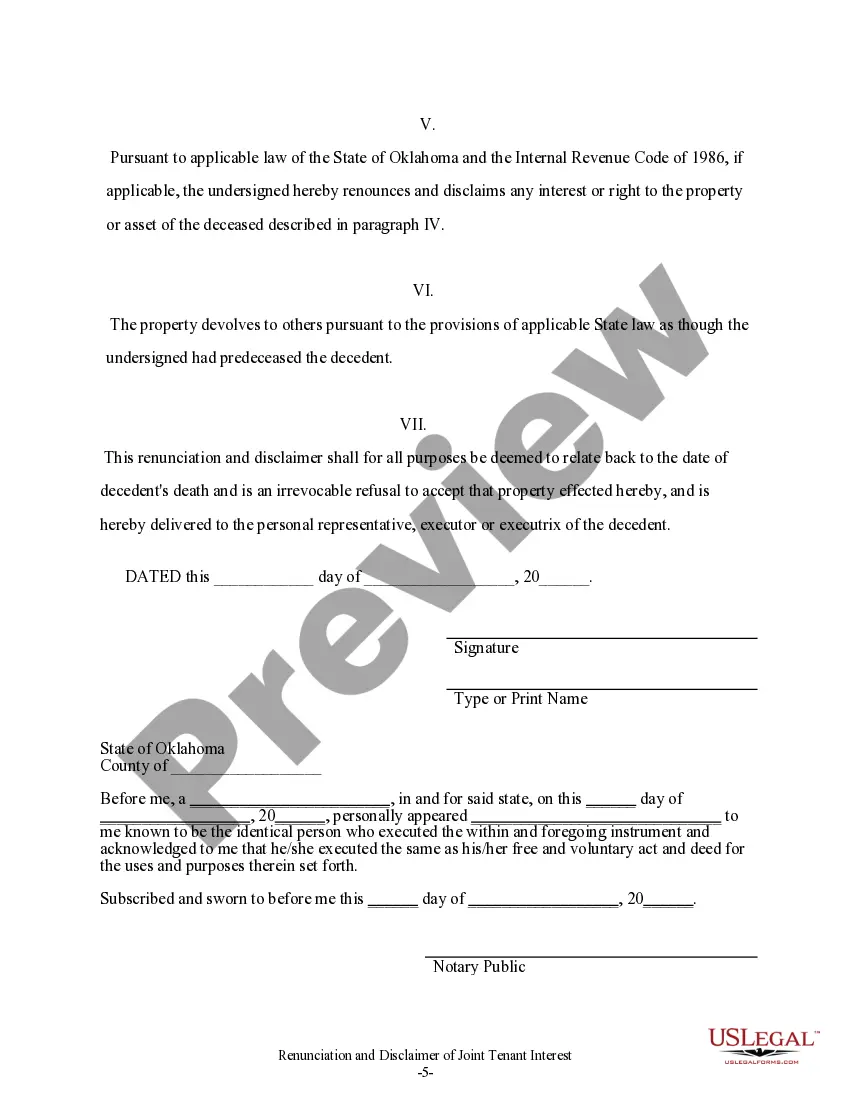
The Renunciation and Disclaimer of Joint Tenant or Tenancy Interest is a legal document used in the State of Oklahoma. It allows a surviving joint tenant to renounce their interest in a property of a deceased joint tenant. This form ensures that the property will be distributed as if the renouncing tenant predeceased the decedent, thereby redirecting the property to other beneficiaries as designated by law. This form is distinct from other estate planning documents as it specifically addresses joint tenancy interests following the death of one tenant.
Form components explained
- Identification of the property and the decedent.
- Declaration by the surviving joint tenant to renounce interest.
- Statement confirming the form will be filed within nine months after the decedent's death.
- Specification of applicable state law governing the renunciation.
- Signature and date of the surviving joint tenant.

When to use this form
This form is typically used in situations where a surviving joint tenant wishes to forfeit their interest in a property following the death of the other joint tenant. It is particularly relevant when the surviving tenant does not want to inherit the property, or when the property should be distributed to other heirs or beneficiaries according to the decedent's wishes or state laws.
Who should use this form
- Surviving joint tenants looking to renounce their interest in a property.
- Beneficiaries wanting to redirect property interest according to the will or state law.
- Individuals involved in estate planning or property distribution processes.
Completing this form step by step
- Identify and enter the names and details of the deceased and the surviving joint tenant.
- Specify the property interest being renounced in the designated field.
- Complete the declaration date and sign the form where indicated.
- Ensure the form is filed within nine months of the decedent's death.
- Return a copy to the personal representative or fiduciary of the decedent.
Notarization requirements for this form
Notarization is generally not required for this form. However, certain states or situations might demand it. You can complete notarization online through US Legal Forms, powered by Notarize, using a verified video call available anytime.
Get your form ready online
Our built-in tools help you complete, sign, share, and store your documents in one place.
Make edits, fill in missing information, and update formatting in US Legal Forms—just like you would in MS Word.
Download a copy, print it, send it by email, or mail it via USPS—whatever works best for your next step.
Sign and collect signatures with our SignNow integration. Send to multiple recipients, set reminders, and more. Go Premium to unlock E-Sign.
If this form requires notarization, complete it online through a secure video call—no need to meet a notary in person or wait for an appointment.
We protect your documents and personal data by following strict security and privacy standards.

Make edits, fill in missing information, and update formatting in US Legal Forms—just like you would in MS Word.

Download a copy, print it, send it by email, or mail it via USPS—whatever works best for your next step.

Sign and collect signatures with our SignNow integration. Send to multiple recipients, set reminders, and more. Go Premium to unlock E-Sign.

If this form requires notarization, complete it online through a secure video call—no need to meet a notary in person or wait for an appointment.

We protect your documents and personal data by following strict security and privacy standards.
Mistakes to watch out for
- Failing to file the renunciation within the nine-month period.
- Not providing complete property descriptions or details about the decedent.
- Inadequately signing or dating the form, leading to potential enforcement issues.
Advantages of online completion
- Convenience of completing the form from home without the need for physical appointments.
- Editability allows for corrections before finalizing the document.
- Instant access to state-specific legal forms prepared by licensed attorneys.
Looking for another form?
Form popularity
FAQ
Yes, a fiduciary can disclaim an interest in property if the will, trust or power of attorney gives the fiduciary that authority or if the appropriate probate court authorizes the disclaimer.The primary reason an executor or trustee might disclaim property passing to an estate or trust is to save death taxes.
Danger #1: Only delays probate. Danger #2: Probate when both owners die together. Danger #3: Unintentional disinheriting. Danger #4: Gift taxes. Danger #5: Loss of income tax benefits. Danger #6: Right to sell or encumber. Danger #7: Financial problems.
Property owned in joint tenancy automatically passes, without probate, to the surviving owner(s) when one owner dies. Setting up a joint tenancy is easy, and it doesn't cost a penny.
Disclaim, in a legal sense, refers to the renunciation of an interest in, or an acceptance of, inherited assets, such as property, by way of a legal instrument. A person disclaiming an interest, right, or obligation is known as a disclaimant.
What is a Deed of Disclaimer? A Deed of Disclaimer is a document that you can execute if you wish to Disclaim an inheritance due via the Rules of Intestacy and you are not applying for probate. A typical example of this is if a spouse of a deceased would prefer the estate passes to the children.
Jointly owned property is treated as consisting of a both present and a future interest in the jointly owned property. Thus, a surviving spouse may disclaim the future interest in jointly owned property on the death of their spouse, including assets that were held by the spouses as tenants by the entirety.
Put the disclaimer in writing. Deliver the disclaimer to the person in control of the estate usually the executor or trustee. Complete the disclaimer within nine months of the death of the person leaving the property. Do not accept any benefit from the property you're disclaiming.
It must be in writing. It must be made within 9 months of the date of death of the decedent. The disclaimant cannot receive any benefits from the assets.
The surviving spouse can serve as the sole trustee, but cannot have any power to direct the beneficial enjoyment of the disclaimed property unless the power is limited by an "ascertainable standard." This is necessary both to qualify the disclaimer and to avoid any taxable general power of appointment.