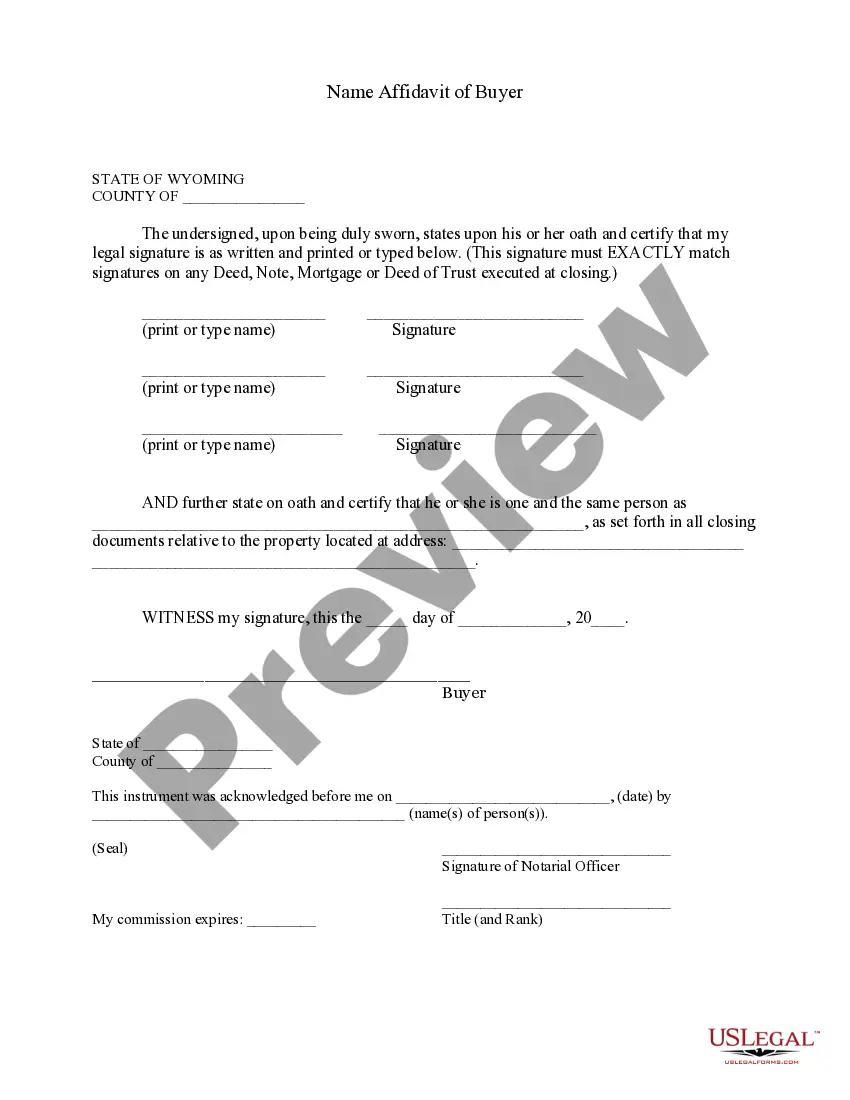
Wyoming Name Affidavit of Buyer
Understanding this form
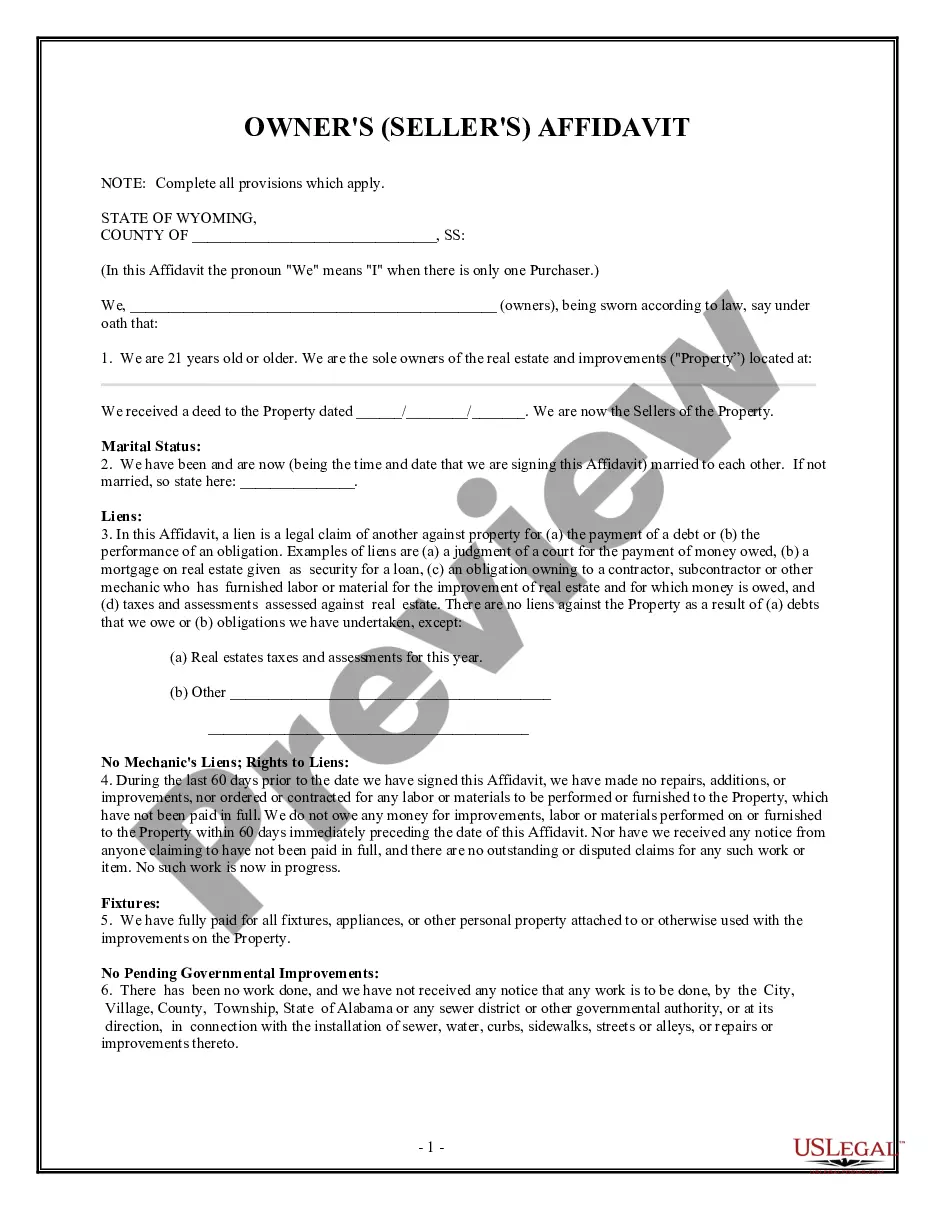
The Buyer Name Affidavit is a legal document that allows the buyer to affirm their legal name and any other names they are commonly known by. It serves to clarify that signatures which may appear different represent the same individual. For instance, it can confirm that John Jones, John T. Jones, and J.T. Jones are the same person.
Key parts of this document
- Statement of legal name
- Signature validation section
- Affirmation of alternative names
- Property identification
- Notary acknowledgment
When this form is needed
This form is typically used during real estate transactions, particularly when the buyer's name appears differently across various documents. It helps prevent disputes about identity and ensures that all titles and documents are aligned with the correct legal name.
Who should use this form
- Individuals purchasing real estate who have multiple name variations
- Buyers needing to clarify their identity for deed or mortgage documents
- Those involved in property transactions requiring notarized signatures
Completing this form step by step
- Enter the county where the statement is being made.
- Clearly print or type the legal names as well as any aliases used.
- Sign the affidavit exactly as it appears on related documents.
- Document the property address relevant to the transaction.
- Complete the notary section to affirm identity.
Notarization guidance
Yes, this form must be notarized to be legally valid. The notarization process confirms the identity of the signers and adds credibility to the affidavit. US Legal Forms offers integrated online notarization services, allowing you to complete this process securely through a video call without needing to travel.
Get your form ready online
Our built-in tools help you complete, sign, share, and store your documents in one place.
Make edits, fill in missing information, and update formatting in US Legal Forms—just like you would in MS Word.
Download a copy, print it, send it by email, or mail it via USPS—whatever works best for your next step.
Sign and collect signatures with our SignNow integration. Send to multiple recipients, set reminders, and more. Go Premium to unlock E-Sign.
If this form requires notarization, complete it online through a secure video call—no need to meet a notary in person or wait for an appointment.
We protect your documents and personal data by following strict security and privacy standards.

Make edits, fill in missing information, and update formatting in US Legal Forms—just like you would in MS Word.

Download a copy, print it, send it by email, or mail it via USPS—whatever works best for your next step.

Sign and collect signatures with our SignNow integration. Send to multiple recipients, set reminders, and more. Go Premium to unlock E-Sign.

If this form requires notarization, complete it online through a secure video call—no need to meet a notary in person or wait for an appointment.

We protect your documents and personal data by following strict security and privacy standards.
Typical mistakes to avoid
- Not matching signatures with those on closing documents
- Failing to include all aliases
- Omitting the property address
Why complete this form online
- Convenient access to downloadable templates
- Ability to complete the form at your own pace
- Reliability of attorney-approved language
Quick recap
- The Name Affidavit of Buyer clarifies identity in real estate transactions.
- This form is essential for buyers who have used variations of their names.
- Proper completion and notarization are crucial for legality.
Looking for another form?



Form popularity
FAQ
In simple situations where you own the vehicle outright and wish to transfer ownership to someone else, all you must do is complete a title certificate. Once you have filled out and signed the certificate, the buyer or recipient can take the title to a local DMV office and officially transfer ownership.
The buyer must complete the back top portion of the title. Legibly write your resident address to ensure your new title is mailed correctly. Ensure you sign and date next to your drivers license number. If you do not have a drivers license write in your identification card number instead.
Have both parties sign it, create a copy, and then send the bill of sale to the DMV. If anything happens and the buyer fails to register the car, you'll have the proof needed to say the car's ownership has been transferred and it is no longer in your name.
After the payment has been transferred, the seller needs to sign the title over to the buyer (instructions are normally provided on the back). The seller will then need to contact the DMV within 5 days to transfer ownership and release themselves from any liability for the vehicle.
Selling a car means that, as the original owner, you don't have to pay any tax.This may make selling a car a better option than giving it to a friend or family member, which could cause the gift tax to come into play. According to the IRS, any gift worth more than $13,000 is liable for gift taxes, as of 2010.
Directly under the statement Assignment of title by registered owner, write in the date the car was sold. On the next line, write in the name or names of the buyers and their address. On the next line, write in the odometer reading. Where it says Signature(s) of buyer, the buyer or buyers must sign the title.
The procedures for transferring ownership are similar to buying or selling a car: the donor must include the odometer disclosure on the title, both parties must sign and date the title, and the recipient must go to the DMV and apply for a a new title in his/her name and pay the transfer fee. Making Name Corrections.
A general Wyoming bill of sale does not need to be notarized. It is used for your personal records. When it is completed, both the buyer and seller should keep several copies.