Vermont Quitclaim Deed from Individual to Two Individuals in Joint Tenancy

Overview of this form
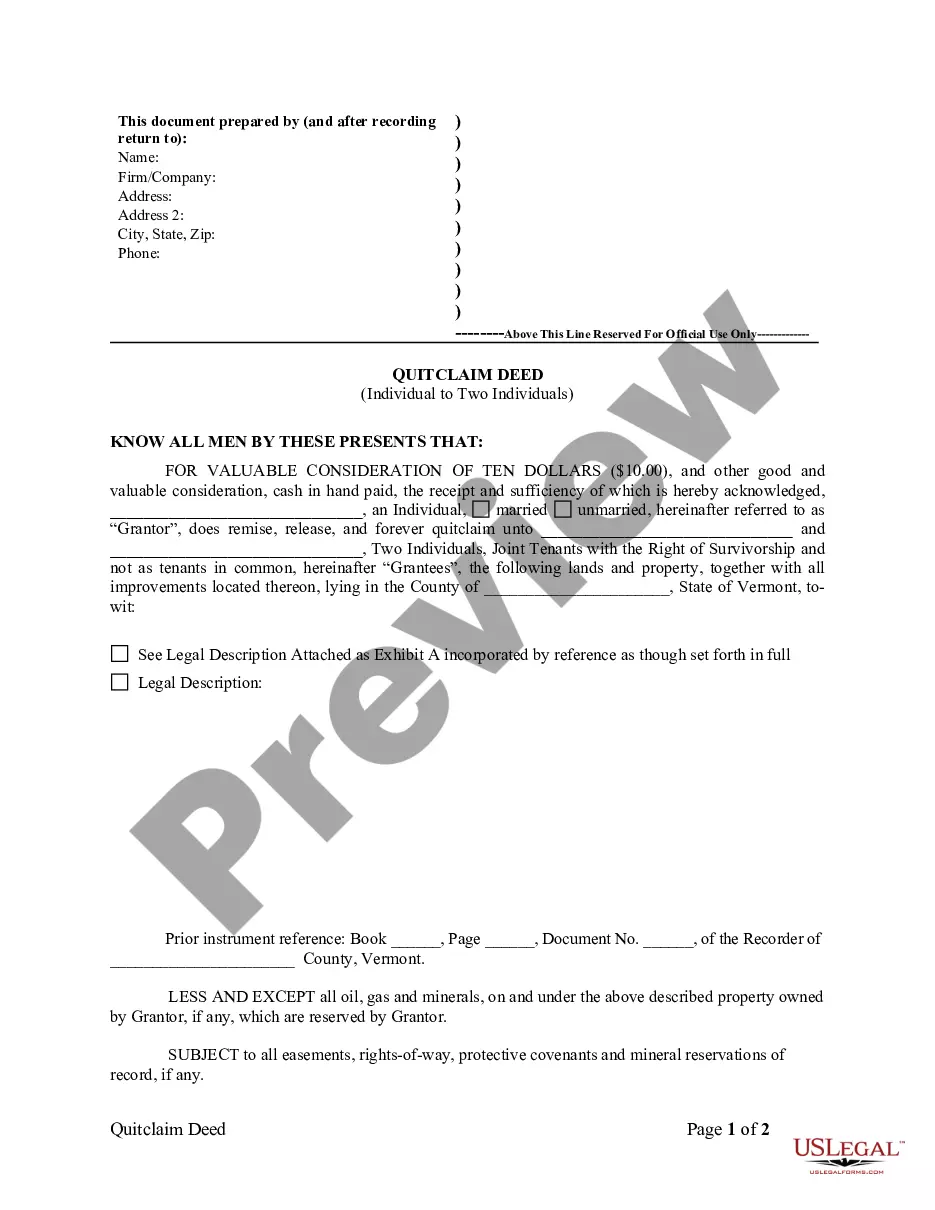
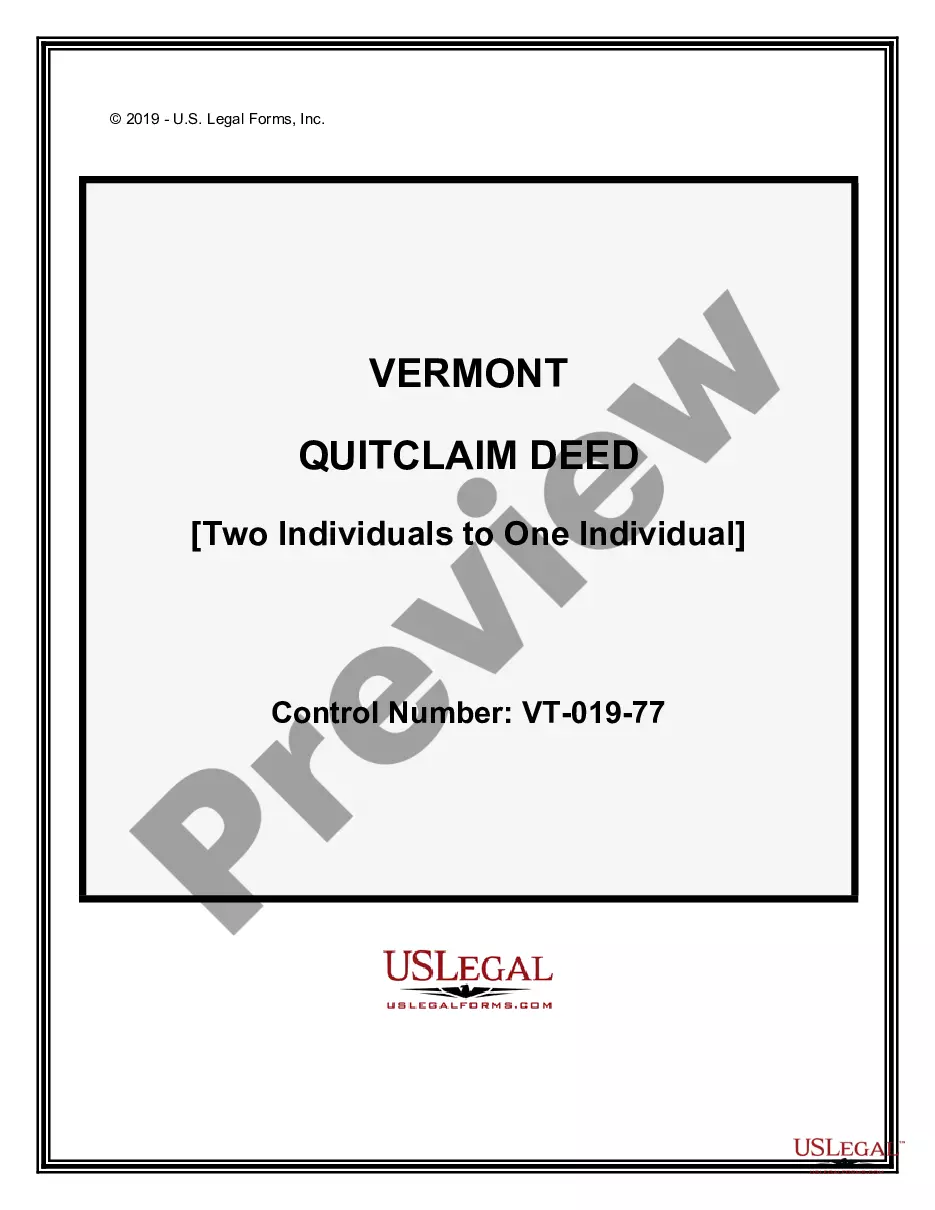
The Quitclaim Deed from Individual to Two Individuals in Joint Tenancy is a legal document used to transfer property ownership from one individual (the Grantor) to two individuals (the Grantees) who will hold the property as joint tenants. This means that if one owner passes away, the other automatically inherits their share of the property without the need for probate. Unlike other types of deeds, a quitclaim deed does not guarantee that the Grantor has good title to the property, making it a more straightforward option primarily for transferring interests among family members or known parties.
Form components explained
- Identification of the Grantor and Grantees, including full names and addresses.
- Description of the property being transferred, referenced as Exhibit A.
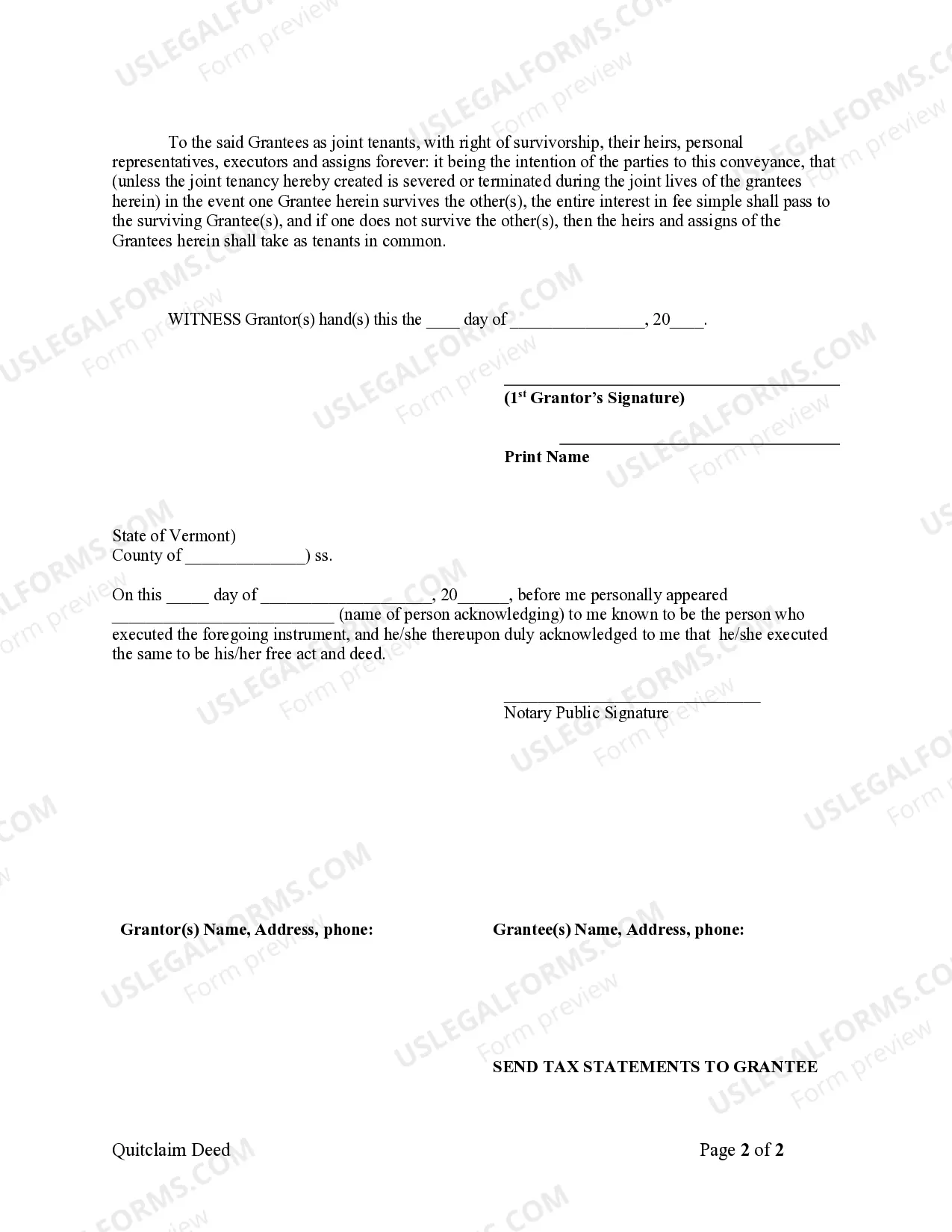
- Joint tenancy clause ensuring right of survivorship.
- Reservations of oil, gas, and mineral rights by the Grantor.
- Signature lines for the Grantor and a notary public.




When to use this form
This quitclaim deed is typically used when an individual wants to transfer property to two individuals who will own the property as joint tenants. Common scenarios may include family members wanting to simplify inheritance, partners wishing to formalize shared ownership, or personal situations where a property interest needs to be transferred quickly and without a warranty of title. It is important to use this form when both Grantees agree on the terms of ownership and when the Grantor wishes to relinquish their interest in the property.
Intended users of this form
- Individuals looking to transfer real estate ownership to two people.
- Family members or partners establishing shared ownership of property.
- Anyone needing a simple and efficient way to transfer property without warranties.
- Grantors who want to retain certain rights, such as mineral rights, during the transfer.
How to complete this form
- Identify the parties involved: the Grantor and the two Grantees.
- Provide the legal description of the property in the space provided or as an attached document (Exhibit A).
- Include any reservations, such as mineral rights, as stated in the form.
- Ensure all parties understand and agree to the joint tenancy terms.
- Sign the document in the designated areas and have it notarized where required.
Notarization requirements for this form
Yes, this form must be notarized to be legally valid. Notarization ensures that the identities of the parties are verified, and the document is executed properly. US Legal Forms provides integrated online notarization services, allowing you to complete this step securely through a video call without needing to travel.
Get your form ready online
Our built-in tools help you complete, sign, share, and store your documents in one place.
Make edits, fill in missing information, and update formatting in US Legal Forms—just like you would in MS Word.
Download a copy, print it, send it by email, or mail it via USPS—whatever works best for your next step.
Sign and collect signatures with our SignNow integration. Send to multiple recipients, set reminders, and more. Go Premium to unlock E-Sign.
If this form requires notarization, complete it online through a secure video call—no need to meet a notary in person or wait for an appointment.
We protect your documents and personal data by following strict security and privacy standards.

Make edits, fill in missing information, and update formatting in US Legal Forms—just like you would in MS Word.

Download a copy, print it, send it by email, or mail it via USPS—whatever works best for your next step.

Sign and collect signatures with our SignNow integration. Send to multiple recipients, set reminders, and more. Go Premium to unlock E-Sign.

If this form requires notarization, complete it online through a secure video call—no need to meet a notary in person or wait for an appointment.

We protect your documents and personal data by following strict security and privacy standards.
Typical mistakes to avoid
- Failing to include a complete legal description of the property.
- Not discussing the implications of joint tenancy with all Grantees prior to signing.
- Omitting necessary signatures or notary acknowledgment.
- Assuming the form is valid without confirming compliance with state-specific laws.
Why complete this form online
- Immediate access to professionally drafted legal documents.
- Ability to edit and customize the form as needed before downloading.
- Convenient and user-friendly process without the need for an in-person visit to an attorney.
- Reliable forms that meet state law requirements, reducing the risk of legal problems.
Looking for another form?

Form popularity
FAQ
In the event that the grantor has an outstanding mortgage on the property, he or she remains legally responsible for the mortgage even after transferring ownership through a quitclaim deed.The new owner will have the title of the property, but the original grantor will still be liable for the outstanding mortgage.
Before a quit claim deed can be filed with the County Clerk's Office, Form PT-172 must be filled out and filed with the Department of Taxes in order to prove that the property tax has been paid. Signing - Vermont Law dictates that the grantor must have the quit claim deed notarized (27 V.S.A § 301).
If the quitclaim deed requires the signature of all co-owners, the deed is invalid unless all co-owners have signed it and the deed is then delivered to the grantee.If one individual owns real estate and desires to add a co-owner such as a spouse, a quitclaim deed might be used.
Filing a quitclaim deed is a right of any property owner. You can file a quitclaim deed without refinancing your mortgage, but you are still responsible for the payments. Transferring the mortgage without refinancing is possible through an assumption of the loan, which requires lender approval.
A quitclaim deed will remove the out-spouse (or departing spouse) from the title to the property, effectively relinquishing their equity or ownership in the home. The execution of a quitclaim deed is typically a requirement of a divorce settlement in order to complete the division of assets.
Discuss property ownership interests. Access a copy of your title deed. Complete, review and sign the quitclaim or warranty form. Submit the quitclaim or warranty form. Request a certified copy of your quitclaim or warranty deed.
You usually do this by filing a quitclaim deed, in which your ex-spouse gives up all rights to the property. Your ex should sign the quitclaim deed in front of a notary. One this document is notarized, you file it with the county. This publicly removes the former partner's name from the property deed and the mortgage.
In some instances, however, quitclaim deeds are used when the grantor has a mortgage. In this case, the grantor remains liable for the mortgage even after ownership has transferred through the execution of a quitclaim deed. Quitclaim deeds transfer title but do not affect mortgages.
You usually do this by filing a quitclaim deed, in which your ex-spouse gives up all rights to the property. Your ex should sign the quitclaim deed in front of a notary. One this document is notarized, you file it with the county. This publicly removes the former partner's name from the property deed and the mortgage.