Virginia Warranty Deed from Corporation to Husband and Wife
About this form
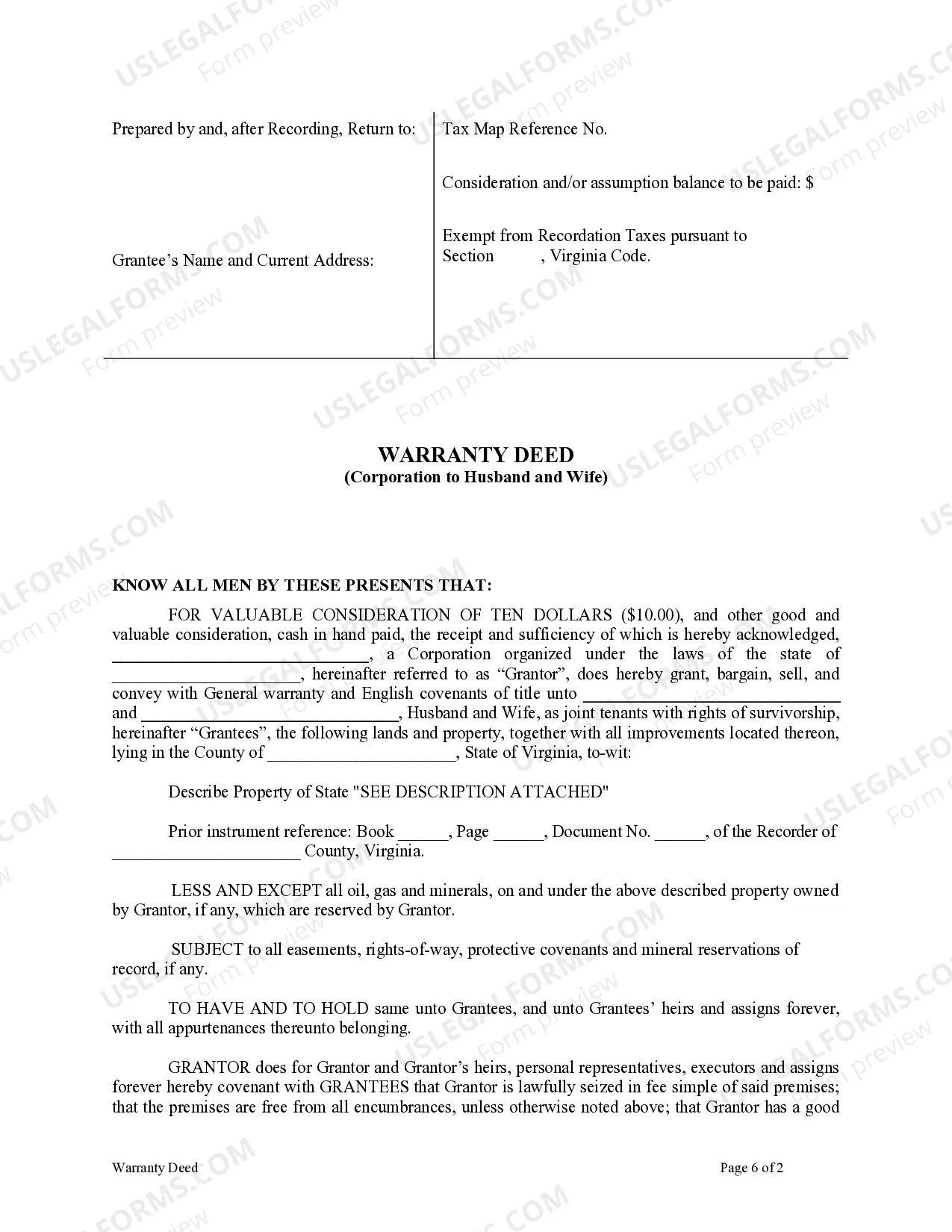
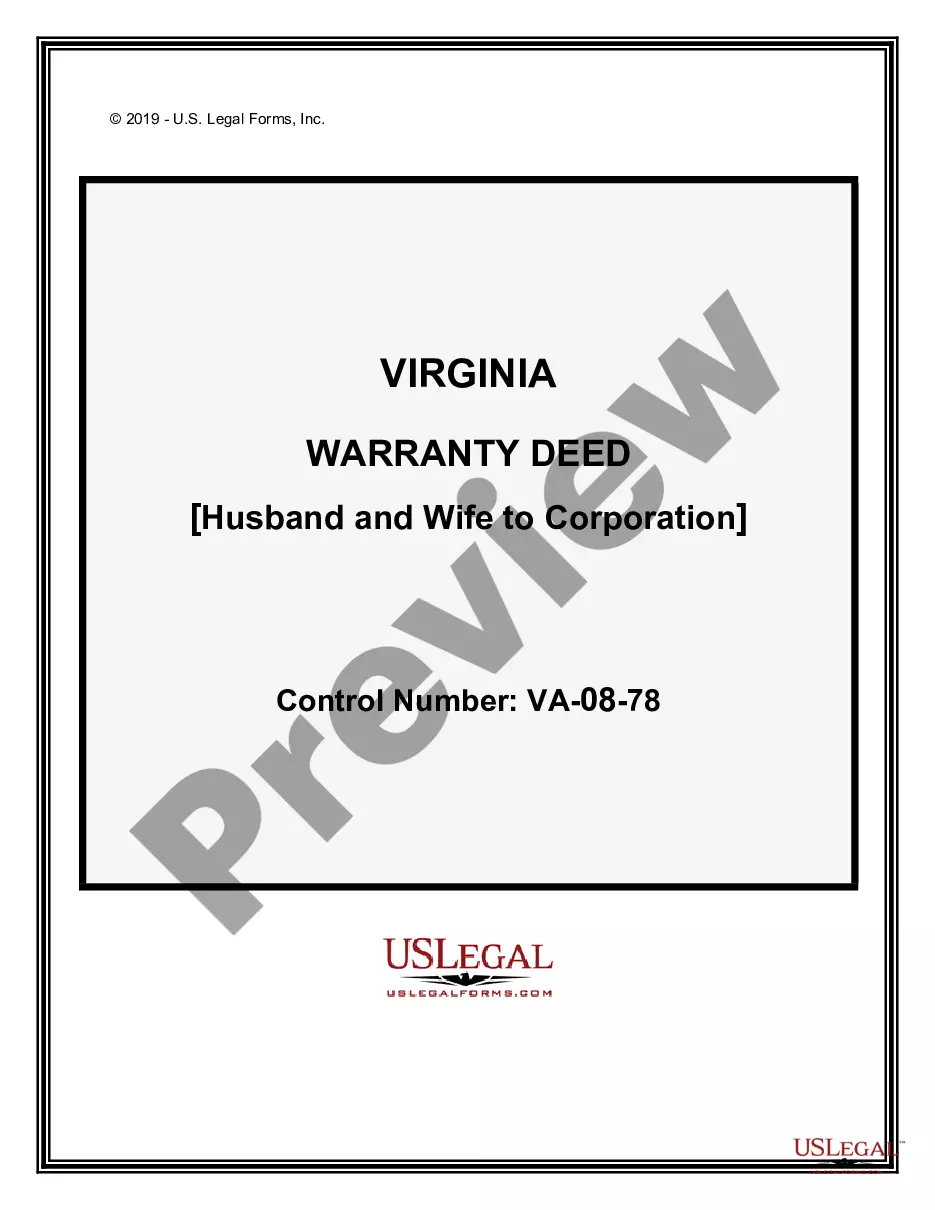
The Warranty Deed from Corporation to Husband and Wife is a legal document that officially transfers property ownership from a corporation (the Grantor) to a married couple (the Grantees). This deed includes a warranty, meaning the corporation guarantees that it has the right to convey the property and that it is free from encumbrances, except for specific reservations like oil, gas, and minerals. This form is unique as it involves a corporate transfer, which is different from individual transfers or transfers between non-corporate entities.
Key parts of this document
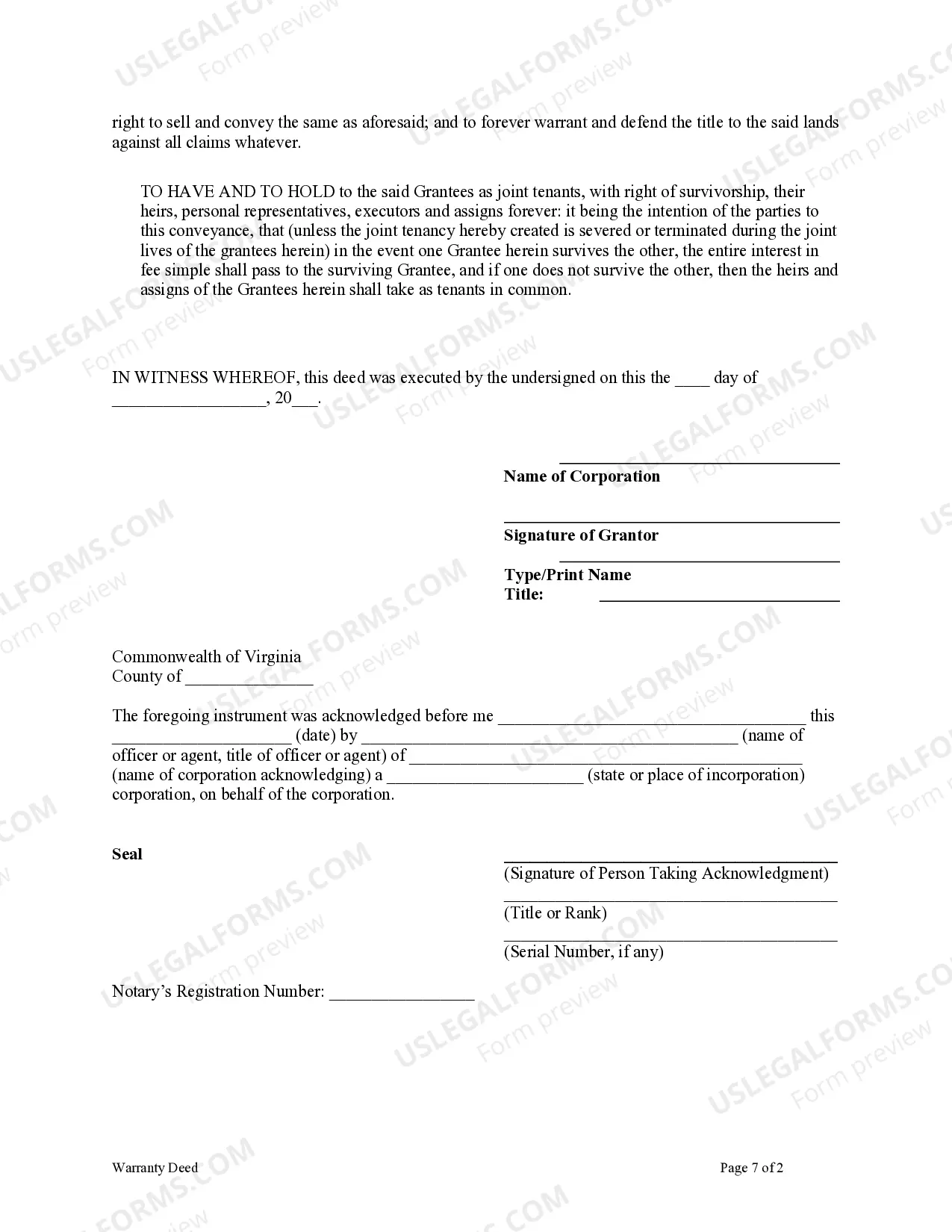
- The identities and signatures of the Grantor (corporation) and Grantees (husband and wife).
- A detailed description of the property being transferred.
- Clauses addressing the retention of certain rights, such as oil, gas, and minerals.
- The warranty clause confirming the Grantor's ownership and rights to the property.
- Provisions regarding joint tenancy and rights of survivorship for the Grantees.



When this form is needed
This warranty deed should be used when a corporation is transferring real estate to a married couple, especially in cases such as a sale of corporate-owned property or in estate planning scenarios where property needs to be passed to spouses. It is also applicable in transactions involving property that is part of corporate assets being divided, liquidated, or restructured.
Who should use this form
- Corporations seeking to transfer property ownership to a married couple.
- Husbands and wives looking to receive property as a joint ownership arrangement.
- Business owners needing to allocate corporate real estate among family members.
How to complete this form
- Identify the parties involved: the corporation (Grantor) and the spouses (Grantees).
- Clearly describe the property being transferred, including any attached legal descriptions.
- Fill in the necessary fields for the Grantorâs and Granteesâ names and signatures.
- Include any reservations, such as rights to minerals and gas, as specified.
- Execute the deed in front of a notary public, if required.
Is notarization required?
Yes, this form must be notarized to be legally valid. Notarization ensures the authenticity of the signatures on the deed and adds a layer of legal protection. If you use US Legal Forms, you can access remote notarization services to complete this process easily and securely.
Get your form ready online
Our built-in tools help you complete, sign, share, and store your documents in one place.
Make edits, fill in missing information, and update formatting in US Legal Forms—just like you would in MS Word.
Download a copy, print it, send it by email, or mail it via USPS—whatever works best for your next step.
Sign and collect signatures with our SignNow integration. Send to multiple recipients, set reminders, and more. Go Premium to unlock E-Sign.
If this form requires notarization, complete it online through a secure video call—no need to meet a notary in person or wait for an appointment.
We protect your documents and personal data by following strict security and privacy standards.

Make edits, fill in missing information, and update formatting in US Legal Forms—just like you would in MS Word.

Download a copy, print it, send it by email, or mail it via USPS—whatever works best for your next step.

Sign and collect signatures with our SignNow integration. Send to multiple recipients, set reminders, and more. Go Premium to unlock E-Sign.

If this form requires notarization, complete it online through a secure video call—no need to meet a notary in person or wait for an appointment.

We protect your documents and personal data by following strict security and privacy standards.
Common mistakes to avoid
- Failing to provide a clear and accurate description of the property.
- Not including all required signatures from both parties.
- Overlooking the need for notarization in some jurisdictions.
- Not specifying any reservations, such as mineral rights, which can lead to disputes.
Benefits of using this form online
- Convenience of accessing and filling the form from anywhere at any time.
- Editable fields that allow users to enter necessary information easily.
- Instant downloadable access, saving time as there is no need to visit a lawyer for a basic deed.
Looking for another form?


Form popularity
FAQ
Locate the most recent deed to the property. Create the new deed. Sign and notarize the new deed. Record the deed in the land records of the clerk's office of the circuit court in the jurisdiction where the property is located.
Locate the most recent deed to the property. Create the new deed. Sign and notarize the new deed. Record the deed in the land records of the clerk's office of the circuit court in the jurisdiction where the property is located.
The only way to forcibly change the ownership status is through a legal action and the resultant court order. However, if an owner chooses to be removed from the deed, it is simply a matter of preparing a new deed transferring that owner's interest in the property.
All deeds must be prepared by the owner of the property or by an attorney licensed to practice in Virginia. The requirements are listed below in the code section. Click here to read about e-Recording. § 17.1-223.
Retrieve your original deed. Get the appropriate deed form. Draft the deed. Sign the deed before a notary. Record the deed with the county recorder. Obtain the new original deed.
Locate the most recent deed to the property. Create the new deed. Sign and notarize the new deed. Record the deed in the land records of the clerk's office of the circuit court in the jurisdiction where the property is located.
A special warranty deed is a common form of conveyance in Virginia that is used to transfer title to real estate. Unless an exception is made in the deed, all appurtenances, buildings, and privileges belonging to the land being conveyed will be included in the conveyance (55.1-303).
The only way to change a recorded deed is to have a new deed prepared and recorded in the Clerk's Land Records Office. The deed on record cannot be changed. Once a document is recorded, it cannot be changed.