Utah Notice of Dishonored Check - Criminal - Keywords: bad check, bounced check
What this document covers
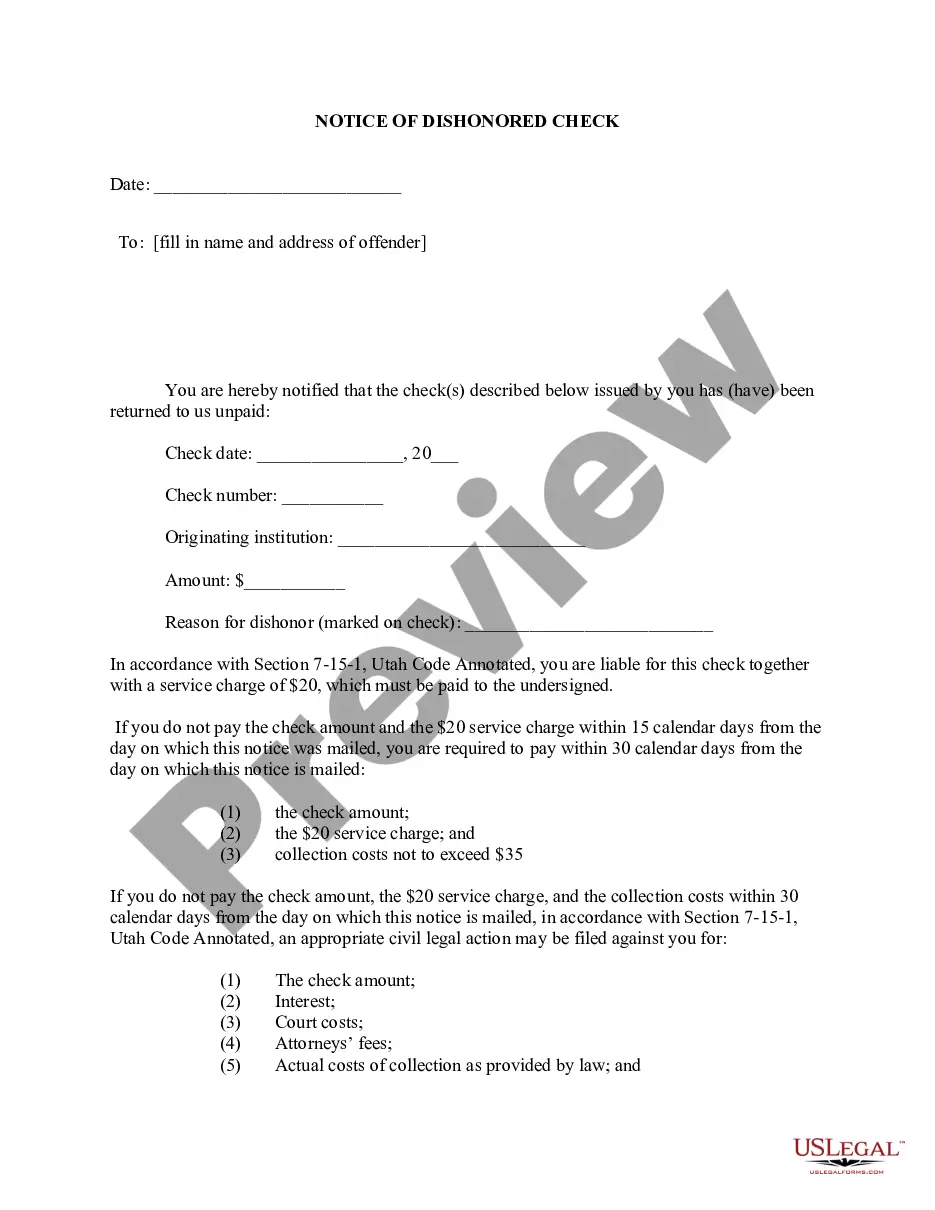
The Notice of Dishonored Check is a legal document used to inform a debtor that their check has bounced or is considered a bad check by the bank. This form serves as a formal notification, providing critical information about the dishonored check and outlining potential legal consequences if the owed amount is not paid. It is essential for businesses or individuals receiving a bad check to use this form to pursue recovery effectively, distinguishing it from civil actions that may follow.
Form components explained
- Check date: The date the dishonored check was issued.
- Check number: The identification number of the bounced check.
- Originating institution: The name of the bank where the check was drawn.
- Amount: The total amount of the check that was dishonored.
- Reason for dishonor: The specific reason indicated by the bank for the check's dishonor.
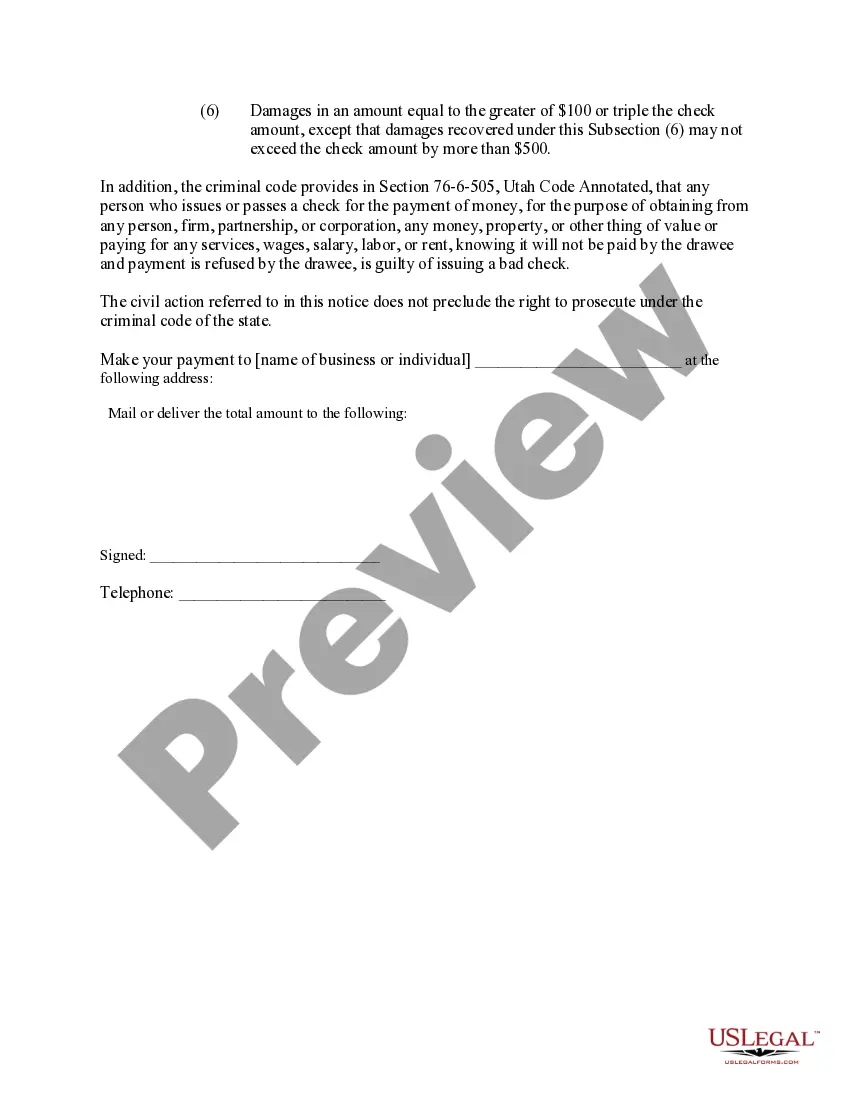
- Payment details: Includes service fees and deadlines for payment to avoid further legal action.
When to use this document
This form should be used when you have received a check that has bounced or been rejected by the bank. Common scenarios include situations where a customer has issued a check without sufficient funds in their account or when the account does not exist. Using this form allows you to formally notify the debtor and serves as a prerequisite for any potential legal action to recover the owed amounts.
Who should use this form
- Businesses that accept checks as a form of payment.
- Individuals who have received a bounced check from a debtor.
- Accountants or financial professionals managing collections on behalf of clients.
Completing this form step by step
- Identify the check date and enter the specific date the bounced check was issued.
- Fill in the check number associated with the dishonored payment.
- Specify the originating institution where the check was drawn.
- Enter the total amount of the bounced check.
- Indicate the reason for dishonor based on the bank's notation.
- Complete payment details, including any service charges and deadlines for recovery.
Does this document require notarization?
This form does not typically require notarization unless specified by local law. It is advisable to check state regulations to ensure compliance before proceeding with any legal actions.
Get your form ready online
Our built-in tools help you complete, sign, share, and store your documents in one place.
Make edits, fill in missing information, and update formatting in US Legal Forms—just like you would in MS Word.
Download a copy, print it, send it by email, or mail it via USPS—whatever works best for your next step.
Sign and collect signatures with our SignNow integration. Send to multiple recipients, set reminders, and more. Go Premium to unlock E-Sign.
If this form requires notarization, complete it online through a secure video call—no need to meet a notary in person or wait for an appointment.
We protect your documents and personal data by following strict security and privacy standards.

Make edits, fill in missing information, and update formatting in US Legal Forms—just like you would in MS Word.

Download a copy, print it, send it by email, or mail it via USPS—whatever works best for your next step.

Sign and collect signatures with our SignNow integration. Send to multiple recipients, set reminders, and more. Go Premium to unlock E-Sign.

If this form requires notarization, complete it online through a secure video call—no need to meet a notary in person or wait for an appointment.

We protect your documents and personal data by following strict security and privacy standards.
Common mistakes
- Failing to include the check number or amount.
- Not specifying the reason for dishonor clearly.
- Missing the deadlines for payment outlined in the notice.
Benefits of completing this form online
- Convenience: Quickly download and complete the form from anywhere.
- Editability: Easily fill in your specific details and customize as necessary.
- Reliability: Forms are drafted by licensed attorneys ensuring legal compliance.
Legal use & context
- Using the notice can prevent further legal issues by formally documenting the debt.
- This form can be a critical first step before pursuing legal action in court.
Main things to remember
- The Notice of Dishonored Check serves to formally inform a debtor about a bounced check.
- It is essential for recovering amounts owed before taking further legal action.
- Carefully complete the form to avoid common mistakes and ensure compliance with state law.
Looking for another form?

Form popularity
FAQ
Instead of an individual filing the complaint, the government usually files the criminal complaint against the individual. However, some states do allow individuals to file criminal complaints. Essentially, it's a judicial order, court-issued document, that charges the suspect, defendant with specific crimes.
Sort Court Documents into Folders/ Sections The easiest way to organize documents is by creating folders and sections. With Bundledocs you can create as many sections, sub-section or even volumes as needed. For example, create a 'Pleadings', 'Correspondence', 'Records' etc. section and add any documents you need to it.
You don't need an attorney to file a Motion for Contempt, but it is a good idea to have one. If you decide to represent yourself, you can go to the courthouse that made the order and ask for help at the Court Service Center.
Affidavit. An Affidavit is a sworn written statement made before an official or anyone who may legally administer an oath. Amending Agreement. Amortization Schedule. Articles of Incorporation. Assignment. Assignment of Partnership Interest. Assignment of Trade Name.
Complaints may be submitted: (1) In writing, or on a form provided by DCJS, signed by the complainant; (2) In writing, submitted anonymously, providing sufficient detailed information for DCJS to conduct an investigation; or (3) Via telephone, providing the complaint alleges activities which constitute a life-
Filing the Documents Take the original and two (2) copies of the Motion to the Civil Division of the Clerk of Superior Court's office in the county where your case is filed. The Clerk will stamp each Motion filed, place the original in the Court file and return two (2) copies of the filed document to you.
Legal documents are defined as a written proof of the limitations and extent of a person's rights and privileges in a clear and specific manner. A common example of a legal document that you may be familiar to is the Last Will and Testament.
Indexes. Indexes to court records are usually incomplete. Dockets. When a judicial body agrees to hear a case, it is placed on the court docket until trial. Court Minutes. All actions of the court are briefly recorded by the clerk in the minutes. Orders. Judgments. Case Files. Witnesses Lists. Jury Records.
Read the Complaint. Find copies of contracts and any other written communications between you and the other side. Analyze the strengths and weaknesses of your case. Prepare your documents and evidence for trial. Identify and prepare any witnesses. Practice, Practice, Practice your presentation.
A motion is an application to the court made by the prosecutor or defense attorney, requesting that the court make a decision on a certain issue before the trial begins.