Agreement to Toll Statute of Limitations
Understanding this form
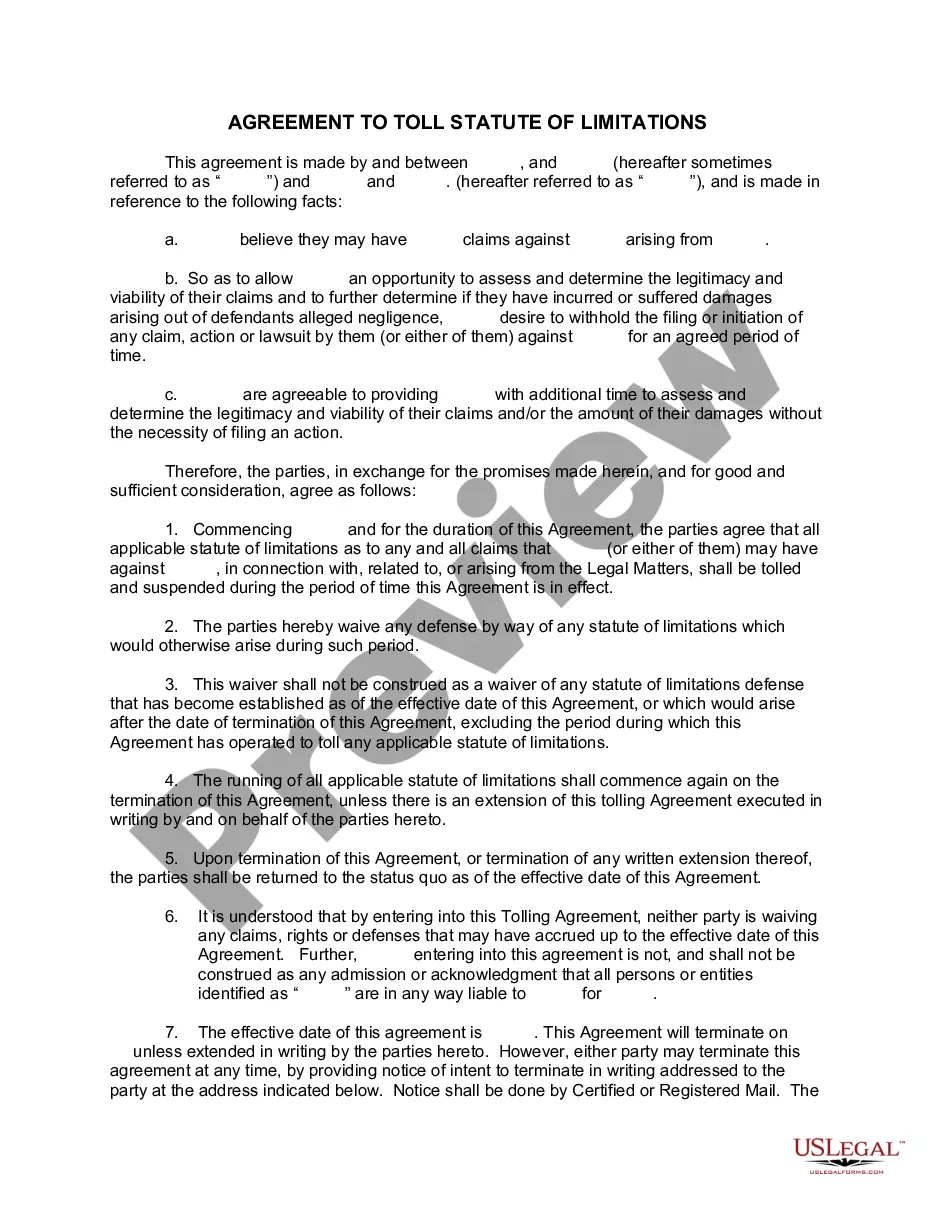
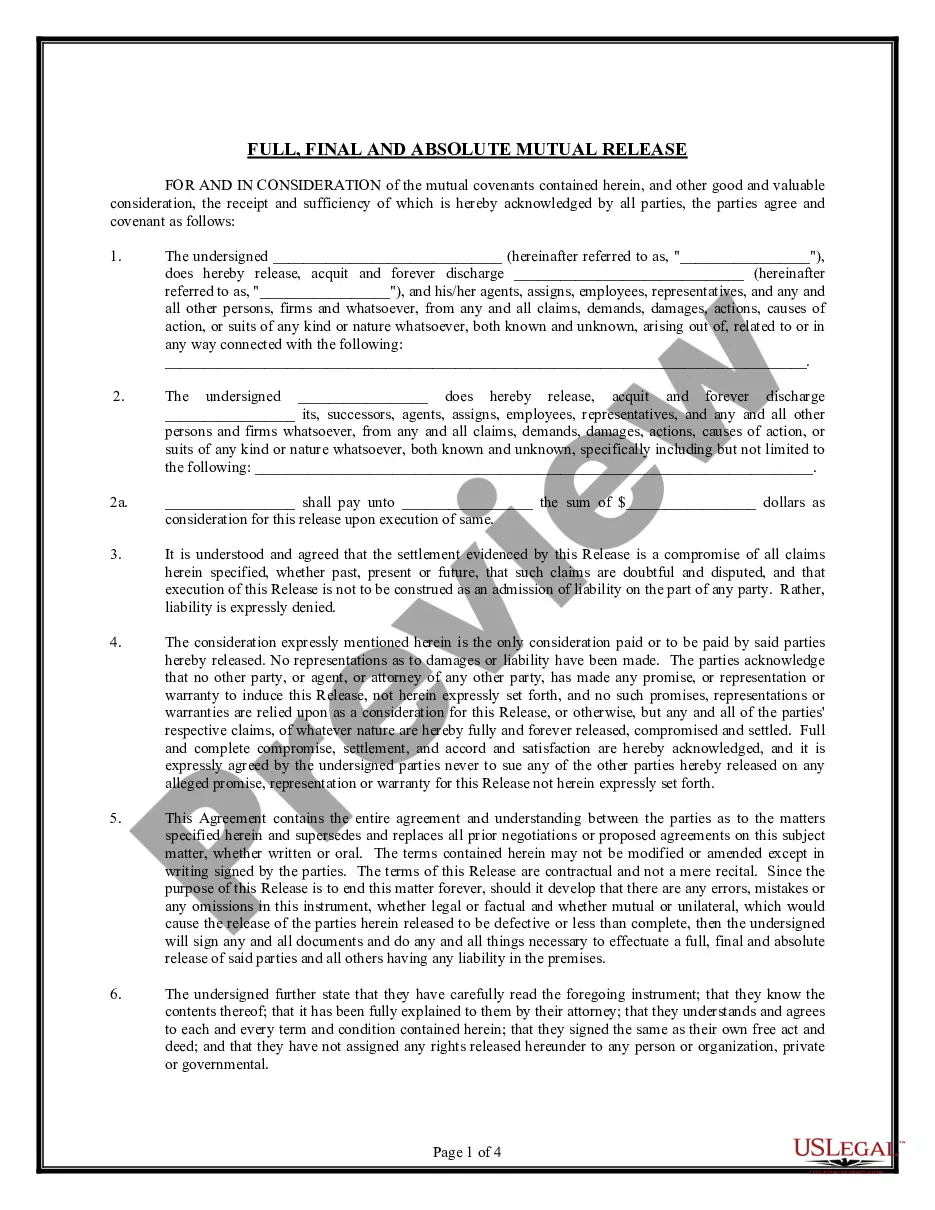
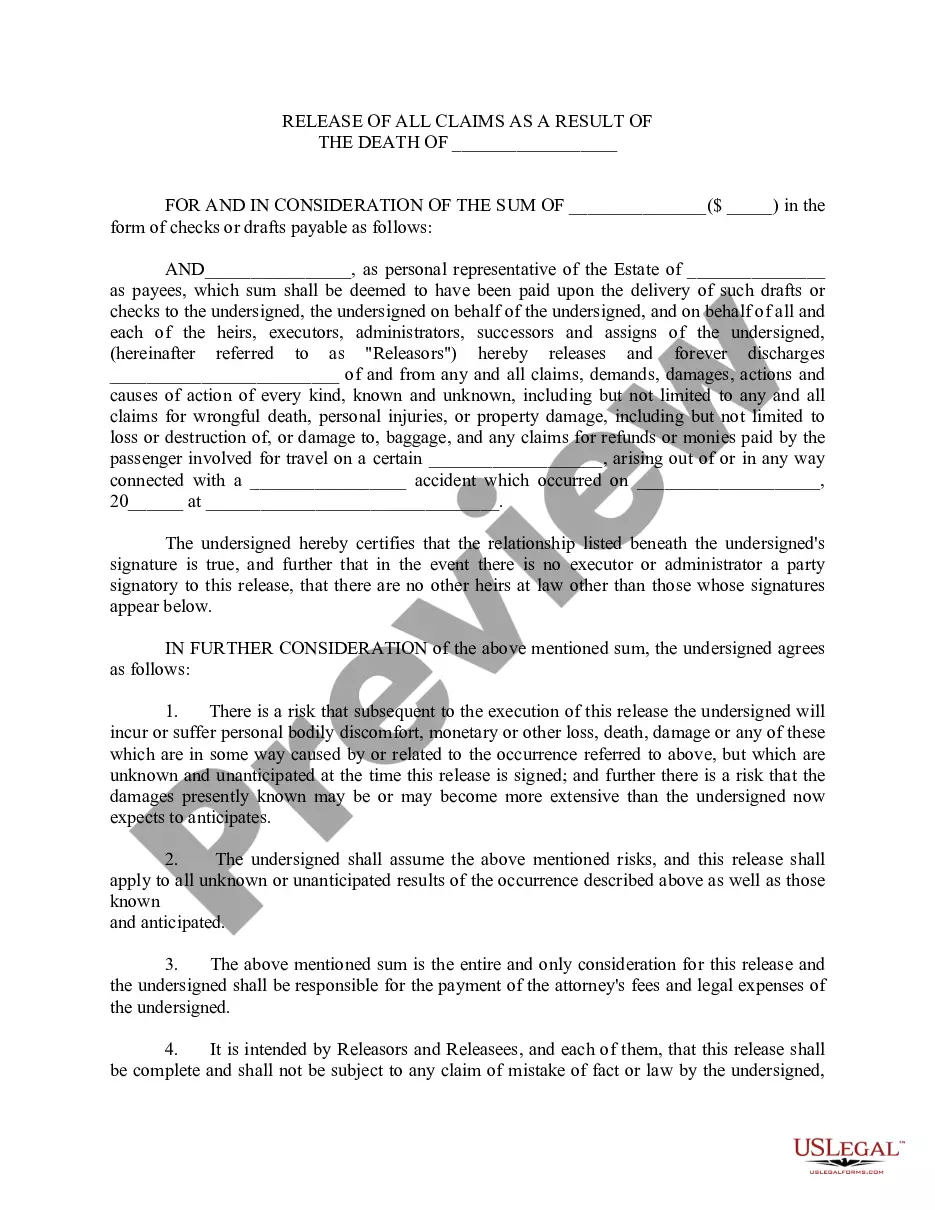
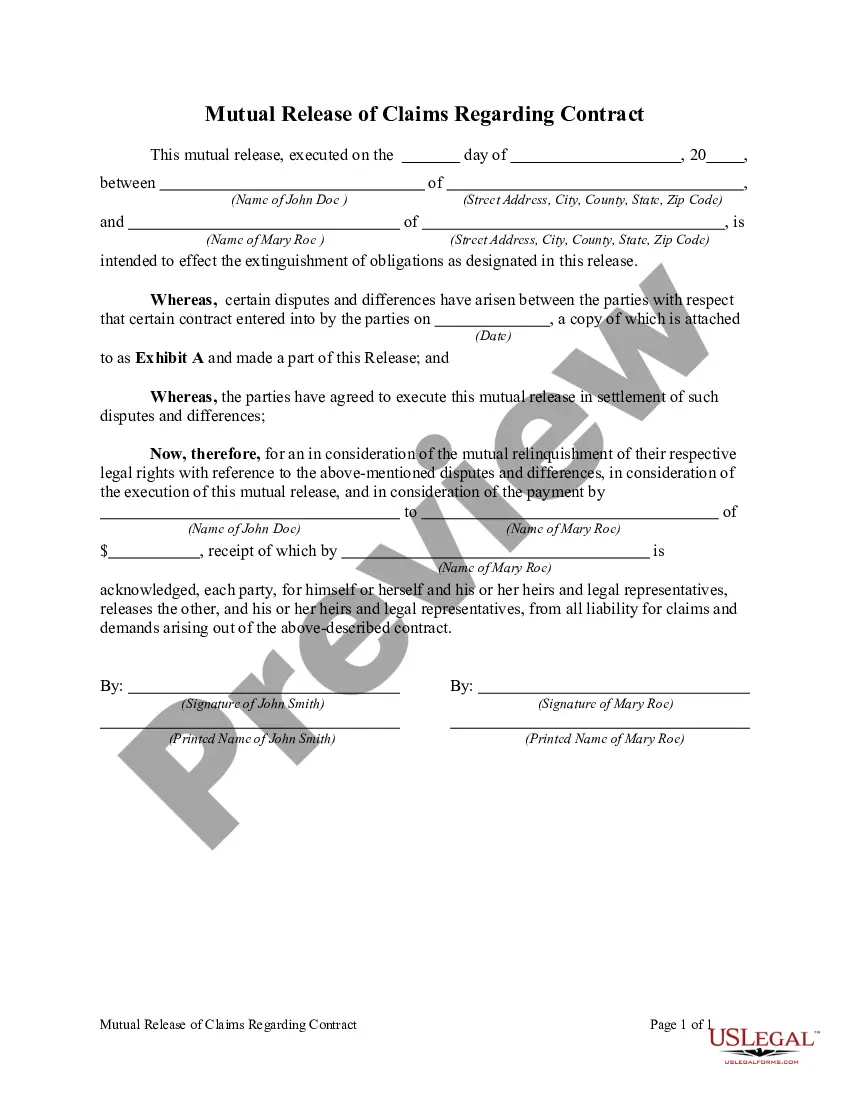
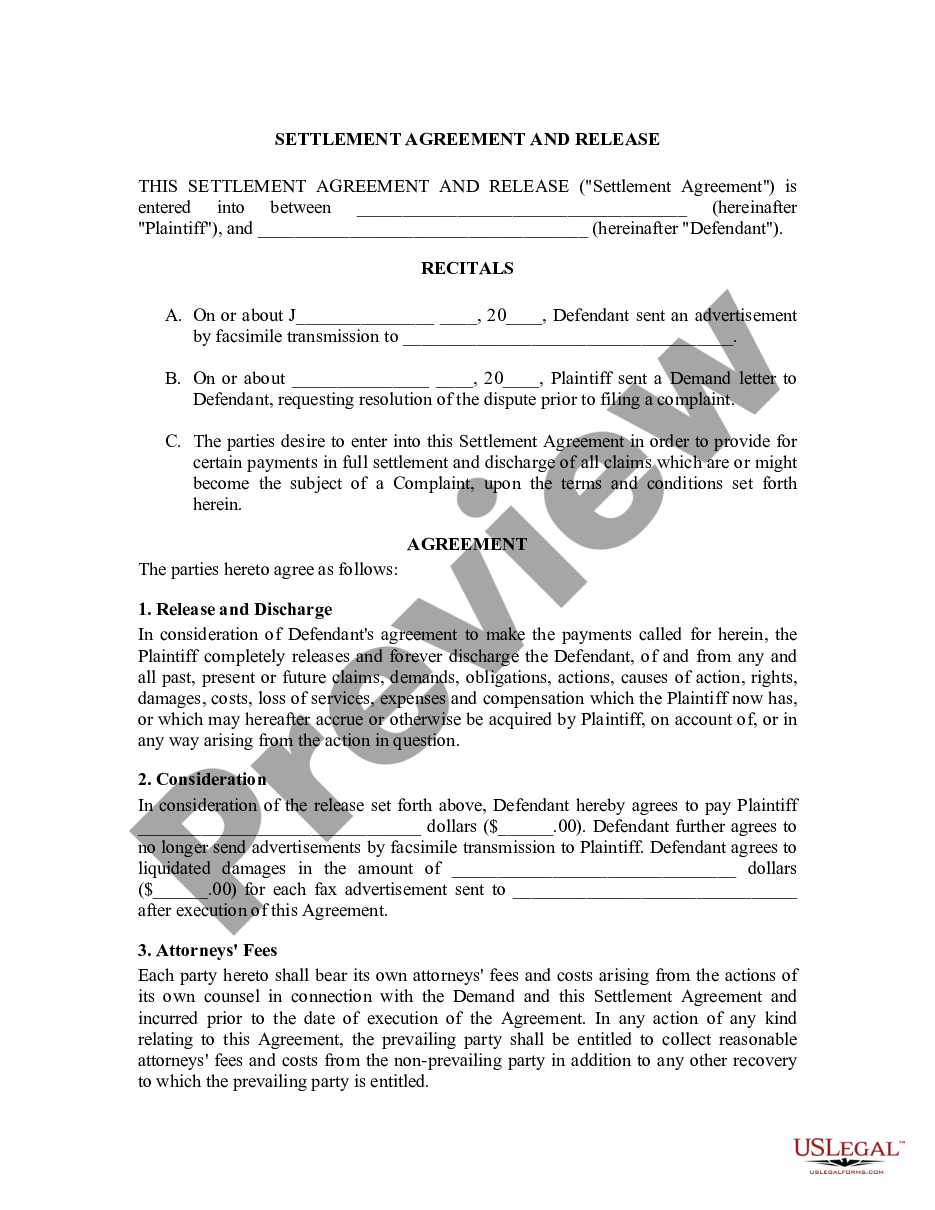
The Agreement to Toll Statute of Limitations is a legal document that allows parties involved in a dispute to pause the running of a statute of limitations period. This agreement essentially waives any defense based on the statute of limitations for a specified timeframe. It differs from other agreements by its explicit focus on preserving rights related to legal claims during negotiations or pending resolutions.
Key parts of this document
- Parties involved: Identification of the parties entering into the agreement.
- Waiver of defenses: Clause stating that the parties waive the right to claim time limitations during the agreement period.
- Duration of tolling: Specification of how long the statute of limitations is tolled and conditions for resuming its application.
- Status quo restoration: Explanation of how the parties' rights revert upon termination of the agreement.
When this form is needed
This form is useful in situations where parties are engaged in discussions about a legal dispute and agree to put off any claims for a limited time. Common scenarios include negotiations for settlements or ongoing mediations where an immediate resolution is being sought, helping to prevent the expiration of legal rights during this process.
Intended users of this form
- Individuals or businesses involved in a legal dispute.
- Parties seeking to negotiate an agreement without the pressure of expiring legal claims.
- Attorneys representing clients in negotiations requiring a pause on statute limitation deadlines.
How to prepare this document
- Identify the parties involved by entering their names and addresses.
- Specify the duration for which the statute of limitations will be tolled.
- Include a clear statement waiving any defense related to the statute of limitations.
- Enter the effective date of the agreement.
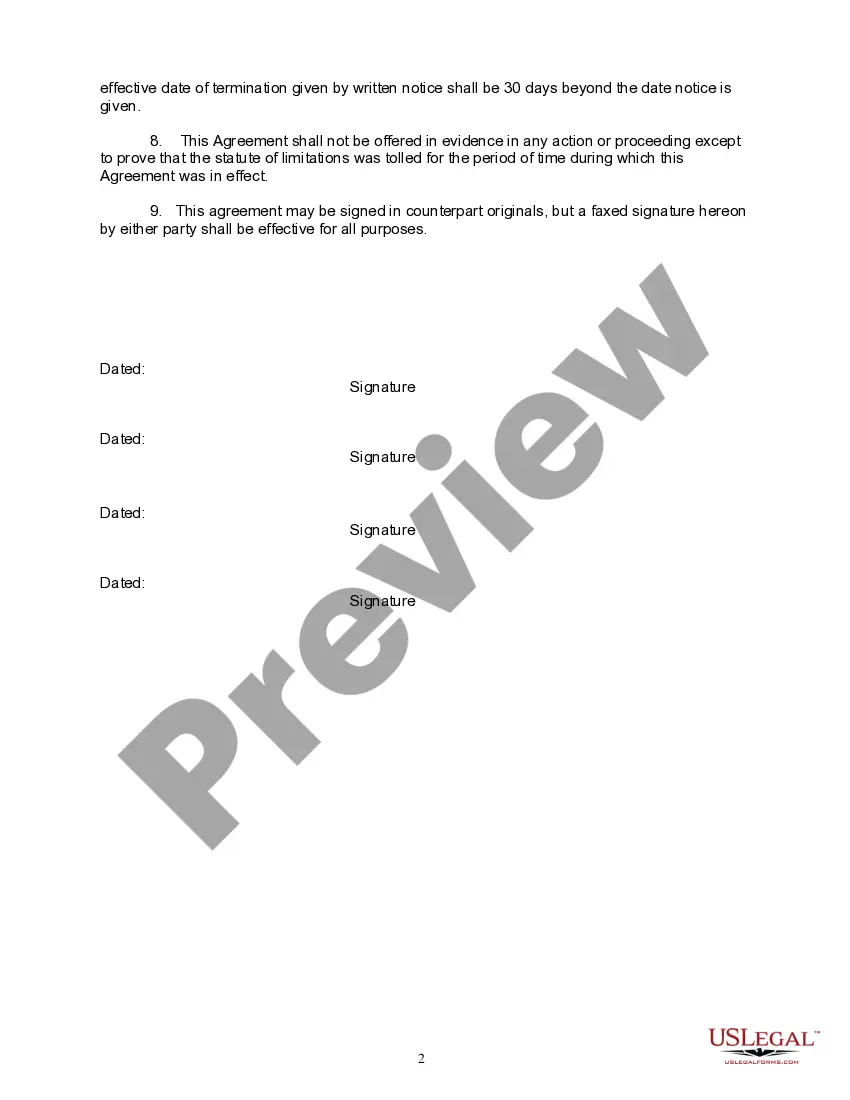
- Ensure all parties sign and date the document to validate the agreement.
Does this document require notarization?
Notarization is generally not required for this form. However, certain states or situations might demand it. You can complete notarization online through US Legal Forms, powered by Notarize, using a verified video call available anytime.
Get your form ready online
Our built-in tools help you complete, sign, share, and store your documents in one place.
Make edits, fill in missing information, and update formatting in US Legal Forms—just like you would in MS Word.
Download a copy, print it, send it by email, or mail it via USPS—whatever works best for your next step.
Sign and collect signatures with our SignNow integration. Send to multiple recipients, set reminders, and more. Go Premium to unlock E-Sign.
If this form requires notarization, complete it online through a secure video call—no need to meet a notary in person or wait for an appointment.
We protect your documents and personal data by following strict security and privacy standards.

Make edits, fill in missing information, and update formatting in US Legal Forms—just like you would in MS Word.

Download a copy, print it, send it by email, or mail it via USPS—whatever works best for your next step.

Sign and collect signatures with our SignNow integration. Send to multiple recipients, set reminders, and more. Go Premium to unlock E-Sign.

If this form requires notarization, complete it online through a secure video call—no need to meet a notary in person or wait for an appointment.

We protect your documents and personal data by following strict security and privacy standards.
Common mistakes
- Failing to specify the exact duration of the tolling period.
- Not obtaining signatures from all involved parties.
- Leaving out essential identifying information about the parties.
Why complete this form online
- Convenient access to a legally vetted document template.
- Ability to customize the agreement to fit specific needs and circumstances.
- Immediate download and editing capability, allowing for quick use.
Legal use & context
- The agreement helps protect parties from losing their rights to pursue claims due to expired statutes of limitations.
- It serves as a legal tool during ongoing negotiations or settlement discussions.
- Proper use can enhance the enforceability of claims once the tolling period concludes.
Quick recap
- The Agreement to Toll Statute of Limitations is vital for pausing legal claims during negotiation periods.
- Proper completion is key to ensuring the agreement is enforceable and effective.
- Consult state-specific rules when using this form to ensure compliance with local laws.
Looking for another form?
Form popularity
FAQ
For causes of action having statutes of limitation or repose that exceed 180 days, the statutes are tolled until October 1, 2020. For causes of action having statutes of limitation or repose that are 180 days or less, the statutes are tolled until August 3, 2020.
A court cannot force a defendant to use a statute of limitations defense, but it is usually in the person's best legal interests to do so.The defense may be waived by an agreement of the parties to the controversy, provided that the agreement is supported by adequate consideration.
You can't sue after the statute of limitations filing deadline has passed, but special circumstances might extend the standard time limit.Each state (and the federal government) sets its own statutes of limitations, with different deadlines for different kinds of cases.
1. To stop the running of a time period, especially a time period set by a statute of limitations. 2. To bar or take away. Tolling a right of entry takes away the right to be present on the land.
While the statute of limitations varies depending upon the type of claim contemplated in any given matter, as a rule, if it runs out prior to the filing of a complaint, the case is no longer valid. Sometimes, however, the statute of limitations is suspended, or tolled, for a while before it begins to run again.
Nope, you have no legal obligation and you should not sign anything without the advice and consult a qualified lawyer.
Statute of limitations is not extended when settlement negotiations are ongoing and the IME is scheduled after the statute of limitations tolls.The court found favorably for the defense, noting that the plaintiff was not entitled to equitable tolling of the statute of limitations.
Unlike in Pacific Harbor, where the agreement attempted to toll the limitations period from the time it was signedwhen the limitations period had already expiredthis Agreement attempts to retroactively toll the limitations period from a time when it was active.