Waiver and Release From Liability For Adult for Individual Four-Wheeling
Understanding this form
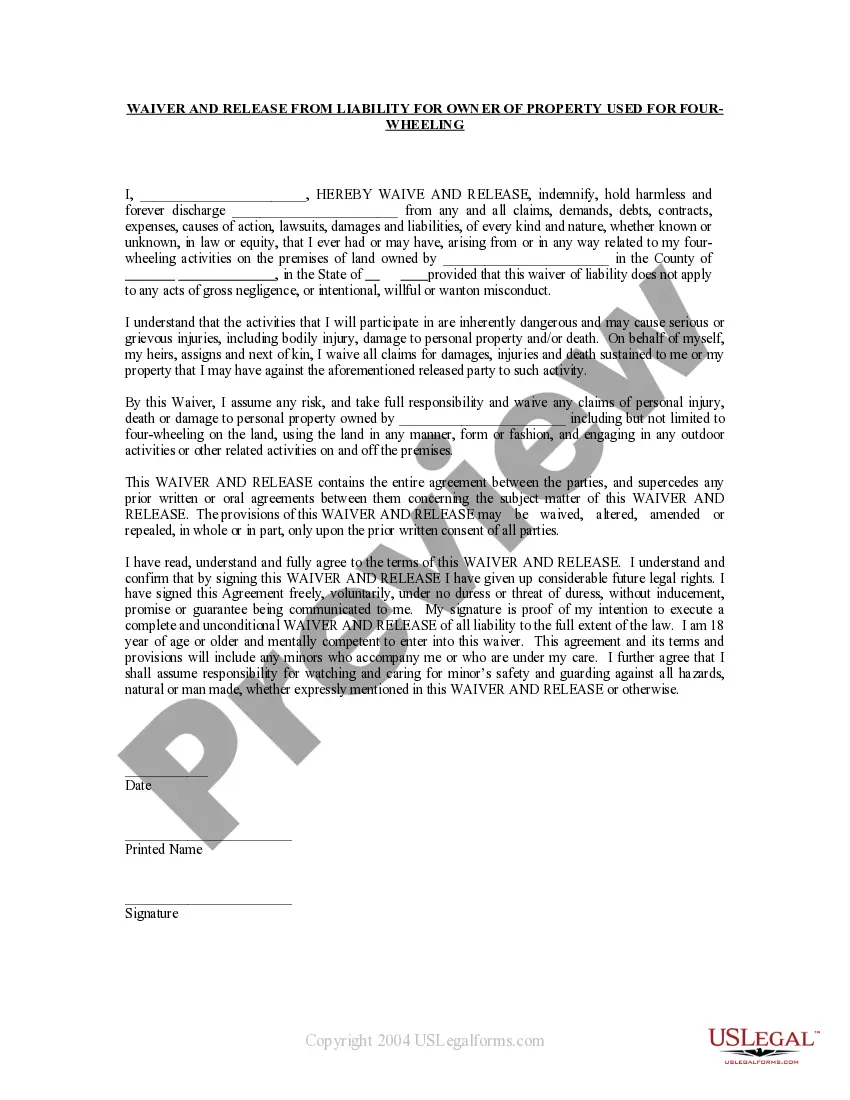
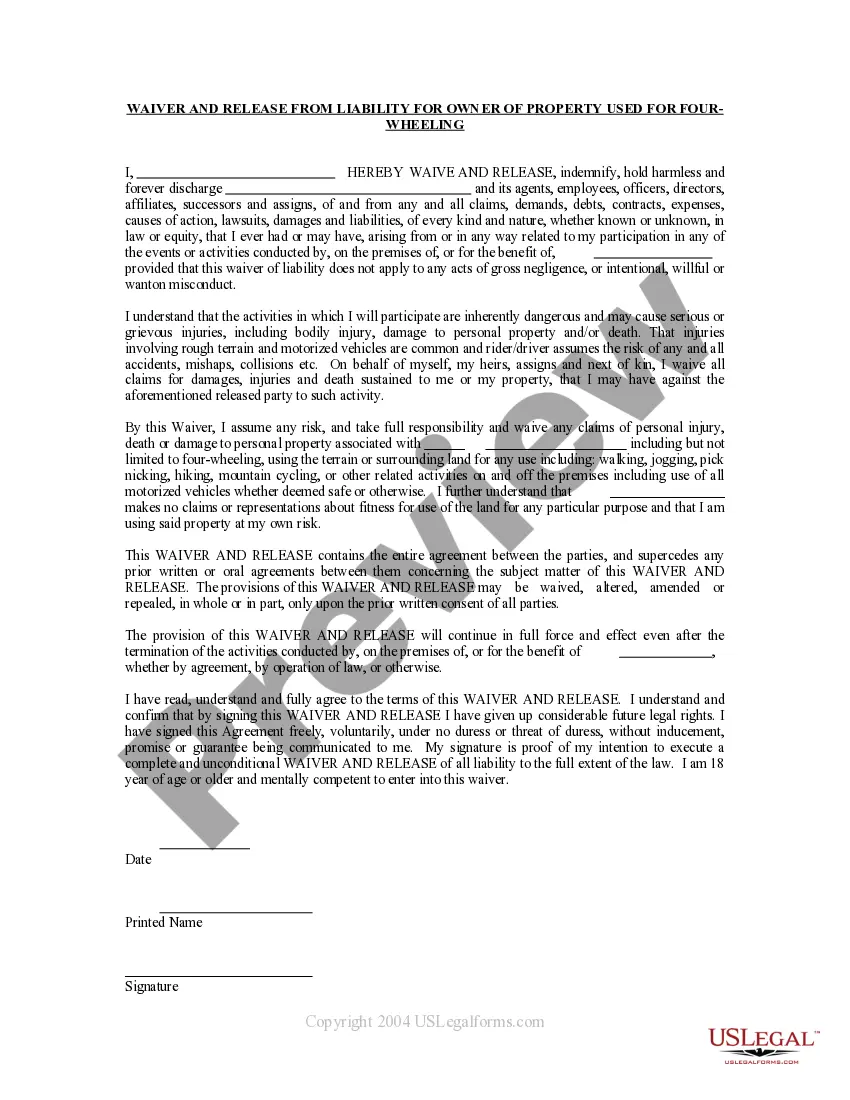
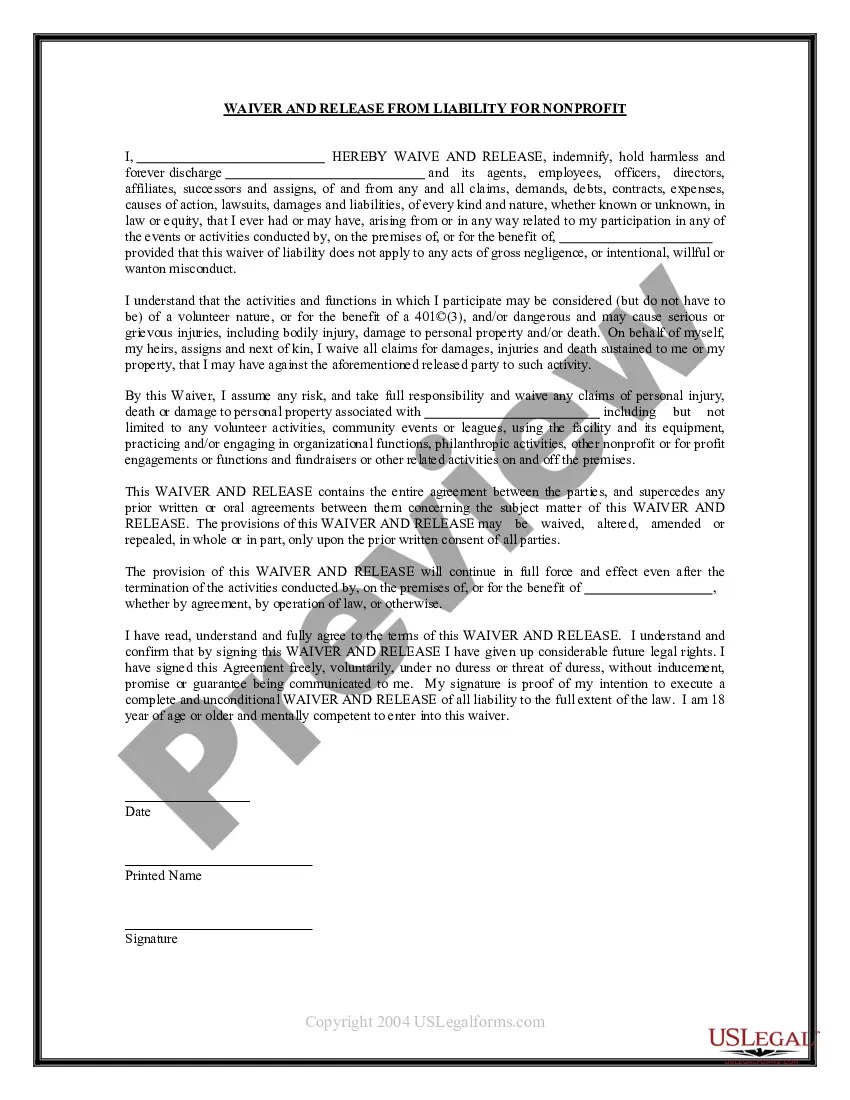
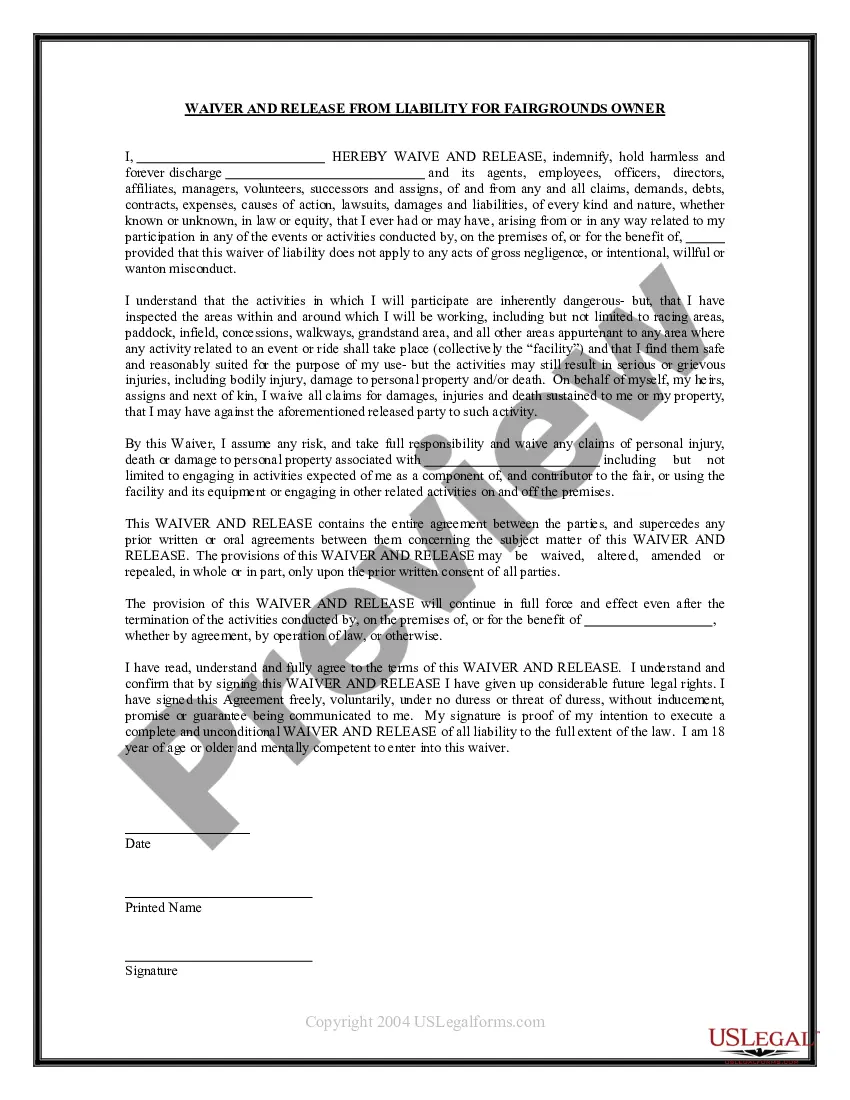
The Waiver and Release From Liability for Adult for Individual Four-Wheeling is a legal document that releases a property owner from liability for injuries or damages that an individual may sustain while riding a four-wheeler on their property. This form is important for ensuring that individuals acknowledge the risks involved in such activities, distinguishing it from general liability waivers that may not cover specific activities like off-road driving.
Main sections of this form
- Understanding of inherent risks associated with four-wheeling activities.
- Release of claims against the property owner for any damages or injuries.
- Assumption of full responsibility for personal injuries or property damage.
- A statement that this waiver supersedes prior agreements.
- Signature, printed name, and date for acknowledgment and acceptance.
Common use cases
This waiver should be used when an individual intends to ride a four-wheeler on someone else's property. It is essential in scenarios where the property owner allows individuals to engage in off-road activities, such as four-wheeling, thereby requiring a formal acknowledgment of risks and waiver of liability. This protects the property owner from legal claims resulting from accidents or injuries incurred during these activities.
Who should use this form
- Individuals planning to ride four-wheelers on private property.
- Property owners who permit recreational activities on their land.
- Adventure sports businesses offering four-wheeling experiences.
- Groups organizing off-road riding events.
How to complete this form
- Read the waiver carefully to understand the risks involved in four-wheeling.
- Fill in your printed name in the designated space.
- Sign the form to acknowledge acceptance of terms and waiver of liability.
- Include the date of signing in the specified field.
- Ensure all parties have copies of the signed waiver for their records.
Does this form need to be notarized?
Notarization is not commonly needed for this form. However, certain documents or local rules may make it necessary. Our notarization service, powered by Notarize, allows you to finalize it securely online anytime, day or night.
Get your form ready online
Our built-in tools help you complete, sign, share, and store your documents in one place.
Make edits, fill in missing information, and update formatting in US Legal Forms—just like you would in MS Word.
Download a copy, print it, send it by email, or mail it via USPS—whatever works best for your next step.
Sign and collect signatures with our SignNow integration. Send to multiple recipients, set reminders, and more. Go Premium to unlock E-Sign.
If this form requires notarization, complete it online through a secure video call—no need to meet a notary in person or wait for an appointment.
We protect your documents and personal data by following strict security and privacy standards.

Make edits, fill in missing information, and update formatting in US Legal Forms—just like you would in MS Word.

Download a copy, print it, send it by email, or mail it via USPS—whatever works best for your next step.

Sign and collect signatures with our SignNow integration. Send to multiple recipients, set reminders, and more. Go Premium to unlock E-Sign.

If this form requires notarization, complete it online through a secure video call—no need to meet a notary in person or wait for an appointment.

We protect your documents and personal data by following strict security and privacy standards.
Common mistakes
- Failing to read the waiver thoroughly before signing.
- Not providing accurate personal information in the form fields.
- Neglecting to sign and date the waiver, rendering it invalid.
- Assuming verbal agreements override the written waiver.
Advantages of online completion
- Easy access to a professionally drafted legal document.
- Convenient download and printable format for immediate use.
- Editable fields allow for customization to meet specific needs.
- Secure and reliable, ensuring compliance with legal standards.
Key takeaways
- The waiver protects property owners from liability related to four-wheeling activities.
- Participants must acknowledge and accept the inherent risks involved.
- Ensure all required information is completed accurately before signing.
Looking for another form?
Form popularity
FAQ
Get help. Writing a waiver should not be complicated. Use the correct structure. Proper formatting. Include a subject line. Include a caution! Talk about the activity risks. Do not forget an assumption of risk. Hold harmless.
In many cases, the waiver is not enforceable.If you've been injured due to negligent actions, you can sue even if you signed a waiver. Winning a lawsuit concerning negligence is not uncommon. Many celebrities have sued for negligence even though they signed documents stating they understood the risks.
A liability waiver, or release of liability, is a legal document that a company or organization has you sign in order to protect them from being sued in the event that you are injured.
200bStart the letter off with a clear explanation regarding your request. For instance, explain that you're requesting certain fees or charges to be waived or to be released from a previous engagement. Communicate any supporting or relative dates, names of parties, monetary figures, or venues as facts.
3. How long do I keep signed waivers? The sponsoring unit is required to retain the waiver for six (6) years after the end of the event or activity for which the waiver was signed.
Waivers should only be signed before participating in an activity, not after you are hurt. If you are injured and given papers to sign, immediately call a personal injury attorney. You can find a personal injury lawyer by contacting your state or local bar association.
In California, a liability waiver must be clear, unambiguous, and explicit. In other words, waivers cannot be printed in faded ink, in small font, on the back of a paper, or in an otherwise ambiguous form. If the waiver that you sign is not represented clearly, it may not hold up in the event of a lawsuit.
The General Release is a broad release from all possible civil claims resulting from a dispute. Since the Releasing Party is giving up all known and unknown claims against the other party, care should be taken to ensure that the Releasor is fully aware of their rights.