Waiver and Release From Liability For Adult for Baseball Stadium
What is this form?
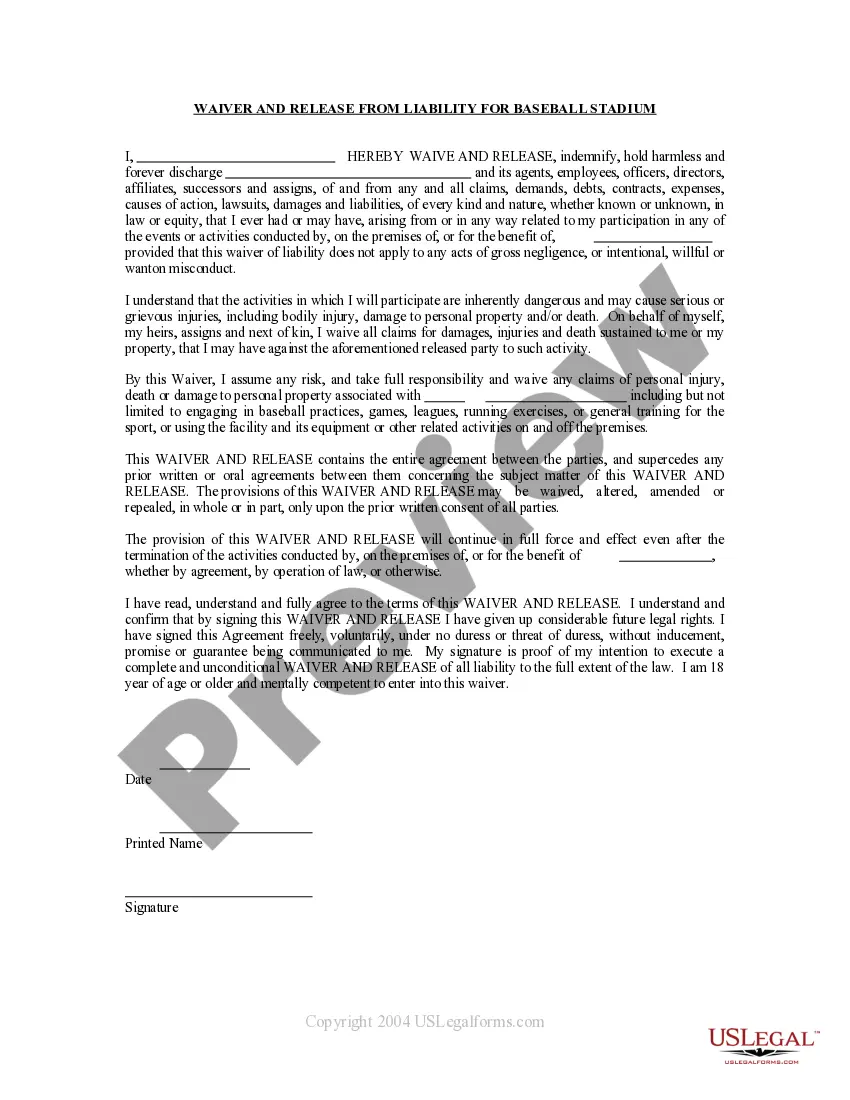
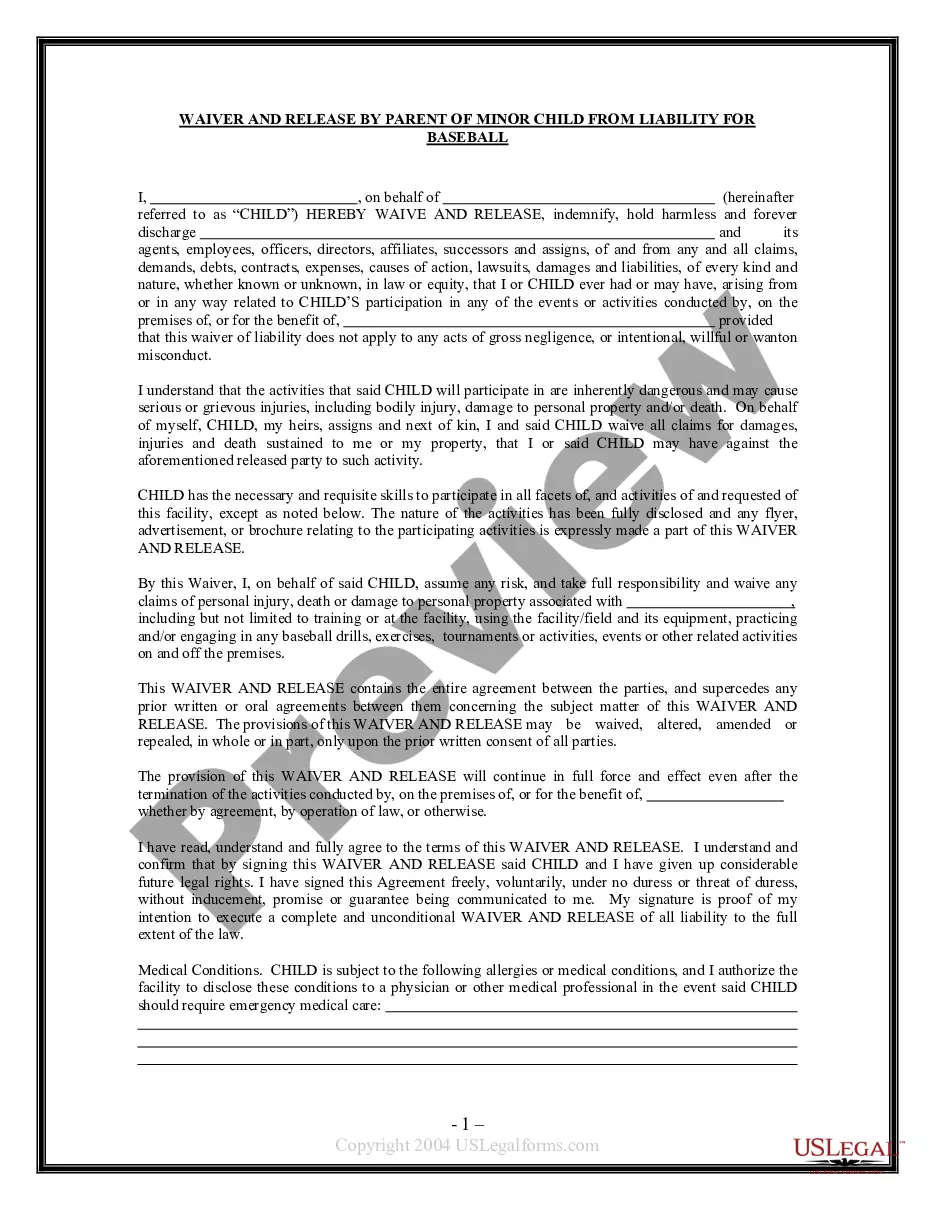
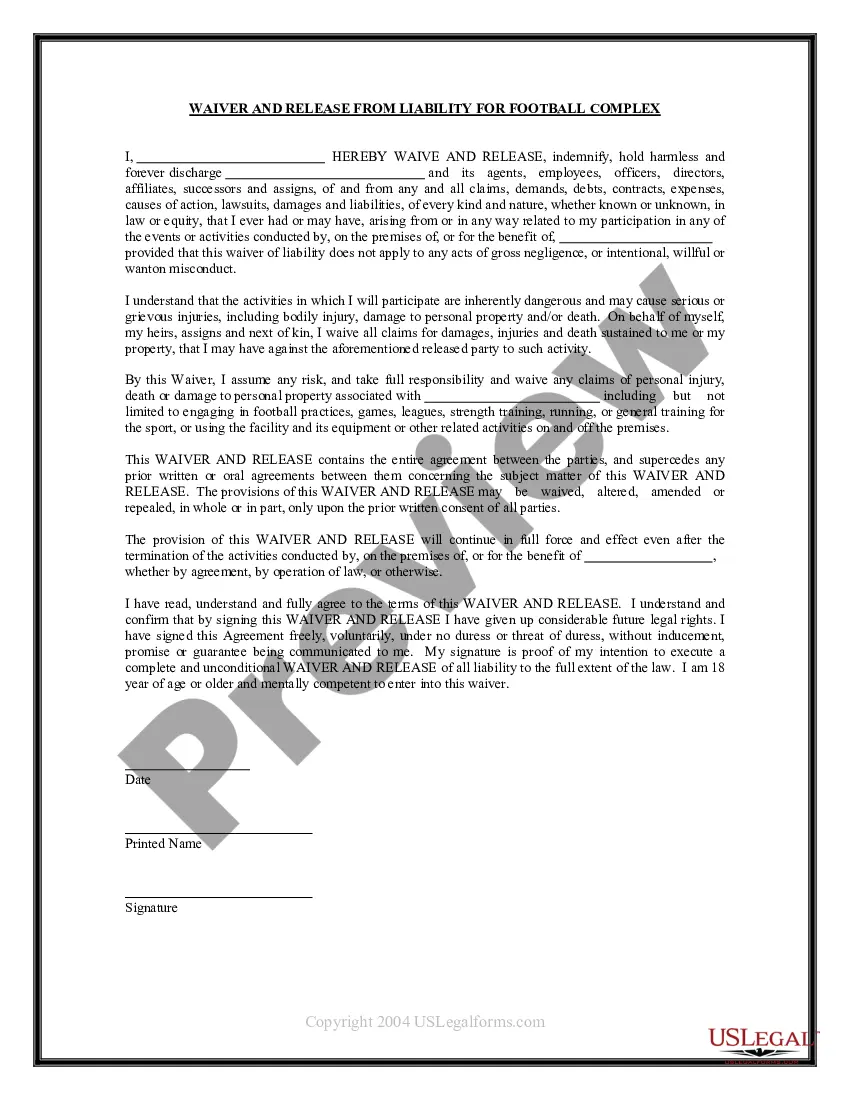
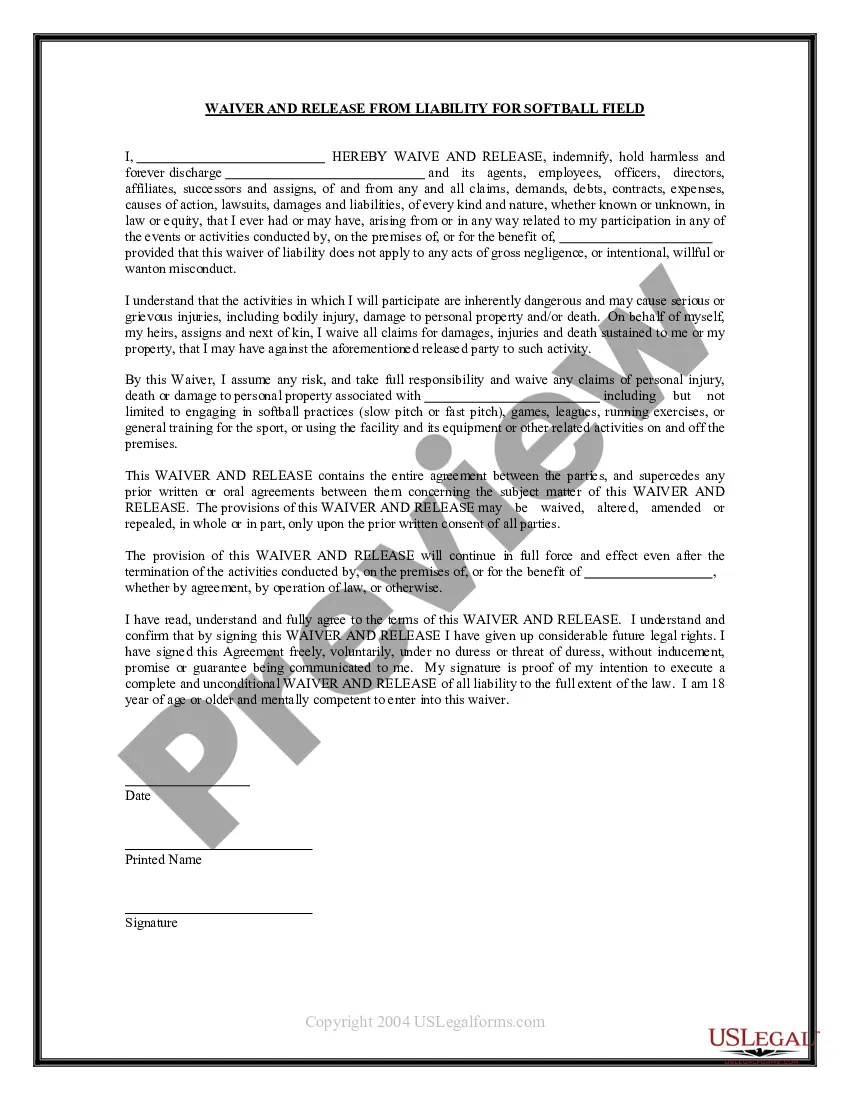
The Waiver and Release From Liability for Adult for Baseball Stadium is a legal document that allows adults to release a baseball stadium from liability for any injuries incurred while on the premises or during activities. This form is crucial for protecting the stadium from lawsuits or claims arising from accidents that may occur during events or visits, differentiating it from other liability waivers that may cover different activities or locations.
Main sections of this form
- Identification of the parties involved, including the adult participant and the baseball stadium.
- A clause detailing the assumption of risk for injuries associated with attending events or using the facilities.
- A statement releasing the stadium from liability for personal injury or property damage.
- A section for the adult's signature and date to confirm understanding and agreement.
- A provision outlining any applicable state laws that may affect the release of liability.
Common use cases
This form should be used when an adult attends events at a baseball stadium and is required to acknowledge the inherent risks of such activities, such as accidents, injuries, or property damage. It is typically needed during ticket purchase or entry into the stadium, where participants must agree to waive certain rights to hold the venue accountable for unforeseen incidents.
Who this form is for
- Adults planning to attend events at a baseball stadium.
- Stadium operators who need to mitigate liability risks associated with attendees.
- Individuals participating in recreational activities at the stadium.
How to prepare this document
- Identify the parties: Fill in your name and the baseball stadium's name.
- Review the assumption of risk clause, ensuring you understand the potential hazards involved.
- Complete the release clause, acknowledging that you are waiving your right to sue.
- Sign and date the form to verify your agreement.
- Keep a copy for your records and provide the signed form to the stadium if required.
Does this document require notarization?
Notarization is generally not required for this form. However, certain states or situations might demand it. You can complete notarization online through US Legal Forms, powered by Notarize, using a verified video call available anytime.
Get your form ready online
Our built-in tools help you complete, sign, share, and store your documents in one place.
Make edits, fill in missing information, and update formatting in US Legal Forms—just like you would in MS Word.
Download a copy, print it, send it by email, or mail it via USPS—whatever works best for your next step.
Sign and collect signatures with our SignNow integration. Send to multiple recipients, set reminders, and more. Go Premium to unlock E-Sign.
If this form requires notarization, complete it online through a secure video call—no need to meet a notary in person or wait for an appointment.
We protect your documents and personal data by following strict security and privacy standards.

Make edits, fill in missing information, and update formatting in US Legal Forms—just like you would in MS Word.

Download a copy, print it, send it by email, or mail it via USPS—whatever works best for your next step.

Sign and collect signatures with our SignNow integration. Send to multiple recipients, set reminders, and more. Go Premium to unlock E-Sign.

If this form requires notarization, complete it online through a secure video call—no need to meet a notary in person or wait for an appointment.

We protect your documents and personal data by following strict security and privacy standards.
Avoid these common issues
- Failing to read the waiver in its entirety before signing.
- Not providing accurate personal information.
- Not mentioning any pre-existing conditions that could be relevant under the waiver.
- Signing without fully understanding the implications of the release.
Advantages of online completion
- Convenience of accessing and completing the form from anywhere.
- Editable fields that allow users to customize the form as necessary.
- Secure storage and quick download options for easy access.
- Reliability, as the forms are drafted by licensed attorneys.
Legal use & context
- This waiver acts as a legal defense for the stadium against injury claims.
- It emphasizes the importance of informed consent regarding risks.
- Its validity may be affected by state laws; consult local regulations for specifics.
Key takeaways
- The Waiver and Release From Liability is essential for reducing liability risks associated with stadium activities.
- Both parties should review and understand the implications of the waiver before signing.
- The form is adaptable for use across various states and should be customized as needed for local regulations.
Looking for another form?
Form popularity
FAQ
A waiver is a legally binding provision where either party in a contract agrees to voluntarily forfeit a claim without the other party being liable. Waivers can either be in written form or some form of action.
A waiver is not complete until it includes the signatures of both the event host and business owner and that of the participant. The date should also be included alongside the signatures. You may also include a signature line for a witness if necessary.
A liability waiver, or release of liability, is a legal document that a company or organization has you sign in order to protect them from being sued in the event that you are injured.
A liability waiver, or release waiver, is a legal document that a company or organization requires members of the public to sign in order to protect their organization from being sued if you sustain an injury.Depending on the facts of your case, you may still be able to file a lawsuit and recover damages.
In California, a liability waiver must be clear, unambiguous, and explicit. In other words, waivers cannot be printed in faded ink, in small font, on the back of a paper, or in an otherwise ambiguous form. If the waiver that you sign is not represented clearly, it may not hold up in the event of a lawsuit.
A US Entry Waiver can be good for six months to five years. You might see references to permanent waivers online; however, those references are out of date.
3. How long do I keep signed waivers? The sponsoring unit is required to retain the waiver for six (6) years after the end of the event or activity for which the waiver was signed.
In many cases, the waiver is not enforceable.If you've been injured due to negligent actions, you can sue even if you signed a waiver. Winning a lawsuit concerning negligence is not uncommon. Many celebrities have sued for negligence even though they signed documents stating they understood the risks.
If you've been injured due to negligent actions, you can sue even if you signed a waiver. Winning a lawsuit concerning negligence is not uncommon. Many celebrities have sued for negligence even though they signed documents stating they understood the risks.