Nonemployee Director Stock Option Plan
What this document covers
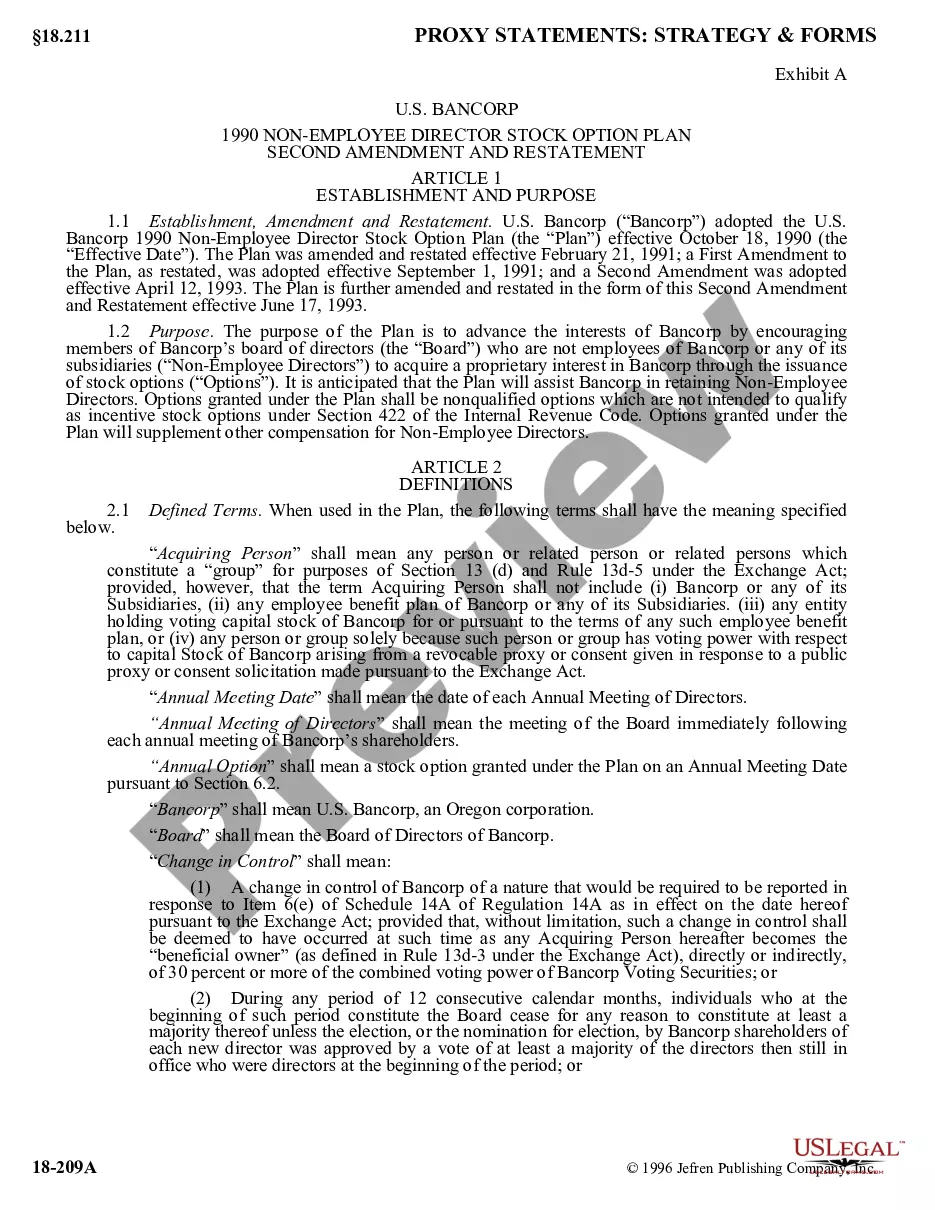
The Nonemployee Director Stock Option Plan is a legal document designed to help companies attract and retain qualified individuals who serve as nonemployee directors. This form outlines the terms under which options to purchase shares of the company's common stock are granted to these directors, incentivizing them to gain an ownership interest in the company. It differs from employee stock option plans by specifically addressing nonemployee directors and the unique considerations associated with their roles.
Form components explained
- Purpose: Attract and retain highly qualified nonemployee directors.
- Eligibility: Only individuals who are not employees of the company can participate.
- Shares Available: Specifies the maximum number of shares that can be granted as options.
- Automatic Grants: Details on how and when stock options are automatically granted to directors.
- Exercise of Options: Procedures on how directors can exercise their granted stock options.
- Termination of Options: Outlines what happens to stock options if a director's service terminates.







Common use cases
This form is used when a company wishes to implement a stock option plan specifically for its nonemployee directors. It is relevant when attracting new directors or retaining existing ones by offering them an opportunity to own shares in the company. This is especially useful in competitive industries where attracting top talent is crucial for success.
Intended users of this form
This form is intended for:
- Corporations looking to establish or maintain a stock option plan for nonemployee directors.
- Board members who are not employees of the company but are eligible to receive stock options.
- Legal and financial advisors assisting companies in structuring incentive plans for their directors.
How to complete this form
- Identify the corporation name and the fiscal year for the stock option plan.
- Specify the maximum number of shares available for options under the plan.
- Outline the criteria for automatic grants to eligible nonemployee directors.
- Detail the terms of option exercise, including prices and timelines.
- Define the procedures for termination of options in case of service termination.
Does this document require notarization?
Notarization is generally not required for this form. However, certain states or situations might demand it. You can complete notarization online through US Legal Forms, powered by Notarize, using a verified video call available anytime.
Get your form ready online
Our built-in tools help you complete, sign, share, and store your documents in one place.
Make edits, fill in missing information, and update formatting in US Legal Forms—just like you would in MS Word.
Download a copy, print it, send it by email, or mail it via USPS—whatever works best for your next step.
Sign and collect signatures with our SignNow integration. Send to multiple recipients, set reminders, and more. Go Premium to unlock E-Sign.
If this form requires notarization, complete it online through a secure video call—no need to meet a notary in person or wait for an appointment.
We protect your documents and personal data by following strict security and privacy standards.

Make edits, fill in missing information, and update formatting in US Legal Forms—just like you would in MS Word.

Download a copy, print it, send it by email, or mail it via USPS—whatever works best for your next step.

Sign and collect signatures with our SignNow integration. Send to multiple recipients, set reminders, and more. Go Premium to unlock E-Sign.

If this form requires notarization, complete it online through a secure video call—no need to meet a notary in person or wait for an appointment.

We protect your documents and personal data by following strict security and privacy standards.
Typical mistakes to avoid
- Failing to specify the number of shares available for the stock option plan.
- Inadequately defining the eligibility criteria for nonemployee directors.
- Not clearly outlining the procedures for exercising options, which can lead to confusion.
- Overlooking the tax implications associated with stock options, which may affect participants.
Benefits of completing this form online
- Access to professionally drafted templates that comply with legal standards.
- Convenience of filling out and downloading the form from anywhere at any time.
- Editability allows for customization to meet specific organizational needs.
- Reliable updates reflect current laws and regulations affecting stock option plans.
Legal use & context
- The Nonemployee Director Stock Option Plan must comply with applicable federal and state securities laws.
- It is essential that the plan aligns with IRS regulations regarding stock options to ensure tax advantages remain intact.
- Failure to meet compliance requirements can lead to penalties or disqualification of options granted under the plan.
Quick recap
- Establishing a Nonemployee Director Stock Option Plan can be a strategic tool for talent retention.
- Understanding eligibility and plan components is crucial for effective implementation.
- Regular review and compliance with legal standards safeguard the integrity of the plan.
Looking for another form?





Form popularity
FAQ
Qualified stock options, also known as incentive stock options, can only be granted to employees. Non-qualified stock options can be granted to employees, directors, contractors and others. This gives you greater flexibility to recognize the contributions of non-employees.
Once you exercise your non-qualified stock option, the difference between the stock price and the strike price is taxed as ordinary income. This income is usually reported on your paystub. There are no tax consequences when you first receive your non-qualified stock option, only when you exercise your option.
Worker directors provide a direct link between the board and employeesand new perspectives on a business.
Executive Directors should have a written employment contract. Non- Executive Directors are not employees for the purposes of Employment Law, but should still have a written letter of appointment.
The first step in deciding when to exercise is to look at which NSOs are vested and eligible to exercise. Also, you should not exercise if the current stock price is lower than your option price, (under water).
The stock option compensation is an expense of the business and is represented by the debit to the expense account in the income statement. The other side of the entry is to the additional paid in capital account (APIC) which is part of the total equity of the business.
Depending upon the tax treatment of stock options, they can be classified into qualified and non-qualified stock options. Qualified stock options are also called Incentive Stock Options (ISO). Nonqualified: Employees generally don't owe tax when these options are granted.
What Is a Non-Qualified Stock Option (NSO)? A non-qualified stock option (NSO) is a type of employee stock option wherein you pay ordinary income tax on the difference between the grant price and the price at which you exercise the option.
A director of a Company's Board of Directors who is not a current employee of the Company (or any parent or subsidiary company).