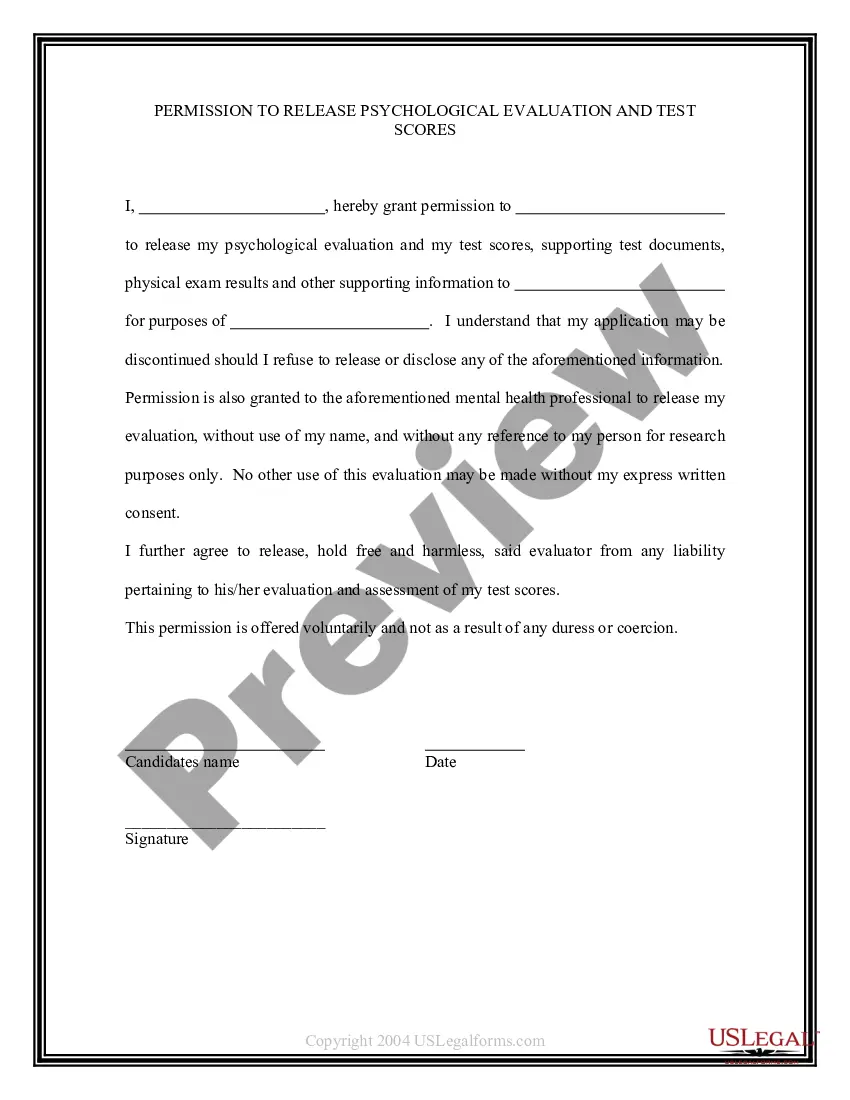
Permission To Release Psychological Evaluation And Test Scores
Overview of this form
The Permission to Release Psychological Evaluation and Test Scores form is a document that allows a candidate to authorize the release of their psychological evaluation results and test scores to specific parties. This form is particularly relevant for candidates seeking positions in sensitive fields, such as the military or clergy. It protects the evaluator from any liability associated with disclosing these evaluations, distinguishing it from other consent forms by its specific focus on psychological assessments.
Key parts of this document
- Candidate's details: This section includes the personal information of the candidate granting permission.
- Evaluator's details: Information about the evaluator who conducted the psychological assessment.
- Scope of release: Specifies which evaluations and test scores may be disclosed.
- Liability release clause: Releases the evaluator from any legal responsibility regarding the evaluation results.
- Signature and date: Where the candidate must sign to confirm their consent.
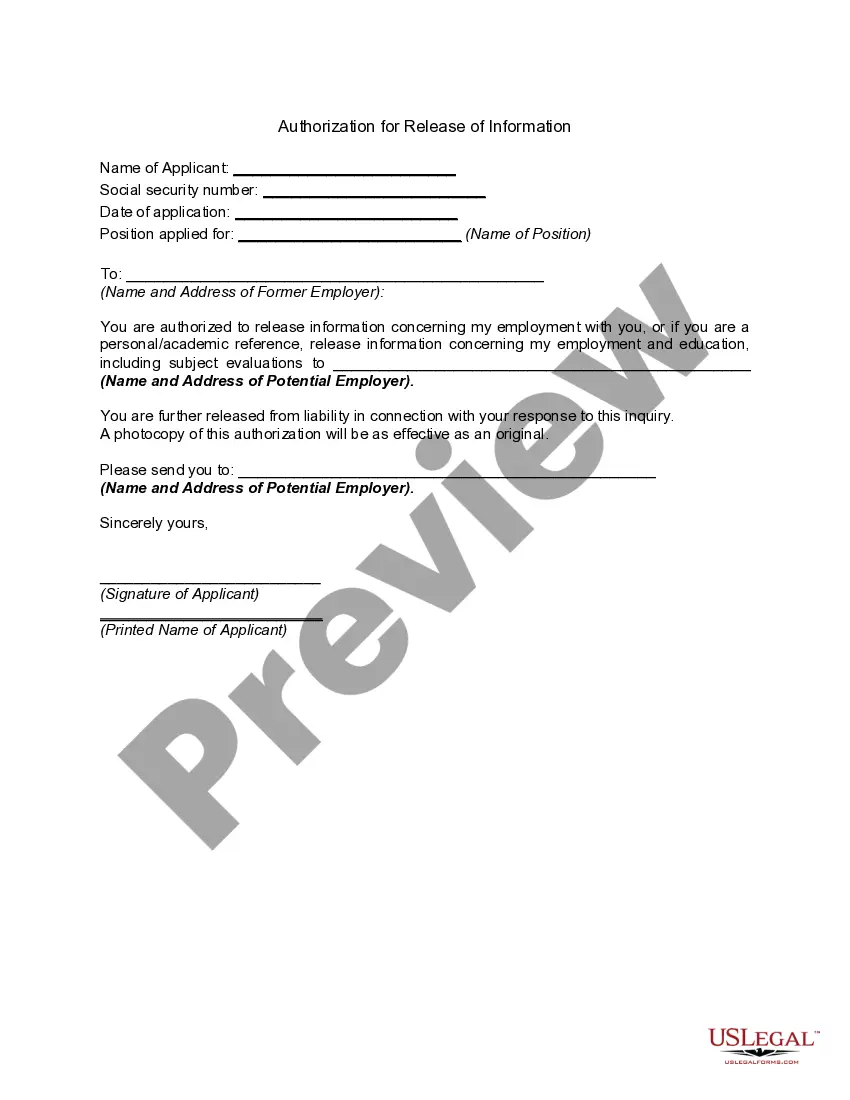
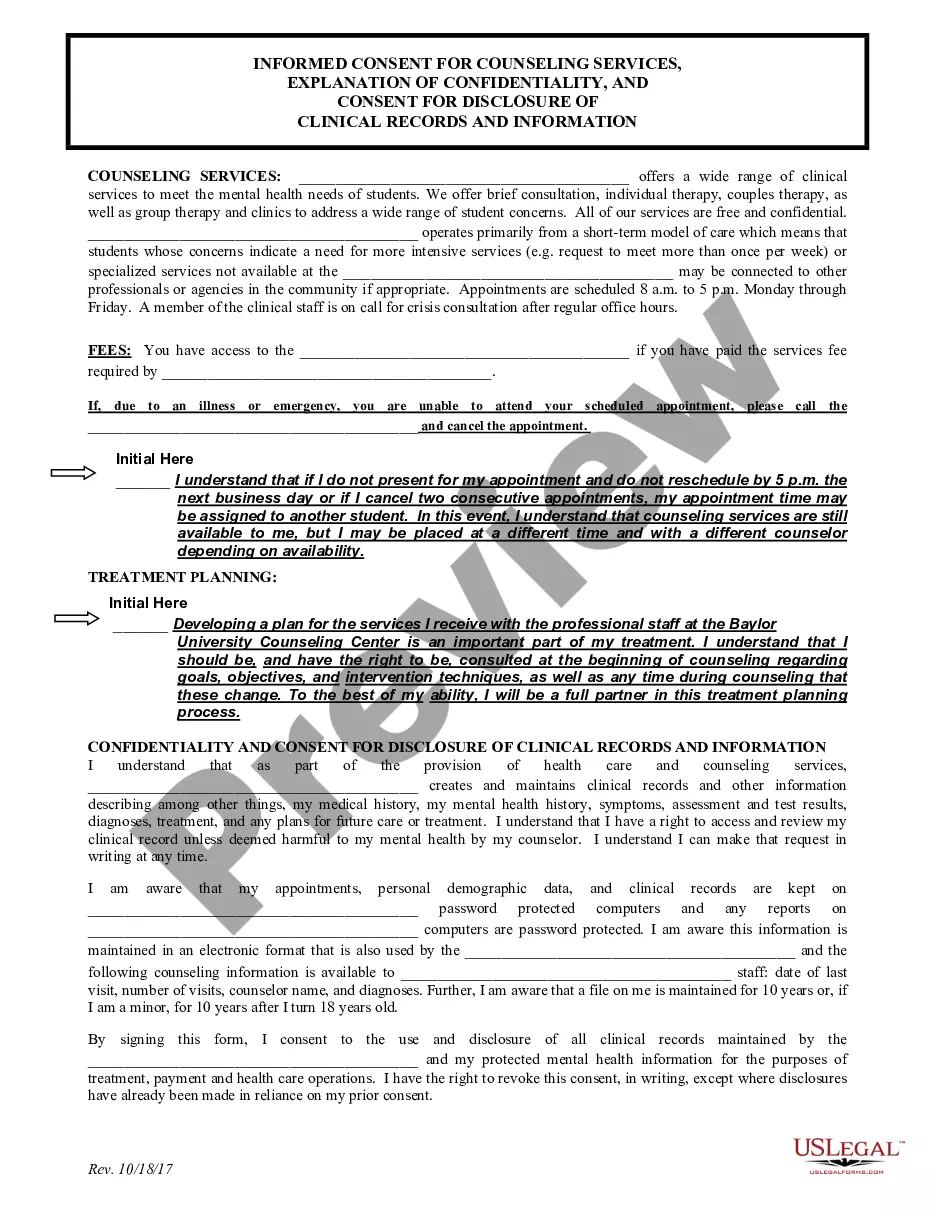
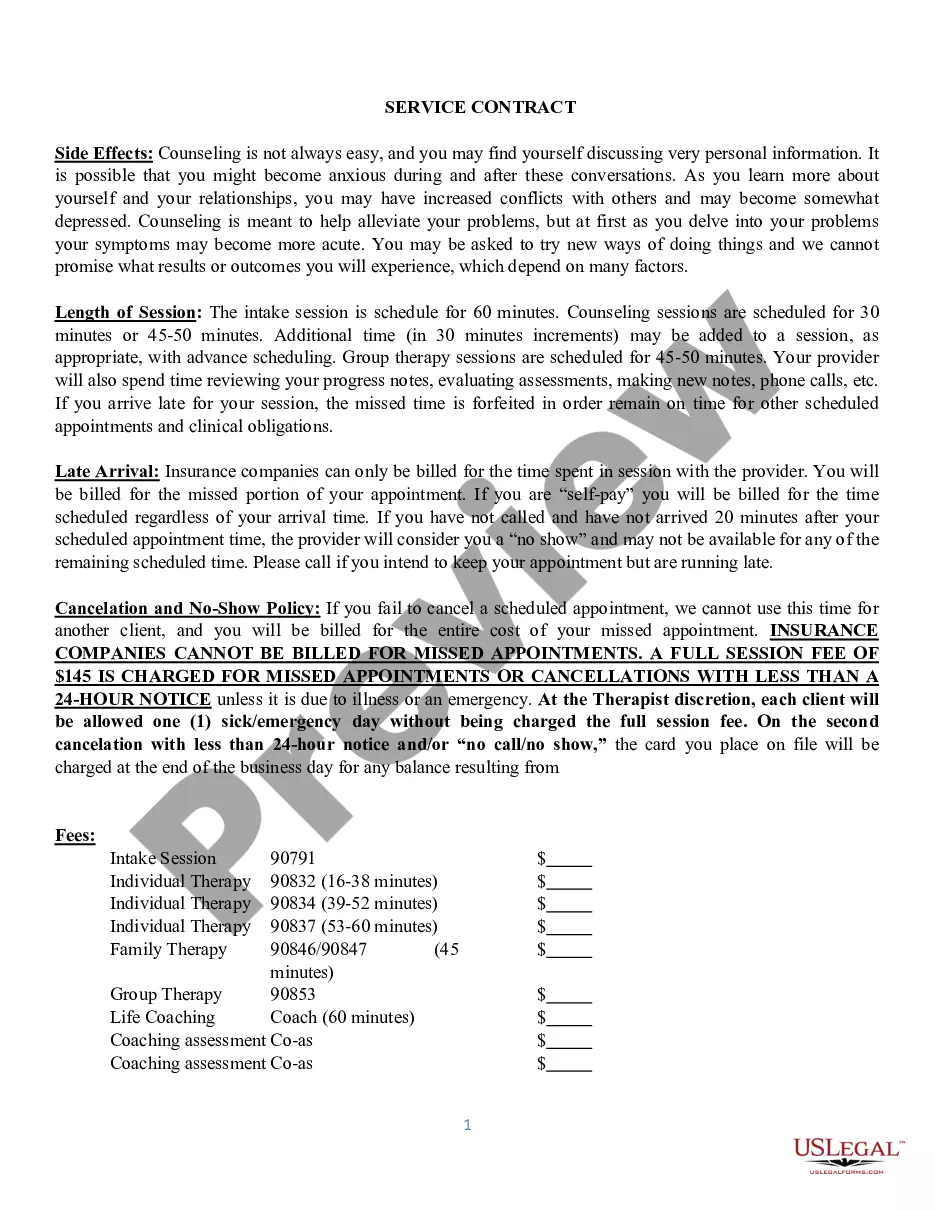
When this form is needed
This form should be used when a candidate needs to authorize the sharing of their psychological evaluation results and test scores with a third party, such as an employer or a licensing board. It is commonly needed during recruitment processes for roles in law enforcement, military service, or positions that require psychological evaluations to verify qualifications and mental fitness.
Who this form is for
- Candidates applying for military service.
- Candidates seeking employment in roles requiring psychological evaluations.
- Individuals who need to share their psychological evaluation results with specific organizations.
- Clergy or religious professionals required to submit psychological evaluations for candidacy.
How to prepare this document
- Identify the candidate: Fill out the section with personal details, including name and contact information.
- Provide evaluator information: Enter the name and contact details of the evaluator responsible for the psychological assessment.
- Specify the tests: Clearly indicate which psychological tests and evaluations are authorized for release.
- Read the liability clause: Ensure understanding of the implications of releasing the evaluator from liability.
- Sign and date the form: The candidate must sign the document, indicating their voluntary consent.
Does this document require notarization?
In most cases, this form does not require notarization. However, some jurisdictions or signing circumstances might. US Legal Forms offers online notarization powered by Notarize, accessible 24/7 for a quick, remote process.
Get your form ready online
Our built-in tools help you complete, sign, share, and store your documents in one place.
Make edits, fill in missing information, and update formatting in US Legal Forms—just like you would in MS Word.
Download a copy, print it, send it by email, or mail it via USPS—whatever works best for your next step.
Sign and collect signatures with our SignNow integration. Send to multiple recipients, set reminders, and more. Go Premium to unlock E-Sign.
If this form requires notarization, complete it online through a secure video call—no need to meet a notary in person or wait for an appointment.
We protect your documents and personal data by following strict security and privacy standards.

Make edits, fill in missing information, and update formatting in US Legal Forms—just like you would in MS Word.

Download a copy, print it, send it by email, or mail it via USPS—whatever works best for your next step.

Sign and collect signatures with our SignNow integration. Send to multiple recipients, set reminders, and more. Go Premium to unlock E-Sign.

If this form requires notarization, complete it online through a secure video call—no need to meet a notary in person or wait for an appointment.

We protect your documents and personal data by following strict security and privacy standards.
Avoid these common issues
- Failing to provide complete candidate or evaluator information.
- Not specifying which test scores or evaluations are covered under the release.
- Skipping the signature or date, which invalidates the form.
- Not understanding the implications of the liability release clause.
Advantages of online completion
- Convenience: Download and complete the form at any time, eliminating the need for physical paperwork.
- Editability: Easily fill out and make changes without hassle.
- Reliability: Access templates created by licensed attorneys, ensuring compliance with legal standards.
Key takeaways
- The Permission to Release Psychological Evaluation and Test Scores form authorizes the release of sensitive evaluation results.
- This form is crucial for candidates in fields like the military or clergy where psychological evaluations are required.
- Ensure all sections are accurately filled out to avoid misuse or legal complications.
Looking for another form?






Form popularity
FAQ
Test takers have the right to request and receive information regarding whether or not they can obtain copies of their test answer sheets or their test materials, if they can have their scores verified, and if they may cancel their test results.
There's No Pass or Fail Just as there's no cookie-cutter approach to psychological testing, there aren't right or wrong answers to any test questions. This means you can't pass or fail a test, which eliminates the need to study.
A "test-taker" is a person who takes a test. Here "taking" a test means doing the test.
Psychological testing requires a clinically trained examiner. All psychological tests should be administered, scored, and interpreted by a trained professional, preferably a psychologist or psychiatrist with expertise in the appropriate area. Psychological tests are only one element of a psychological assessment.
Psychological testing and evaluation, sometimes called psychological assessment, involves a series of tests that help a qualified therapist determine the cause of mental health symptoms. The goal of this type of testing is to identify the correct diagnosis and provide the appropriate treatment.
Importance of Test Security The primary goal of test security is to protect the integrity of the examination and to assure that results are accurate and meaningful. All summative test items and test materials are secure and must be appropriately handled.
Old versions of the test should be destroyed in a secure manner, in much the same manner that would occur with patient records. The materials can be recycled through a secure shredding process, or they can be shipped back to test publishers for secure recycling.
Informed Consent. Debrief. Protection of Participants. Deception. Confidentiality. Withdrawal.
Psychologists and other test users have devised several methods for protecting testing material and procedures, including developing alternate/parallel test forms; proctoring testing sites; physically and electronically securing locations of test materials and results; monitoring and analyzing test response data for