USLegal Pamphlet on Confession of Judgment
Understanding this form
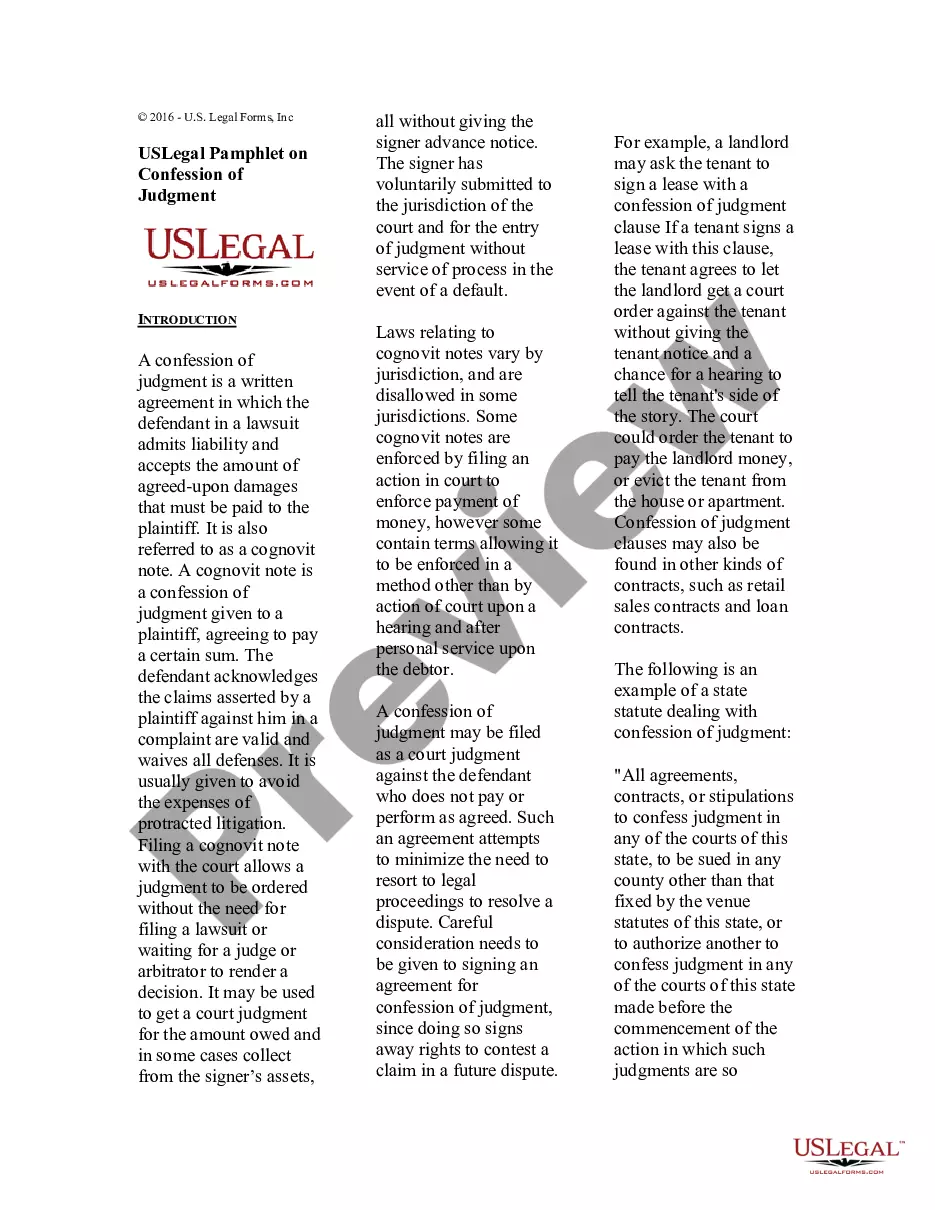
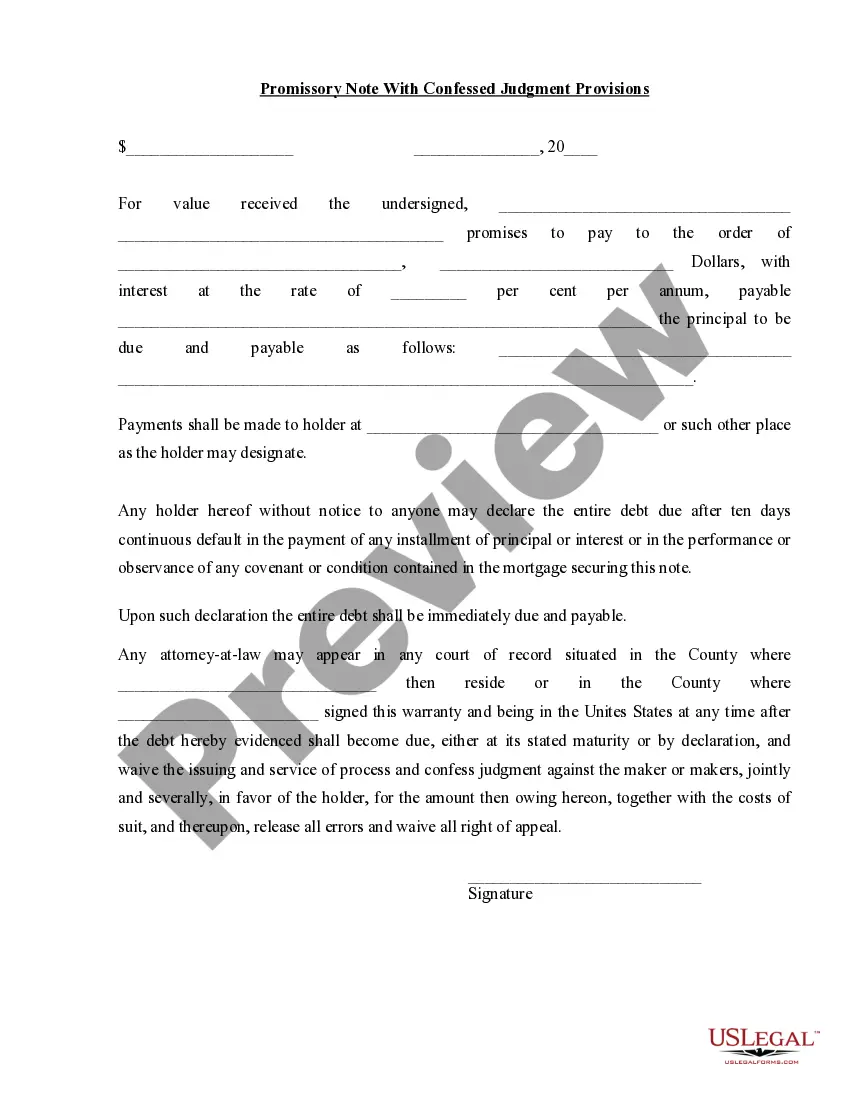
The USLegal Pamphlet on Confession of Judgment provides an overview of a confessed judgment clause in contracts. This pamphlet explains what a confession of judgment is, its purpose, and how it differs from other legal agreements. A confession of judgment allows a defendant to admit liability and accept a specific amount of damages without the need for trial, thereby streamlining the resolution process. Understanding this form is crucial as it gives up certain legal rights in future disputes.
Key parts of this document
- Definition of confession of judgment and cognovit note.
- Explanation of drafting a confession of judgment clause.
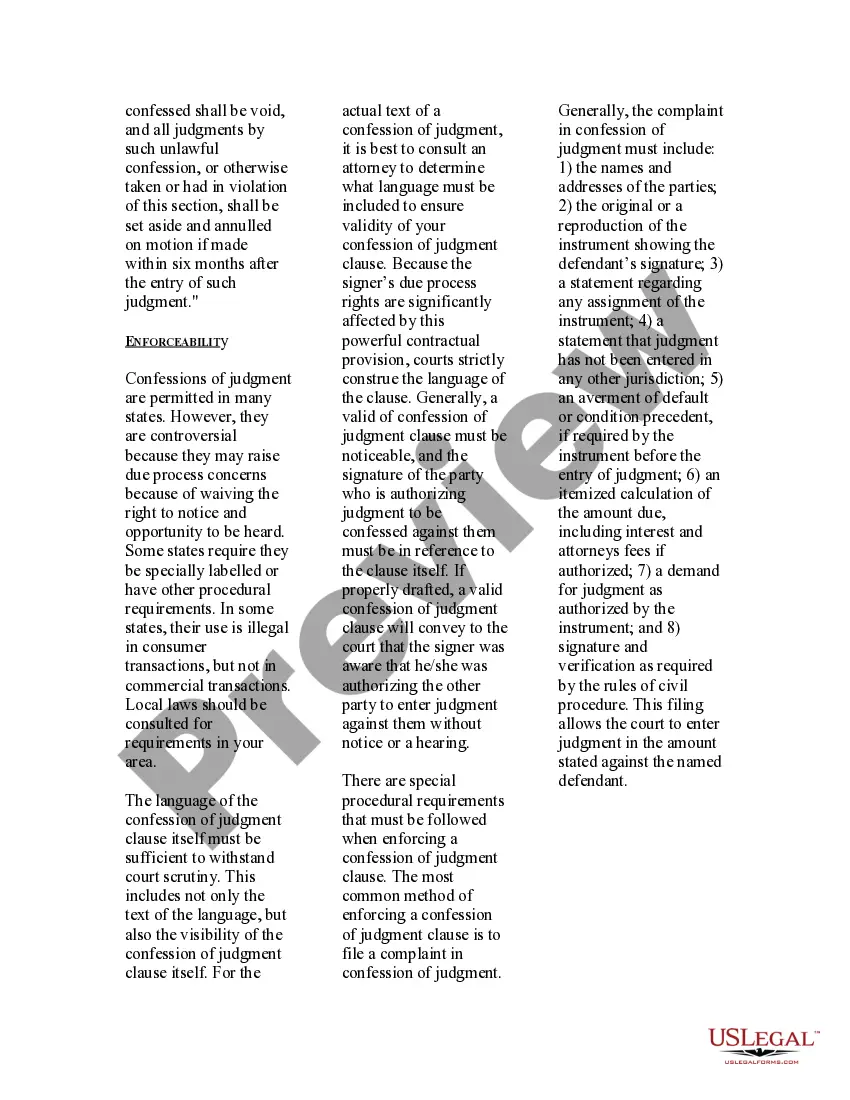
- Details on enforceability and jurisdictional variations.
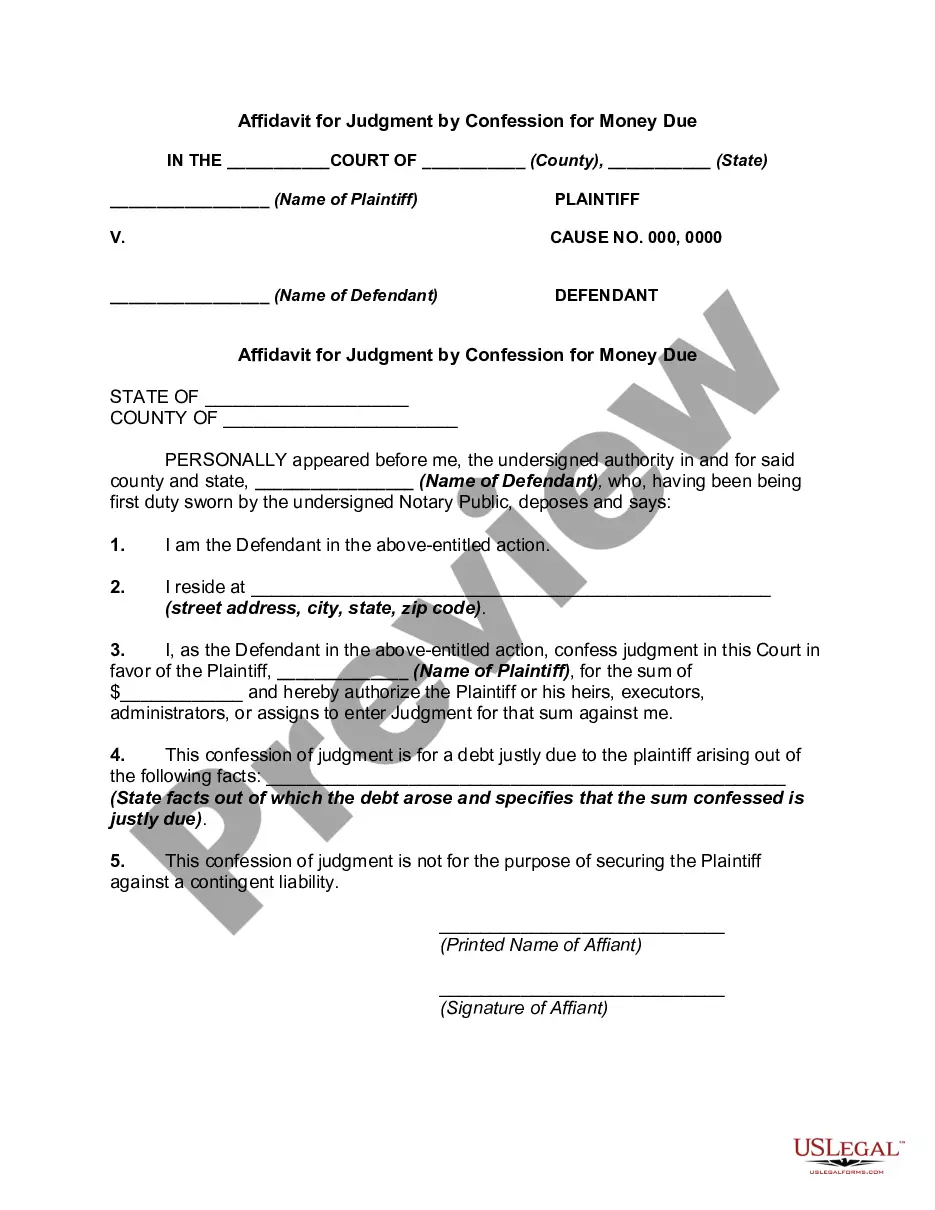
- Procedural requirements for filing and enforcing the judgment.
- Example state statute regarding confession of judgment.
When this form is needed
This form is useful in scenarios where parties wish to expedite debt collection processes or minimize litigation costs. Common situations include landlord-tenant agreements, commercial contracts, and retail transactions where one party is willing to admit liability upfront to avoid lengthy court proceedings.
Who this form is for
- Landlords seeking to secure payment from tenants.
- Creditors wanting to streamline debt recovery.
- Businesses engaging in contracts that involve potential liability confessions.
- Individuals looking to formalize agreements with cognovit notes in commercial settings.
How to complete this form
- Identify the parties involved in the agreement.
- Clearly state the amount of damages agreed upon.
- Draft the confession of judgment clause with precise language.
- Ensure the clause is noticeable and signed by the party admitting liability.
- File the complaint in confession of judgment with the appropriate documentation.
Does this document require notarization?
In most cases, this form does not require notarization. However, some jurisdictions or signing circumstances might. US Legal Forms offers online notarization powered by Notarize, accessible 24/7 for a quick, remote process.
Get your form ready online
Our built-in tools help you complete, sign, share, and store your documents in one place.
Make edits, fill in missing information, and update formatting in US Legal Forms—just like you would in MS Word.
Download a copy, print it, send it by email, or mail it via USPS—whatever works best for your next step.
Sign and collect signatures with our SignNow integration. Send to multiple recipients, set reminders, and more. Go Premium to unlock E-Sign.
If this form requires notarization, complete it online through a secure video call—no need to meet a notary in person or wait for an appointment.
We protect your documents and personal data by following strict security and privacy standards.

Make edits, fill in missing information, and update formatting in US Legal Forms—just like you would in MS Word.

Download a copy, print it, send it by email, or mail it via USPS—whatever works best for your next step.

Sign and collect signatures with our SignNow integration. Send to multiple recipients, set reminders, and more. Go Premium to unlock E-Sign.

If this form requires notarization, complete it online through a secure video call—no need to meet a notary in person or wait for an appointment.

We protect your documents and personal data by following strict security and privacy standards.
Common mistakes
- Not ensuring that the confession of judgment clause is clearly visible in the contract.
- Failing to include necessary information in the filing complaint.
- Not consulting an attorney for proper language and structure of the clause.
- Using the form in jurisdictions where confessions of judgment are prohibited.
Benefits of completing this form online
- Immediate access to a legally vetted confession of judgment template.
- Convenient editing options to customize the form to specific needs.
- Reliable guidance on legal standards across jurisdictions.
Legal use & context
- Confessions of judgment can expedite the legal process by allowing for a judgment without a trial.
- They can raise due process issues because they waive the right to notice and hearing.
- Jurisdictional variations affect the enforceability and legality of such clauses.
What to keep in mind
- A confession of judgment is a powerful legal tool that requires careful consideration.
- Proper drafting and awareness of jurisdictional laws are essential for validity.
- This form is useful for expediting financial recoveries in pre-agreed situations.
Looking for another form?
Form popularity
FAQ
The three-year shelf-life of affidavits of confession of judgment is sometimes overlooked by practitioners and is important to bear in mind.
The confession of judgment is allowed in New Jersey only after notice to the defendant is served in lieu of a summons either by registered or certified mail.The court may, if satisfied, enter a judgment satisfied with the proofs, enter a judgment for what the court finds due.
A Florida court decision from 1997 recognized that even though confessions of judgment are per se illegal in Florida, the state of Florida is, nonetheless, required to recognize such judgments entered in other states, based upon the full faith and credit clause of the U.S. Constitution.
Renew the judgment Money judgments automatically expire (run out) after 10 years.If the judgment is not renewed, it will not be enforceable any longer and you will not have to pay any remaining amount of the debt. Once a judgment has been renewed, it cannot be renewed again until 5 years later.
The statute of limitations for a debt collector to collect a past-due debt in New Jersey is six years, said Karra Kingston, a bankruptcy attorney in Union City.
In order to vacate a judgment in California, You must file a motion with the court asking the judge to vacate or set aside the judgment. Among other things, you must tell the judge why you did not respond to the lawsuit (this can be done by written declaration).
United StatesConfessions of judgment are permitted in many states. New Jersey and Pennsylvania permit them, among others. Some states, including Michigan, require they be specially labelled or have other procedural requirements.
In New Jersey, there is a six-year statute of limitations on collecting a debt. This means that a creditor can no longer make attempts to collect on a debt once six years have passed since the original date that payment was owed.
Judgments in New Jersey remain in effect for 20 years and may be renewed for an additional 20 years by filing a motion in the Superior Court, Law Division, Civil Part and/or in the Special Civil Part if the Special Civil Part case was assigned a DJ or J docket number.