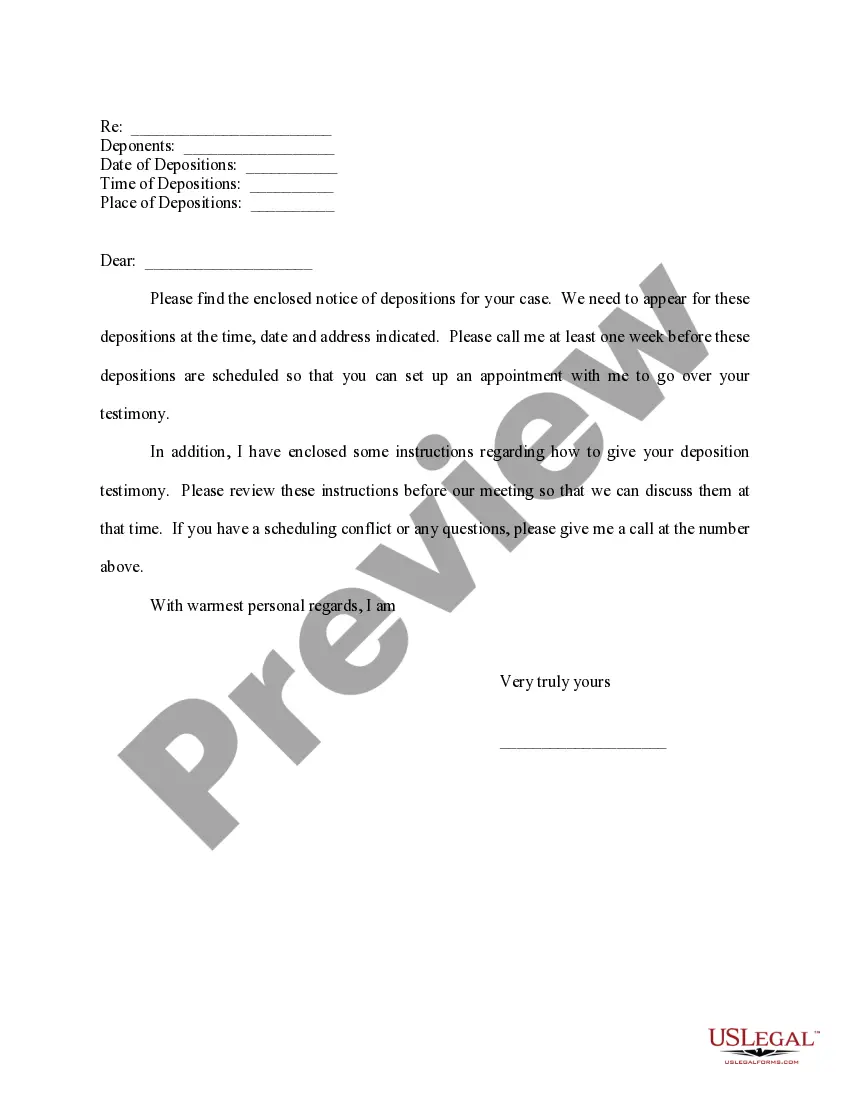
Letter regarding Notice to Client of Deposition
Understanding this form
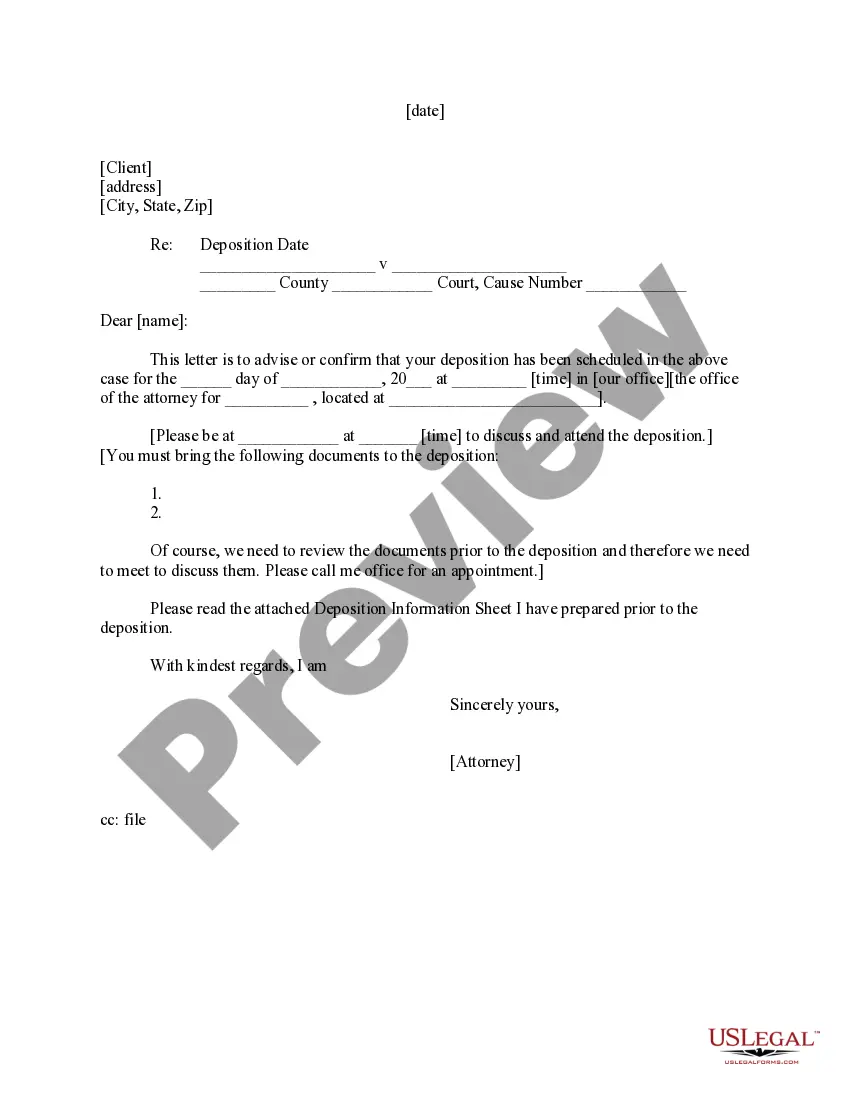
The Letter regarding Notice to Client of Deposition is a formal communication that informs a client about an upcoming deposition scheduled in their legal case. This document ensures that the client is aware of the date, time, and location of the deposition, as well as the need to prepare for their testimony. Unlike other legal notices, this letter specifically focuses on deposition arrangements and client preparation.
Main sections of this form
- Re: Subject line indicating the case or matter.
- Identification fields for deponents and deposition details including the date, time, and place.
- A greeting that personalizes the communication.
- Information about reviewing deposition instructions prior to the meeting.
- Contact information for follow-up questions or scheduling conflicts.
- Closing signature line for the attorney.
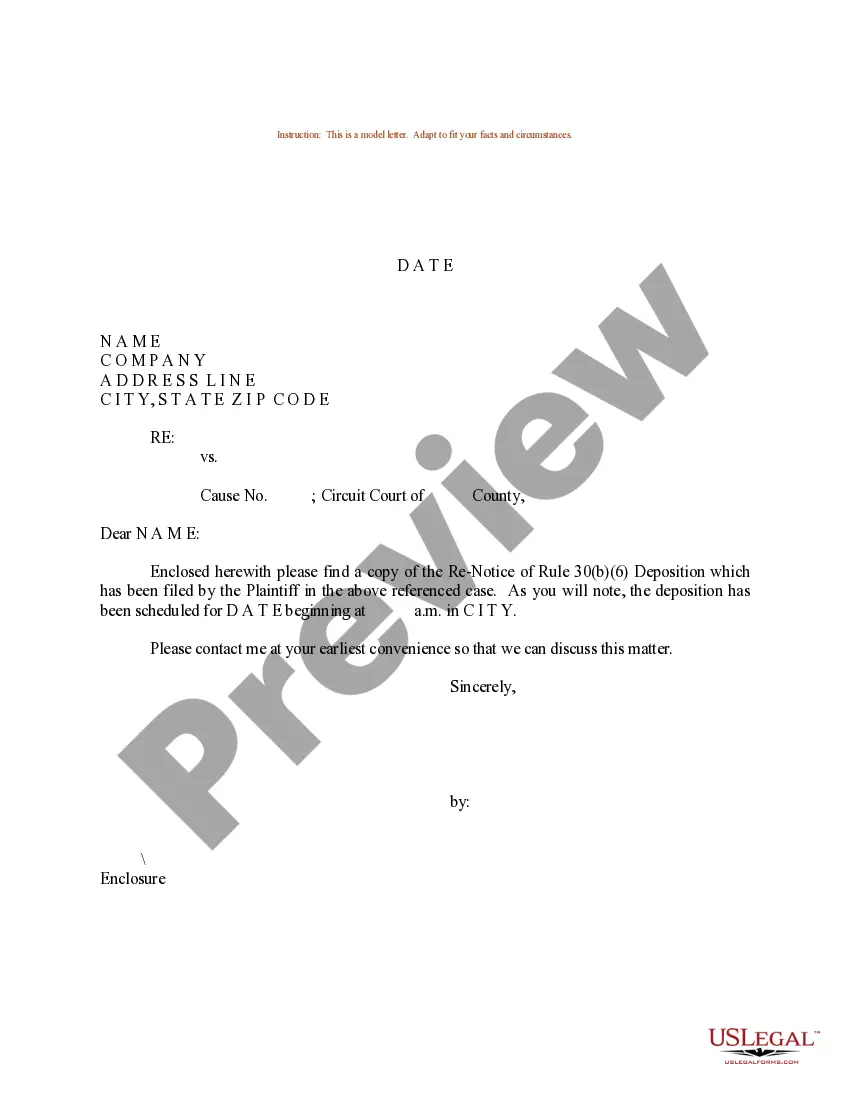
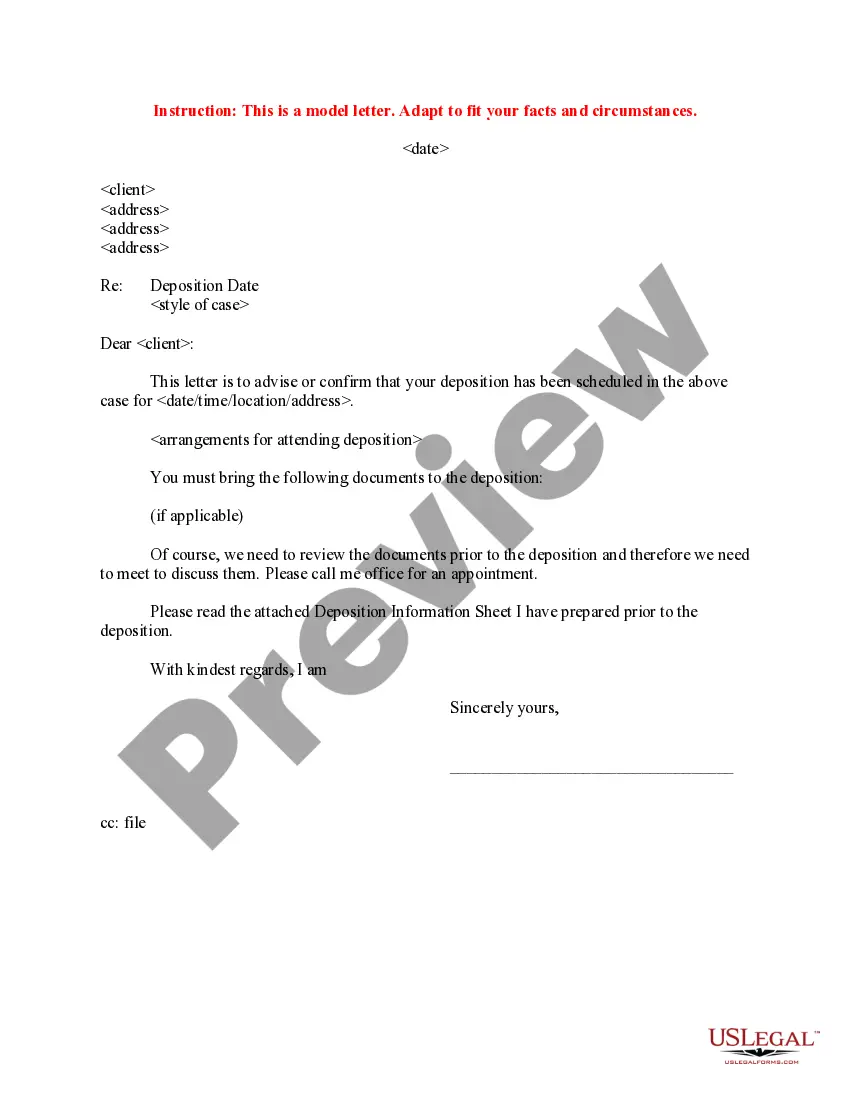
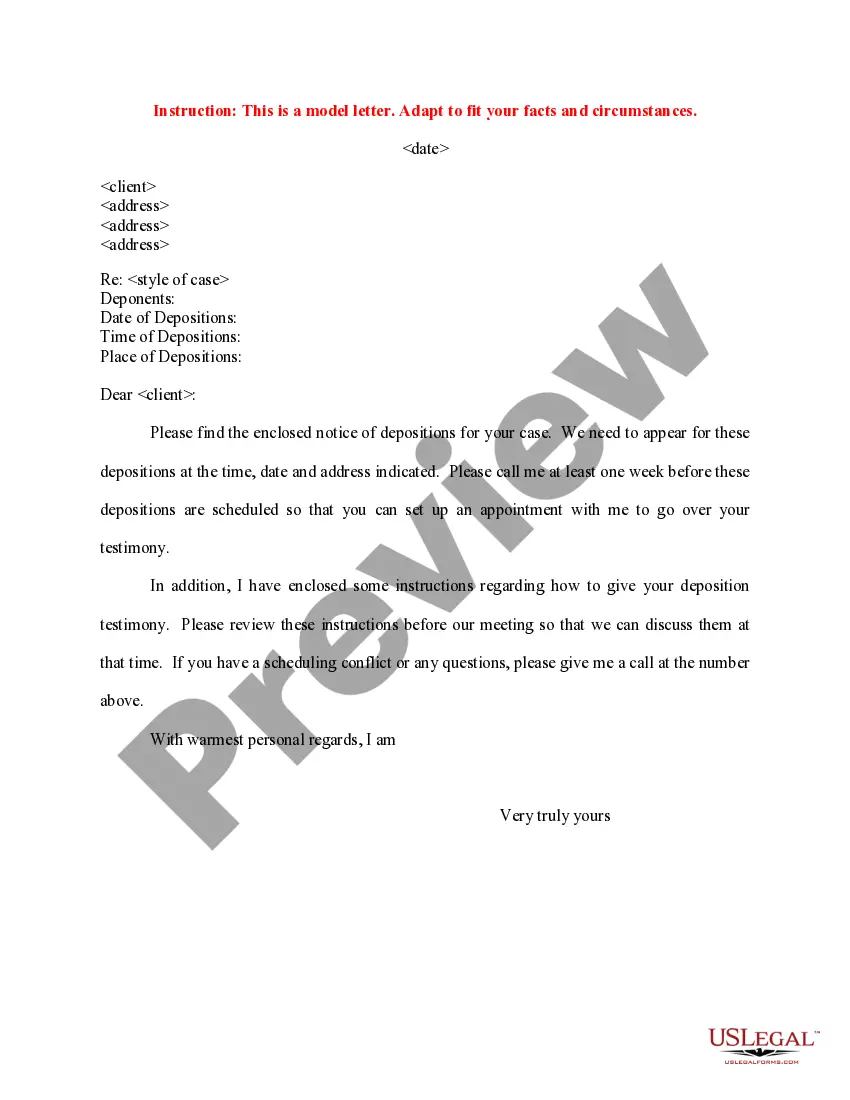
When this form is needed
This form should be used when an attorney needs to formally notify their client about an upcoming deposition. It is particularly useful in preparing the client for the deposition process, ensuring they understand the importance of their testimony, and addressing any potential scheduling conflicts. It also serves as a reminder for the client to review relevant instructions provided by the attorney.
Who needs this form
- Attorneys managing cases involving depositions.
- Clients who are scheduled to provide testimony in a legal matter.
- Legal assistants who prepare correspondence related to depositions.
Instructions for completing this form
- Fill in the subject line with the relevant case information.
- Specify the names of the deponents and the date, time, and place of the depositions.
- Address the letter to the client by including their name.
- Provide instructions about reviewing deposition materials before the meeting.
- Include a contact number for any questions or scheduling conflicts.
- Sign the letter at the bottom with your name and title.
Is notarization required?
This form does not typically require notarization to be legally valid. However, some jurisdictions or document types may still require it. US Legal Forms provides secure online notarization powered by Notarize, available 24/7 for added convenience.
Get your form ready online
Our built-in tools help you complete, sign, share, and store your documents in one place.
Make edits, fill in missing information, and update formatting in US Legal Forms—just like you would in MS Word.
Download a copy, print it, send it by email, or mail it via USPS—whatever works best for your next step.
Sign and collect signatures with our SignNow integration. Send to multiple recipients, set reminders, and more. Go Premium to unlock E-Sign.
If this form requires notarization, complete it online through a secure video call—no need to meet a notary in person or wait for an appointment.
We protect your documents and personal data by following strict security and privacy standards.

Make edits, fill in missing information, and update formatting in US Legal Forms—just like you would in MS Word.

Download a copy, print it, send it by email, or mail it via USPS—whatever works best for your next step.

Sign and collect signatures with our SignNow integration. Send to multiple recipients, set reminders, and more. Go Premium to unlock E-Sign.

If this form requires notarization, complete it online through a secure video call—no need to meet a notary in person or wait for an appointment.

We protect your documents and personal data by following strict security and privacy standards.
Mistakes to watch out for
- Failing to include the correct date, time, or place of the deposition.
- Not personalizing the greeting or neglecting to include the client's name.
- Overlooking instructions for the client, which can lead to unpreparedness.
Why use this form online
- Quick access to legally vetted templates ready for use.
- Easy customization to fit individual case needs.
- Time-saving compared to drafting from scratch.
- Secure storage of legal documents for future reference.
Looking for another form?


Form popularity
FAQ
A deposition is the legal term for a formal, recorded, question and answer session which occurs when the witness is under oath. A deposition generally serves two purposes: (1) find out what you know; and (2) preserve your testimony for later use (either in motions to be filed with the Court or at trial).
Skip three lines and enter "Deposition of name of person being questioned." Skip one line and enter "Court Reporter:" justified to the left and the name, address and phone number of the court reporter justified to the right. Set up your word processor to number lines and pages beginning on the second page.
Start a deposition by explaining the process to the witness. Always be professional and courteous. Use an outline so you do not forget anything, but do not tie yourself to it. Be curious. Listen to the witness. Make sure you get the sound bite. Leave well enough alone.
Prepare. Tell the Truth. Be Mindful of the Transcript. Answer Only the Question Presented. Answer Only as to What You Know. Stay Calm. Ask to See Exhibits. Don't Be Bullied.
Deposition by written questions is essentially the same as an in-person, oral deposition, only the attorney's questions are written down and approved before the deposed person is required to answer them.
Don't guess, speculate, or play a hunch. A deposition is sworn testimony; only say what you know to be true. On the other hand, don't use this tip to avoid giving testimony that you know. If you don't understand a question, ask for the questioner to rephrase it.
When you receive a subpoena to give a deposition, you are being ordered by the court to participate. In this circumstance, you have no choice but to oblige. Refusing to give a deposition following a subpoena will result in serious legal consequences.
Tell the truth. Speak audibly. Talk slowly. Think before you speak. Do not volunteer information; answer only the question that is asked. Be professional and polite. Take breaks as necessary (usually one per hour) If you do not understand the question, then ask for clarification.
A deposition letter is a notice given to a person who is requested for a deposition in the context of a lawsuit.The lawyer will then send a deposition letter to his or her client advising that notice for deposition has been received for the client.