Motion to Consolidate - Personal Injury
Understanding this form
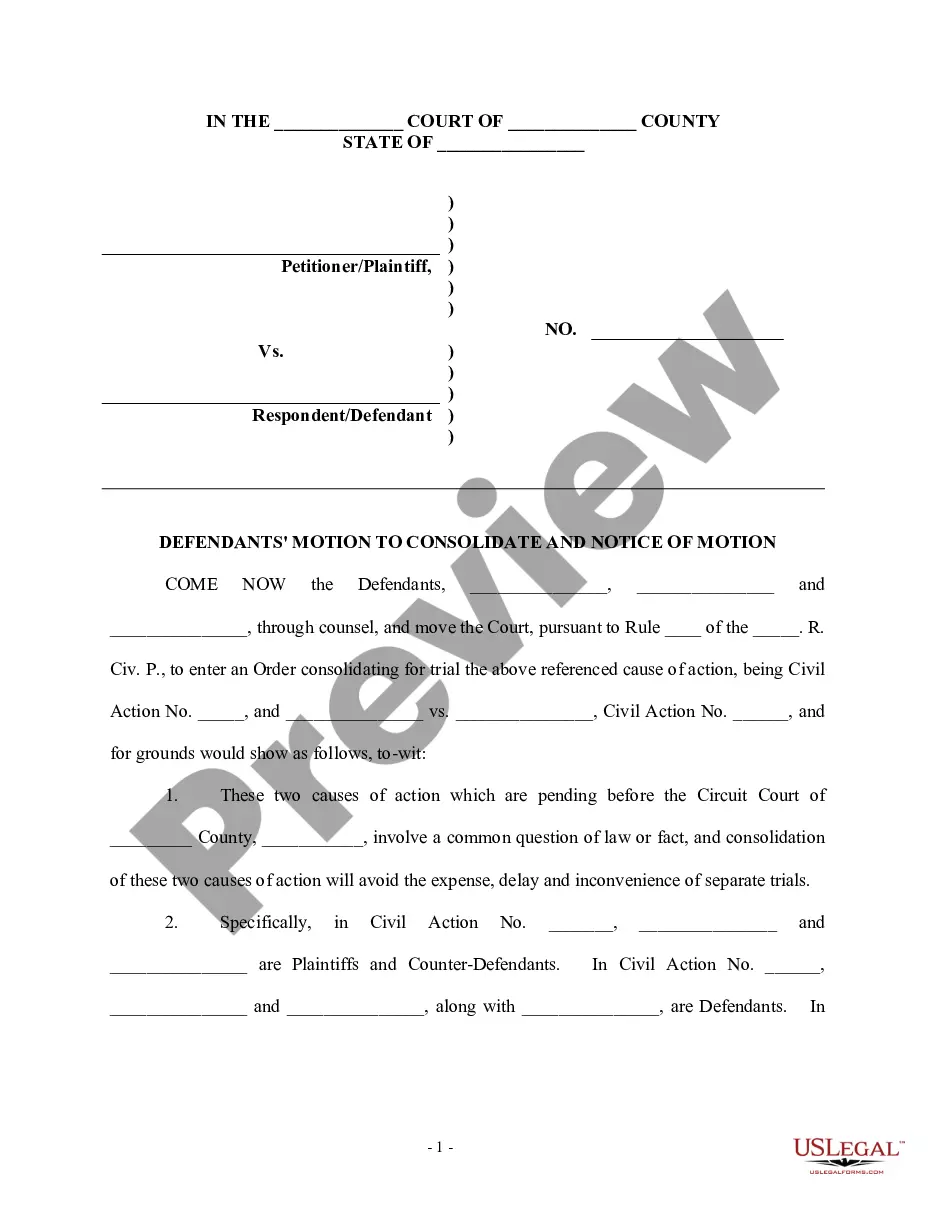
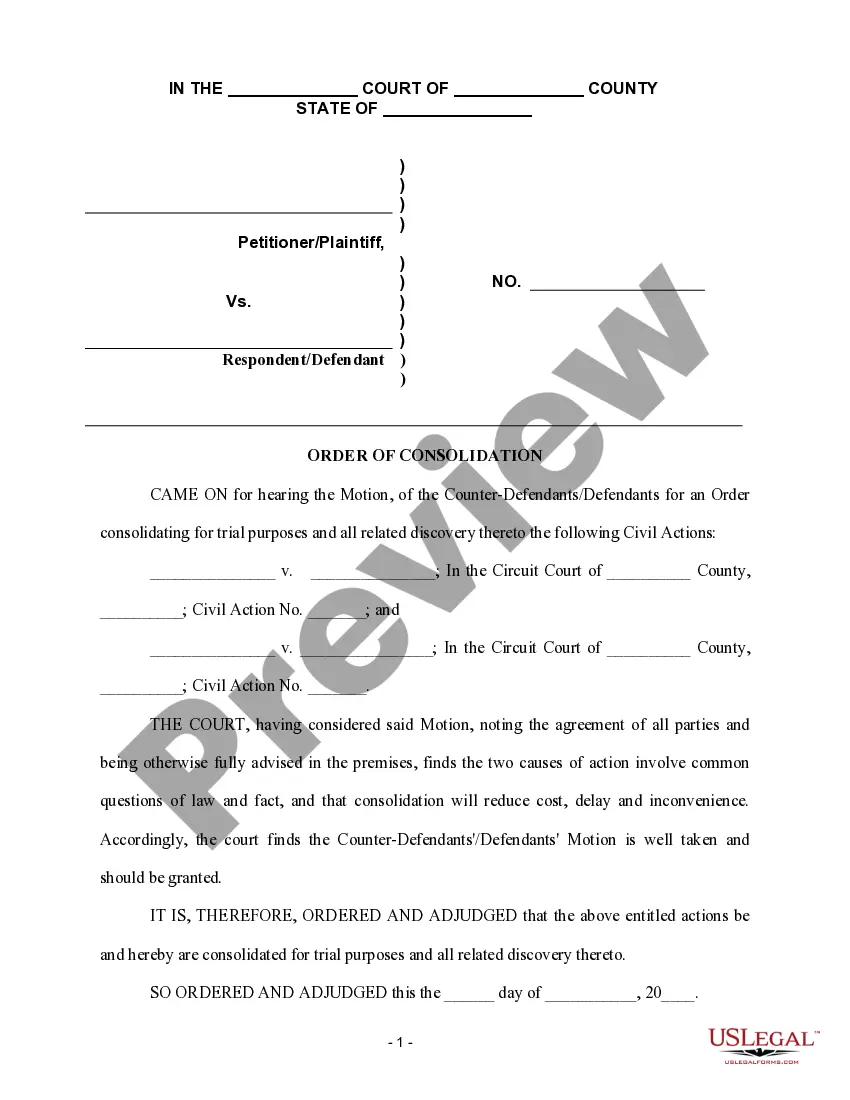
The Motion to Consolidate - Personal Injury is a legal document used in personal injury cases to request that the court combine two separate lawsuits into one trial. This motion is particularly useful when both cases arise from the same incident or set of facts, allowing for greater efficiency in court proceedings and reducing overall litigation costs. By consolidating, the court can address common questions of law or fact in a unified manner.
Key components of this form
- Details of the two civil actions including case numbers and parties involved.
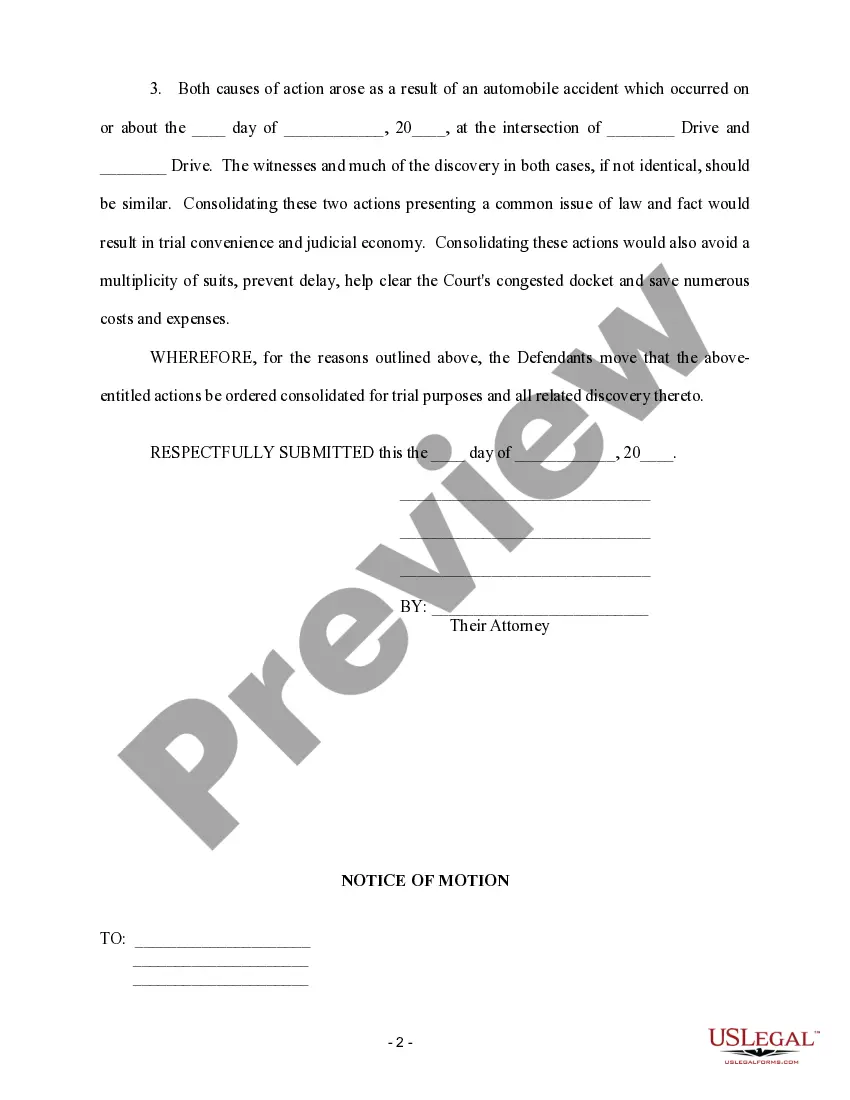
- Description of the common facts leading to both cases, such as the date and location of the incident.
- Arguments supporting the request for consolidation, emphasizing cost-effectiveness and judicial economy.
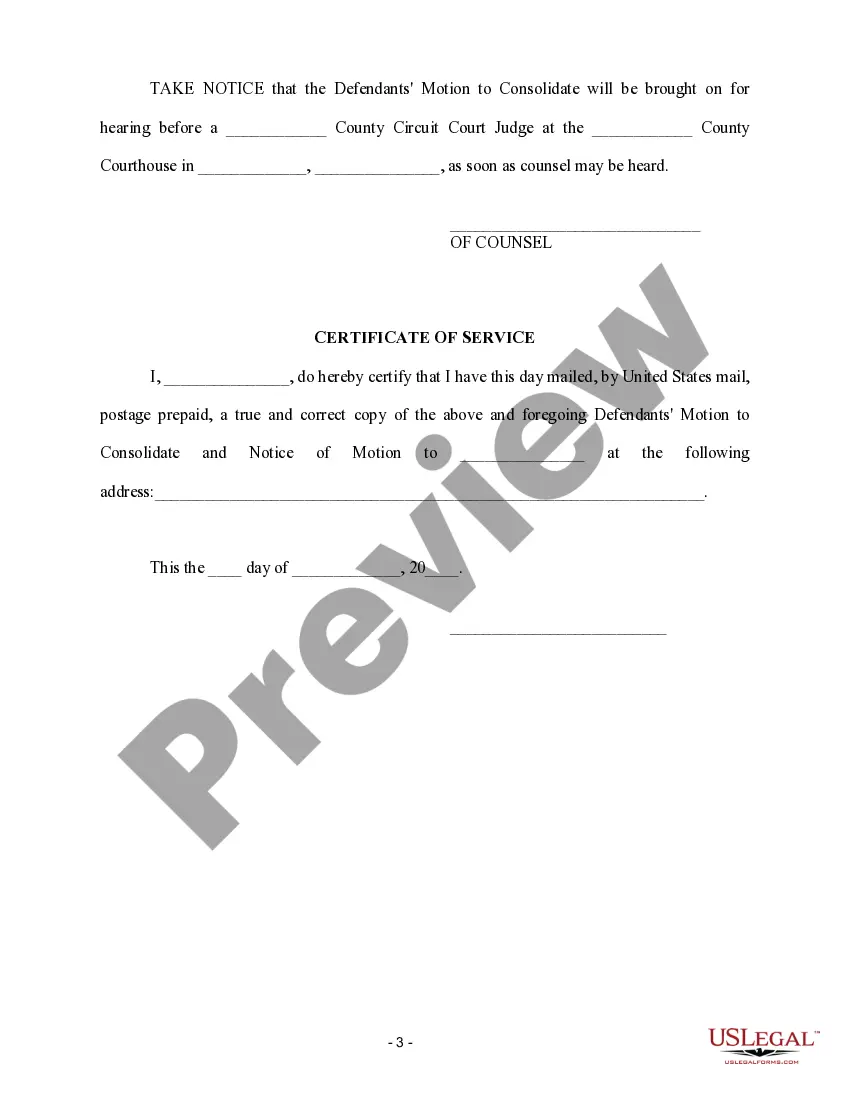
- Notice of motion providing information on the hearing before the court.
- Certification of service indicating that necessary parties have been informed of the motion.

Situations where this form applies
This form is used when there are multiple lawsuits concerning the same event, such as an automobile accident. If you are a defendant facing multiple claims from different plaintiffs related to the same incident, utilizing a Motion to Consolidate can help streamline the proceedings and minimize the complications associated with separate trials.
Who can use this document
This form is intended for:
- Defendants in personal injury lawsuits involving multiple claims arising from the same event.
- Legal representatives of the defendants looking to reduce costs and expedite court proceedings.
- Parties seeking to resolve similar legal issues together for judicial efficiency.
How to complete this form
- Identify the parties involved in the lawsuits and list their roles as plaintiffs or defendants.
- Provide the case numbers associated with each action to clarify the matters being consolidated.
- Specify the common facts surrounding the incident that led to both actions, including the accident date and location.
- Detail the reasons for consolidation, citing benefits such as cost savings and reduced court congestion.
- Complete the notice of motion indicating where and when the motion will be heard.
Is notarization required?
This form does not typically require notarization to be legally valid. However, some jurisdictions or document types may still require it. US Legal Forms provides secure online notarization powered by Notarize, available 24/7 for added convenience.
Get your form ready online
Our built-in tools help you complete, sign, share, and store your documents in one place.
Make edits, fill in missing information, and update formatting in US Legal Forms—just like you would in MS Word.
Download a copy, print it, send it by email, or mail it via USPS—whatever works best for your next step.
Sign and collect signatures with our SignNow integration. Send to multiple recipients, set reminders, and more. Go Premium to unlock E-Sign.
If this form requires notarization, complete it online through a secure video call—no need to meet a notary in person or wait for an appointment.
We protect your documents and personal data by following strict security and privacy standards.

Make edits, fill in missing information, and update formatting in US Legal Forms—just like you would in MS Word.

Download a copy, print it, send it by email, or mail it via USPS—whatever works best for your next step.

Sign and collect signatures with our SignNow integration. Send to multiple recipients, set reminders, and more. Go Premium to unlock E-Sign.

If this form requires notarization, complete it online through a secure video call—no need to meet a notary in person or wait for an appointment.

We protect your documents and personal data by following strict security and privacy standards.
Mistakes to watch out for
- Failing to include all relevant parties in the motion.
- Not accurately stating the case numbers for the actions being consolidated.
- Overlooking the local rules on form submission and required documentation.
- Providing insufficient justification for consolidation, which can lead to denial of the motion.
Advantages of online completion
- Convenience of accessing and completing the form from anywhere at any time.
- Editable templates that allow you to customize the form to fit your specific case details.
- Reliability, with forms drafted and reviewed by licensed attorneys to ensure legal compliance.
Looking for another form?


Form popularity
FAQ
A motion to consolidate is a motion to join two or more cases together into one action, where the issues are basically the same. Code of Civil Procedure Section 1048 states: "When actions involving a common question of law or fact are...
Consolidation of suits is ordered for meeting the ends of justice as it saves the parties from multiplicity of proceedings, delay and expenses. Complete or even substantially and sufficient similarity of the issues arising for decision in two suits enables the two suits being consolidated for trial and decision.
To consolidate (consolidation) is to combine assets, liabilities, and other financial items of two or more entities into one.Consolidation also refers to the union of smaller companies into larger companies through mergers and acquisitions (M&A).
Retail Order Consolidation is the ability to bring together all the merchandise of an online order with multiple products into one single shippable package.If you are a small retailer with a single store, and stock all your merchandise in one location; this is a non-issue.
Consolidate means to combine or unify into one mass or body. In Civil law, it refers to combining of two or more actions involving the same parties or issues into a single action through court order.
Consolidation Order means an order by a Tribunal that a Primary Dispute and a Linked Dispute be consolidated and heard as one dispute in the same arbitral proceedings.Consolidation Order means an order by a Tribunal that a Primary Dispute and a Linked Dispute be resolved in the same arbitral proceedings.
Courts have the power to consolidate cases that raise common questions of fact or issues of law for many purposes, including to hold a single trial. But consolidating cases, no matter the purpose, does not destroy the independent cases for appeal, according to a decision by the U.S. Supreme Court.