Plaintiff's Response to Defendants' Offer of Judgment
Understanding this form
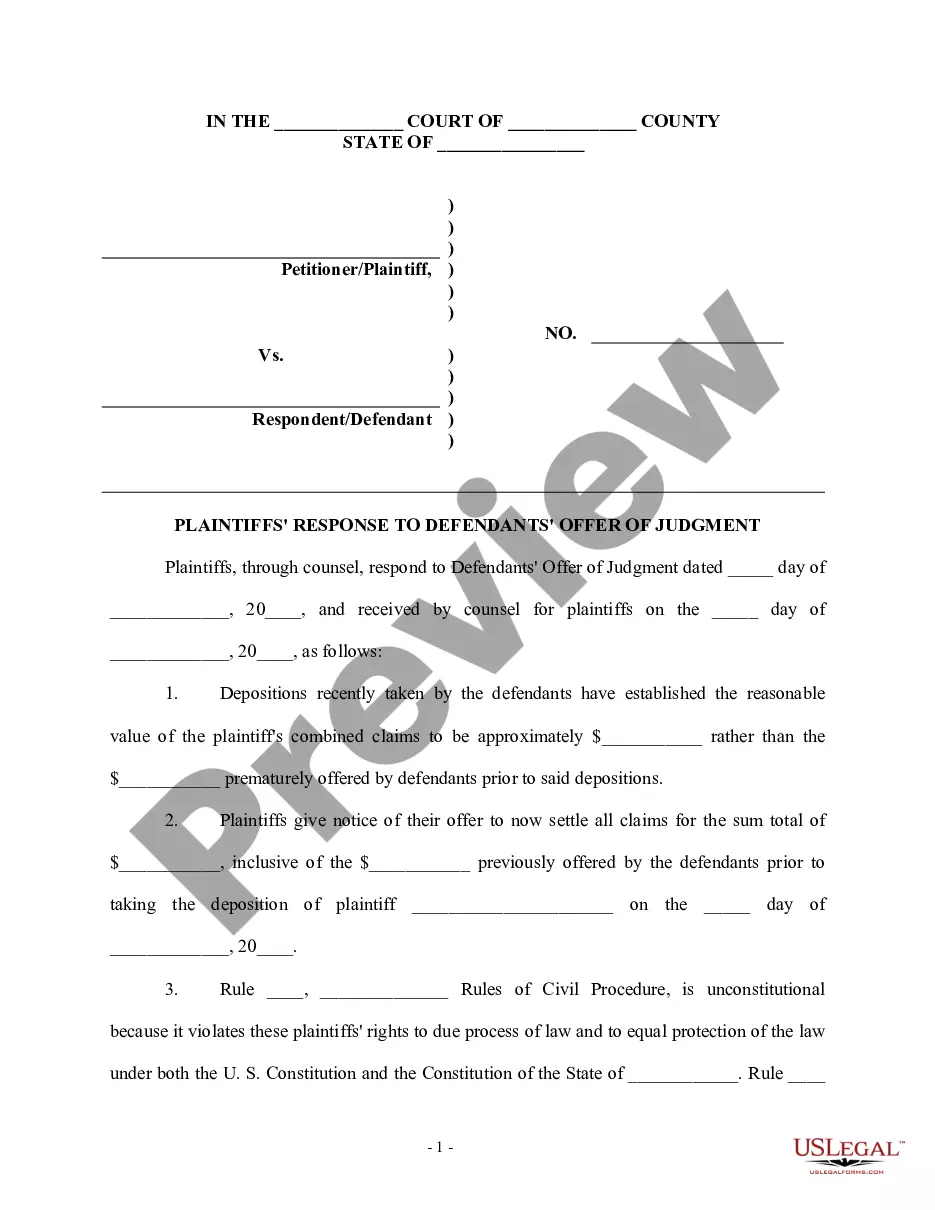
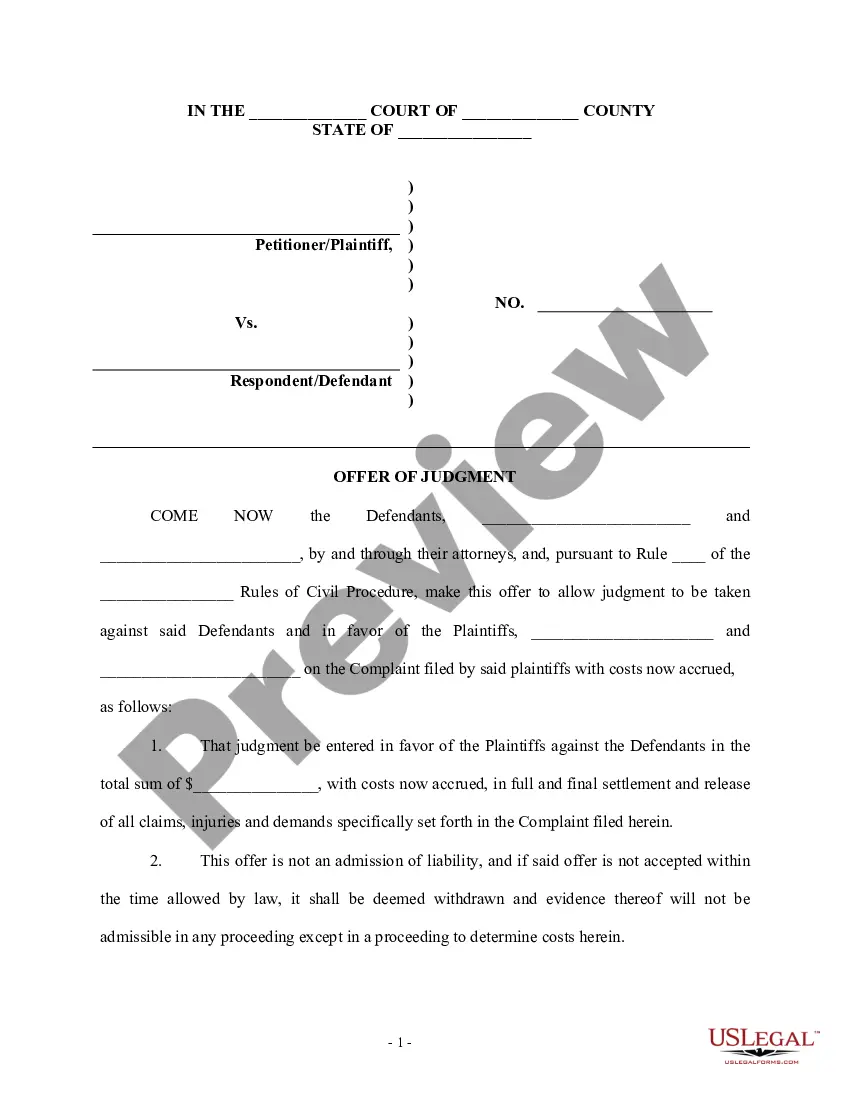
The Plaintiff's Response to Defendants' Offer of Judgment is a legal document that allows a plaintiff to respond to a defendant's settlement offer before trial. This form specifically enables the plaintiff to propose a counter-offer, reflecting a willingness to negotiate the terms of settlement. Unlike other forms that may simply accept a settlement, this form provides a structured way for the plaintiff to assert their position and adjust the proposed settlement amount based on the reasonable value of their claims.
Form components explained
- Identification of the reasonable value of the plaintiff's claims.
- Notice of counter-offer to settle all claims for a specific sum.
- Reference to the notices and depositions that support the plaintiff's valuation.
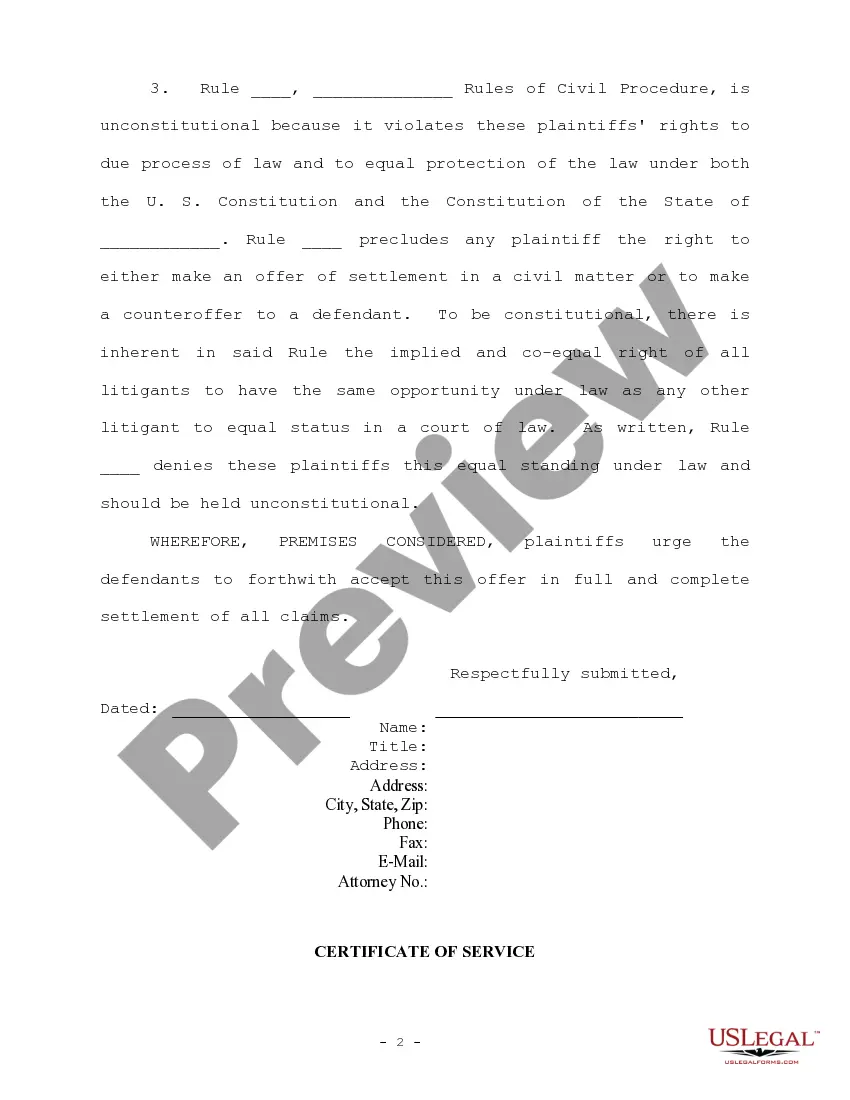
- Constitutional arguments regarding the validity of existing rules related to settlement offers.
- Call for acceptance of the counter-offer to finalize the settlement.
- Date of submission and signature lines for the plaintiff.

Situations where this form applies
This form should be used when a plaintiff receives a settlement offer from a defendant before trial and wishes to negotiate further. It is commonly utilized in civil litigation cases where the plaintiff believes the initial offer does not reflect the reasonable value of their claims and seeks to counter with a more favorable amount.
Who this form is for
- Individuals or entities acting as plaintiffs in a civil lawsuit.
- Those who have received a settlement offer from a defendant.
- Individuals seeking to negotiate a more favorable settlement before proceeding to trial.
- Legal representatives who are managing cases on behalf of plaintiffs.
How to prepare this document
- Identify the parties involved, confirming the plaintiff and defendant's names.
- Insert the reasonable value of the combined claims based on recent depositions.
- Clearly state the counter-offer amount and reference any prior offers made by the defendants.
- Cite any relevant rules of Civil Procedure pertaining to offers of judgment.
- Provide the date of the deposition and affix your signature at the designated space.
Notarization guidance
Notarization is generally not required for this form. However, certain states or situations might demand it. You can complete notarization online through US Legal Forms, powered by Notarize, using a verified video call available anytime.
Get your form ready online
Our built-in tools help you complete, sign, share, and store your documents in one place.
Make edits, fill in missing information, and update formatting in US Legal Forms—just like you would in MS Word.
Download a copy, print it, send it by email, or mail it via USPS—whatever works best for your next step.
Sign and collect signatures with our SignNow integration. Send to multiple recipients, set reminders, and more. Go Premium to unlock E-Sign.
If this form requires notarization, complete it online through a secure video call—no need to meet a notary in person or wait for an appointment.
We protect your documents and personal data by following strict security and privacy standards.

Make edits, fill in missing information, and update formatting in US Legal Forms—just like you would in MS Word.

Download a copy, print it, send it by email, or mail it via USPS—whatever works best for your next step.

Sign and collect signatures with our SignNow integration. Send to multiple recipients, set reminders, and more. Go Premium to unlock E-Sign.

If this form requires notarization, complete it online through a secure video call—no need to meet a notary in person or wait for an appointment.

We protect your documents and personal data by following strict security and privacy standards.
Typical mistakes to avoid
- Failing to accurately assess the reasonable value of claims, which could lead to an ineffective counter-offer.
- Omitting relevant depositions or evidence that support the counter-offer valuation.
- Not properly citing rules or constitutional arguments that may strengthen the case.
- Submitting the form without appropriate signatures or dates.
Benefits of using this form online
- Immediate access to a professionally drafted legal form created by licensed attorneys.
- The ability to edit and personalize the form to fit specific case details.
- Convenient downloading options that allow for quick printing and submission.
- Reliable resources available for guidance on completing the form correctly.
Legal use & context
- The form serves as an official response in legal proceedings, establishing the plaintiff's intent to negotiate.
- It can be used as evidence of the plaintiff's willingness to settle, which may impact court proceedings if the case goes to trial.
- Always ensure that the arguments made within this form align with current legal standards to maintain enforceability.
Looking for another form?


Form popularity
FAQ
Section 998 of the Code of Civil Procedure provides that, not less than 10 days before commencement of trial, any party to an action "may serve an offer in writing upon any other party to the action to allow judgment to be taken in accordance with the terms and conditions stated at that time." The offer is deemed
Rule 68 is a risk-shifting tool built into the federal rules to encourage settlements and avoid unnecessary trials. The rule allows defendants to make an offer of judgment at any point up to 14 days before trial.The offer of judgment works like a wager with the plaintiff on the value of the case.
Most often, it is a judgment in favor of a plaintiff when the defendant has not responded to a summons or has failed to appear before a court of law.A party can have a default judgment vacated, or set aside, by filing a motion, after the judgment is entered, by showing of a proper excuse.
When making a Rule 68 offer of judgment, it is essential that the offeror clearly state whether attorney fees and costs are included in the final offer. This principle was highlighted in Louie Medina v.
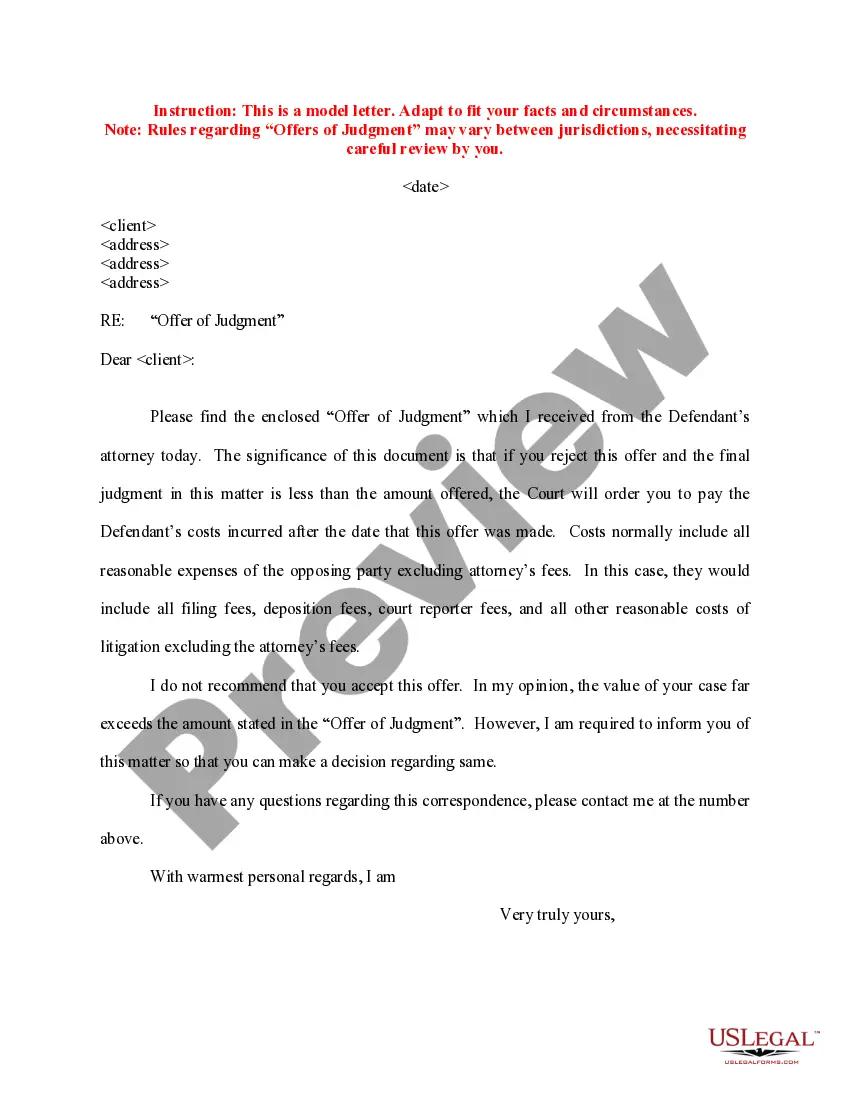
An offer of judgment is a written offer made to the opposing party to resolve the plaintiff's claim on specified terms, with the costs then accrued. For instance, a defendant might offer to pay the plaintiff $50,000.00, plus the costs accrued by the plaintiff to that point in the litigation to fully and finally
It is like an option that you have for ten days based upon a valuable consideration. If you have paid for any option, you are entitled to it, and it cannot be withdrawn. The fact that the offer is made under these rules takes out of it the element of gratuity, and gives to it an enforceable legal effect.
Making an Offer of Judgment by itself is not an admission of liability. If the Offer is accepted, then the Judgment is entered by the Court.