Parent - Child Driving Privilege Contract
What this document covers
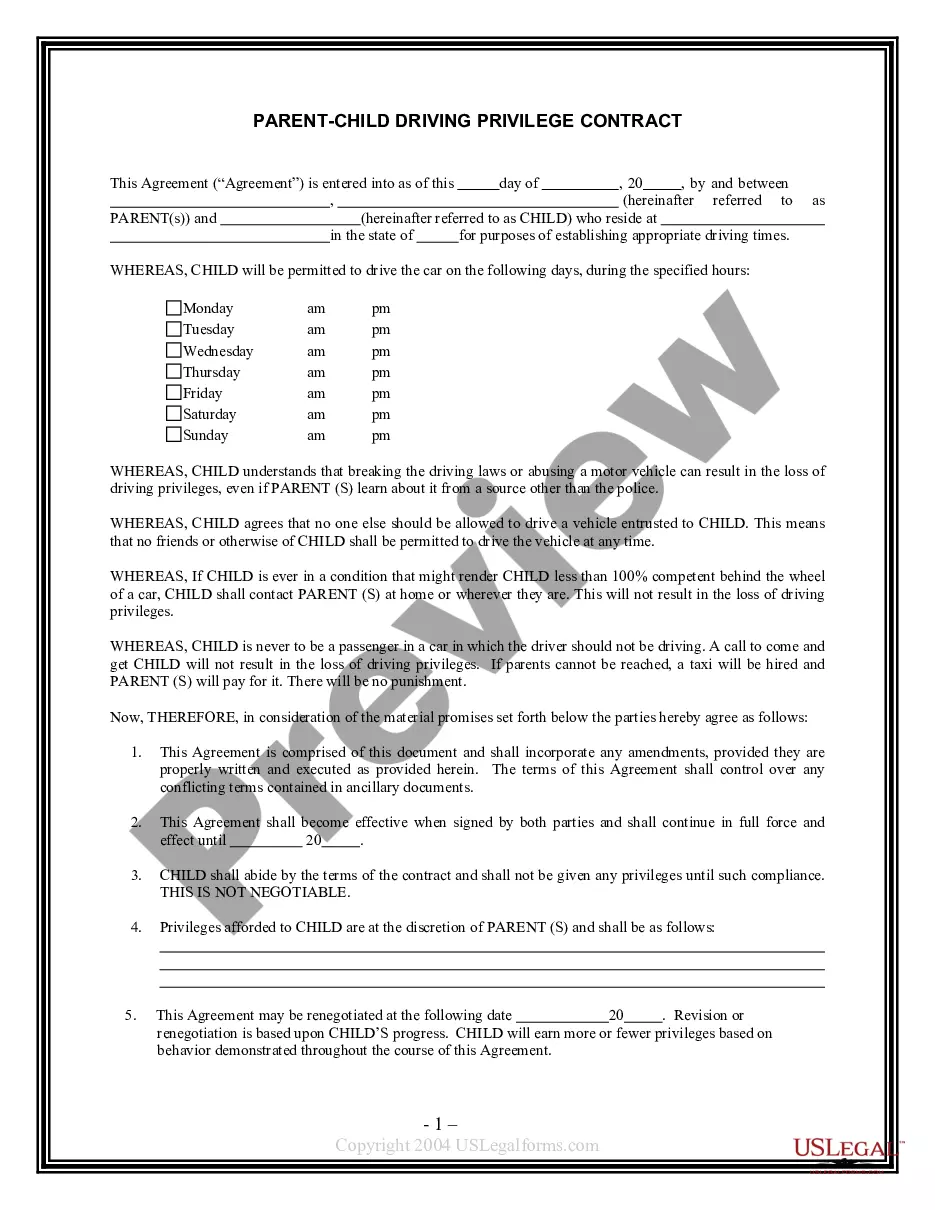
The Parent - Child Driving Privilege Contract is a legal agreement between parents and their child that outlines the terms under which the child is allowed to drive. This contract specifically addresses key elements such as alcohol use while driving and the consequences for failing to adhere to the established rules. It serves as both a guideline and a protective measure to ensure safe driving practices and communication between parents and their child.
Key components of this form
- Identification of the parents and child involved in the agreement.
- Clear rules regarding alcohol use while driving.
- Responsibilities of the child to contact parents if feeling unfit to drive.
- Protocols for emergency situations, including transportation arrangements.
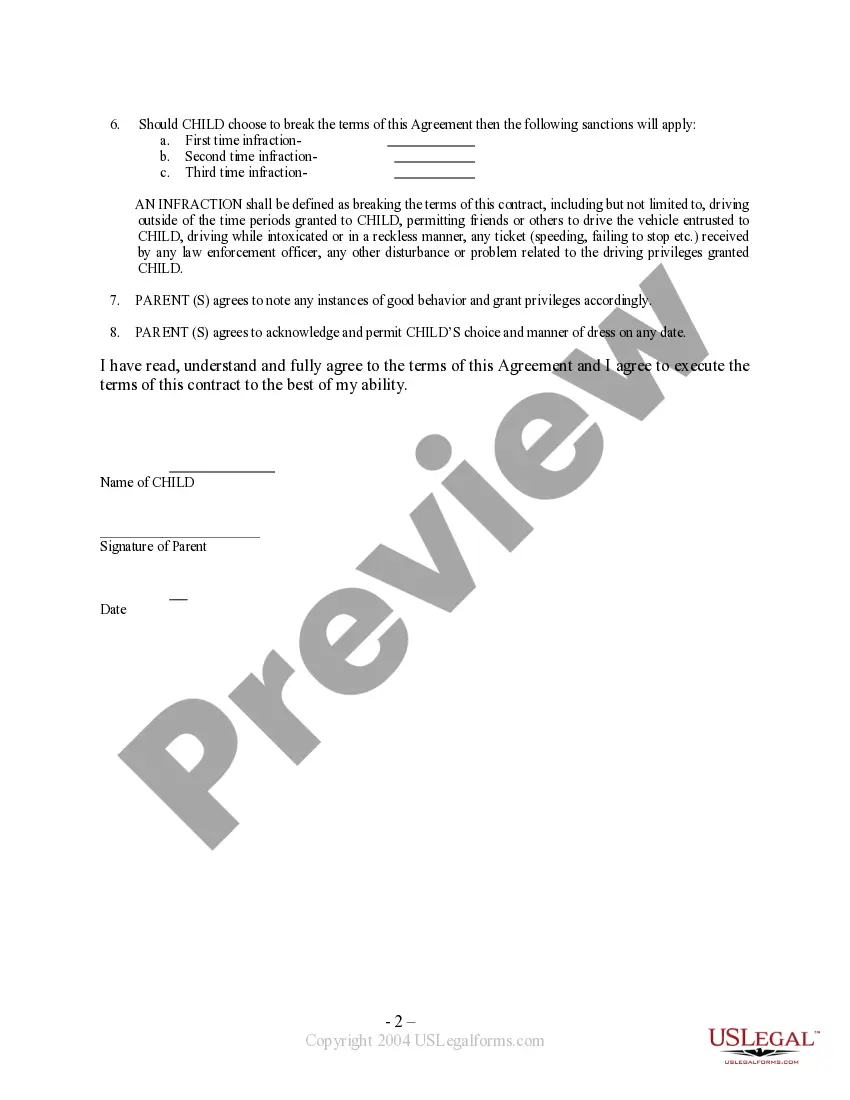
- Details regarding monitoring of behavior and consequences for violations of the contract.
When this form is needed
This form should be utilized when a parent wishes to establish driving privileges for their child, particularly during the teenage years. It's especially useful when a child is beginning to drive independently and requires guidance on responsible driving behavior. Additionally, it serves as a preventive measure to encourage communication and accountability regarding alcohol use and safe driving practices.
Who can use this document
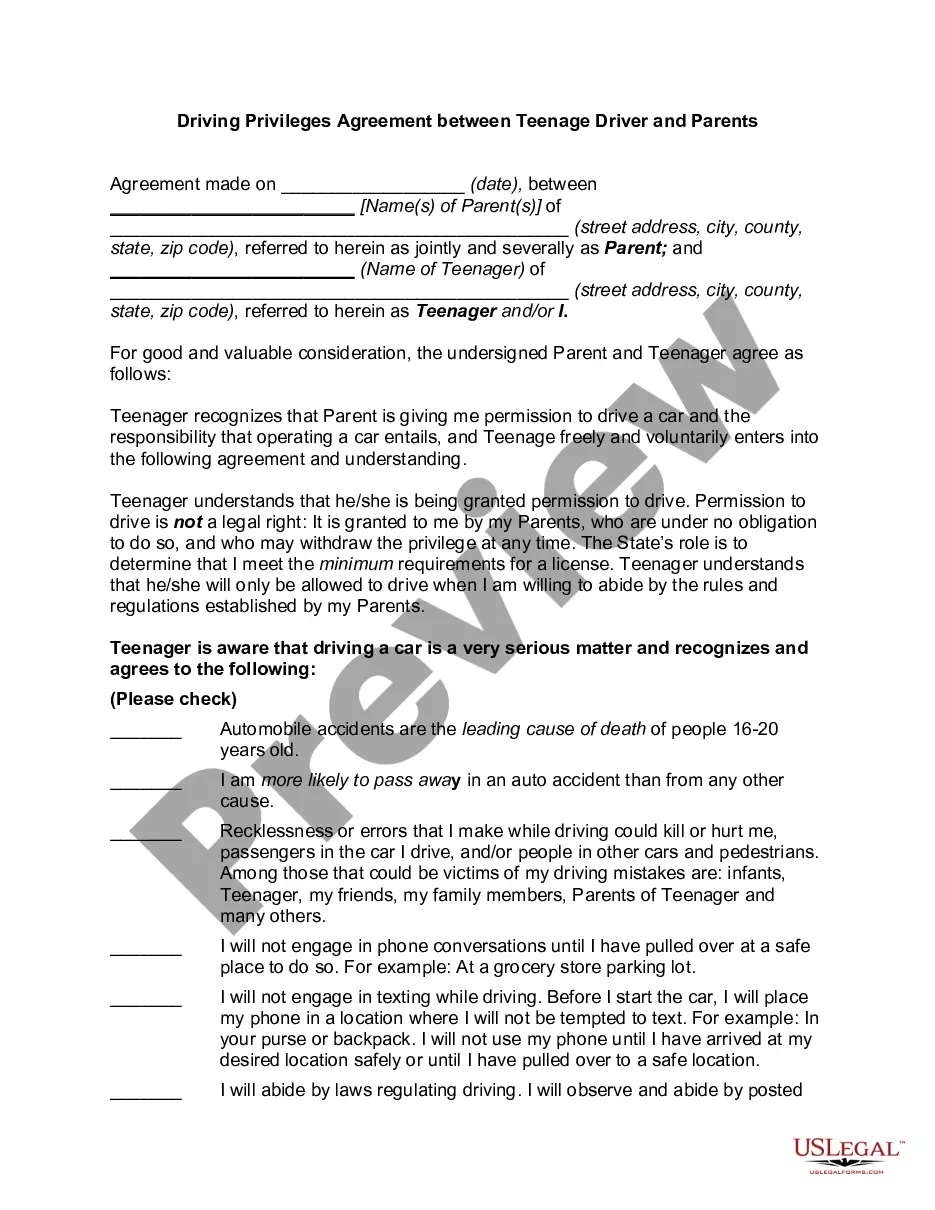
- Parents or guardians of teenagers who have just received their driver's licenses.
- Families looking to foster discussions about responsible driving and alcohol use.
- Those wishing to establish written agreements regarding driving behavior and expectations.
Steps to complete this form
- Identify the parties involved, including the names of the parents and the child.
- Clearly outline the rules and expectations regarding alcohol use and driving conduct.
- Detail the procedures for contacting parents if the child feels unsafe to drive.
- Specify the consequences for any violations of the agreement.
- Both parents and the child should sign and date the agreement to confirm understanding and acceptance.
Notarization guidance
This form does not typically require notarization to be legally valid. However, some jurisdictions or document types may still require it. US Legal Forms provides secure online notarization powered by Notarize, available 24/7 for added convenience.
Get your form ready online
Our built-in tools help you complete, sign, share, and store your documents in one place.
Make edits, fill in missing information, and update formatting in US Legal Forms—just like you would in MS Word.
Download a copy, print it, send it by email, or mail it via USPS—whatever works best for your next step.
Sign and collect signatures with our SignNow integration. Send to multiple recipients, set reminders, and more. Go Premium to unlock E-Sign.
If this form requires notarization, complete it online through a secure video call—no need to meet a notary in person or wait for an appointment.
We protect your documents and personal data by following strict security and privacy standards.

Make edits, fill in missing information, and update formatting in US Legal Forms—just like you would in MS Word.

Download a copy, print it, send it by email, or mail it via USPS—whatever works best for your next step.

Sign and collect signatures with our SignNow integration. Send to multiple recipients, set reminders, and more. Go Premium to unlock E-Sign.

If this form requires notarization, complete it online through a secure video call—no need to meet a notary in person or wait for an appointment.

We protect your documents and personal data by following strict security and privacy standards.
Typical mistakes to avoid
- Failing to have both parents sign the agreement.
- Not including specific rules regarding driving behavior.
- Neglecting to discuss or document emergency procedures.
- Overlooking regular reviews of the contract to adapt to changing circumstances.
Benefits of using this form online
- Convenience of accessing and downloading the form at any time.
- The ability to customize the contract to fit specific family needs.
- Reliability, as forms are drafted by licensed attorneys to ensure legal compliance.
Legal use & context
- This form helps establish a legal framework for driving privileges between parents and children.
- It enhances accountability and sets clear expectations, reducing misunderstandings.
- By signing the agreement, all parties are committed to upholding the defined rules and responsibilities.
Main things to remember
- The Parent - Child Driving Privilege Contract clarifies driving expectations.
- It encourages open communication regarding alcohol use and safe driving.
- This contract can be tailored to meet specific family needs and circumstances.
Looking for another form?


Form popularity
FAQ
Under this privilege, a parent or the parent's child cannot be compelled to testify about confidential communications between them when one of them is (1) a party to a proceeding or (2) called to give testimony about the other in a grand jury proceeding.
It's the law in many other countries, but in the U.S., only four states recognize a parent-child privilege.
25. Parental and filial privilege. - No person may be compelled to testify against his parents, other direct ascendants, children or other direct descendants.
California does not have a minimum age requirement in order for a child to be permitted to testify in court. Instead, judges are given discretion to determine whether a child is competent to testify.When asked by a court evaluator who told him to say that his father hit his mother, he answered, my mommy.
There is no lower age limit in relation to giving evidence, but prosecutors should be satisfied that the child will be able to give understandable evidence - all witnesses have to be able to understand questions and be able to give replies that can be understood as set out in section 53 of the Youth Justice and
24, 1998, at 029. 6 New York is the only state to have judicially permitted parents and children to claim a parent-child privilege. Three other states, Idaho, Minnesota, and Massachusetts have statutes that permit parents or children to assert the privilege.
It's well established in U.S. law that husbands and wives don't have to testify against each other in court. But for the most part, there is no such protection for parents and children.