Affidavit of Attorney-in-Fact that Power of Attorney in Full Force with Witnesses
What this document covers
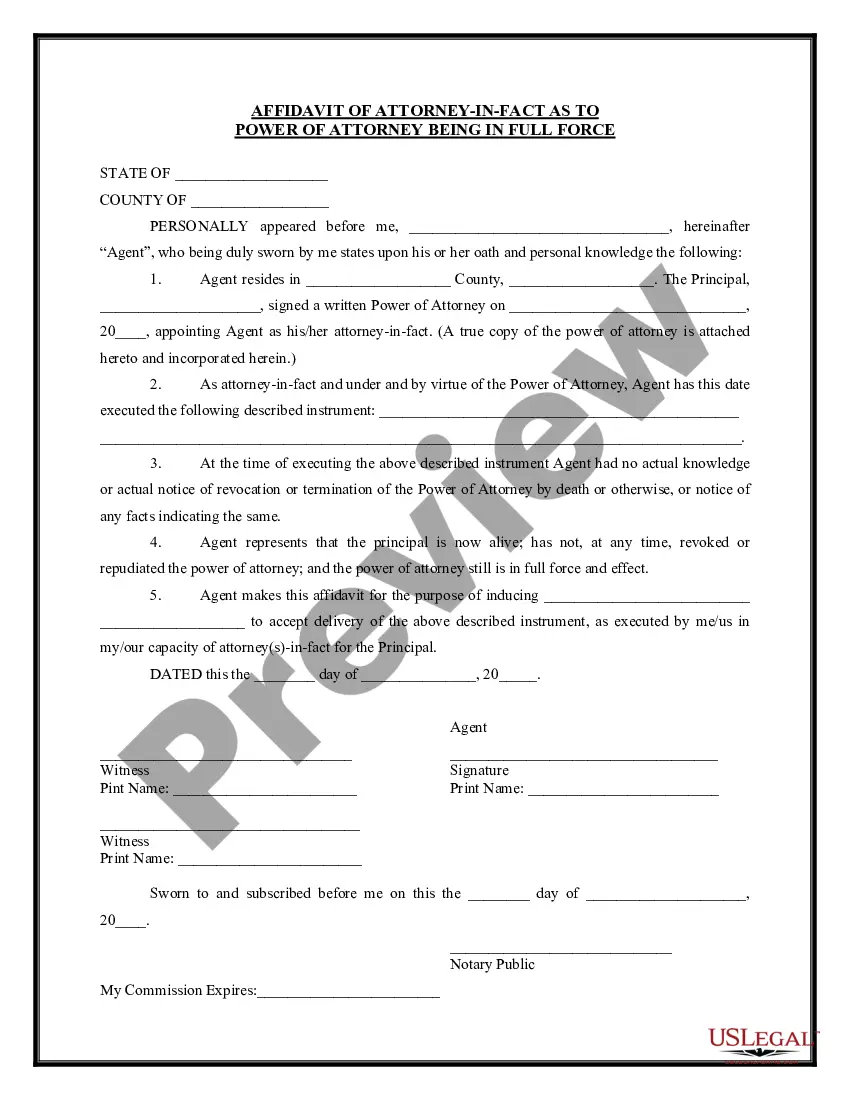
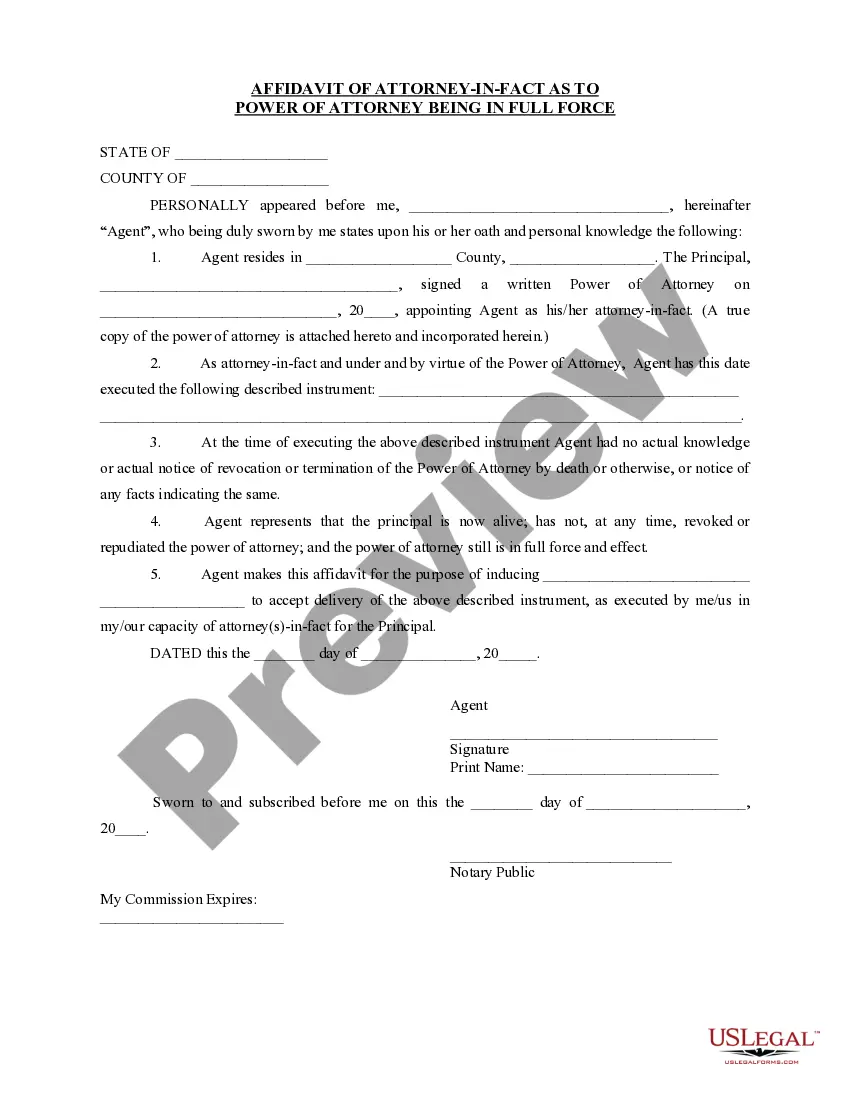
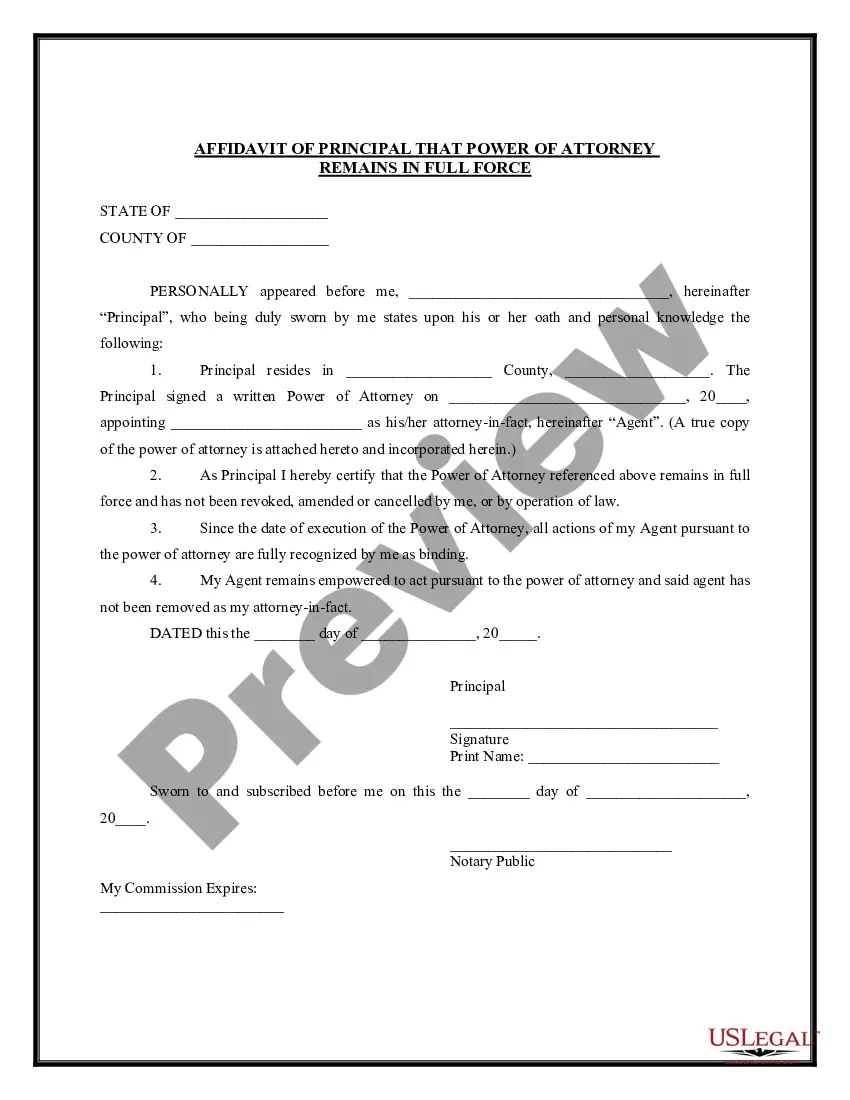
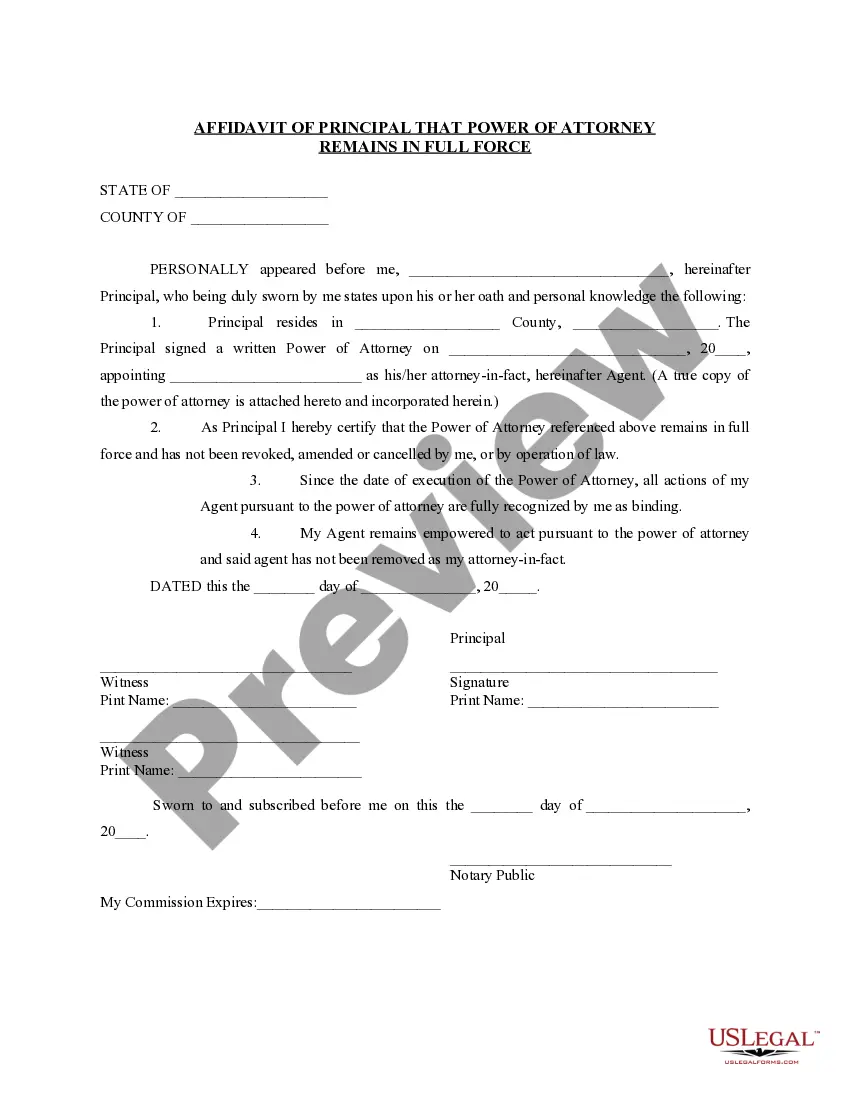
The Affidavit of Attorney-in-Fact that Power of Attorney is in Full Force is a legal document used to affirm that the power of attorney granted to an agent remains valid and has not been revoked. This affidavit serves as proof for third parties that the agent can act on behalf of the principal, ensuring their authority is recognized legally. It is specifically designed for use in Florida, Michigan, Ohio, South Carolina, or Vermont, making it distinct from other types of power of attorney documents.
Form components explained
- Identification of the agent and principal involved.
- Statement affirming that the power of attorney is still in effect.
- Confirmation of the date the power of attorney was originally signed.
- Declaration that the agent had no knowledge of any revocation.
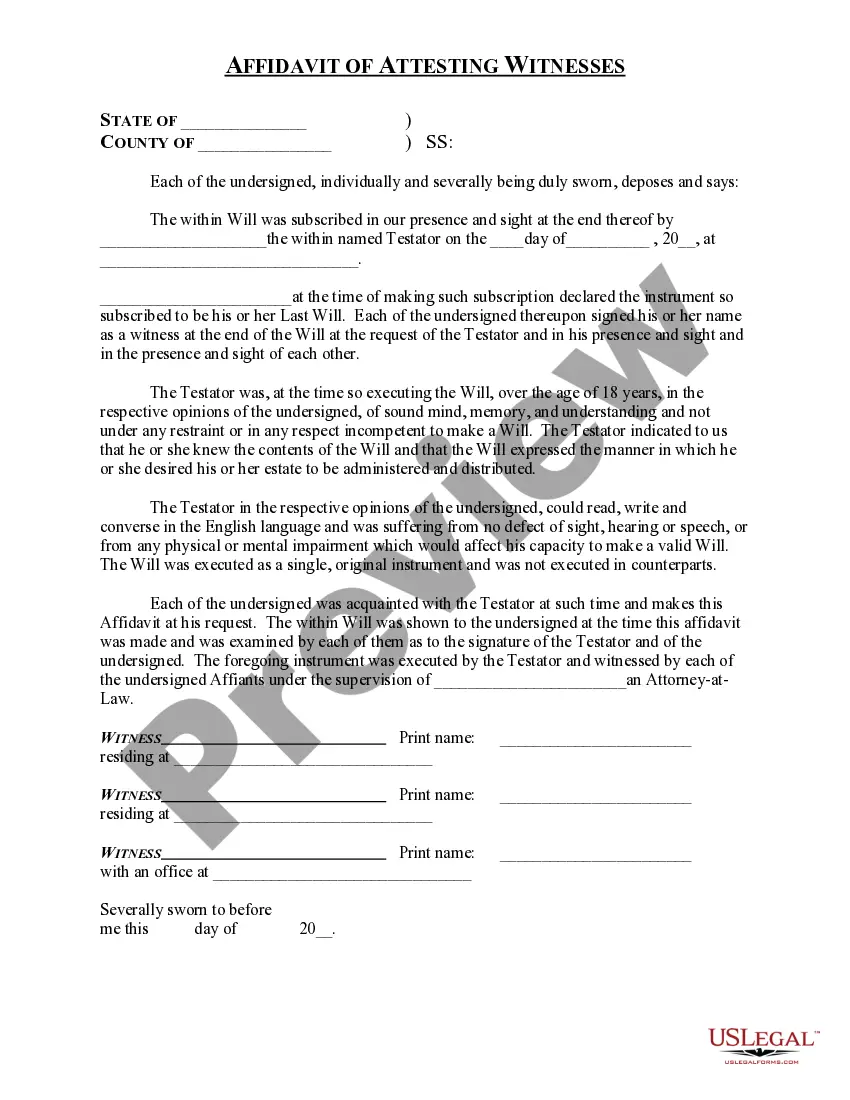
- Signature lines for the agent and witnesses, including a notary public section.
When to use this form
This form is essential when an agent needs to verify their authority under a power of attorney, particularly when dealing with financial institutions, healthcare providers, or other entities that require assurance of the agent's standing. It can be used in situations where transactions, legal decisions, or health care directives are to be enacted by the agent on behalf of the principal.
Intended users of this form
- Agents acting under a valid power of attorney in the states listed.
- Individuals who require confirmation of their authority to act for another person.
- Legal representatives who need to validate documents that require a statement of authority.
Instructions for completing this form
- Begin by filling in the name of the state and county where the affidavit will be executed.
- Provide the name and address of the agent who is acting under the power of attorney.
- Specify the name of the principal and the date when the power of attorney was executed.
- Complete the section detailing the instrument executed by the agent.
- Ensure witnesses sign the affidavit and that it is notarized by a licensed notary public.
Does this document require notarization?
To make this form legally binding, it must be notarized. Our online notarization service, powered by Notarize, lets you verify and sign documents remotely through an encrypted video session.
Get your form ready online
Our built-in tools help you complete, sign, share, and store your documents in one place.
Make edits, fill in missing information, and update formatting in US Legal Forms—just like you would in MS Word.
Download a copy, print it, send it by email, or mail it via USPS—whatever works best for your next step.
Sign and collect signatures with our SignNow integration. Send to multiple recipients, set reminders, and more. Go Premium to unlock E-Sign.
If this form requires notarization, complete it online through a secure video call—no need to meet a notary in person or wait for an appointment.
We protect your documents and personal data by following strict security and privacy standards.

Make edits, fill in missing information, and update formatting in US Legal Forms—just like you would in MS Word.

Download a copy, print it, send it by email, or mail it via USPS—whatever works best for your next step.

Sign and collect signatures with our SignNow integration. Send to multiple recipients, set reminders, and more. Go Premium to unlock E-Sign.

If this form requires notarization, complete it online through a secure video call—no need to meet a notary in person or wait for an appointment.

We protect your documents and personal data by following strict security and privacy standards.
Common mistakes to avoid
- Failing to include the notarization, which is often required for the affidavit to be valid.
- Leaving fields blank, especially identification details of the agent or principal.
- Not ensuring that witnesses sign the document where necessary.
Why complete this form online
- Instant access to the form ensures you can complete it when you need it.
- Downloadable format allows for easy storage and sharing.
- Legal accuracy guaranteed by licensed attorneys who draft these forms.
- Convenience in editing the form to fit your specific requirements.
- Quick support and guidance if you have questions while filling out the form.
Key takeaways
- The affidavit serves to confirm that the power of attorney is active and has not been revoked.
- This form is specifically for use in Florida, Michigan, Ohio, South Carolina, or Vermont.
- Proper completion includes notary and witness signatures, making it legally enforceable.
Looking for another form?







Form popularity
FAQ
The person who witnesses your signature must be over the age of 18 and cannot be one of your attorneys or replacement attorneys. Your certificate provider can act as your witness. How can I get an LPA form?
Yes, California law requires that the Durable Power of Attorney must be notarized or signed by at least two witnesses. In California, a principal cannot act as one of the witnesses.
An attorney in fact is a person authorized to sign documents on someone else's behalf, but is not necessarily a practicing lawyer.When an attorney in fact signs a document, the signature should include the name of the principal he or she represents.
Definition. An agent authorized to act on behalf of another person, but not necessarily authorized to practice law, e.g. a person authorized to act by a power of attorney. An attorney in fact is a fiduciary. Also known as attorney in fact or private attorney.
If it is signed by two witnesses, they must witness either (1) the signing of the power of attorney or (2) the principal's signing or acknowledgment of his or her signature. A durable power of attorney that may affect real property should be acknowledged before a notary public so that it may easily be recorded.
If you have executed a Durable Power of Attorney, then you have signed a document appointing a person to make financial decisions on your behalf. The document is called a Power of Attorney, and the person named to make decisions on your behalf is called an Attorney-in-Fact (otherwise known as an Agent).
Most states offer simple forms to help you create a power of attorney for finances. Generally, the document must be signed, witnessed and notarized by an adult. If your agent will have to deal with real estate assets, some states require you to put the document on file in the local land records office.
When the document goes into effect, you become that person's attorney in fact, which means you act as their agent. Generally, to sign documents in this capacity, you will sign the principal's name first, then your name with the designation "attorney in fact" or "power of attorney."
An attorney-in-fact is a person who is authorized to act on behalf of another person, usually to perform business or other official transactions. The person represented usually designates someone as their attorney-in-fact by assigning power of attorney. An attorney-in-fact is not necessarily a lawyer.