Provision Calling for Inspecting and Monitoring of Work Quality
About this form
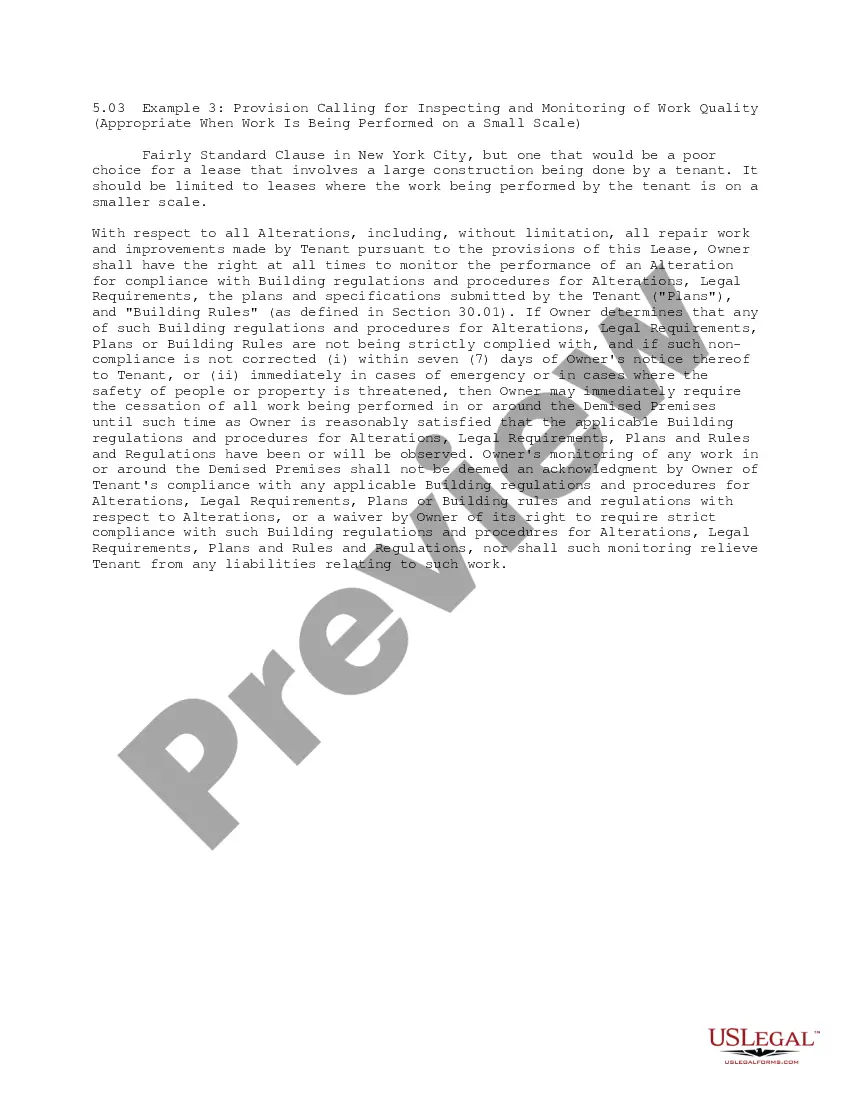
The Provision Calling for Inspecting and Monitoring of Work Quality is a legal form used in commercial leases to ensure that any alterations made by a tenant comply with established building rules and regulations. This provision is particularly useful for smaller scale renovations rather than significant construction projects. It empowers property owners to monitor and verify that all work done by the tenant adheres to the agreed-upon standards, thus protecting the integrity of the property and the safety of its occupants.
Key components of this form
- Tenant's obligation to comply with building regulations and established procedures for alterations.
- Owner's right to inspect and monitor the work for compliance.
- Timeframe for tenant to correct any non-compliance issues after notification.
- Owner's authority to halt work if important regulations are not followed.
- Clarification that monitoring by the owner does not imply compliance by the tenant.
When to use this form
This form should be used when a tenant plans to make alterations or improvements to a leased property, especially in situations involving minor renovations. It is essential when the lease terms include the tenant's ability to make changes to the space while ensuring those changes meet necessary legal and safety standards. The form is particularly relevant in urban areas where building codes and regulations may be strict.
Intended users of this form
- Landlords or property owners looking to protect their investment during tenant alterations.
- Tenants who intend to make any changes to the leased property, ensuring compliance with lease terms.
- Real estate professionals managing lease agreements on behalf of owners or tenants.
How to complete this form
- Identify the parties involved: enter the names of the landlord and tenant.
- Specify the property where the alterations will occur, including the address.
- Detail the proposed alterations, including plans and specifications.
- Include clauses regarding monitoring and compliance requirements.
- Ensure all parties sign and date the form to validate the agreement.
Notarization requirements for this form
Notarization is not commonly needed for this form. However, certain documents or local rules may make it necessary. Our notarization service, powered by Notarize, allows you to finalize it securely online anytime, day or night.
Get your form ready online
Our built-in tools help you complete, sign, share, and store your documents in one place.
Make edits, fill in missing information, and update formatting in US Legal Forms—just like you would in MS Word.
Download a copy, print it, send it by email, or mail it via USPS—whatever works best for your next step.
Sign and collect signatures with our SignNow integration. Send to multiple recipients, set reminders, and more. Go Premium to unlock E-Sign.
If this form requires notarization, complete it online through a secure video call—no need to meet a notary in person or wait for an appointment.
We protect your documents and personal data by following strict security and privacy standards.

Make edits, fill in missing information, and update formatting in US Legal Forms—just like you would in MS Word.

Download a copy, print it, send it by email, or mail it via USPS—whatever works best for your next step.

Sign and collect signatures with our SignNow integration. Send to multiple recipients, set reminders, and more. Go Premium to unlock E-Sign.

If this form requires notarization, complete it online through a secure video call—no need to meet a notary in person or wait for an appointment.

We protect your documents and personal data by following strict security and privacy standards.
Typical mistakes to avoid
- Failing to clearly specify the alterations and their compliance with local regulations.
- Not entering the correct or full names of all parties involved in the lease.
- Overlooking the timeline for addressing non-compliance issues.
Why use this form online
- Immediate access to professionally drafted legal documents.
- Easy to fill out and customize to fit specific leasing situations.
- Convenient download options for clients to keep or print.
Legal use & context
- This provision is effective in codifying the monitoring rights of property owners.
- It protects both parties from misunderstandings regarding the scope and quality of work.
- Such forms must align with local legal standards to be enforceable.
Main things to remember
- The Provision Calling for Inspecting and Monitoring of Work Quality is essential for managing minor tenant alterations.
- This form protects the interests of both landlords and tenants by ensuring compliance with relevant regulations.
- Always verify specific state regulations that may affect the use of this form.
Looking for another form?
Form popularity
FAQ
Purpose of workplace inspectionsWorkplace health and safety inspections are a useful tool to help prevent risk. When you carry out a workplace inspection, you are critically examining the workplace to identify and report potential hazards that can be removed or avoided.
Identifying and recording actual and potential hazards posed by buildings, equipment, the environment, processes and practices. recording any hazards requiring immediate attention. determining whether existing hazard controls are adequate and operational. recommending corrective action where appropriate.
Identify existing and potential hazards. determine underlying causes of hazards. recommend corrective action. monitor steps taken to eliminate hazards or control the risk (e.g., engineering controls, administrative controls, policies, procedures, personal protective equipment)
Quality control (QC) is a process through which a business seeks to ensure that product quality is maintained or improved.This is done by training personnel, creating benchmarks for product quality and testing products to check for statistically significant variations.
Environment. dust, gases, fumes, sprays, lighting, noise, ventilation. Buildings. windows, doors, floors, stairs, roofs, walls, elevators. Containers. Electrical. Fire protection equipment. Hand tools. Hazardous products. Materials handling.
An opening conference. The opening conference is a brief meeting during which the OSHA inspector will explain the purpose of the inspection. A worksite walkaround The walkaround is the actual inspection. A closing conference.
Pulling random samples for inspection. Checking the product against specifications. Verifying packaging requirements. Classifying and reporting quality defects. Conducting on-site testing.
Listen to the concerns of workers and their representatives. Review and analyse workplace hazards and incident reporting data. Identify existing and potential hazards and determine their underlying cause.
Set your quality standards. Decide which quality standards to focus on. Create operational processes to deliver quality. Review your results. Get feedback. Make improvements.