Provision Allocation Risks and Setting Forth Insurance Obligations of Both the Landlord and the Tenant
What this document covers
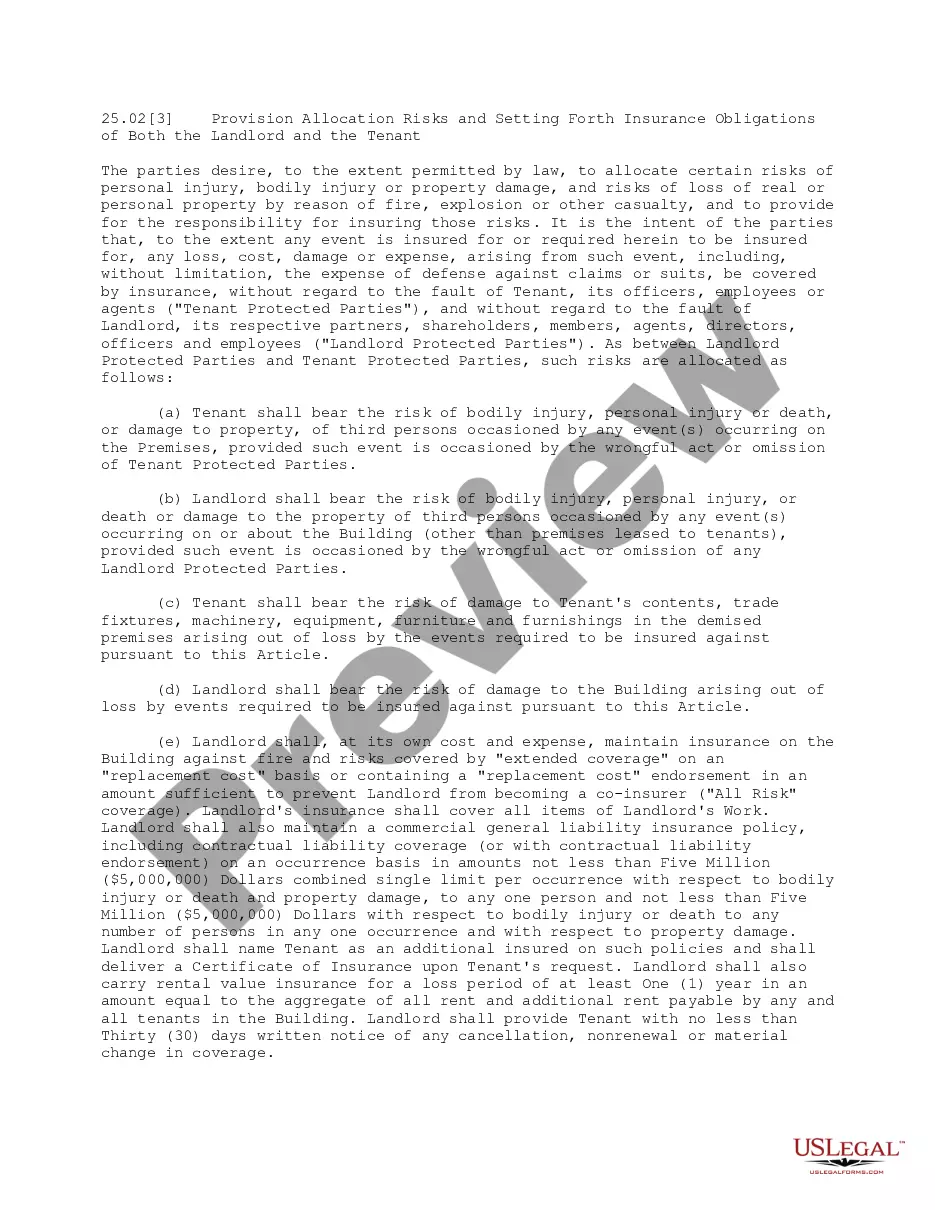
The Provision Allocation Risks and Setting Forth Insurance Obligations of Both the Landlord and Tenant form is designed to outline the responsibilities of both landlords and tenants regarding risk allocation and insurance obligations related to personal injury, property damage, and loss. This form helps parties understand their respective liabilities and ensures that adequate insurance coverage is maintained to protect against potential losses, differentiating it from standard lease agreements which may not address these specific provisions in detail.
Main sections of this form
- Risk allocation for bodily injury and property damage between landlords and tenants.
- Insurance requirements for landlords, including coverage details and limits.
- Insurance obligations for tenants concerning their personal property in the rented space.
- Notice requirements for changes in insurance coverage from landlords to tenants.
- Specific definitions for "tenant protected parties" and "landlord protected parties".
Situations where this form applies
This form should be used when entering into a commercial lease agreement where both parties wish to clearly define their insurance responsibilities and risk-sharing arrangements. It is especially important in situations where the potential for liability due to personal injury or property damage is high, such as in retail or industrial properties. Utilizing this form ensures that both the landlord and tenant have a mutual understanding and agreement on how risks are managed and insured against.
Intended users of this form
- Landlords managing commercial properties.
- Tenants leasing space in commercial buildings.
- Real estate agents facilitating lease agreements.
- Property managers overseeing commercial properties.
Instructions for completing this form
- Identify and list the parties involved: the landlord and the tenant.
- Specify the property being leased, ensuring accuracy in the description.
- Outline the risk allocation clauses, clearly stating which party is responsible for which risks.
- Detail the insurance obligations for both parties, including required coverage amounts.
- Include provisions for notifying tenants of any changes to the landlord's insurance.
- Ensure all parties sign and date the document to formalize the agreement.
Notarization guidance
This form does not typically require notarization unless specified by local law. However, having the document notarized can provide an additional layer of verification and legal assurance for both parties.
Get your form ready online
Our built-in tools help you complete, sign, share, and store your documents in one place.
Make edits, fill in missing information, and update formatting in US Legal Forms—just like you would in MS Word.
Download a copy, print it, send it by email, or mail it via USPS—whatever works best for your next step.
Sign and collect signatures with our SignNow integration. Send to multiple recipients, set reminders, and more. Go Premium to unlock E-Sign.
If this form requires notarization, complete it online through a secure video call—no need to meet a notary in person or wait for an appointment.
We protect your documents and personal data by following strict security and privacy standards.

Make edits, fill in missing information, and update formatting in US Legal Forms—just like you would in MS Word.

Download a copy, print it, send it by email, or mail it via USPS—whatever works best for your next step.

Sign and collect signatures with our SignNow integration. Send to multiple recipients, set reminders, and more. Go Premium to unlock E-Sign.

If this form requires notarization, complete it online through a secure video call—no need to meet a notary in person or wait for an appointment.

We protect your documents and personal data by following strict security and privacy standards.
Mistakes to watch out for
- Failing to specify the coverage amounts required for insurance policies.
- Not clearly defining the events that trigger liability.
- Overlooking the need for tenants to be named as additional insured parties.
- Neglecting to include notice periods for changes in insurance coverage.
- Failing to review the form for state-specific legal compliance.
Benefits of using this form online
- Access to reliable legal templates drafted by licensed attorneys.
- Convenient downloadable format that allows for easy customization.
- Time-saving, as it streamlines the process of negotiating lease terms.
- Reduces the risk of legal disputes by clearly outlining responsibilities.
- Easy updates to reflect changes in laws or business practices.
- This form serves to clarify insurance obligations, thereby reducing potential disputes between landlords and tenants.
- Understanding and agreeing to the outlined provisions enhances the enforceability of the lease agreement.
- Complying with insurance requirements helps mitigate risks associated with property lease arrangements.
Looking for another form?

Form popularity
FAQ
State Laws One of the most basic rights that tenants have is the right to a habitable, safe place to live. According to California's Department of Consumer Affairs, this means that landlords must keep the rental unit reasonably clean and ensure that it has adequate insulation, heating and utility service.
Like a homeowners policy, landlord insurance typically helps cover the building itself (and other structures on the property, such as sheds or fences) if there's damage from a fire, lighting, wind, hail or another covered loss. To purchase homeowners insurance, you must live in the home.
The lease is mutually beneficial. A tenant can't stop paying rent or vacate the property during the lease term this is a violation of the agreement.A rental agreement, by contrast, is a month-to-month agreement. At the end of each 30-day period, the landlord and tenant are both free to change the terms.
Simply put, the landlord should name tenant as an additional insured for the common areas, with such coverage being primary and noncontributory other than for gross negligence; and a lawsuit can be avoided. Landlord insuring tenant's risk.
Most rental agreements are short-term agreements, such as month-to-month tenancies, while lease agreements are usually for longer rental periods, such as six months, a year, or more.
Overview. Alberta has 2 types of rental agreements: Fixed term agreement. A fixed term tenancy begins and ends on specific dates. Periodic agreement. A periodic tenancy has a start date but no end date. Boarding and employer accommodations. Application of the legislation.
The term is the length of the rental. The document should include the beginning date and whether it's a month-to-month tenancy or a lease.Leases often have a term of one year. The term of the tenancy is usually the primary difference beween a lease and a rental agreement, and the choice is typically the landlord's.
It is the landlord's responsibility to ensure that acceptable standards are maintained throughout the duration of the tenancy. Landlords must: Maintain the tenant's home in a good state of repair and fit for habitation and at the landlord's expense comply with health, safety, housing and maintenance standards.
Complying with all state and local health and building codes. Maintaining structural components and a reasonably weather-protected unit. Providing the necessary heat, electric, and hot and cold water facilities. Making any requested repairs promptly.