Indemnity Provisions - Scope of the Indemnity
What is this form?
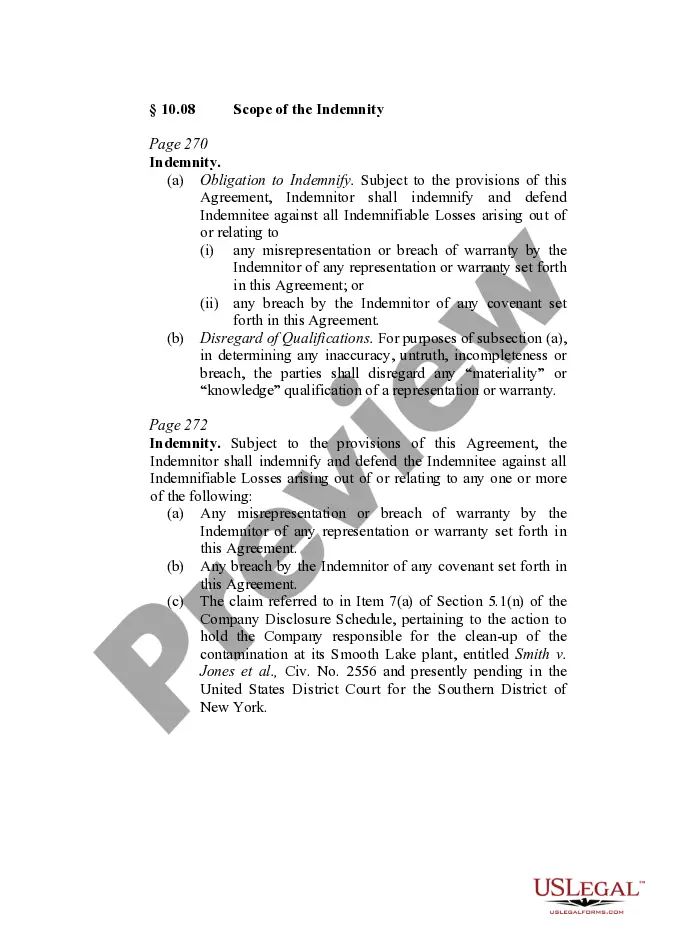
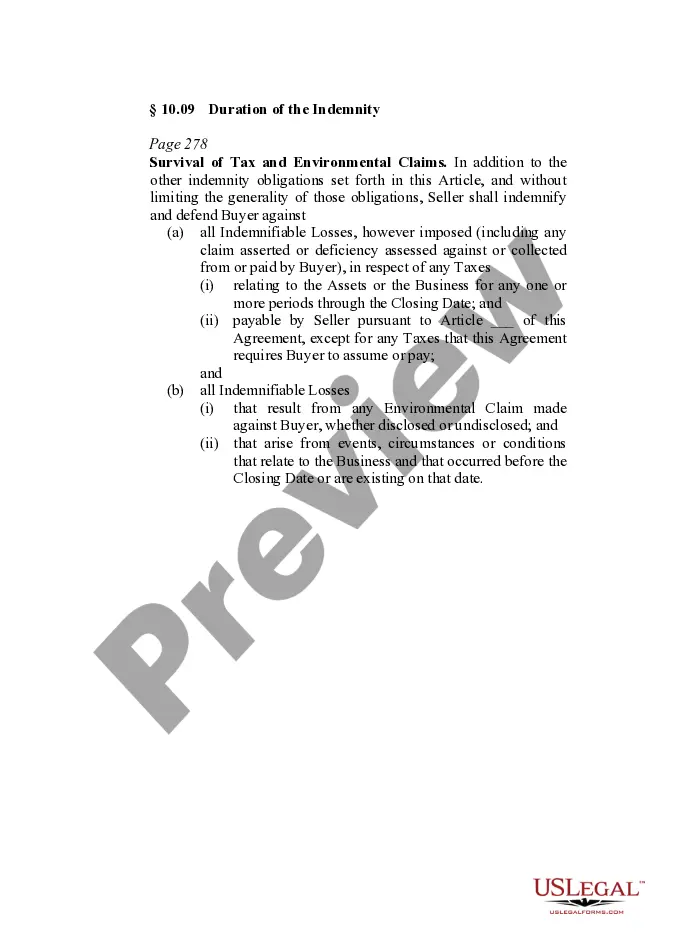
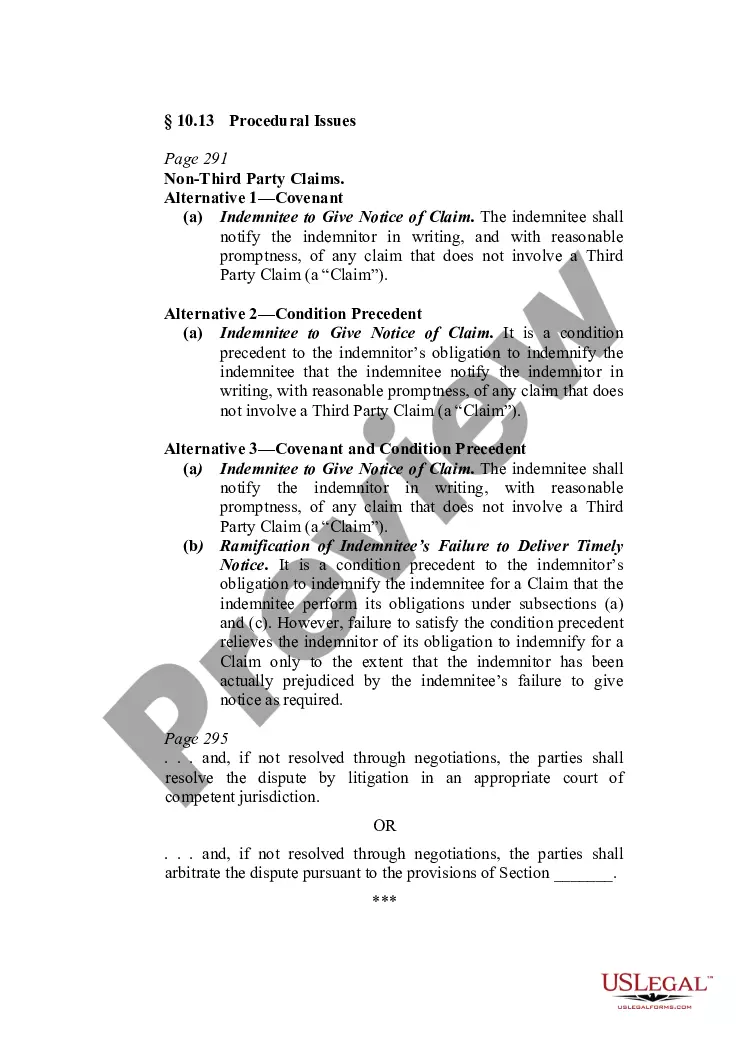
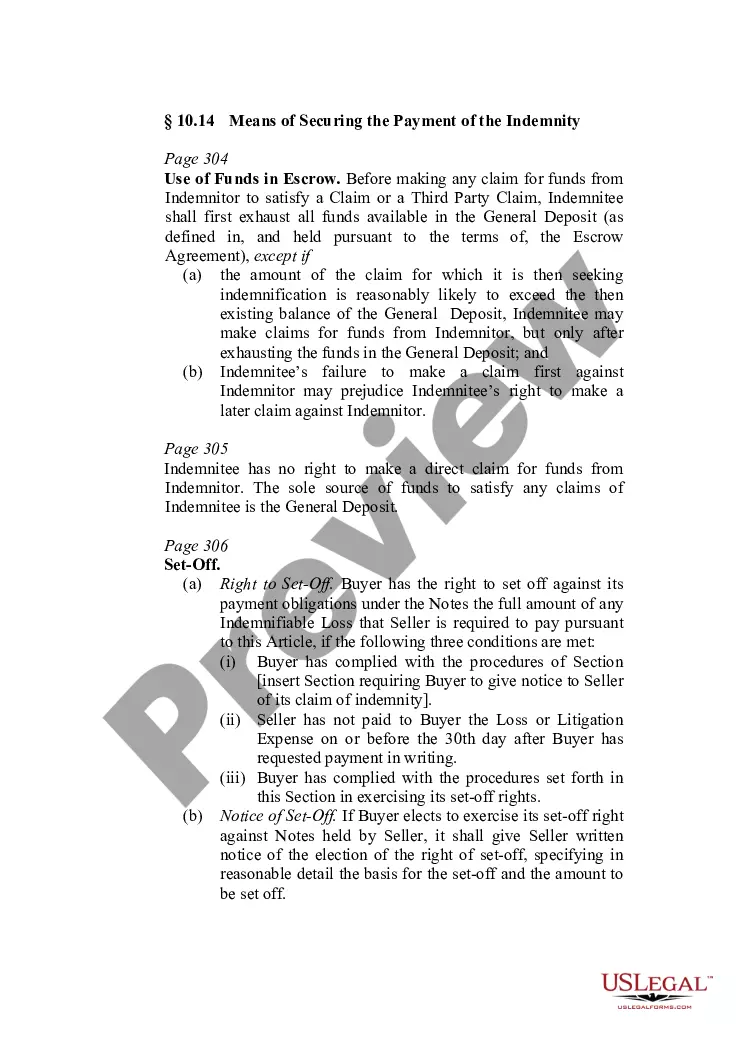
The Indemnity Provisions - Scope of the Indemnity form provides essential clauses that define the extent of indemnity within a contractual agreement. This form helps clarify the obligations of the indemnifying party, including provisions for defending against certain losses. It is tailored to accommodate various legal needs and scenarios, making it distinct from other indemnity forms that may not be as comprehensive or specific.
Key parts of this document
- Obligation to indemnify: Specifies the duty of the Indemnitor to cover Indemnitee against defined losses.
- Disregard of qualifications: Clarifies how certain representations are assessed without materiality qualifications.
- Detailed description of indemnifiable losses: Outlines specific losses that trigger indemnification, including breaches of warranty.
- Legal claim references: Includes references to specific legal proceedings that affect the indemnity terms.
- Flexible language options: Offers different phrases to suit various legal contexts and needs.
Common use cases
This form is essential when entering into a contract where one party agrees to protect the other from potential losses due to breaches of the agreement. It is particularly useful in real estate transactions, partnership agreements, or any contractual relationships involving significant liability risks. Use this form to establish clear indemnification terms to avoid disputes in the future.
Who can use this document
- Business owners entering contracts with partners or clients.
- Landlords renting property to tenants.
- Individuals engaged in real estate deals.
- Legal professionals drafting or reviewing contracts.
How to complete this form
- Identify the parties involved in the indemnity agreement.
- Clearly define the scope of indemnifiable losses.
- Specify any relevant legal claims related to the indemnity.
- Review and select the language options that best fit your legal situation.
- Ensure all parties sign and date the document where required.
Does this form need to be notarized?
This form does not typically require notarization unless specified by local law. Always check your state requirements or consult a legal professional to ensure compliance.
Get your form ready online
Our built-in tools help you complete, sign, share, and store your documents in one place.
Make edits, fill in missing information, and update formatting in US Legal Forms—just like you would in MS Word.
Download a copy, print it, send it by email, or mail it via USPS—whatever works best for your next step.
Sign and collect signatures with our SignNow integration. Send to multiple recipients, set reminders, and more. Go Premium to unlock E-Sign.
If this form requires notarization, complete it online through a secure video call—no need to meet a notary in person or wait for an appointment.
We protect your documents and personal data by following strict security and privacy standards.

Make edits, fill in missing information, and update formatting in US Legal Forms—just like you would in MS Word.

Download a copy, print it, send it by email, or mail it via USPS—whatever works best for your next step.

Sign and collect signatures with our SignNow integration. Send to multiple recipients, set reminders, and more. Go Premium to unlock E-Sign.

If this form requires notarization, complete it online through a secure video call—no need to meet a notary in person or wait for an appointment.

We protect your documents and personal data by following strict security and privacy standards.
Avoid these common issues
- Failing to define all potential indemnifiable losses, which can lead to confusion later.
- Using boilerplate language without adapting it to the specific circumstances.
- Not ensuring that all parties sign the agreement, leading to unenforceability.
Benefits of using this form online
- Immediate access: Download the form at your convenience without waiting for physical copies.
- Editability: Customize the form to meet your specific needs.
- Reliability: Assured quality as the forms are drafted by licensed attorneys.
Legal use & context
- Indemnity provisions are legally binding, provided they are clear and specific.
- Properly executed indemnity agreements can prevent lengthy and costly legal disputes.
- Ensure the terms comply with state laws to reinforce enforceability.
Looking for another form?



Form popularity
FAQ
A letter of indemnity must mention the details of both the parties involved in the transaction. These details are, generally, full legal name and complete official or residential address with pin code.
As discussed, an indemnity provision transfers risk from one party (called the indemnitee) to another party (called the indemnitor). Under an indemnity provision, the indemnitor agrees to reimburse the indemnitee for losses resulting from a claim or claims brought by a third-party.
A typical example is an insurance company wherein the insurer or indemnitor agrees to compensate the insured or indemnitee for any damages or losses he/she may incur during a period of time.
Drafting of the indemnity clause An indemnifier must limit the amount of indemnities that is given while entering into a contract. An express obligation must be imposed so as to minimize the loss, and the duration of time in which the claim can be brought must be limited.
Company/Business/Individual Name shall fully indemnify, hold harmless and defend _______ and its directors, officers, employees, agents, stockholders and Affiliates from and against all claims, demands, actions, suits, damages, liabilities, losses, settlements, judgments, costs and expenses (including but not
You should look to limit indemnification clauses by narrowing their scope, putting in caps on damages, and clearly defining the indemnifiable acts (i.e. the representations and warranties in the example above). Also consider purchasing insurance as a means to limit your financial risk.
Indemnity is compensation paid by one party to another to cover damages, injury or losses.An example of an indemnity would be an insurance contract, where the insurer agrees to compensate for any damages that the entity protected by the insurer experiences.
Indemnification clauses are clauses in contracts that set out to protect one party from liability if a third-party or third entity is harmed in any way. It's a clause that contractually obligates one party to compensate another party for losses or damages that have occurred or could occur in the future.