Special Military Power of Attorney for Rental Lease
What is this form?
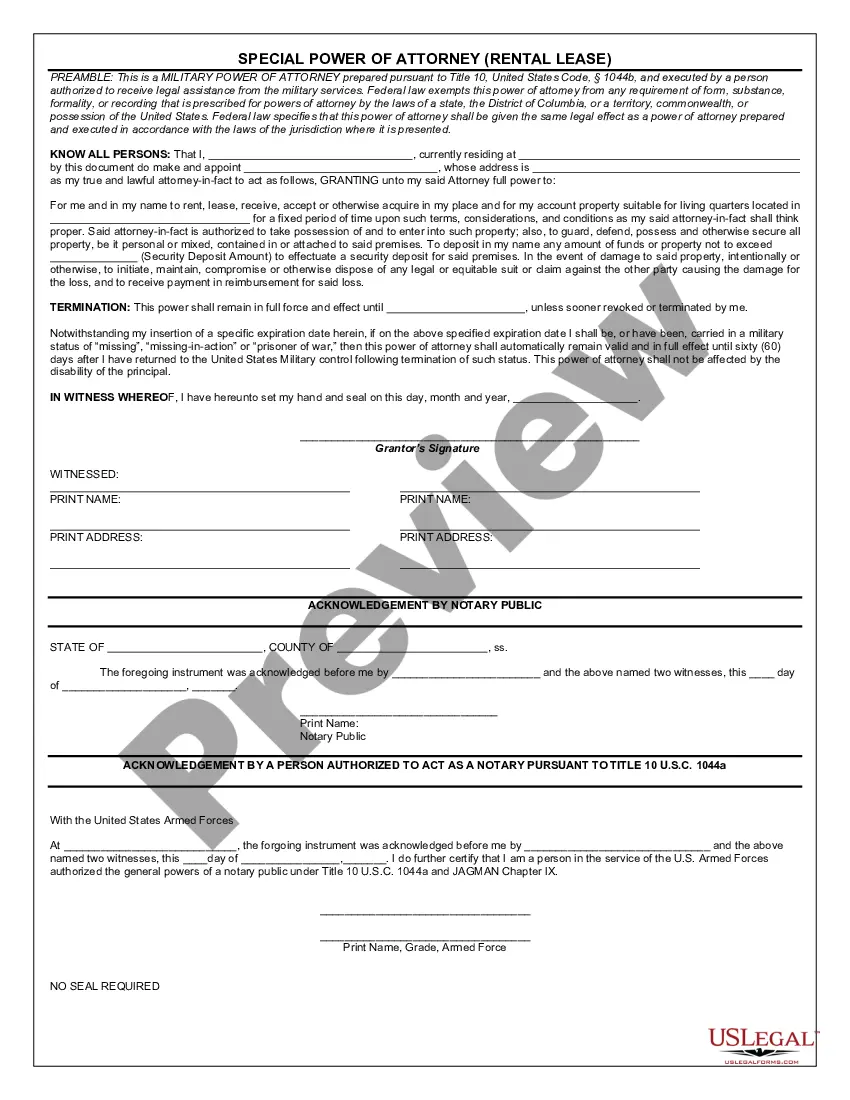
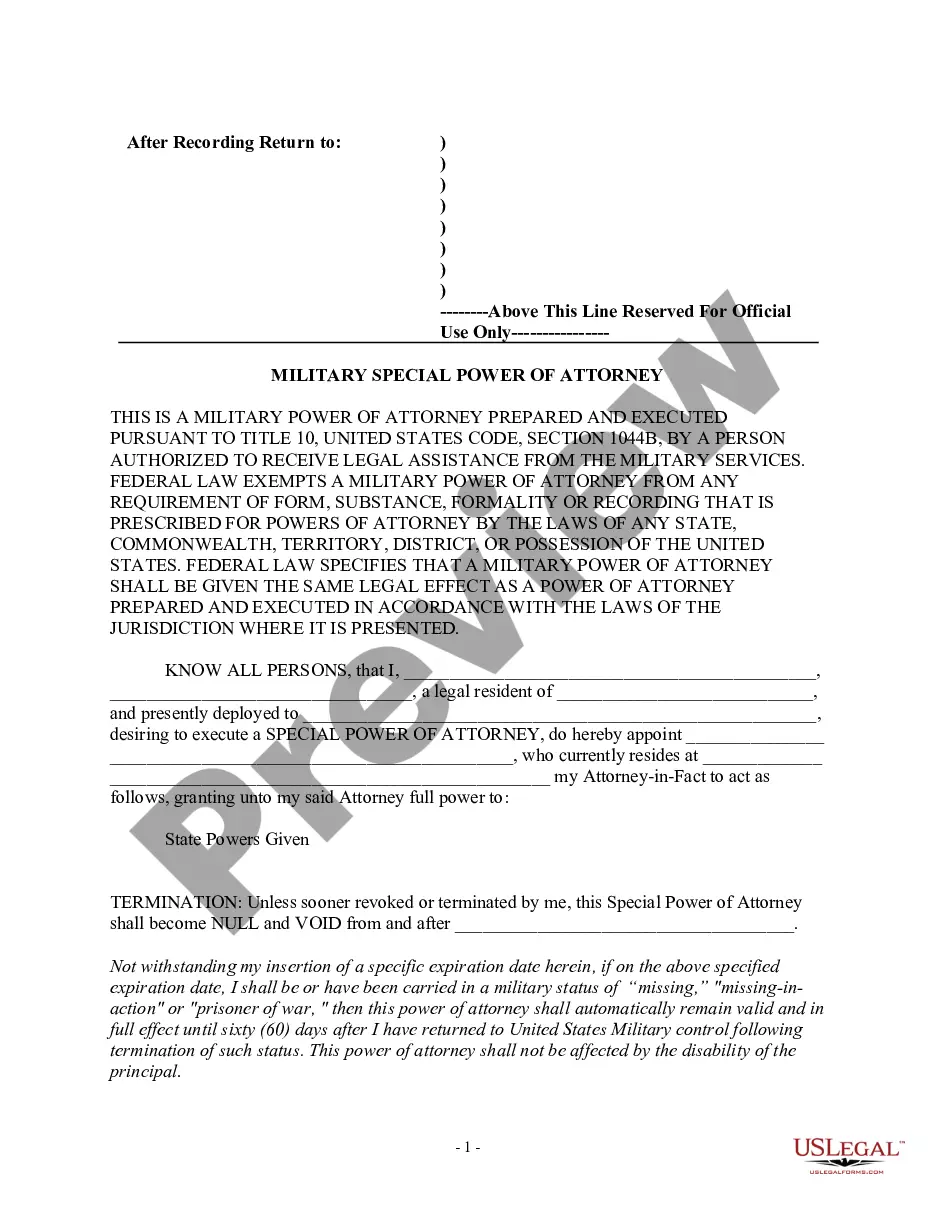
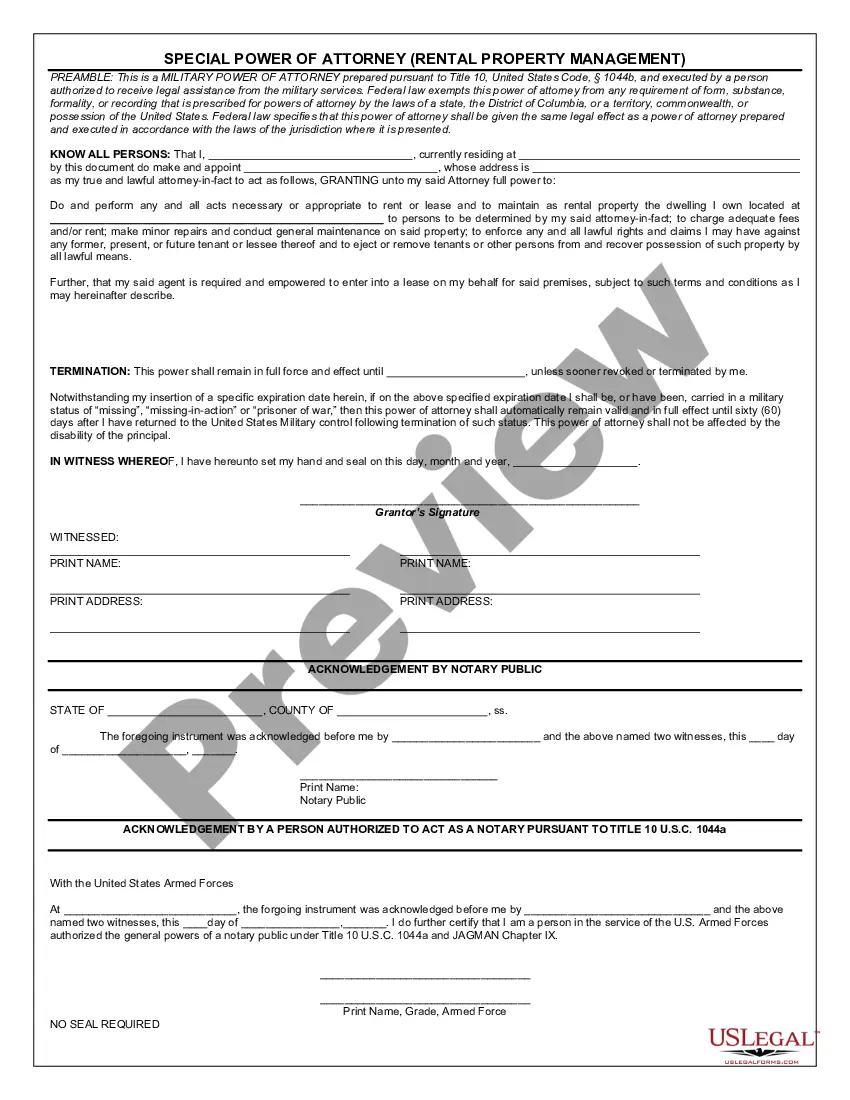
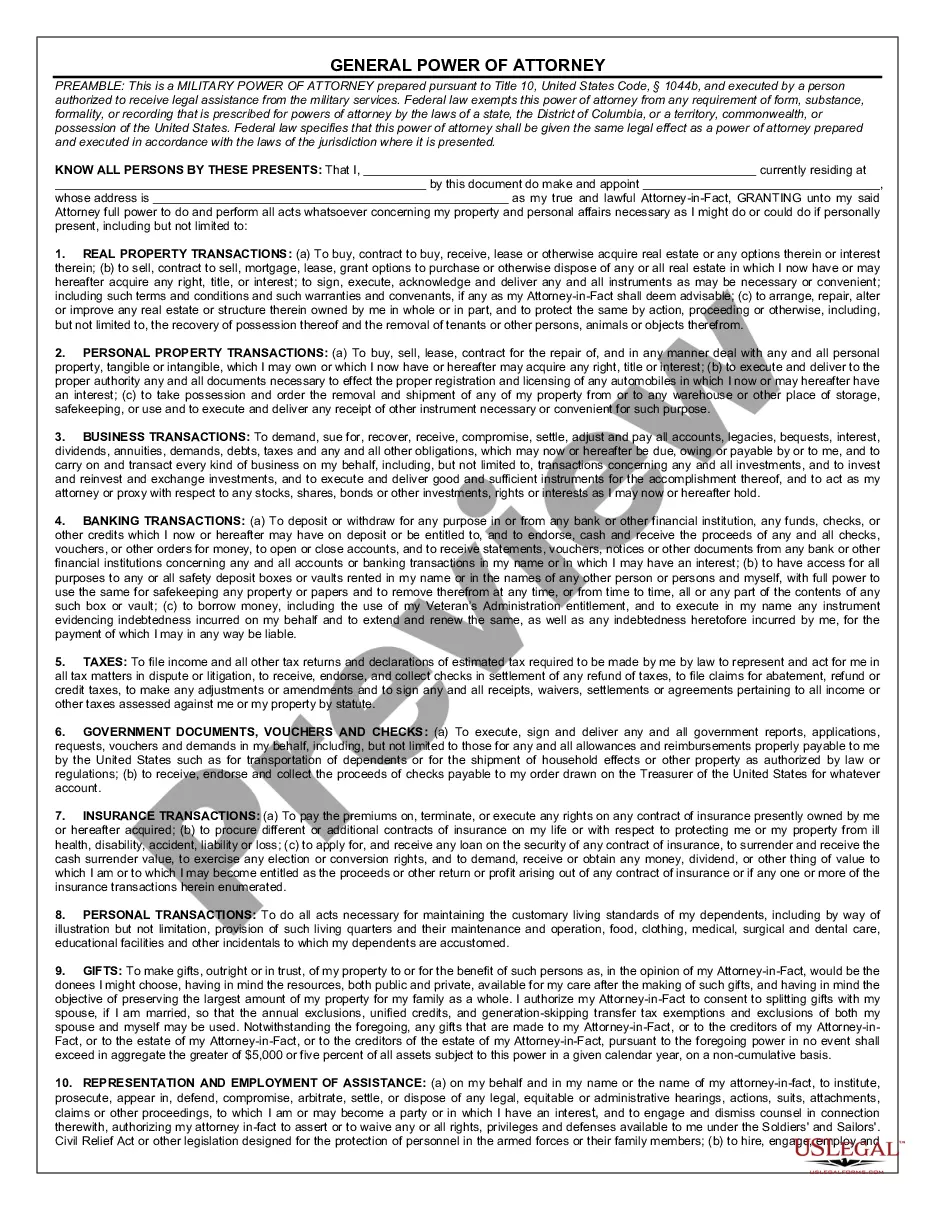
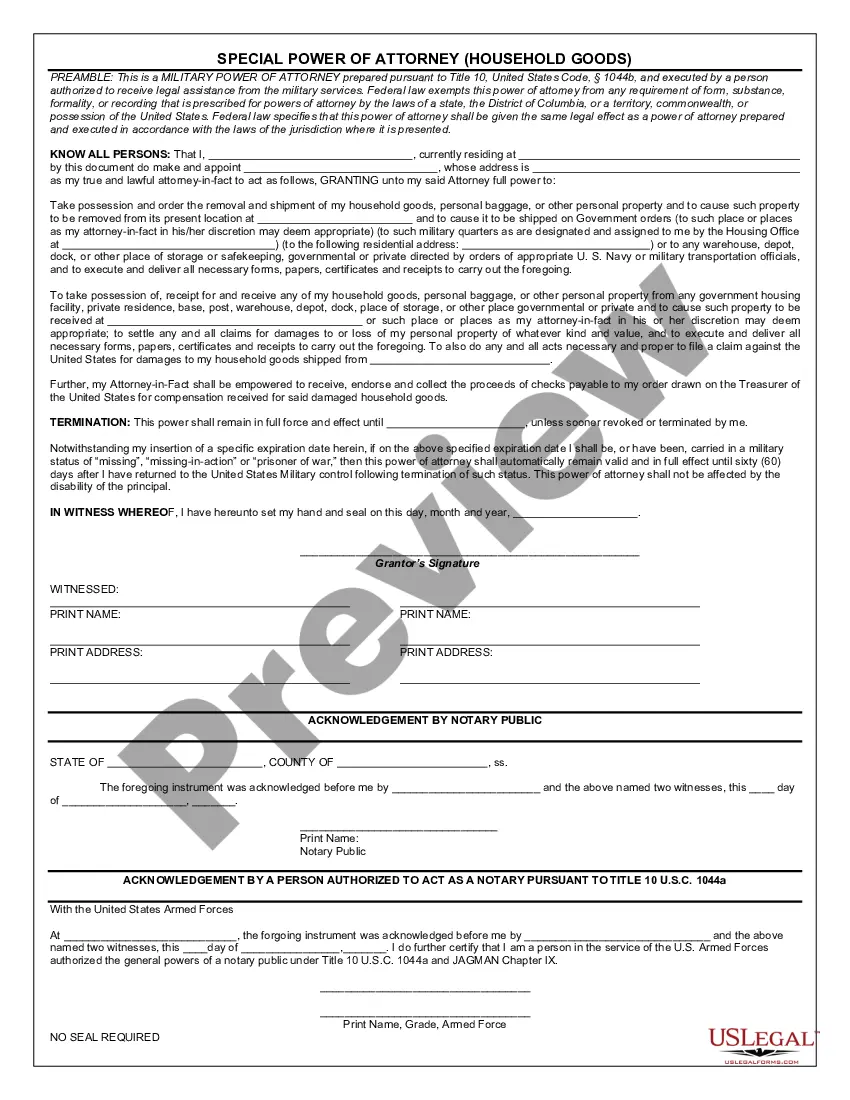
The Special Military Power of Attorney for Rental Lease is a legal document that allows military personnel to appoint another person as their agent. This agent is authorized to act on behalf of the military individual in matters related to renting property while they are away on duty. This form differs from a general power of attorney as it specifically focuses on rental lease transactions which may be necessary for military members who need to secure housing during their service.
Key components of this form
- Identification of the principal (military member) and the agent (appointed person).
- Detailed description of the property being rented.
- Duration of the power granted to the agent.
- Specific powers granted to the agent related to rental agreements.
- Notarization section for legal validation (if required).
When to use this form
This form should be used when a military member needs to delegate authority to someone else for handling rental agreements while they are deployed or stationed away from their typical residence. Real-world scenarios include securing a lease on a new apartment, renewing an existing lease, or managing rental property obligations in their absence.
Who this form is for
- Active duty military personnel who require temporary management of their rental properties.
- Service members who need someone trustworthy to handle rental agreements or negotiations.
- Personnel who will be away from their residence for an extended period and require an agent to support their housing needs.
How to complete this form
- Identify and provide the full names and addresses of both the military member and the appointed agent.
- Specify the rental property, including the complete address and any relevant details.
- Clearly state the duration for which the power is effective.
- Outline the specific powers granted to the agent regarding the rental lease.
- Sign and date the document in the appropriate sections.
- If required, have the document notarized to ensure it is legally valid.
Is notarization required?
This form needs to be notarized to ensure legal validity. US Legal Forms provides secure online notarization powered by Notarize, allowing you to complete the process through a verified video call, available anytime.
Get your form ready online
Our built-in tools help you complete, sign, share, and store your documents in one place.
Make edits, fill in missing information, and update formatting in US Legal Forms—just like you would in MS Word.
Download a copy, print it, send it by email, or mail it via USPS—whatever works best for your next step.
Sign and collect signatures with our SignNow integration. Send to multiple recipients, set reminders, and more. Go Premium to unlock E-Sign.
If this form requires notarization, complete it online through a secure video call—no need to meet a notary in person or wait for an appointment.
We protect your documents and personal data by following strict security and privacy standards.

Make edits, fill in missing information, and update formatting in US Legal Forms—just like you would in MS Word.

Download a copy, print it, send it by email, or mail it via USPS—whatever works best for your next step.

Sign and collect signatures with our SignNow integration. Send to multiple recipients, set reminders, and more. Go Premium to unlock E-Sign.

If this form requires notarization, complete it online through a secure video call—no need to meet a notary in person or wait for an appointment.

We protect your documents and personal data by following strict security and privacy standards.
Common mistakes
- Not clearly identifying the property, leading to confusion about which rental agreement the agent will manage.
- Failing to specify the duration of the power granted, which can cause legal issues later.
- Neglecting to have the form notarized if required by state law.
- Not providing clear instructions on the powers granted to the agent.
Why complete this form online
- Convenience of downloading and printing the form at any time.
- Editability allows users to tailor the document to their specific situation easily.
- Access to reliable templates drafted by licensed attorneys ensures legal compliance.
- Easy handling of document submission and storage for future reference.
Quick recap
- The Special Military Power of Attorney for Rental Lease is designed specifically for military personnel.
- It allows a trusted individual to manage rental agreements during the military member's absence.
- Ensure the form is completed accurately to avoid common pitfalls.
- Consult state requirements to confirm any specific stipulations for validity.
Looking for another form?


Form popularity
FAQ
In its legal application, a military power of attorney doesn't differ from a POA that a civilian would execute, except that the signature of the principal, or person executing the document, must be notarized by either a military lawyer known as a Judge Advocate General (JAG) or another person authorized by the
Below your own name is where you make it clear that you have the authority to sign on the principal's behalf. To indicate that you've been given power of attorney for signing authority, write attorney-in-fact under your name. Other variations are also acceptable to write out, like POA, or power of attorney.
The lawyer has asked you to sign for them, above their name and position title at the end of the letter. You write 'p. p' in the signature space and sign your name after it. This validates the letter, in informing the reader the letter has been signed on behalf of the lawyer with authorisation.
Draft a list of special powers. Decide what powers are springing. Pick an agent and a successor agent. Note the expiration date. Compile the information into one document. Execute the power of attorney letter.
Most states do not require a POA to be in writing in order to be effective, except in specific cases established by statute.As a result, most POAs can be executed electronically with or without authorization under the eCommerce laws, since there is no writing or signature requirement to begin with.
Special Power of Attorney deed has to be compulsorily registered from a Sub-Registrar office where the property is situated, if immovable property of value of Rs. 100 or above is the subject matter of the deed. Appropriate Registration charges are to be paid as per the State Rules.
Signing as a Power of Attorney You can sign the person's name first, then follow it with "by your name under POA." Or, you can sign your own name first, then identify yourself as "attorney-in-fact for the person's name for whom you are attorney-in-fact.
After the principal's name, write by and then sign your own name. Under or after the signature line, indicate your status as POA by including any of the following identifiers: as POA, as Agent, as Attorney in Fact or as Power of Attorney.
In many states, notarization is required by law to make the durable power of attorney valid. But even where law doesn't require it, custom usually does. A durable power of attorney that isn't notarized may not be accepted by people with whom your attorney-in-fact tries to deal.