USLegal Guide to Stalking
Understanding this form
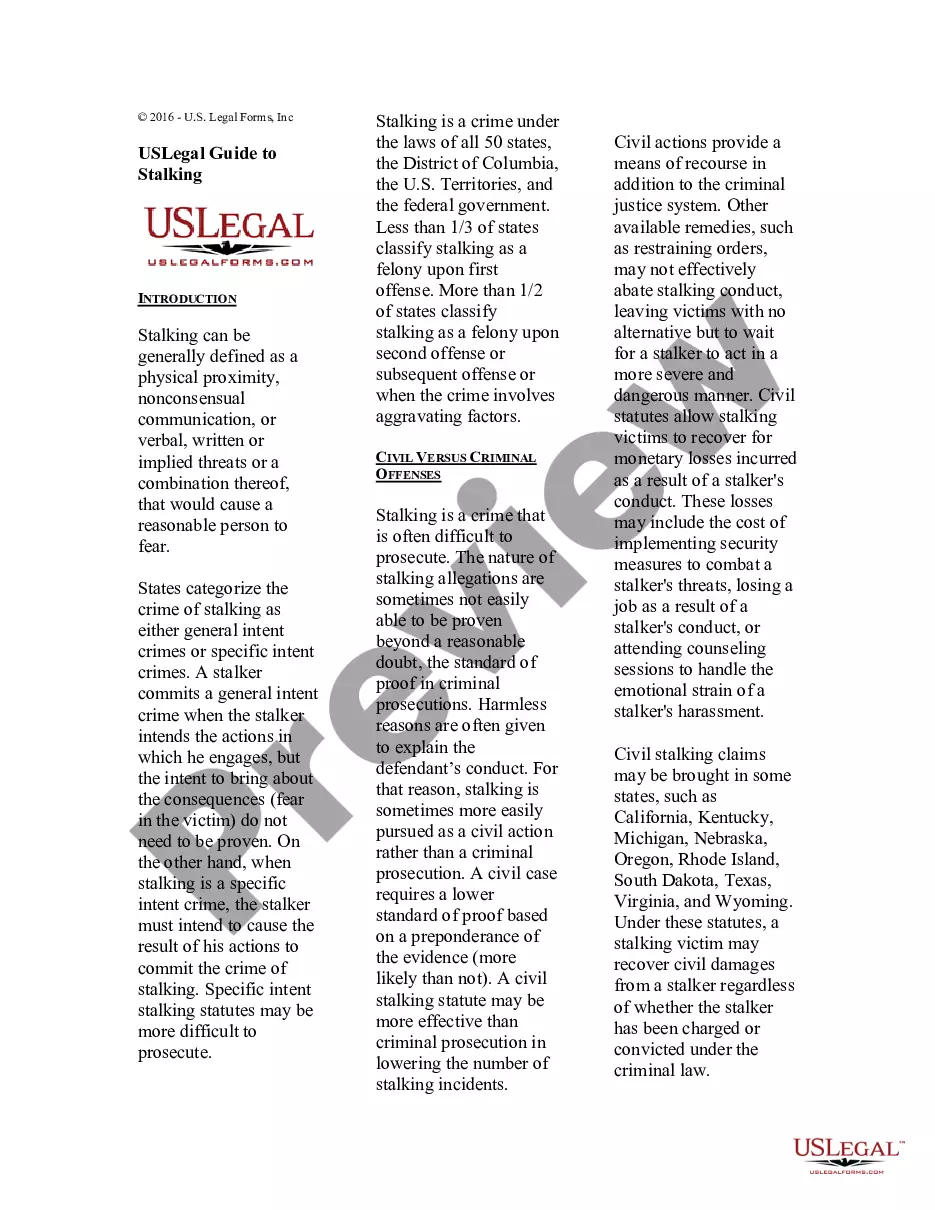
The USLegal Guide to Stalking offers comprehensive information about stalking laws, covering both civil and criminal aspects. This guide explains the distinctions between these offenses, outlines the process for obtaining protective orders, and discusses the emergence of cyberstalking. It is a valuable resource for understanding the legal landscape surrounding stalking and how it can be addressed through various means.
What’s included in this form
- Definition of stalking and its classification as a general or specific intent crime.
- Comparison of civil and criminal remedies for stalking victims.
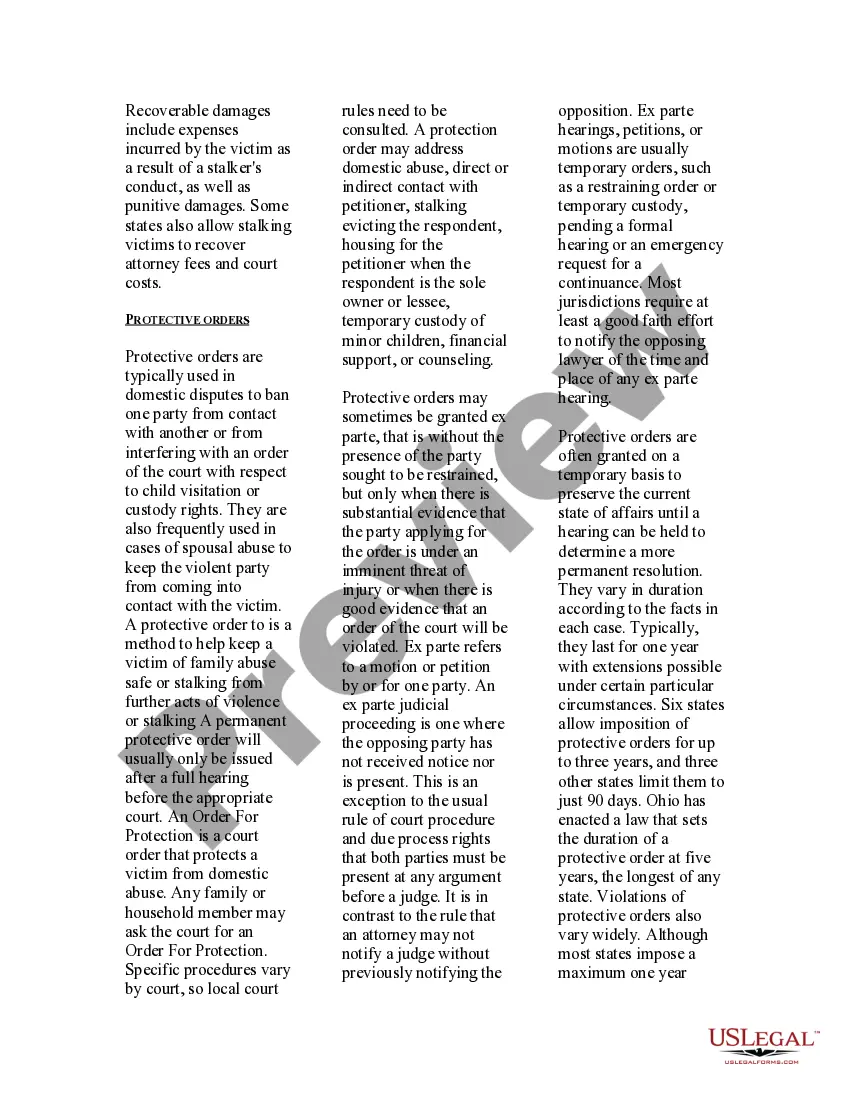
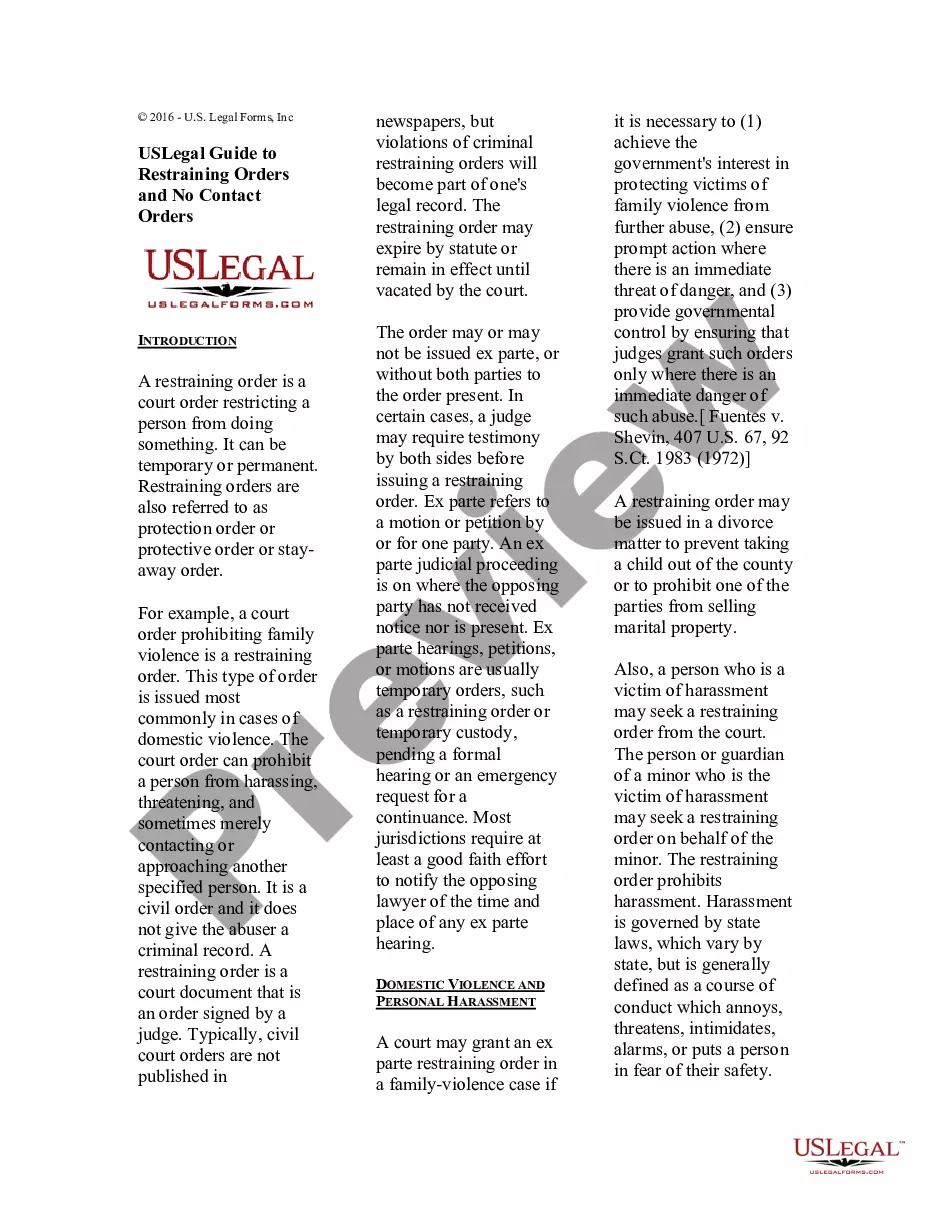
- Information on protective orders and their application in stalking cases.
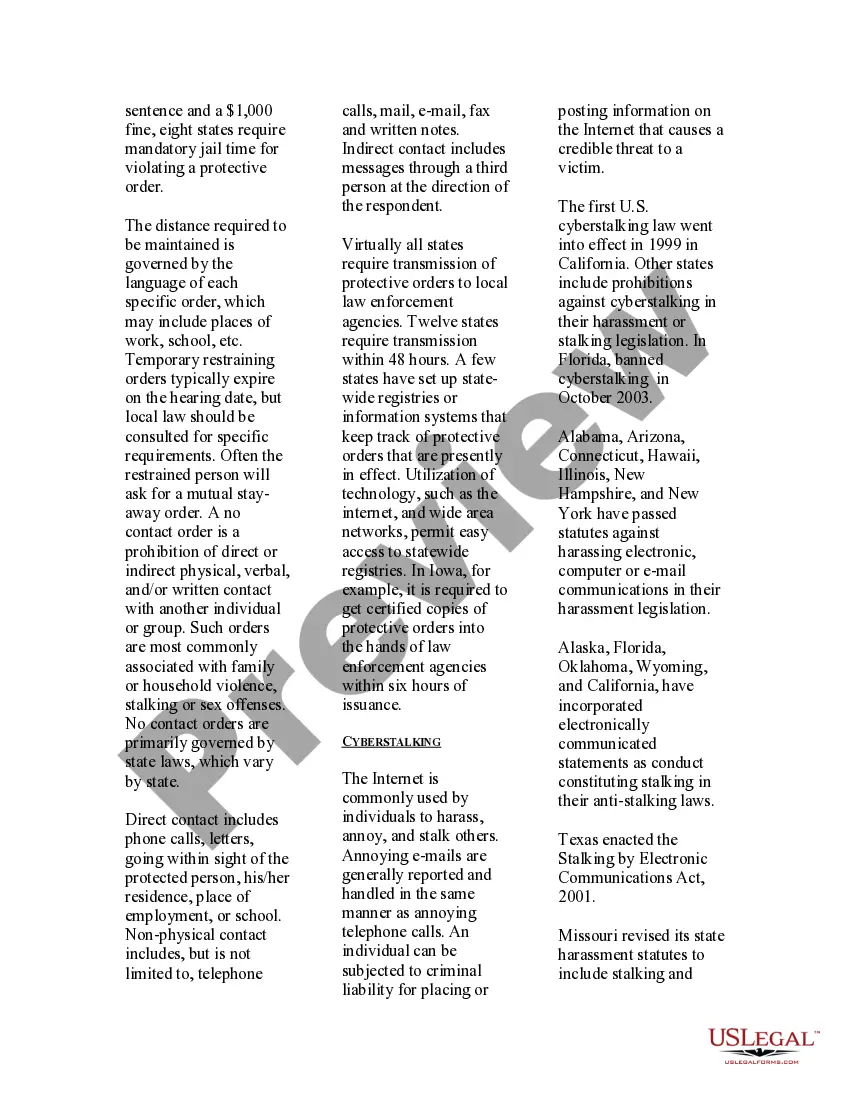
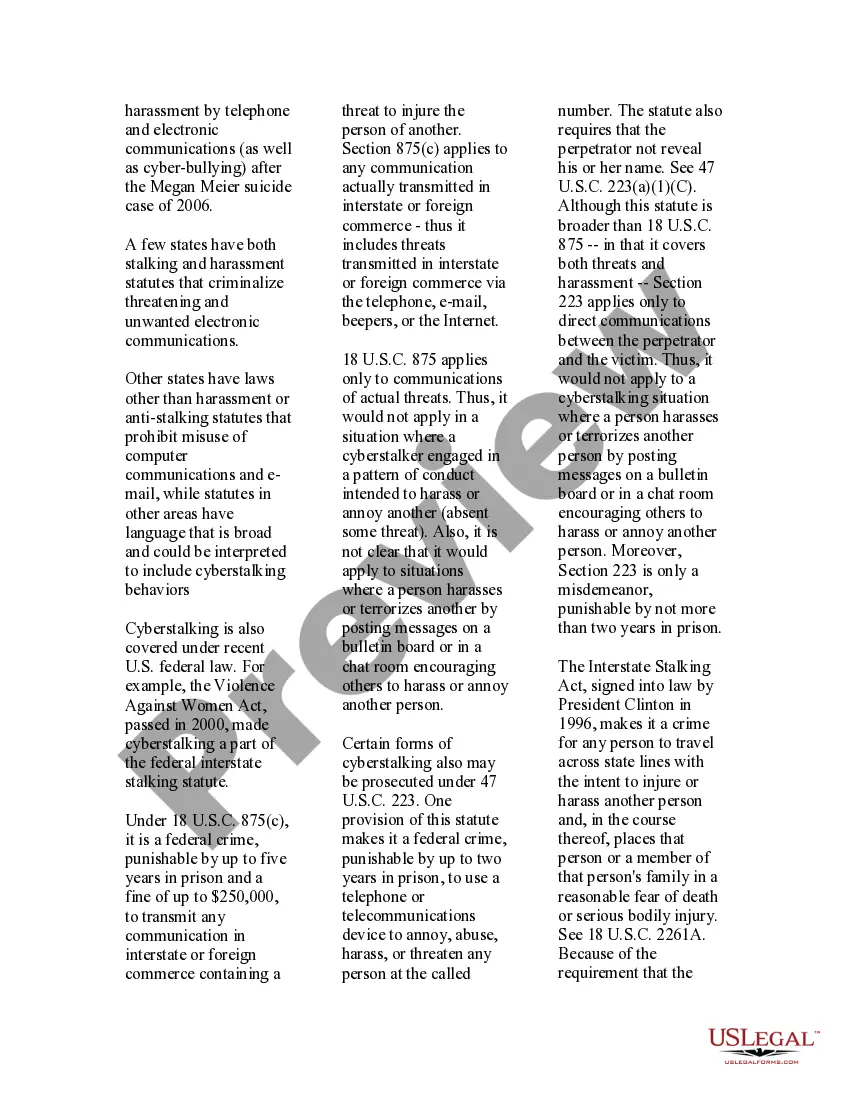
- Overview of cyberstalking laws and their enforcement across different states.
- Resources for further support and guidance for stalking victims.
When to use this form
This guide should be referenced when individuals believe they are victims of stalking or are seeking to understand stalking laws in their jurisdiction. It's particularly useful for those contemplating legal action, applying for protective orders, or dealing with emerging issues related to cyberstalking.
Who this form is for
- Victims of stalking seeking to understand their legal rights and options.
- Individuals needing advice on how to file a civil or criminal case related to stalking.
- Legal professionals assisting clients with stalking-related issues.
- Anyone interested in learning about the legal definitions and remedies for stalking.
How to complete this form
- Review the definition of stalking as it pertains to your situation.
- Determine whether to pursue a civil or criminal remedy based on the context of the stalking.
- Gather evidence and documentation related to the stalking incidents.
- Consider filing for a protective order if immediate safety is a concern.
- Utilize the resources provided to seek additional support and guidance.
Does this form need to be notarized?
Notarization is not commonly needed for this form. However, certain documents or local rules may make it necessary. Our notarization service, powered by Notarize, allows you to finalize it securely online anytime, day or night.
Get your form ready online
Our built-in tools help you complete, sign, share, and store your documents in one place.
Make edits, fill in missing information, and update formatting in US Legal Forms—just like you would in MS Word.
Download a copy, print it, send it by email, or mail it via USPS—whatever works best for your next step.
Sign and collect signatures with our SignNow integration. Send to multiple recipients, set reminders, and more. Go Premium to unlock E-Sign.
If this form requires notarization, complete it online through a secure video call—no need to meet a notary in person or wait for an appointment.
We protect your documents and personal data by following strict security and privacy standards.

Make edits, fill in missing information, and update formatting in US Legal Forms—just like you would in MS Word.

Download a copy, print it, send it by email, or mail it via USPS—whatever works best for your next step.

Sign and collect signatures with our SignNow integration. Send to multiple recipients, set reminders, and more. Go Premium to unlock E-Sign.

If this form requires notarization, complete it online through a secure video call—no need to meet a notary in person or wait for an appointment.

We protect your documents and personal data by following strict security and privacy standards.
Common mistakes
- Failing to document incidents of stalking adequately.
- Not understanding the difference between civil and criminal actions.
- Delaying action when a protective order is needed.
- Ignoring local laws that may affect the filing process.
Advantages of online completion
- Access to accurate legal information tailored to stalking-related issues.
- Convenient download of materials for personal review and use.
- Quick access to critical resources and legal definitions.
Legal use & context
- Stalking laws vary significantly by state, affecting how victims can seek justice.
- Civil actions can often be a more effective option due to lower proof requirements.
- Cyberstalking is increasingly recognized under both state and federal laws.
Summary of main points
- Stalking is a serious crime that can be addressed through civil and criminal avenues.
- Protective orders can provide immediate relief for victims facing threats.
- Understanding the nuances of stalking laws can empower victims to take appropriate actions.
Looking for another form?

Form popularity
FAQ
Stalking is unwanted and/or repeated surveillance by an individual or group toward another person. Stalking behaviors are interrelated to harassment and intimidation and may include following the victim in person or monitoring them.
One of the reasons for this action is to take away the person's sense of safety. Other forms of stalking include posting information or spreading rumors of the victim in a public place or by word of mouth.
Simple Obsessional: This is the most common type of stalker. The stalker is usually a male and the focus of the stalking is an ex-wife, ex-lover or former boss. In intimate relationships, the stalking frequently starts before the break-up.
Stalking is behavior wherein an individual willfully and repeatedly engages in a knowing course of harassing conduct directed at another person, which reasonably and seriously alarms, torments, or terrorizes that person.
Common stalking behaviors include: Repeated and unwanted communications through phone calls, mail, emails, or social media sites. Following the victim to work, school, home, or other places where they frequently visit.Repeatedly sending the victim unwanted gifts. Posting information, or spreading rumors about, the
The Rejected stalker (click to expand) Rejected stalking arises in the context of the breakdown of a close relationship. The Resentful stalker (click to expand) The Intimacy Seeking stalker (click to expand) The Incompetent Suitor (click to expand) The Predatory stalker (click to expand)
Stalking is a pattern of behavior that makes you feel nervous and susceptible to attack. Each scenario with a stalker may differ (from repeated contact to unwanted gifts), but the goal remains the same, to make you feel vulnerable.